
Endometriosis Stage by Stage: Rakta Pradara Progression Protocol
I remember the moment I was diagnosed with stage II endometriosis. I had spent years being told my periods were just “painful” and that I was being dramatic. I was twenty-six, sitting across from a gynecologist who had just done a laparoscopy, and she said: “You have endometriosis. It is not curable, but it is manageable.” What I was not told was that “manageable” would often mean long-term hormonal suppression with significant effects on daily wellbeing.
It was only later, through Ayurveda, that I encountered a framework describing chronic pelvic inflammatory and proliferative uterine disorders through the lens of Rakta, Vata, and Pitta imbalance, along with Yonivyapat classifications that help contextualize symptom progression. While not a direct one-to-one classical disease name, the functional mapping offers a structured way to understand progression and care principles.
This post presents a stage-wise Ayurvedic framework for endometriosis care, focused on symptom management, dosha balance, and supportive therapies alongside modern medical care.
What Ayurveda Sees in Endometriosis
Endometriosis is understood in Ayurveda through overlapping concepts rather than a single named condition, primarily involving disturbances in Rakta Dhatu, Apana Vayu, and uterine channels (Artava Vaha Srotas).
Rakta Pradara framework: This refers to disorders of abnormal movement, quality, or distribution of Rakta (blood tissue), associated with excessive or misplaced flow patterns within reproductive physiology.
Udavarta concept: Describes the vitiation of Apana Vayu, the downward-moving force responsible for menstruation and pelvic function. When disrupted, it contributes to pain, reverse movement patterns, and improper elimination.
Yonivyapat context: Classical texts such as Sushruta Samhita describe uterine disorders characterized by pain, abnormal bleeding, and reproductive dysfunction. These descriptions provide a functional lens for understanding chronic uterine inflammatory conditions.
The typical doshic pattern involves Vata (pain, spasm, obstruction), Pitta (inflammation, heat, irritation), and Rakta involvement (tissue-level dysregulation), often with secondary Kapha contributing to adhesions and cystic formations.
Stage I Endometriosis: Superficial Peritoneal Lesions
Stage I represents early superficial implantation of endometrial-like tissue with minimal adhesions. Symptoms may be mild or sometimes disproportionate to visible pathology.
At this stage, imbalance is primarily Vata-Pitta affecting Rakta Dhatu, with early disturbance of Apana Vayu. Agni impairment and Ama accumulation are generally mild but present.
Stage I Protocol: Focus is placed on calming Vata, reducing Pitta inflammation, and supporting healthy Rakta circulation.
Dietary approach: Warm, freshly prepared foods are emphasized. Excessively spicy, salty, fried, and processed foods are minimized. Cooling but non-cold foods such as pomegranate, coriander, amalaki, and seasonal vegetables are supportive. Raw and cold foods are reduced to maintain digestive fire (Agni).
Herbal support:
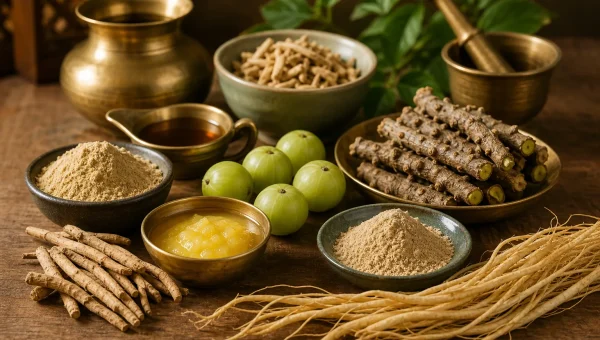
- Shatavari (Asparagus racemosus): Traditionally used to nourish reproductive tissues and balance Pitta and Vata in the female reproductive system.
- Lodhra (Symplocos racemosa): Traditionally used in uterine and bleeding-related imbalances, supporting tone and regulation of uterine tissues.
- Dashamula: Classical formulation used for Vata imbalance in the pelvic region and to support Apana Vayu function.
External support: Warm castor oil applications over the lower abdomen are traditionally used in Ayurveda to pacify Vata and support pelvic comfort.
Stage II Endometriosis: Deeper Implants and Early Cysts
Stage II involves deeper lesions and possible early ovarian cyst formation. Pain and inflammatory symptoms become more consistent.
At this stage, Kapha begins contributing to structural changes alongside Vata-Pitta imbalance. Ama becomes more established, contributing to stagnation and adhesion tendency.
Stage II Protocol: Focus expands to include Ama reduction, improved circulation, and deeper Rakta support.
Additional herbs:
- Manjistha (Rubia cordifolia): Traditionally used for Rakta purification and support of healthy inflammatory response in tissues.
- Kanchanar Guggulu: Classical formulation used for glandular and cystic growth tendencies (Granthi support).
- Ashoka (Saraca asoca): Traditionally used in uterine disorders and menstrual irregularities, especially those involving bleeding or pain.
| Stage | Conventional Features | Ayurvedic Dosha Pattern | Primary Herbs | Key Support Approach |
|---|---|---|---|---|
| Stage I | Superficial lesions | Vata-Pitta, Rakta imbalance | Shatavari, Lodhra, Dashamula | Vata-Pitta pacification |
| Stage II | Deeper lesions, small cysts | Vata-Pitta-Kapha, Ama presence | Manjistha, Kanchanar Guggulu, Ashoka | Ama reduction + tissue support |
| Stage III | Large cysts, adhesions | Kapha-Vata obstruction | Punarnava, Guggulu, Trikatu, Haridra | Channel clearing (Srotas support) |
| Stage IV | Dense adhesions, frozen pelvis | Severe Vata-Ama obstruction | Rasayana + post-surgical support | Rehabilitation focus |
Stage III Endometriosis: Adhesions and Structural Progression
Stage III is characterized by significant adhesions and larger cystic formations, with increasing impact on pelvic organ function and fertility.
At this stage, Kapha-driven structural binding combines with Ama, creating obstruction in pelvic channels (Srotas). Vata becomes trapped within obstructed pathways, intensifying pain patterns and chronic discomfort.
Stage III Protocol: Focus is placed on improving Agni, reducing Ama, and supporting tissue metabolism under supervision.
Supportive herbs and approaches:
- Punarnava: Traditionally used to support fluid balance and reduce inflammatory swelling tendencies.
- Trikatu: Classical digestive stimulant formulation supporting Agni and Ama reduction.
- Haridra (Turmeric): Traditionally used for inflammatory balance and tissue support in chronic conditions.
Uttara Basti: A classical Ayurvedic procedure involving medicated oil administration through the vaginal route, traditionally used in Yonivyapat management. It must only be performed by a trained practitioner.
Stage IV Endometriosis: Severe Structural Disease
Stage IV involves dense adhesions, large cysts, and significant distortion of pelvic anatomy. At this stage, surgical intervention is often part of management.
Ayurvedic care at this stage focuses on supportive preparation and recovery rather than attempting to reverse structural disease.
Pre-surgical support: Emphasis is placed on strengthening Agni, supporting nutrition, and maintaining tissue resilience through Rasayana approaches such as Amalaki and Shatavari.
Post-surgical recovery: Restoration of Apana Vayu function is prioritized using Vata-pacifying protocols, including Basti therapies under supervision, along with nourishing Rasayana support to rebuild depleted tissues.
Hormonal therapy support: In cases of medically induced hormonal suppression, Vata-aggravation is common. Traditionally used herbs such as Ashwagandha and Shatavari are used to support resilience under supervision.
Pain Management Across All Stages
Pelvic pain in endometriosis is primarily related to Vata disturbance, often compounded by Pitta inflammation.
Hingwastaka support: Traditionally used to support digestion and reduce Vata-related abdominal discomfort during menstrual cycles.
Ginger decoction: Fresh ginger tea is traditionally used to support digestive fire and reduce menstrual discomfort.
Castor oil packs: Warm abdominal applications are used in Ayurveda to pacify Vata and support pelvic relaxation.
For broader dietary support, anti-inflammatory Ayurvedic nutrition principles can help reduce systemic Pitta and Rakta imbalance. For deeper understanding of tissue-level nourishment, classical Sapta Dhatu principles describe how reproductive tissues are maintained through sequential nourishment pathways.
A Note on Clinical Reality and Support
Endometriosis is a complex condition requiring gynecological evaluation and individualized management. Ayurvedic approaches are best understood as supportive systems aimed at reducing inflammation, improving comfort, and supporting systemic balance alongside modern medical care.
Advanced structural disease such as dense adhesions or frozen pelvis requires medical or surgical management. Ayurvedic care is most effective when integrated thoughtfully with conventional treatment under professional supervision.
Medical Disclaimer: This content is for educational purposes only and does not replace medical diagnosis or treatment. Endometriosis requires evaluation by a qualified healthcare professional. Ayurvedic interventions should be undertaken under the guidance of a qualified practitioner, especially in moderate to severe disease.

for PMDD, the Dashamoola Kwath dosage given is 20ml twice daily. is that before or after meals and does it matter?
the Rutu-Kshetra-Ambu-Beeja framework gave me a new way to understand my irregular cycles. my Ayurvedic doc used this same framework and now I understand her recommendations better.
that framework really is clarifying — when my doctor explained Kshetra (the uterine environment) as a factor separate from the cycle itself, suddenly the need for Basti treatments made sense to me. it changed how I understood why the same protocol doesn’t work for everyone with endo.
the PMDD framing as Artava Kshaya with Vata-Pitta aggravation clicked for me. my worst premenstrual symptoms match that combination exactly. नमस्ते
shatavari 500mg daily for 3 months and my cycle regularized from 38-40 days to 28-31 days. finally.
the staging framework here is really valuable — understanding that stage I and stage IV would need completely different Rakta-Pitta management makes so much more sense than treating all endo the same way. has anyone tried the Shatavari protocol specifically for the inflammatory phase?
the explanation of how Rakta Pradara develops across stages gave me context I never got from my gynecologist. I’m at stage II and the protocol described here matches almost exactly what my Ayurvedic practitioner recommended — seeing it written out with the rationale behind each step is reassuring.
does the Artava Kshaya classification cover all types of PMDD or only the type with significant anxiety and restlessness?
eight years of being dismissed before a diagnosis — that opening hit hard because that was my story too. the protocol breakdown by stage is exactly the kind of structured approach I wished existed when I was first diagnosed. stage III here, currently working through the Kanchanara Guggulu phase.
wishing you both the best with the results. the protocol here is focused on endometriosis specifically so the Rakta-Pitta angle differs from what I’ve read about endo management — did your practitioner say whether there’s overlap in the herbs used for both conditions?
the confidence in the Garbha Vriddhi descriptions is unsupported by ultrasound-validated research. I wish there were citations for the embryological claims.
in which trimester does Shatavari ghrita supplementation begin? article says from month 3 but I’ve seen month 5 recommended elsewhere.
in which trimester does Shatavari ghrita supplementation begin? article says from month 3 but ive seen month 5 recommended elsewhere.
the article mentions Phala Ghrita for endometriosis-related infertility. is this taken in the follicular phase only or throughout the cycle?
Has anyone tried the castor oil packs mentioned for stage I and noticed a change in cramping after a few cycles?
@Jessica for PMDD, the Dashamoola Kwath dosage given is 20ml twice daily. is that before or after meals and does it matter?
that’s an important gap — especially since Dashamoola Kwath timing around meals could affect absorption. before or after food genuinely matters for some of these formulations. does anyone here know if the practitioner guidance on this differs by constitution or is it consistent?
for the male fertility protocol, is Shilajit safe alongside standard soerm motility supplements like CoQ10 and zinc?
the confidence in the Garbha Vriddhi descriptions is unsupported by ultrasound-validated resesrch. I wish there were citations for the embryological claims.
I appreciate the breakdown of each stage, especially the herb dosages for Shatavari and Lodhra in the early phase.
Good one.
asking about Beeja (seed) quality the article discusses diet but not timing of relations relative to Rutu window. is that covered elsewhere?
the Garbha Vriddhi month-by-month guide is so detailed. I’m in month 5 and following the Panchamasa recommendations for Basti.
Thanks!
The article mentions Virechana should be done by a trained practitioner; what precautions should someone take before attempting that preparation?
for PMDD, the Dashamoola Kwath sosage given is 20ml twice daily. is that before or after meals and does it matter?
@Karen in which trimester does Shatavari ghrita supplementation begin? article says from month 3 but Ive seen month 5 recommended elsewhere.
@Stephanie good one. ✨
I found the explanation of Rakta Pradara as abnormal blood flow really helped me visualize what’s happening inside the pelvis.
Same here.
Does the protocol suggest any dietary changes for managing Kapha buildup in stage II, like reducing dairy or fried foods?
It’s helpful to see how modern research on Manjistha aligns with its traditional use for blood purification.
I wonder if the Ashoka decoction dosage would need adjustment for someone with a sensitive stomach.
the part about Rakta Pradara staging resonated — my specialist never explained why my symptoms shifted between cycles and this framework actually gives that some structure. wondering if anyone here has found the dietary restrictions in the protocol hard to maintain long term.
disappointed the PMDD article doesn’t address casea where the dysphoria is severe enough to require psychiatric medication alongside Ayurveda.
@Ashok disappointed the PMDD article doesn’t address cases where the dysphoria is severe enough to require psychiatric medication alongside Ayurveda.
@Rachel the confidence in the Garbha Vriddhi descriptions is unsupported by ultrasound-validated research. I wish there were citations for the embryological claims.
The stage III section’s focus on Agni restoration with Trikatu makes sense, but I’d like more meal examples to avoid aggravating Pitta.
While the Ayurvedic approach offers hope, I agree that structural issues like dense adhesions likely need surgical input alongside herbs.
disappointed the PMDD article doesn’t address cases where the dysphoria is srvere enough to require psychiatric medication alongside Ayurveda.
I’ve had stage I endo for three years and what this article gave me that nothing else has is a reason why the pain pattern changes across the month rather than being constant. the Pitta-Rakta accumulation model explains the cycle-phase variation in a way that actually maps to what I experience.
the acknowledgment that Ayurveda works alongside gynecological care rather than replacing it is something I really appreciated here. too many articles in this space are all-or-nothing. the protocol is presented as adjunct support, not a cure, which feels honest.
the Garbha Vriddhi month-by-month guide is so detailed. im in month 5 and following the Panchamasa recommendations for Basti. tbh 🙌