
Prakriti and the gut microbiome are sometimes discussed as though bacterial sequencing has already produced a biological test for Vata, Pitta, and Kapha. The published human literature supports a narrower but still important conclusion: several exploratory studies have reported differences in the relative abundance of particular microorganisms among healthy people classified by Prakriti. These findings establish a field of investigation, but they do not establish a universal microbial fingerprint, a diagnostic microbiome test, or a causal link between a constitutional type and a particular disease.
Most of this work has used 16S ribosomal RNA gene sequencing, which estimates the bacterial composition of a sample by analysing selected genetic regions. The method is useful for comparing microbial communities, but its taxonomic and functional resolution is limited. Results are also influenced by diet, geography, age, sex, medication exposure, stool collection, sequencing platform, and statistical method. These factors are especially important when interpreting constitution-based comparisons.
Prakriti in the Classical Ayurvedic Framework
In Ayurveda, deha-prakriti is the constitutional pattern expressed through the relative predominance of Vata, Pitta, and Kapha. Classical descriptions assess stable physical, physiological, and psychological characteristics rather than relying on a single symptom or questionnaire score. Charaka Samhita discusses constitutional examination in Vimana Sthana, while Sushruta Samhita and Ashtanga Hridaya also describe the characteristic features of dosha-predominant constitutions.
The classical framework is broader than the three labels commonly used in microbiome papers. It includes Vata-, Pitta-, and Kapha-predominant constitutions, three dual-dosha combinations, and a constitution in which the doshas are comparatively balanced. Many modern studies deliberately recruit people with strongly expressed or “extreme” single-dosha phenotypes because these groups are easier to compare statistically. Their findings therefore cannot automatically be applied to every person assessed in ordinary Ayurvedic practice.
Prakriti is also not equivalent to a medical diagnosis. It is used in Ayurveda as one element of individualized assessment alongside age, digestive capacity, strength, habitat, season, habits, current dosha disturbance, and the nature and stage of illness. A constitutional classification by itself does not diagnose irritable bowel syndrome, inflammatory bowel disease, obesity, diabetes, or metabolic syndrome.
What Human Microbiome Investigations Have Reported
The available studies differ substantially in sample size, recruitment, phenotype assessment, body site, analytical pipeline, and statistical approach. Their common finding is not that the three Prakriti groups possess completely separate microbial ecosystems, but that a broadly shared microbiome may contain taxa whose relative abundance differs between selected groups.
| Publication | Cohort and method | Principal verified finding | Interpretive limit |
|---|---|---|---|
| Frontiers in Microbiology, 2018 | 113 healthy rural western Indian adults with extreme Vata, Pitta, or Kapha phenotypes; fecal 16S rRNA profiling | Bacteroidetes and Firmicutes were major components in all groups. Some core taxa displayed differential and sex-specific enrichment. | The overall community composition remained broadly similar, and the findings came from one geographically restricted cohort. |
| Journal of Biosciences, 2019; PMID 31719221 | 18 healthy participants; gut, oral, and skin 16S rRNA analysis | Gut abundance differed for genera including Bacteroides, Desulfovibrio, Parabacteroides, Slackia, and Succinivibrio. | The sample was too small to define population-wide biomarkers or disease risks. |
| 3 Biotech, 2020; PMID 32802721 | Reanalysis of public data from 113 Prakriti-classified Indian adults and 40 Sasang-classified Korean adults | Some taxonomic and imputed functional differences were reported, but within-system beta-diversity analysis did not produce distinct constitution-specific clusters. | Functional pathways were computationally inferred from 16S data rather than directly measured by metagenomic sequencing. |
| Journal of Biosciences, 2021; PMID 34148877 | Buccal and fecal samples from 272 healthy people with predominant Prakriti types | The gut microbiome was dominated by genera such as Prevotella, Bacteroides, and Dialister. A shared core was present, with preferential detection of taxa including Paraprevotella and Christensenellaceae in Vata participants. | Preferential abundance within one cohort is not a validated diagnostic signature and requires independent replication. |
The 2021 investigation is the largest of these reports, but its results do not support the claim that every Vata, Pitta, and Kapha sample formed a clean, non-overlapping cluster. The authors identified a shared core microbiome and group-associated taxa. Twenty-one operational taxonomic units described as unique to a Prakriti group occurred in no more than four samples each, illustrating the difference between an exploratory association and a dependable population biomarker.
Why a Firmicutes-to-Bacteroidetes Table Is Misleading
A fixed table assigning high microbial diversity to Pitta, a high Bacteroidetes proportion to Vata, and a high Firmicutes-to-Bacteroidetes ratio to Kapha is not supported across the published cohorts. The 2018 investigation described Firmicutes and Bacteroidetes as major phyla with a similar overall pattern among the three groups, while later analyses emphasized subtler taxonomic or predicted functional differences.
The Firmicutes-to-Bacteroidetes ratio is itself an unreliable stand-alone marker of obesity or gut health. Human obesity studies have reported inconsistent results, partly because each phylum contains many organisms with different biological functions and because laboratory and population variables strongly affect the calculated ratio. It should therefore not be used to diagnose Kapha constitution, metabolic syndrome, microbial imbalance, or treatment need.
The available Prakriti cohorts consisted mainly of healthy participants. Their taxonomic differences cannot be converted into claims that Vata individuals are predisposed to irritable bowel symptoms, Pitta individuals to inflammatory gastrointestinal disease, or Kapha individuals to metabolic syndrome. Such associations require prospective clinical cohorts in which diagnoses, diet, medication, body composition, and other confounders are measured directly.
Host Constitution, Genetics, and Possible Biological Pathways
Earlier Ayurgenomics investigations reported gene-expression, biochemical, and genetic associations among carefully selected extreme Prakriti groups. A 2008 study examined whole-genome expression and biochemical variables, and a 2015 genome-wide study reported single-nucleotide polymorphisms whose frequencies differed among selected Vata, Pitta, and Kapha groups. These studies support examining Prakriti as a multidimensional phenotype, but they do not make dosha classification genetically deterministic or establish it as a substitute for clinical laboratory testing.
Several biological pathways could be investigated when studying host phenotype and microbial ecology. Diet, intestinal transit, bile acids, gastric conditions, mucosal secretions, immune activity, sleep, physical activity, and medication use can all influence microbial composition. Prakriti assessment may capture combinations of traits that co-vary with some of these factors. Demonstrating that a Prakriti-associated host feature directly creates a microbial pattern would, however, require longitudinal studies and controlled mechanistic experiments rather than cross-sectional stool sampling alone.
Agni and Microbial Composition Are Not Interchangeable Concepts
Ayurveda uses Agni to describe the functional capacity involved in digestion, transformation, and metabolism. Classical interpretation recognizes four principal digestive patterns: sama agni, a balanced pattern; vishama agni, an irregular pattern associated with Vata predominance; tikshna agni, an intense pattern associated with Pitta predominance; and manda agni, a slower pattern associated with Kapha predominance.
These are clinical Ayurvedic categories, not direct measurements of bacterial diversity, intestinal transit time, gastric acid, calorie expenditure, or a phylum ratio. A person with Kapha Prakriti does not necessarily have manda agni at every stage of life, and a person with Pitta Prakriti does not necessarily have persistently intense digestion. Current dosha state, food intake, season, illness, age, sleep, and treatment may alter digestive function.
The comparison between Agni and the microbiome can be useful as a research question because both frameworks place importance on diet and digestion. The 2020 paper associated with PMID 32932766 discusses this relationship as a review of modern and Ayurvedic perspectives; it was not an intervention trial demonstrating that Prakriti-specific dietary advice creates a defined microbial community.
Triphala and Direct Microbiome Research
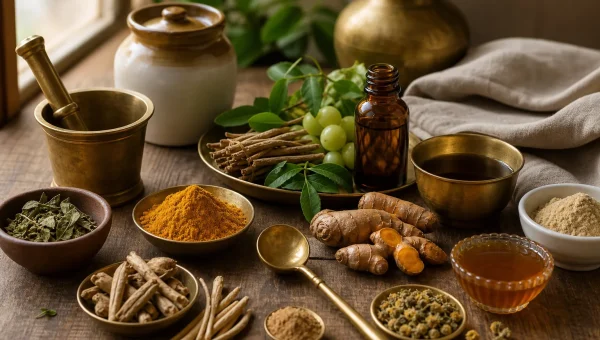
Triphala Churna is an official Ayurvedic formulation consisting of equal parts of the powdered fruits of Haritaki (Terminalia chebula), Bibhitaka or Bibhitaki (Terminalia bellirica), and Amalaki (Phyllanthus emblica, also known by the synonym Emblica officinalis). This composition is listed in the Ayurvedic Formulary of India. The identity and quality standards of its individual ingredients are addressed in official Ayurvedic pharmacopoeial publications.
An in-vitro investigation using anaerobic human fecal cultures found that Triphala altered the experimental microbial community and increased the relative abundance of certain Bifidobacterium, Lactobacillus, and butyrate-producing organisms. Because the work was performed in laboratory cultures rather than as a controlled clinical microbiome trial, it establishes prebiotic potential under the tested conditions, not a guaranteed effect in the human intestine.
A universal daily dose of three to five grams cannot be presented as the standard microbiome dose. Ayurvedic prescribing considers formulation, indication, digestive capacity, age, strength, accompanying substances, concurrent medicines, and treatment duration. Extracts, powders, tablets, and products sold under the same name may also differ substantially in composition and concentration.
Panchakarma, Herbs, and Dietary Reviews
Panchakarma is a group of clinician-directed Ayurvedic procedures rather than a generic two-week “detox.” The 2024 publication identified by PMID 38401105 is a narrative review. It notes that virechana and basti have been examined in a small number of microbiome-related reports, while the available human literature is too limited and heterogeneous to define a reproducible Panchakarma microbiome outcome. It did not test Ashwagandha, Brahmi, and Tulsi together as a clinical treatment for stress-induced microbial imbalance, and it did not establish the stated extract doses as microbiome therapy.
The article identified by PMCID PMC10468021 is likewise a review, not a 2023 clinical intervention. It discusses Ayurvedic diet and lifestyle concepts, fiber-rich foods, plant polyphenols, and possible microbiome pathways in relation to type 2 diabetes. It does not demonstrate that a Prakriti-specific diet produced measured microbial changes or improved diabetes outcomes in a controlled participant group.
Traditional dietary qualities such as warm, unctuous, light, dry, bitter, pungent, or astringent remain part of individualized Ayurvedic dietetics. Assigning each quality a predetermined effect on bile acids, intestinal transit, Firmicutes abundance, or inflammatory signalling goes beyond the available clinical data. Dietary care for diabetes, inflammatory bowel disease, unexplained weight change, or persistent digestive symptoms should remain coordinated with appropriate medical diagnosis and monitoring.
A Responsible Research Agenda
The next stage of this field requires reproducible Prakriti assessment, inclusion of dual-dosha constitutions, multicentre recruitment, detailed dietary and medication records, and cohorts representing different regions and ethnic backgrounds. Repeated sampling is needed because one stool specimen provides only a time-limited view of a changing ecosystem.
Shotgun metagenomic sequencing could identify microbial genes and species more directly than 16S-based functional prediction. Metabolomics could measure products such as short-chain fatty acids and bile-acid derivatives, while carefully designed intervention trials could test whether a defined diet or authenticated formulation produces a clinically meaningful effect. Analyses should be preregistered and replicated in independent populations before microbial features are used for constitution assessment or treatment selection.
Longitudinal birth cohorts could also examine when constitution-associated traits and microbial communities begin to co-vary. Such studies would need serial infant sampling, parental and childhood dietary records, medication and delivery data, environmental measures, and constitution assessment performed with methods appropriate to age. Until that work exists, developmental explanations remain hypotheses rather than established Ayurvedic-microbiome mechanisms.
Safety note: Prakriti assessment, herbal prescribing, virechana, basti, and other Panchakarma procedures should be supervised by a qualified Ayurvedic practitioner. People who are pregnant, have a chronic illness, take prescription medicines, or have persistent gastrointestinal symptoms should also consult an appropriate healthcare provider. Ayurvedic products and microbiome tests must not replace indicated diagnostic testing or established medical treatment.
Practical Interpretation
Prakriti-microbiome research has identified group-level microbial associations worthy of further investigation. Its strongest verified message is that healthy Prakriti-classified participants share much of their gut microbiome while displaying some cohort-dependent differences in particular taxa. It does not yet justify fixed microbial profiles for Vata, Pitta, and Kapha, disease predictions based on constitution, or self-treatment intended to “correct” a presumed microbiome type.
Ayurveda contributes a detailed tradition of individualized assessment centred on constitution, current imbalance, digestion, diet, behaviour, and environment. Microbiome science contributes methods for measuring one part of the biological ecosystem involved in digestion and health. Their productive meeting point lies in carefully controlled, transparent research—not in treating preliminary associations as completed validation.
References
- Jaims (jaims.in)
- Charaka Samhita — Agni
- Frontiersin (frontiersin.org)
- Understanding the association between the human gut, oral and skin microbiome and the Ayurvedic concept of prakriti (2019), PubMed
- Comparative gut microbiome analysis of the Prakriti and Sasang systems reveals functional level similarities in constitutionally similar classes (2020), PubMed Central
- Exploring the signature gut and oral microbiome in individuals of specific Ayurveda prakriti (2021), PubMed
- Ias (ias.ac.in)
- Western Indian Rural Gut Microbial Diversity in Extreme Prakriti Endo-Phenotypes Reveals Signature Microbes (2018), PubMed Central
- The Firmicutes/Bacteroidetes Ratio: A Relevant Marker of Gut Dysbiosis in Obese Patients? (2020), PubMed Central
- Whole genome expression and biochemical correlates of extreme constitutional types defined in Ayurveda (2008), PubMed
- Genome-wide analysis correlates Ayurveda Prakriti (2015), PubMed
- The Microbiome in Health and Disease from the Perspective of Modern Medicine and Ayurveda (2020), PubMed
- Ayurvedic Pharmacopoeia of India
- Prebiotic Potential of Herbal Medicines Used in Digestive Health and Disease (2018), PubMed
- Ayurvedic Therapies to Target the Microbiome: Evidence and Possibilities (2024), PubMed
- Modulation of gut microbiota with Ayurveda diet and lifestyle: A review on its possible way to treat type 2 diabetes (2022), PubMed Central
- NCCIH
Nothing in this article diagnoses or treats a medical condition. Use it as educational information and consult a qualified Ayurvedic practitioner or physician before starting herbs, supplements, detoxes, or therapeutic protocols, especially if pregnant, managing a condition, or taking medication.
The traditional knowledge systems described here had thousands of years of empirical observation. Modern science is essentially validating what healers learned through patient outcomes.
As an immunologist, the mechanisms described for the immune-modulating herbs align well with what we understand about these pathways. Good translation of complex science.
Your grandmother sounds like an amazing woman! Traditional knowledge passed through families is so precious
The biomarker studies cited here suggest mechanisms that go beyond placebo. That’s an important threshold for clinical credibility
Could you address the challenge of publishing Ayurvedic research in high-impact Western journals? The gatekeeping issues are significant for the field
The connection you made between those two things is really insightful. I hadn’t thought of it that way before.
I would like more detail on Your Dosha Predicts Your Gut Bacteria. A few more examples would still help.
I would like more detail on Your Dosha Predicts Your Gut Bacteria. The article avoids making it sound like a quick fix.
The mechanism explanations are fascinating. Understanding HOW these compounds work at a cellular level makes the traditional observations make much more sense.
Same here! The practitioner recommendation made all the difference for me. Don’t try to do this without guidance
This makes sense for Your Dosha Predicts Your Gut Bacteria. The timing advice is the part I would start with.
So encouraging to hear! Starting my first week and this is motivating me to stick with it.
I appreciate the discussion of what we don’t yet know as much as what we do. Scientific humility is undervalued in health communication.
I’ve been using it for a year and can confirm, the results you’re describing are consistent with my longer-term experience.
This makes sense for Your Dosha Predicts Your Gut Bacteria. The article avoids making it sound like a quick fix.
this is so helpful to read. I’m just starting out with this and hearing positive experiences helps me stay motivated
What I’d love to see explored further is whether the microbiome differences between Prakriti types are cause or consequence. Do we colonize our gut with Dosha-specific bacteria because of how we eat and live according to our constitution, or does the microbiome partially drive the constitutional tendencies we observe? The causal direction changes how you’d use this clinically.
I work in clinical trials and I’ve seen some of these studies firsthand. The interpretations here are fair and measured. Well done.
I would like more detail on Your Dosha Predicts Your Gut Bacteria. I would still ask a practitioner before changing medicines.
The cytokine data cited here is consistent with what we know from preclinical models. Eager to see the larger clinical trials that are apparently in progress.
This makes sense for Your Dosha Predicts Your Gut Bacteria. I would like to know how long to try it before judging results.
This makes sense for Your Dosha Predicts Your Gut Bacteria. The main idea is clear even if someone is new to Ayurveda.
I appreciate you sharing the skeptical perspective too. It keeps the conversation grounded.
as someone with a science background, I find the mechanism explanations here a bit hand-wavy. Correlation isn’t causation
I shared this with three colleagues from my university’s integrative medicine program. The evidence synthesis here is genuinely graduate-level quality.
Three months sounds right from my experience too. Commit to that and then evaluate.
Valid concerns. Ayurveda works best as a complementary approach, not a replacement for evidence-based medicine. Thank you for highlighting this important distinction.
The historical context of when these compounds were first investigated scientifically, versus how long they’d been used traditionally, is always striking to me.
Your experience with the diet changes mirrors mine almost exactly. Week two is when it clicks.
As a biomedical researcher I appreciate the careful distinction between correlation and causation in the studies cited here. More honest than most health content I read.
The microbiome angle is what finally got my conventionally-minded gastroenterologist to take Prakriti seriously. When I showed him the 16S rRNA sequencing data showing distinct microbial signatures across Vata, Pitta, and Kapha types, his first response was ‘this needs replication’ — which is fair — but he stopped dismissing it outright.
It’s wonderful to see both believers and skeptics engaging respectfully in the comments. That’s how we all learn
I think the article could be improved by addressing the quality control issues with Ayurvedic herbs. Heavy metal contamination is a real concern with unregulated products.
The microbiome-dosha correlation research from the Indian research institutions mentioned here is genuinely exciting. If Vata, Pitta, and Kapha constitutions have distinguishable gut microbiome profiles, there’s a path to objective Prakriti assessment that doesn’t depend on practitioner interpretation.
The Sonnenburg lab and other major microbiome research groups haven’t published on dosha-microbiome correlations as far as I know. Citing Indian institutional research is fine but the field is in early stage and the correlations found so far are preliminary.
I think there’s a middle ground being missed here. You don’t have to choose between Ayurveda and conventional medicine, both have value.
The Kapha constitution microbiome being associated with Firmicutes-dominant profile is interesting because Firmicutes dominance is also associated with obesity in the Western microbiome literature. The cross-mapping is imperfect but the thematic connection is there.
Microbiome research is advancing so quickly that articles like this become outdated fast. The 16S rRNA sequencing methodology used in earlier dosha studies has been largely superseded by metagenomic approaches with better resolution. The specific findings mentioned here may not replicate.
If my dosha directly correlates with microbiome composition then changing diet to balance the dosha should shift microbiome composition. The article implies this but doesn’t say it directly. Has any study tracked microbiome changes following Ayurvedic dietary protocols?
Great topic, average execution. I’d love to see this rewritten with specific product recommendations and exact dosing schedules
The three-months timeline for significant microbiome shifts from dietary change is well established in modern research. The Ayurvedic dietary protocol duration recommendations for dosha rebalancing often fall in similar 90-day windows. The timing convergence is interesting.
The article makes a clear point about why a single microbial signature for each dosha hasn’t emerged yet.
The Lachnospiraceae family which has protective roles in butyrate production appearing in Vata-associated microbiome research is a significant finding if it replicates. Butyrate is the gut lining fuel and Vata constitution’s tendency to dry mucosa might be explained partly through this pathway.
I had an American Gut Project sample done and separately got a Prakriti assessment from an Ayurveda practitioner. Both were completed without sharing results. Both independently identified similar tendencies. Small personal data point but the convergence was striking.
I found the breakdown of the two thousand eighteen Frontiers in Microbiology study especially helpful for understanding geographic limits.
One thing that stands out is how diet age and medication can swamp any subtle dosha related signal.
The challenge in this research area is that microbiome composition in Indian populations differs significantly from Western populations used in most microbiome studies. Indian-specific microbiome reference ranges are needed and some of the larger metabolic disease research is starting to develop them.
It would be interesting to see if future work uses shotgun sequencing instead of relying on 16S data alone.
The discussion about Agni not being a direct measure of bacterial diversity clarifies a common mix up.
Three months of Vata-pacifying diet tracked alongside a microbiome test kit. My Akkermansia abundance increased significantly. Whether that’s the diet or some other variable I can’t say but the trajectory was consistent with what the article predicted.
I wonder whether the authors considered seasonal changes when they collected stool samples.
Several comments elsewhere claim a firmicutes to bacteroidetes ratio predicts Kapha but the article shows that’s not supported.
The safest part of the Your Dosha Predicts Your Gut Bacteria advice is keeping it simple. This is the kind of detail readers can test slowly.
The table of studies listed makes it easy to compare sample sizes and methods at a glance.
If you are thinking about using Triphala as a prebiotic keep in mind the lab culture results may not translate to the gut.
Fascinating area but reading the actual papers rather than summaries reveals how early stage this is. Many of these findings are single studies with small Indian cohorts. Replication studies across populations and methodological standardization are still needed before the dosha-microbiome connection is established.
I appreciate the reminder that Prakriti is just one piece of an Ayurvedic assessment alongside habits and current imbalance.
The piece does a good job of explaining why dual dosha constitutions are often left out of microbiome research.
It seems prudent to wait for longitudinal infant cohorts before tying any microbial pattern to a constitutional type.
The caution about not swapping microbiome tests for medical diagnosis feels especially relevant now.
I liked the note about how Agni categories are clinical observations not direct measurements of gas production or pH.
The cost of a quality Ayurvedic protocol adds up. Factoring that in for anyone budgeting: turmeric alone runs me about 800 rupees a month for a good brand.
Good breakdown. I’ve been intimidated by Ayurveda but starting simple with one or two herbs seems manageable.
Switched to organic moringa last month after reading about heavy metal contamination in cheaper brands. More expensive but feels safer.
Future studies that record detailed diet medication and geography will help sort out whether any observed taxa are truly linked to dosha.
I came for Your Dosha Predicts Your Gut Bacteria and this answered the main question. This feels more usable than a long list of herbs.
The part about Your Dosha Predicts Your Gut Bacteria feels realistic. The practical details matter more than people think.
My grandmother used to give us ashwagandha every winter. Never knew the full reasoning behind it until I started reading articles like this.
Makes sense
The personal accounts in the comments here are more useful than another anecdotal ‘this cured everything’ testimonial. Real experiences matter.
This makes sense for Your Dosha Predicts Your Gut Bacteria. This is the kind of detail readers can test slowly.
For what it’s worth, I’ve tried most mainstream approaches for my PCOS with limited success. Now giving this a proper 6-month trial.
How long before you’d expect to see results with bibhitaki for skin health? The article doesn’t specify a timeline.
Finding the right brand was my biggest challenge. The price difference between reputable and budget brands is significant but so is the quality gap.
is there a difference between organic and regular for shatavari? or doesnt matter
Been experimenting with shatavari for my stress for about a month. Still early days but the bloating is slightly less.
For Your Dosha Predicts Your Gut Bacteria, consistency seems like the hard part. I would still ask a practitioner before changing medicines.
I’d add that the water quality matters when making herbal teas. Switched to filtered water and the preparation tastes and feels different.
Reading this later and the Your Dosha Predicts Your Gut Bacteria advice still feels relevant. A few more examples would still help.
Reading this later and the Your Dosha Predicts Your Gut Bacteria advice still feels relevant. This is the kind of detail readers can test slowly.