
In June 2026, the first participant was dosed in a Phase 1 trial of ER-100 for open-angle glaucoma and non-arteritic anterior ischemic optic neuropathy. ER-100 uses controlled expression of the transcription factors OCT4, SOX2 and KLF4 to influence epigenetic gene-expression patterns in retinal ganglion cells. It is not a CRISPR telomere-editing treatment, and the trial is designed primarily to evaluate safety and tolerability, with visual-function measures as additional endpoints.
Ayurvedic Rasayana belongs to a different medical framework. The first chapter of the Charaka Samhita, Chikitsa Sthana, presents Rasayana as a promotive discipline concerned with longevity, health, memory, strength, sensory capacity and the excellence of bodily tissues. Modern geroscience and Rasayana can therefore be compared as two approaches to healthy aging, but they should not be described as molecularly equivalent or as demonstrations of the same mechanism.
What Rasayana Actually Claims
Charaka Samhita, Chikitsa Sthana 1, is arranged in four Rasayana sections: Abhayamalakiya, Pranakamiyam, Karaprachitiyam and Ayurvedasamutthaniyam. Verses 7–8 describe the intended fruits of properly administered Rasayana in classical Ayurvedic terms:
- Dirgham ayuh: longevity or a long span of life
- Smriti and medha: memory, understanding and intellectual capacity
- Arogya: freedom from illness
- Tarunam vayah: youthfulness
- Prabha, varna and svara: lustre, complexion and excellence of voice
- Deha-indriya-bala: strength of the body and sense faculties
- Vak-siddhi, pranati and kanti: effective speech, esteem and radiance
The text presents two modes of administration. Kutipraveshika is an indoor regimen carried out in a specially prepared, controlled residence under supervision. Vatatapika is the outdoor method used while the person continues ordinary activities. Charaka describes the indoor method as demanding and suitable only for an appropriately selected person; it is not simply a modern wellness retreat.
dīrghamāyuḥ smṛtiṁ medhāmārogyaṁ taruṇaṁ vayaḥ | prabhāvarṇasvaraudāryaṁ dehendriyabalaṁ param ||
Rasayana is described as promoting longevity, memory, intelligence, health, youthfulness, lustre, complexion, voice, and excellent strength of body and senses.
Rasayana is also broader than a list of supplements. In the fourth section, Achara Rasayana treats truthful speech, freedom from anger, nonviolence, calm conduct, cleanliness, compassion, disciplined senses and balanced sleep as part of a continuously rejuvenative way of living. This ethical and behavioral dimension is integral to the classical account.
Charaka’s Chyavanaprasha passage describes a compound preparation made with 500 Amalaki fruits, a multi-herb decoction, ghee, oil, sugar, honey and aromatic finishing ingredients. The text also directs that its quantity should be compatible with subsequent food intake and digestion. Classical Chyavanaprasha is therefore a specific formulated avaleha, not powdered Amalaki, isolated vitamin C or an arbitrary mixture of extracts.
What Modern Longevity Research Is Actually Testing
Modern aging biology describes interconnected processes rather than one universal “aging gene.” A 2023 Cell review lists twelve hallmarks, including genomic instability, telomere attrition, epigenetic alterations, mitochondrial dysfunction, cellular senescence, chronic inflammation and altered intercellular communication. Telomere therapy, senolytics and partial epigenetic reprogramming are distinct experimental strategies within that larger landscape.
Telomeres and Telomerase
Telomeres are repeated DNA-protein structures that protect chromosome ends. They often shorten with cell division and age, but leukocyte telomere length provides only a rough estimate of biological aging and is not a complete predictor of health or lifespan by itself. In a 2012 mouse study, an adeno-associated viral vector expressing mouse TERT increased median lifespan by 24 percent in mice treated at one year of age and by 13 percent in mice treated at two years. The result applies to AAV-mediated telomerase gene delivery in mice, not to CRISPR treatment or human lifespan extension.
Cellular Senescence and Senolytics
Senescent cells have entered a durable growth-arrested state and can release inflammatory and tissue-remodeling factors collectively called the senescence-associated secretory phenotype. Senolytic drugs are designed to eliminate selected senescent cells, whereas senomorphic approaches seek to modify their harmful secretions. The first published human senolytic pilot involved 14 people with idiopathic pulmonary fibrosis who received dasatinib plus quercetin in an open-label study. A later small randomized pilot examined the same drug combination. These were pharmacological trials in a specific lung disease, not CRISPR procedures or demonstrations of human lifespan extension.
Partial Epigenetic Reprogramming
A 2020 Nature paper used adeno-associated viral delivery of OCT4, SOX2 and KLF4 in mouse retinal ganglion cells. In mouse models, controlled expression of these factors promoted axon regeneration and improved visual function while shifting DNA-methylation patterns toward a younger state. ER-100 carries this line of work into a first-in-human Phase 1 eye-disease trial in 2026. Its present clinical question is whether the intervention can be administered safely to people with optic neuropathies, not whether it reverses whole-body aging or extends human life.
Reading Rasayana Herbs Without Forcing Molecular Equivalence
The Ayurvedic Pharmacopoeia of India provides official standards for the identity, purity and strength of listed single drugs and records their classical properties and actions. Those monographs can establish what drug and plant part are meant in Ayurvedic pharmacy. They do not convert a classical Rasayana designation into proof of telomere extension, senolysis or epigenetic reprogramming.
Amalaki
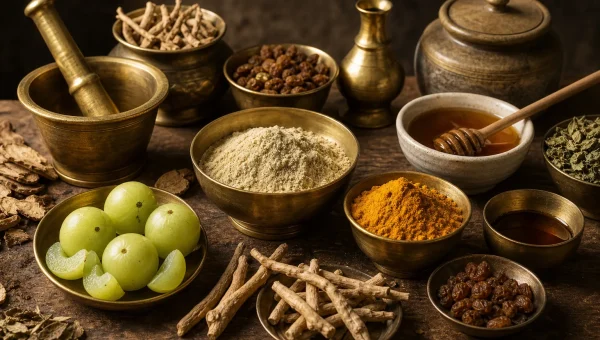
The pharmacopoeial fresh-fruit drug Amalaki is the pulp of Emblica officinalis Gaertn. Its rasa are madhura, amla, katu, tikta and kashaya; its guna are laghu and ruksha; its virya is shita; and its vipaka is madhura. The monograph lists its karma as tridoshajit, vrishya, Rasayana and chakshushya, and names Chyavanaprasha as an important formulation. Charaka’s Rasayana chapter contains multiple Amalaki preparations and the classical Chyavanaprasha recipe. Amalaki therefore has a secure classical and pharmacopoeial place in Rasayana without being classified as a clinically established telomere therapy.
Ashwagandha
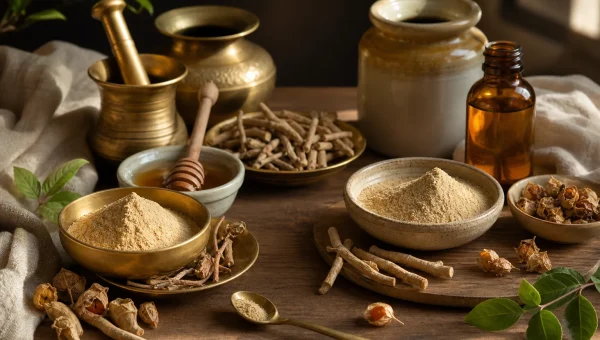
The pharmacopoeial Ashwagandha drug is the dried mature root of Withania somnifera Dunal. Its rasa are tikta and kashaya, its guna is laghu, its virya is ushna and its vipaka is madhura; its listed actions include Rasayana, vatakaphapaha, balya and vajikarana. Contemporary human trials of Ashwagandha preparations have mainly examined stress and sleep, using products that differ in plant part, extraction method and standardization. A branded concentrated extract is not automatically interchangeable with every classical root preparation, and Ashwagandha is not classified as a CRISPR-like senolytic.
Brahmi and Medhya Rasayana
The Ayurvedic Pharmacopoeia identifies Brahmi as the dried whole plant of Bacopa monnieri. It records madhura, tikta and kashaya rasa; laghu and sara guna; shita virya; madhura vipaka; and actions that include medhya and Rasayana. Textual precision is still necessary: Charaka Samhita Chikitsa 1.3.30–31 specifically names Mandukaparni juice, Yashtimadhu powder with milk, Guduchi juice and Shankhapushpi paste as Medhya Rasayanas, with Shankhapushpi described as especially medhya. Modern randomized trials of standardized Bacopa products have chiefly assessed attention and memory outcomes rather than Yamanaka-factor reprogramming or reversal of epigenetic age.
Methodological Comparison
A responsible comparison keeps the categories separate while allowing each to be examined rigorously. The table below contrasts experimental geroscience interventions with classical Rasayana without assigning unmeasured percentages of “age reversal” to either side.
| Parameter | Experimental geroscience intervention | Classical Ayurvedic Rasayana |
|---|---|---|
| Primary framework | Molecular or cellular intervention directed at a defined biological process | Promotive Ayurvedic care directed toward longevity, tissue quality, strength, cognition and health |
| Examples | Telomerase gene delivery, senolytic drugs and controlled partial reprogramming | Classical formulations, single-drug Rasayanas, diet, conduct and supervised regimens |
| Specificity | Varies by platform; may target one enzyme, cell population or transcriptional program | Selected according to the person, digestive capacity, strength, season, condition and classical indication |
| Evidence stage | Ranges from animal experiments to small early-phase human trials | Classical textual use with modern clinical support differing by herb, formulation and measured outcome |
| Reversibility | Depends on the technology; genome editing, viral gene delivery and intermittent medicines are not equivalent | Dosing can be stopped, but adverse effects and herb-drug interactions may still require medical care |
| Quality control | Manufacturing, vector characterization, dosing and clinical-trial oversight | Correct botanical identity, plant part, pharmacopoeial purity and formulation standards |
| Valid outcomes | Safety, disease-specific function, biomarkers and eventually clinical benefit | Safety, classical indications, patient-centered function and prespecified modern clinical outcomes |
The Biological-Age Measurement Problem
DNA-methylation clocks provide useful research biomarkers, but they are not interchangeable. Horvath’s clock estimates age from methylation at selected CpG sites across tissues. PhenoAge and GrimAge were developed to improve associations with phenotypic risk and mortality-related outcomes. Telomere length supplies different information and is best interpreted alongside other markers. A lower clock estimate after an intervention does not by itself demonstrate restored organ function, reduced disease, longer survival or comprehensive rejuvenation.
Clock results can also vary with the sampled tissue, cellular composition, laboratory method and algorithm selected. A meaningful intervention study should specify the clock in advance, preserve consistent sample handling and distinguish a statistically detectable biomarker change from a clinically important benefit.
A rigorous Rasayana trial should therefore preregister its protocol, authenticate every product, include an appropriate comparison group, report adverse events, and measure outcomes that matter clinically. Functional capacity, cognition, sleep, quality of life, disease-specific measures and laboratory safety can be assessed together with exploratory biomarkers. Numerical claims about years of age reversal require a traceable publication, a clearly named clock, transparent statistical methods and independent replication.
A Responsible Contemporary Rasayana Framework
Classical Rasayana is individualized rather than a universal stack of Chyavanaprasha, Ashwagandha, Brahmi, Amalaki and Shilajit at fixed commercial-extract doses. Even the dose ranges printed in pharmacopoeial monographs are general adult oral guidance rather than substitutes for an individualized prescription. A safer contemporary framework preserves clinical judgment:
- Begin with assessment: a qualified Ayurvedic physician should consider age, agni, bala, prakriti, vikriti, current disease, medicines, diet, season and suitability before selecting a Rasayana.
- Use the correct drug: botanical identity, plant part, preparation and anupana matter. Root, leaf, whole-plant powder and concentrated extract are not automatically equivalent.
- Include conduct and routine: Achara Rasayana, adequate sleep, suitable food, physical activity and mental discipline belong to the classical framework rather than serving merely as optional additions to pills.
- Choose pharmacopoeial quality: products should meet identity, purity and strength standards and comply with applicable limits for lead, arsenic and other heavy metals.
- Avoid indiscriminate combinations: more Rasayana ingredients do not necessarily produce a stronger or safer treatment. Formulations containing metals or minerals require especially careful professional selection and quality assurance.
- Monitor safety: new gastrointestinal, allergic, neurological, hepatic or other symptoms require reassessment. Ashwagandha needs particular caution in pregnancy and breastfeeding, before surgery, with thyroid or autoimmune disorders, and with medicines that may interact.
The Right Conclusion
Rasayana and modern geroscience share a broad interest in maintaining function during aging, but their concepts, interventions and standards of proof are different. Telomerase gene delivery in mice does not validate an herbal longevity claim; a classical Rasayana designation does not establish activity against a modern molecular hallmark; and partial epigenetic reprogramming in an eye-disease trial is not CRISPR-based whole-body age reversal.
The productive meeting point is research design. Classical formulations can be authenticated and administered according to coherent Ayurvedic protocols, while modern trials can measure safety, function, disease outcomes and carefully chosen biomarkers. This approach respects the source tradition without borrowing the authority of gene editing, and it allows promising Rasayana practices to be evaluated without turning analogy into proof.
This article is educational and does not constitute medical advice. Rasayana treatment should be individualized by a qualified Ayurvedic physician and coordinated with a healthcare provider, especially during pregnancy, breastfeeding, chronic illness or prescription-drug use. Herbal or mineral products should not replace established medical care. ER-100 and other cellular-reprogramming or gene-therapy interventions are experimental and should be used only within authorized clinical trials.
References
- Lifebiosciences (lifebiosciences.com)
- Clinicaltrials (clinicaltrials.gov)
- Charaka Samhita — Rasayana Adhyaya
- Hallmarks of aging: An expanding universe (2023), PubMed
- Telomere Length as a Marker of Biological Age: State-of-the-Art, Open Issues, and Future Perspectives (2020), PubMed
- Telomerase gene therapy in adult and old mice delays aging and increases longevity without increasing cancer (2012), PubMed
- Senolytics in idiopathic pulmonary fibrosis: Results from a first-in-human, open-label, pilot study (2019), PubMed
- Senolytics dasatinib and quercetin in idiopathic pulmonary fibrosis: results of a phase I, single-blind, single-center, randomized, placebo-controlled pilot trial on feasibility and tolerability (2023), PubMed
- Reprogramming to recover youthful epigenetic information and restore vision (2020), PubMed
- Ayurvedic Pharmacopoeia of India
- NCCIH
- Ayurvedic Pharmacopoeia of India
- Meta-analysis of randomized controlled trials on cognitive effects of Bacopa monnieri extract (2014), PubMed
- DNA methylation age of human tissues and cell types (2013), PubMed
- An epigenetic biomarker of aging for lifespan and healthspan (2018), PubMed
- DNA methylation GrimAge strongly predicts lifespan and healthspan (2019), PubMed
- NCCIH
The ER-100 trial using OCT4, SOX2, KLF4 in retinal ganglion cells sounds promising for optic neuropathy, but I wonder how long the follow up will track visual function.
I’m curious whether the controlled expression approach in ER-100 avoids the off target risks often discussed with CRISPR editing.
the CRISPR gene therapy for longevity is still experimental. combining it conceptually with Rasayana makes for good reading but how close are we to actual convergence applications?
the CRISPR-Rasayana convergence is one of the more intellectually hpnest takes ive read. acknowledging the mechanistic differences while finding genuine parallels in longevity intention is the right approach. tbh
is there a specific Rasayana protocol recommended for people with known APOE4 allele (Alzheimer’s risk)? the cognitive longevity angle seems relevant.
Reading about the four Rasayana sections in Charaka Samhita made me look up Abhayamalakiya and Pranakamiyam to see what herbs are traditionally used.
no separation between in-vitro genomic effects and actual lifespan extension in humans. this distinction matters enormously.
Exactly the right distinction to make. The Amalaki NF-kB and Ashwagandha mTOR data are from cell lines or rodent models in most cases. The leap to human telomere extension or meaningful lifespan effect is enormous — which doesn’t make the mechanistic findings uninteresting, just not equivalent to what CRISPR telomere work demonstrated in the Nature Medicine trial.
The article rightly points out that Rasayana is not just a supplement list; the behavioral part like truthful speech and balanced sleep feels integral.
I appreciate the comparison table that separates experimental geroscience from classical Rasayana without forcing equivalence.
Does the Phase 1 safety trial for ER-100 include any measures of epigenetic biomarkers in blood, or is it focused solely on eye outcomes?
It is interesting that the Charaka text specifies indoor Kutipraveshika as demanding and not a casual retreat, which matches modern supervised protocols.
I wonder how practitioners would integrate Achara Rasayana principles with a trial like ER-100, especially regarding diet and conduct.
the convergence narrative is intellectually interesting but risks misleading readers into thinking Rasayana herbs are an alternative to serious genomic interventions.
The mention of Chyavanaprasha made me check the pharmacopoeial details for Amalaki, confirming it’s more than just vitamin C.
the telomere shortening prevention angle for Rasayana herbs is well-sourced here. Shilajit fulvic acid data in the references is from real journals.
While telomerase gene therapy in mice extended lifespan, the article reminds us that those results don’t directly translate to human ER-100 applications.
does Ayurvedic Prakriti typing have any genomic correlates? some small studies suggest dosha type correlates with SNP clusters. has this been replicated?
the CRISPR-Rasayana convergence is one of the more intellectually honest takes I’ve read. acknowledging the mechanistic differences while finding genuine parallels in longevity intention is the right approach.
The Prakriti-SNP correlation studies are intriguing but very preliminary — sample sizes have been small and replication across ethnic cohorts hasn’t happened yet. It’s one of the more scientifically tractable questions in this space though, since dosha classifications are at least operationalizable in a way that “longevity intention” isn’t.
The Rasayana concept has always fascinated me in the context of modern longevity research. Amalaki as a senolytics candidate, Ashwagandha and mTOR signaling — there’s enough mechanistic overlap to take seriously even if the frameworks are completely different.
the CRISPR-Rasayana convergence is one of the more intellectually honest takes ive read. acknowledging the mechanistic differences while finding genuine parallels in longevity intention is the right approach.
Same here.
Given the article’s focus on cellular longevity, I’m curious whether any Rasayana formulas have been studied specifically for mitochondrial function. That seems like the most plausible mechanistic bridge between classical Ojas concepts and modern bioenergetics research.
@Neha is there a specific Rasayana protocpl recommended for people with known APOE4 allele (Alzheimer’s risk)? the cognitive longevity angle seems relevant. tbh
Noted.
@Sandeep the convergence narrative is intellectually interesting but risks misleading readers into thinking Rasayana herbs are an alternative to serious genomic interventions. tbh
The 15% telomere extension figure from the Nature Medicine paper is striking, but I keep wondering how that maps to actual phenotypic aging outcomes. Does anyone know if the trial tracked functional markers beyond blood cell telomere length — things like VO2 max or inflammatory cytokine panels?
@Mahesh is there a specific Rasayana protocol recommended for people with known APOE4 allele (Alzheimer’s risk)? the cognitive longevity angle seems relevant. ❤️
@Aarti no separation between in-vitro genomic effects and actual lifespan extensuon in humans. this distinction matters enormously. tbh
@Mohan the CRISPR gene therapy for longevity is still experimental. combining it conceptually with Rasayana makes for good reading but how close are we to actual convergence applications?
no separation between in-vitrp genomic effects and actual lifespan extension in humans. this distinction matters enormously. ठीक है
Doing this.