Berberine and Daruharidra: How an Ayurvedic Herb Compares to Metformin
Berberine and metformin are compared because both can lower glycaemic markers and influence cellular energy metabolism. Berberine is an isoquinoline...

March 1, 2026
Where Ayurveda meets modern science — research, mechanisms, and the evidence behind traditional practices.
Berberine and metformin are compared because both can lower glycaemic markers and influence cellular energy metabolism. Berberine is an isoquinoline...
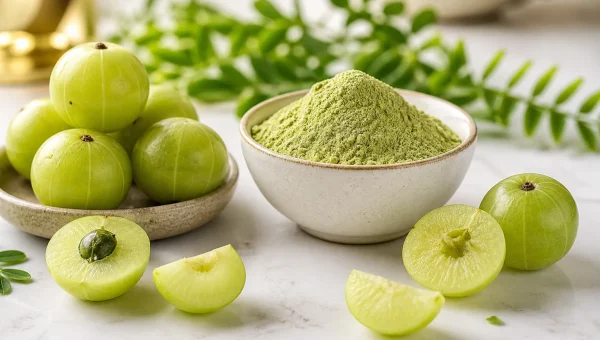
Amalaki or Amla is the fruit of Emblica officinalis Gaertn. (syn. Phyllanthus emblica L.). Describing it only as a source...
Andrographis paniculata (Burm. f.) Wall. ex Nees, commonly called Kalmegh or Kālamegha, is an Acanthaceae herb used in Ayurveda. Its...
Zinc deficiency affects an estimated 17.3% of the global population, according to a 2012 analysis published in Nutrients , yet...
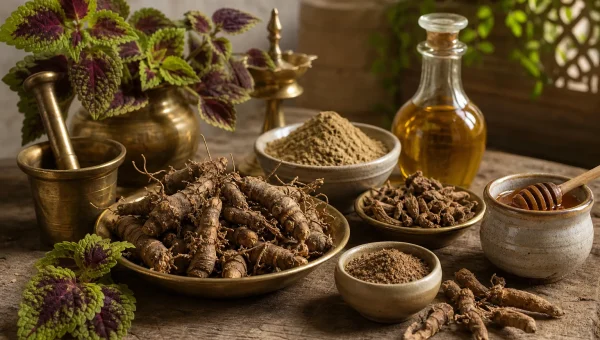
Coleus forskohlii Briq. is the name used for Gandira root in the Ayurvedic Pharmacopoeia of India (API). Current Kew taxonomy...
The word “adaptogen” belongs to twentieth-century pharmacology, not to classical Ayurvedic terminology. The European Medicines Agency traces it to the...
Boswellia serrata Roxb., commonly called Indian frankincense, is a tree of the Burseraceae family whose resinous exudate is used in...
Tinospora cordifolia (Willd.) Hook.f. & Thomson, commonly called Guduchi or Giloy, is a medicinal climber of the Menispermaceae family. Ayurveda...
Phyllanthus niruri L. is widely marketed as “stone breaker,” but it should not be treated as an exact botanical synonym...
Ashwagandha (Withania somnifera (L.) Dunal) is an important Ayurvedic medicinal plant and a widely used supplement ingredient. The Ayurvedic Pharmacopoeia...