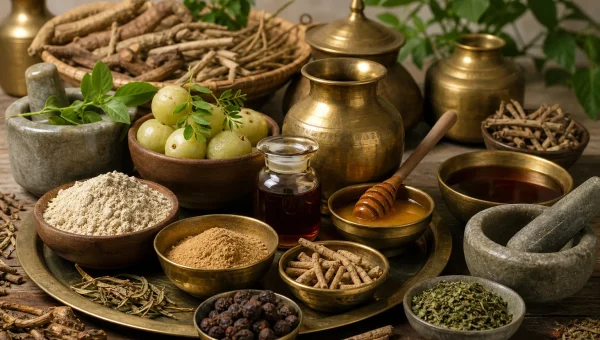
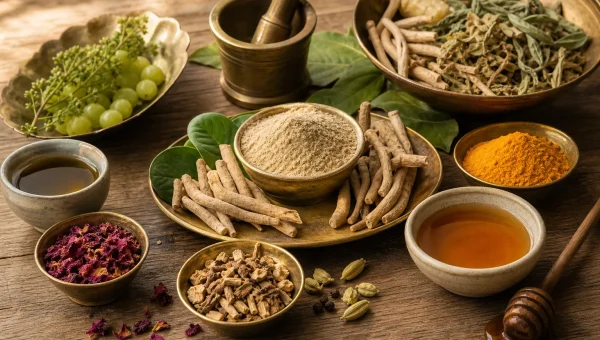
Ayurvedic Vocal Cord Care for Singers: The Svara Raksha System
Ayurvedic vocal cord care for singers can be understood as Svara Raksha, or protection of the voice, a practical discipline for keeping the singing voice clear, steady, lubricated, and resilient through rehearsal, performance, and recovery. Classical Ayurveda places speech under the influence of Udana Vata, the upward-moving aspect of Vata associated with the chest, throat pathway, speech, effort, enthusiasm, strength, and expression. For singers, this means that vocal care is not limited to the throat alone; it includes breath control, nervous-system steadiness, hydration, diet, sleep, and correct use of voice.
The Svara Raksha approach addresses three useful levels of vocal care: the comfort and resilience of the throat tissues, the moist mucosal surface that allows smooth vibration, and the breath-voice coordination governed by Prana and Udana Vata. A singer may therefore need different support when the voice is dry and strained, when it is clogged with mucus, when it fatigues from overuse, or when performance anxiety tightens the breath and throat.
The Most Common Vocal Patterns Singers Face
Choosing the right Ayurvedic support begins with identifying the pattern. The same herb or routine is not suitable for every voice problem. A dry, hot, strained voice needs soothing and cooling support, while a heavy, mucus-coated voice needs lightening and clearing support. Persistent hoarseness, sudden voice loss, pain, or a diagnosed vocal fold lesion should be assessed by a qualified clinician rather than managed only with home remedies.
| Presentation | Ayurvedic Pattern | Supportive Measures | When to Be Cautious |
|---|---|---|---|
| Hoarseness after heavy use | Vata-Pitta irritation in the throat with Udana strain | Yashtimadhu gargle, warm water, voice rest, gentle steam, soft warm foods | If hoarseness persists beyond two weeks, seek medical evaluation |
| Morning mucus, throat clearing, heavy coating | Kapha accumulation with possible Ama tendency | Kantakari under guidance, warm fluids, lighter evening meals, avoidance of personal mucus triggers | Avoid drying or heating herbs if the throat feels raw, burning, or inflamed |
| Dry voice, fatigue, loss of ease in upper range | Vata dryness and depleted vocal recovery | Regular sleep, hydration, warm moist meals, mild Yashtimadhu support, reduced vocal load | Do not sing through progressive fatigue or pain |
| Diagnosed vocal nodules, polyps, or chronic lesions | Structural voice disorder requiring clinical assessment | ENT or laryngology care, voice therapy, vocal load management; herbs only as supportive care if appropriate | Do not rely on herbal treatment as a substitute for diagnosis or voice therapy |
| Stage fright with throat tightening or breathy tone | Prana-Udana Vata disturbance with anxiety and constricted breath | Nadi Shodhana, gentle humming, slow exhalation, steady warm-up, practitioner-guided Medhya herbs | Avoid experimenting with sedating herbs for the first time before a performance |
Yashtimadhu: The Primary Throat-Soothing Herb
Yashtimadhu (Glycyrrhiza glabra, licorice root) is one of the most useful Ayurvedic herbs for a strained, dry, irritated, or hoarse voice. The Ayurvedic Pharmacopoeia of India lists Yashti with Madhura rasa, Guru and Snigdha guna, Shita virya, Madhura vipaka, and actions including Balya, Vatapittajit, and Raktaprasadana. Its listed therapeutic uses include Kasa and Svarabheda, making it directly relevant to cough, throat irritation, and altered voice quality.
For singers, Yashtimadhu is best understood as a cooling, unctuous, throat-soothing herb. It is especially suitable when the voice feels hot, scraped, dry, tired, or rough after practice. Contemporary use of licorice also includes gargling for throat discomfort, but a singer should not treat it as a way to force the voice through injury. Its role is to soothe and support recovery while vocal load is reduced.
Practical Yashtimadhu protocols for singers:
- Daily gargle: Simmer 1/2 to 1 teaspoon of Yashtimadhu powder in 200 ml water for about 5 minutes. Cool until comfortably warm, then gargle gently in repeated rounds for 2-3 minutes. Use during heavy rehearsal periods or after mild strain.
- Pre-performance support: Sip a mild warm Yashtimadhu infusion 30-60 minutes before singing if the throat feels dry or irritated. Keep it light; a thick coating immediately before singing may feel uncomfortable for some voices.
- Post-performance recovery: Mix a small pinch to 1/2 teaspoon of Yashtimadhu powder with raw honey and let a small amount dissolve slowly in the mouth. Add honey only when the preparation is not hot.
Yashtimadhu safety: Licorice is not suitable for everyone. Frequent or therapeutic use should be avoided or supervised in pregnancy, breastfeeding, hypertension, kidney disease, heart disease, low potassium, edema, or when taking medicines such as diuretics, corticosteroids, digoxin, or blood pressure medication. Singers who use Yashtimadhu regularly should do so under the guidance of a qualified Ayurvedic practitioner or healthcare provider.
Kantakari: Clearing the Mucus-Blocked Voice
Kantakari (Solanum surattense, commonly treated in Ayurvedic usage with the synonym Solanum xanthocarpum) is more appropriate for the singer whose voice is heavy, phlegmy, coated, or difficult to start in the morning. The Ayurvedic Pharmacopoeia of India lists Kantakari with Katu and Tikta rasa, Laghu and Ruksha guna, Ushna virya, Katu vipaka, and actions including Shothahara, Dipana, Pachana, Amadoshanashaka, and Kanthya. Its listed therapeutic uses include Kasa, Shvasa, Pinasa, and Svarabheda.
This makes Kantakari a better choice for Kapha-type vocal congestion than for a dry, burning, overused throat. In practice, it is used to support clearer breathing and a lighter throat when mucus and heaviness interfere with tone. Because it is heating and drying in quality, it should be used carefully in singers who already have dryness, acidity, throat burning, or Pitta aggravation.
Practical Kantakari use for singers:
- Kapha-mucus pattern: Use Kantakari decoction or a traditional preparation only under professional guidance, especially if it will be taken for more than a few days.
- Balanced throat formula: When mucus and irritation occur together, a practitioner may combine Kantakari with a soothing herb such as Yashtimadhu so that clearing does not become excessive drying.
- Timing: Take Kapha-clearing preparations earlier in the day rather than immediately before singing, so the throat has time to settle before performance.
- Food support: Keep dinner light, warm, and easy to digest when morning mucus is a recurring issue. Avoid large late-night meals and personal food triggers that reliably thicken the throat.
Steam and Hydration: The Svara Snehana Practice
Steam, humidified air, and steady water intake support the moist surface needed for comfortable vocal vibration. In Ayurvedic language, this is a form of gentle snehana for the voice: not heavy oiling of the throat, but protection from dryness, friction, and overuse. This is especially helpful during long rehearsals, dry weather, air-conditioned rooms, and travel.
- Use plain steam or clean humidified air rather than strong essential oils, which may irritate sensitive singers.
- For steam inhalation, boil water, remove it from heat, wait until the vapor is comfortable, and inhale gently for 5-10 minutes.
- Keep the face far enough from the vessel to avoid burns, and stop if the throat tightens, burns, or feels irritated.
- Rest the voice quietly after steaming; do not use steam as a last-minute substitute for warming up or vocal rest.
- Clean humidifiers regularly, and aim for comfortable room humidity rather than damp, mold-prone air.
Vata-Pitta Vocal Diet: What to Eat and Avoid
The singing voice often reflects digestion, hydration, sleep, and the previous day’s vocal load. A Vata-Pitta protective diet for singers is warm, moist, regular, and non-irritating. The aim is to keep the throat lubricated without creating heaviness, mucus, reflux, or sluggish digestion.
Avoid or reduce before performance: very cold drinks, iced foods, excessive spicy or acidic foods, alcohol, excessive caffeine, and any food that personally increases mucus, reflux, throat clearing, or belching. Large amounts of heavy dairy may aggravate Kapha-type throat coating in some singers, especially when taken late at night or before performance.
Optimize daily: warm water through the day, moist cooked foods, soups, soft grains, cooked vegetables, and a small amount of ghee with meals if digestion tolerates it. Singers with dryness should avoid skipping meals and overusing dry snacks, while singers with mucus should keep evening meals lighter and reduce heavy, cold, sweet, or oily foods that reliably worsen the morning voice.
Use honey correctly: honey may be used in small amounts with throat preparations once they are lukewarm, but it should not be boiled or added to very hot liquids. Classical Ayurvedic caution against heated honey is best respected in daily vocal-care routines.
The Stage Anxiety Vocal Protocol
Performance anxiety can disturb Prana and Udana Vata, creating a familiar pattern: shallow breath, dry mouth, constricted throat, unstable pitch, and a voice that feels less available on stage than in practice. The Ayurvedic response is to steady breath, lengthen exhalation, calm the sensory system, and build a reliable pre-performance ritual that the body recognizes.
Long-term conditioning: Practice Nadi Shodhana and gentle humming daily during the performance season, not only on the day of the event. Practitioner-guided Medhya Rasayana herbs such as Brahmi or constitutionally appropriate Rasayana support may be considered when anxiety, poor sleep, or mental fatigue are part of the pattern. Ashwagandha is sometimes used for stress resilience, but it is not suitable for everyone and should not be started casually before a performance.
Acute pre-performance calming: About 20-30 minutes before singing, sit upright and complete 5 slow rounds of alternate nostril breathing. Then hum gently on exhalation for 1-2 minutes, keeping the jaw soft and the throat relaxed. Follow with an easy vocal warm-up rather than pushing volume or range. This sequence gives Udana Vata a clear pathway through breath, tone, and steadiness.
When to Rest and When to Refer
Ayurvedic vocal care works best when it supports intelligent voice use rather than replacing rest, diagnosis, or therapy. Sudden voice loss, painful singing, coughing blood, breathing difficulty, swallowing difficulty, recurrent reflux symptoms, or persistent hoarseness should be evaluated by a qualified healthcare provider. Vocal nodules, polyps, cysts, hemorrhage, and chronic laryngitis require clinical assessment and may need voice therapy, medical treatment, or specialist care.
Medical Disclaimer: Persistent hoarseness lasting more than two weeks, especially in adult singers, requires evaluation by an ENT specialist, laryngologist, or qualified healthcare provider to exclude vocal nodules, polyps, chronic laryngitis, reflux-related injury, or other laryngeal pathology. Herbal preparations and home routines may support comfort and recovery from minor strain, but they do not replace diagnosis, voice therapy, or medical care.
Nothing in this article diagnoses or treats a medical condition. Use it as educational information and consult a qualified Ayurvedic practitioner or physician before starting herbs, supplements, detoxes, or therapeutic protocols, especially if pregnant, managing a condition, or taking medication.
References
- Easyayurveda (easyayurveda.com)
- Ayurvedic Pharmacopoeia of India
- An evaluation of the efficacy of licorice gargle for attenuating postoperative sore throat: a prospective, randomized, single-blind study (2009), PubMed
- Glycyrrhiza glabra: Chemistry and Pharmacological Activity (2018), PubMed Central
- Heart (heart.org)
- NCCIH
- Studies on the physicochemical characteristics of heated honey, honey mixed with ghee and their food consumption pattern by rats (2010), PubMed Central
- Nidcd (nidcd.nih.gov)
- The role of hydration in vocal fold physiology (2010), PubMed Central
- Med (med.umn.edu)
- Mayoclinic (mayoclinic.org)
- Mayoclinic (mayoclinic.org)
- Jamanetwork (jamanetwork.com)
- NIH Office of Dietary Supplements
- NCBI
- Effect of Alternate Nostril Breathing Exercise on Experimentally Induced Anxiety in Healthy Volunteers Using the Simulated Public Speaking Model: A Randomized Controlled Pilot Study (2017), PubMed Central
- Effects of Bhramari Pranayama on health – A systematic review (2018), PubMed Central