Raktaja Disorders Ayurvedic Treatment: Classifying Blood Tissue Pathology
Raktaja disorders ayurvedic treatment refers to the classical management of disorders arising from vitiation of Rakta or Shonita, the blood tissue. In Charaka Samhita, the detailed discussion of pure blood, causes of blood vitiation, clinical features, and management appears in Sutra Sthana 24, Vidhishonitiya Adhyaya, while the enumeration of Rakta-pradoshaja disorders appears in Sutra Sthana 28, Vividhashitapitiya Adhyaya. The value of this framework is its emphasis on mechanism: remove causative factors, assess dosha and dhatu involvement, clear vitiation where required, and only then rebuild depleted tissue.
Raktaja Vikara is not a one-to-one substitute for a modern diagnosis. It is an Ayurvedic pathological category used when Rakta is affected by heat, discoloration, bleeding tendency, inflammatory skin change, suppuration, foul smell, itching, burning, altered digestion, or depletion. In contemporary clinical care, symptoms such as anemia, active bleeding, hematuria, jaundice, fever with spreading redness, severe pallor, or non-healing ulcers require appropriate biomedical evaluation alongside Ayurvedic assessment.
Classical Pathogenesis: How Rakta Becomes Vitiated
Charaka describes many causative factors for Rakta vitiation, including unsuitable or spoiled foods and drinks, overeating, excessive sour, salty, pungent, alkaline, fermented, incompatible, or putrid foods, curd and sour preparations, day sleep after heavy and unctuous meals, anger, excessive sun and wind exposure, suppression of vomiting, exertion, injury, heat, indigestion, and improper eating during indigestion. This makes Raktaja pathology a diet-lifestyle-dosha condition rather than a simple blood-count abnormality.
The same classical framework also explains how vitiated doshas move from the central digestive region toward the peripheral tissues and channels when provoked by heat, exertion, unwholesome habits, and disturbed Vata. Treatment therefore aims to reverse this movement, protect Agni, open obstructed channels, and remove the vitiated dosha through appropriate measures rather than merely adding tonics.
| Classical Category | Typical Classical Features | Dosha Reading | Treatment Direction |
|---|---|---|---|
| Rakta-pradoshaja Vikara | Kushtha, Visarpa, Pidaka, Raktapitta, Asrugdara, Kamala, Vyanga, Dadru, Pama, Kotha, and related Rakta disorders | Rakta affected by one or more doshas | Nidana removal, dosha assessment, Shodhana when indicated |
| Pitta-dominant Rakta Dushti | Burning, thirst, bitter or sour eructation, yellow-black discoloration, delayed coagulation pattern | Pitta affecting Rakta | Pitta-pacifying diet, cooling Rakta-supportive herbs, Virechana when fit |
| Kapha-dominant Rakta Dushti | Pale, slimy, fibrous, viscous qualities; heaviness, itching, thick eruptions | Kapha obstructing Rakta and Srotas | Lightening, Agni support, channel-clearing herbs |
| Vata-dominant Rakta Dushti | Thin, frothy, reddish, non-slimy blood qualities; pain, dryness, irregularity | Vata disturbing Rakta movement | Careful Vata-pacification without excessive depletion |
| Rakta-kshaya or Pandu-type presentation | Pallor, weakness, reduced strength, digestive impairment, depletion signs | Dhatu depletion with Agni and Srotas involvement | Correct cause, protect Agni, then use Raktavardhana and Rasayana under supervision |
Shodhana: When Purification Comes First
For disorders of vitiated Rakta, Charaka gives the treatment direction of Raktapitta-hara measures together with Virechana, Upavasa, and Shonita-sravana or Raktamokshana, selected according to the patient’s strength, dosha, site, and stage of disease. In practical terms, this means that Rakta disorders are not managed by tonics alone; the vitiated dosha and causative habits must be addressed before blood-building therapy is emphasized.
Virechana is used in suitable patients when Pitta-Rakta aggravation is prominent, while fasting or lightening measures are chosen carefully when heaviness, Ama, or Kapha obstruction is present. Raktamokshana belongs only in a qualified clinical setting and should never be attempted as self-bleeding, unsupervised bloodletting, or a substitute for urgent medical care. The Panchakarma protocol overview provides broader context for staging purification procedures safely.
When strong Shodhana is unsuitable because of pregnancy, severe debility, active bleeding, frailty, serious cardiac disease, or acute medical instability, treatment is redirected toward Nidana Parivarjana, Agni protection, gentle diet correction, and physician-selected Rakta-prasadana or Rakta-shodhaka herbs.
Key Rakta Shodhaka and Rakta Prasadana Dravyas
The Ayurvedic Pharmacopoeia of India lists several classical herbs with actions relevant to Rakta disorders, including Raktashodhaka, Raktaprasadana, Shonitasthapana, Kushthaghna, Shothaghna, and Jvaraghna actions. The dose ranges below refer to crude drug ranges listed in pharmacopoeial monographs and must be individualized by a qualified practitioner.
Manjistha (Rubia cordifolia): Manjistha is listed as the dried stem of Rubia cordifolia. Its rasa is Kashaya, Tikta, and Madhura; its guna is Guru; its virya is Ushna; and its vipaka is Katu. Classical actions listed include Kaphapittashamaka, Varnya, Shothaghna, Kushthaghna, Rasayana, and Shonitasthapana. It is used in formulations such as Brihanmanjishthadi Kvatha and Manjishthadi Taila, with a pharmacopoeial crude drug dose of 2–4 grams.
Guduchi (Tinospora cordifolia): Guduchi is listed as the dried mature stem of Tinospora cordifolia. Its rasa is Tikta and Kashaya; its guna is Laghu; its virya is Ushna; and its vipaka is Madhura. Its listed actions include Balya, Dipana, Rasayana, Sangrahi, Tridoshashamaka, Raktashodhaka, and Jvaraghna. It is traditionally used where fever, inflammatory skin involvement, Pandu, Prameha, Vatarakta, or Kamala-like presentations accompany Rakta vitiation. The pharmacopoeial dose is 3–6 grams of powder or 20–30 grams for decoction preparation.
Sariva (Hemidesmus indicus): Sariva is listed as the dried root of Hemidesmus indicus. Its rasa is Madhura; its guna is Guru and Snigdha; its virya is Shita; and its vipaka is Madhura. Its listed actions include Raktashodhaka, Vishaghna, Tridoshanashana, Dipana, Amanashana, and Jvarahara. It is especially suited to Pitta-Rakta presentations with burning, itching, skin involvement, or heat signs, with a pharmacopoeial decoction dose of 20–30 grams.
Khadira (Acacia catechu): Khadira is listed as the heartwood of Acacia catechu. Its rasa is Tikta and Kashaya; its guna is Laghu and Ruksha; its virya is Shita; and its vipaka is Katu. Its actions include Krimighna, Kushthaghna, Medohara, Raktashodhaka, Kaphapittahara, and Dantya. Khadirarishta, Arimedadi Taila, and Khadiradi Gutika are among its important formulations, and it is used classically in Shotha, Kushtha, Prameha, and Vrana presentations. The pharmacopoeial decoction dose is 20–30 grams.
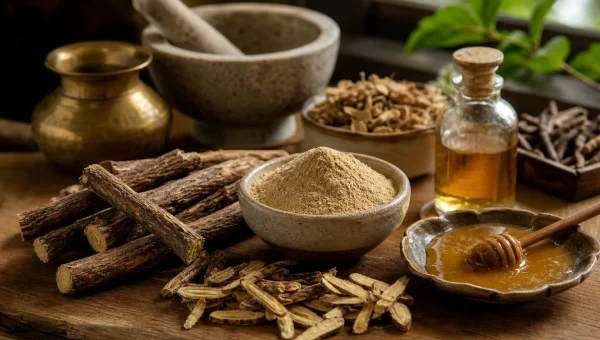
Yashti or Mulethi (Glycyrrhiza glabra): Yashti is listed as the dried unpeeled stolon and root of Glycyrrhiza glabra. Its rasa is Madhura; its guna is Guru and Snigdha; its virya is Shita; and its vipaka is Madhura. Its actions include Balya, Chakshushya, Vrishya, Varnya, Vatapittajit, and Raktaprasadana. It is used where Pitta-Rakta irritation is accompanied by dryness, tissue irritation, cough, wound tendency, or Vatarakta-type presentation. The pharmacopoeial powder dose is 2–4 grams.
Punarnava (Boerhaavia diffusa): Punarnava is listed as the dried mature whole plant of Boerhaavia diffusa. Its rasa is Madhura, Tikta, and Kashaya; its guna is Ruksha; its virya is Ushna; and its vipaka is Madhura. Its listed actions include Anulomana, Shothahara, Mutrala, and Vatashleshmahara. It is used in Shotha and Pandu, and Punarnavadi Mandura is listed among its important formulations. Iron-containing and herbo-mineral preparations should be used only under qualified supervision.
Rakta-Kshaya, Pandu, and the Rasayana Phase
When the presentation is depletion-oriented, with pallor, weakness, reduced vitality, or suspected anemia, the first task is to identify the cause rather than adding iron or Rasayana indiscriminately. Bleeding, nutritional deficiency, chronic infection, inflammatory disease, kidney disease, liver disease, and medication-related causes require appropriate medical assessment. In Ayurveda, Pandu-type depletion is treated after Agni, diet, causative factors, and Srotas obstruction are addressed.
After Shodhana or gentle clearing is complete, Rasayana and Raktavardhana measures are chosen according to the patient’s constitution, digestion, and clinical condition. Punarnavadi Mandura and related preparations belong to this rebuilding phase when indicated by a qualified practitioner. The Srotas channel framework helps explain why channel clarity and Agni stability are emphasized before tissue-building medicines are introduced.
Charaka also advises careful diet after Rakta-clearing procedures: food should protect Agni and should not be excessively hot, excessively cold, heavy, or difficult to digest. This principle remains central in Raktaja disorders because new tissue formation depends on clean digestion and proper dhatu nourishment.
Monitoring and Clinical Endpoints
Classical endpoints include reduction in burning, thirst, itching, eruptions, discoloration, foul smell, heaviness, feverishness, digestive disturbance, and abnormal bleeding tendency, along with return of appetite, strength, complexion, clear senses, cheerful state, and unobstructed natural urges. These are signs that Rakta and its channels are moving toward a cleaner functional state.
In integrative care, laboratory monitoring may include CBC, ferritin, liver function tests, urine examination, inflammatory markers, coagulation assessment, or peripheral smear when clinically appropriate. Active bleeding, black stools, vomiting blood, blood in urine, jaundice, high fever, spreading skin infection, fainting, chest pain, severe breathlessness, or marked pallor should be treated as medical warning signs requiring prompt evaluation.
Medical Disclaimer: This article is for educational purposes only and does not replace evaluation by a licensed physician, hematologist, or qualified Ayurvedic practitioner. Blood disorders, active bleeding, anemia, infections, jaundice, and non-healing ulcers require proper diagnosis. Ayurvedic herbs, mineral preparations, Panchakarma, Virechana, Raktamokshana, and iron-containing formulations should be used only under appropriate professional supervision, especially during pregnancy, childhood, chronic disease, anticoagulant use, or concurrent prescription medication.