Rock Climbing Ayurvedic Tendon Care: Why Climbers Break Down
Rock climbing Ayurvedic tendon care begins with the finger flexor tendon-pulley system. In the crimp position, the middle finger joint is strongly flexed while the end joint is extended, creating high load on the A2 pulley; biomechanical measurement has placed A2 pulley load at about three times the fingertip force during crimping. This is why repeated hard crimping, pockets, small edges, and high-volume board sessions can irritate the pulley system even without one dramatic injury event.
In Ayurvedic language, repeated forceful loading with inadequate recovery is best viewed as Vata aggravation affecting snayu and nearby sandhi. Snayu refers to connective support structures such as tendons, ligaments, and fibrous bands, while sandhi refers to joints and joint regions. For climbers, this Ayurvedic lens is useful for organizing care around unloading, warmth where appropriate, oiling, tissue nourishment, sleep, and a gradual return to stress. It does not replace sports medicine diagnosis, imaging, splinting, or hand-therapy rehabilitation when a pulley injury is suspected.
Snayu, Sandhi and Vata: The Ayurvedic Lens for Climbing Fingers
Classical Ayurveda describes Vata disorders according to the tissue and site involved. Charaka lists Snayugata Vata as Vata located in snayu and Sandhigata Vata as Vata located in joints, where painful movement and swelling are important features. A climber with finger stiffness, tendon-line discomfort, morning tightness, creaking pain, or recurring soreness after crimp-heavy sessions should treat these signs as a warning that training load and recovery are out of balance.
The practical Ayurvedic principle is to reduce the qualities that aggravate Vata: excessive dryness, cold exposure, irregular meals, sleep loss, overtraining, and repeated high-force gripping without adequate recovery. Supportive care emphasizes snigdha measures such as oiling, ushna measures such as gentle warmth when there is no acute heat or swelling, and brimhana measures such as adequate food, protein, rest, and strengthening performed at the right time.
Recovery Map for Common Climbing Tendon and Pulley Problems
The table below keeps Ayurvedic support in its proper place: as an adjunct to correct diagnosis, load management, and progressive rehabilitation. Sudden pain with a pop, bruising, bowstringing, visible swelling, loss of finger flexion strength, locking, numbness, or pain that affects daily use requires prompt assessment by a sports medicine physician, hand surgeon, or qualified physiotherapist.
| Climbing Presentation | Biomedical Priority | Ayurvedic Support | Return Guidance |
|---|---|---|---|
| Mild pulley irritation or low-grade strain | Reduce crimping, avoid painful loading, consider taping and hand-therapy guidance | Light oiling of palm, finger base, and forearm after acute heat is absent; warm cloth application if it feels comfortable | Resume with pain-free open-hand holds, low volume, and no hard crimping |
| Partial pulley injury with swelling or tenderness | Clinical grading, short protection or immobilization when prescribed, then progressive therapy | Whole-body Vata calming through sleep, regular meals, gentle oil massage away from acute swelling, and warm nourishing food | Increase load only after daily activity and basic finger motion are pain-free |
| Complete pulley rupture or suspected multiple-pulley injury | Stop climbing, obtain imaging or specialist assessment, use splinting or surgery when indicated | Ayurvedic care is supportive only; avoid forceful massage, heat, or manipulation over the injured pulley | Return only after professional clearance and a structured rehabilitation plan |
| Flexor tendon sheath irritation or tenosynovitis-like symptoms | Unload the finger, assess swelling, heat, locking, or persistent pain | Avoid heating an already hot or swollen tendon; select oils and herbs according to practitioner assessment | Return after swelling and tendon-line pain have settled |
| Forearm flexor fatigue and dry, tight recovery | Deload, improve sleep, hydration, food intake, and progressive conditioning | Gentle forearm oil massage, warm bath, adequate protein, and Vata-pacifying meals | Rebuild volume before intensity, and avoid stacking hard board sessions too close together |
The Recovery Oil Protocol for Finger Tendons
Ayurveda uses sneha and svedana in Vata disorders: oiling softens and nourishes dry tissues, while gentle warmth helps relieve cold stiffness when there is no acute inflammation. Charaka’s Vata treatment framework includes oil massage, warm applications, poultices, local sweating methods such as nadi sveda, and nourishing measures. For climbers, these principles can be adapted safely as a supportive home routine after acute swelling, bruising, and heat have settled.
Use this oil routine only on intact skin and only when the finger does not feel hot, acutely swollen, or freshly injured:
- Choose the oil carefully: plain warm sesame oil is a simple Vata-pacifying option; a practitioner may choose a medicated oil such as Mahanarayana Taila according to the pattern and stage of recovery.
- Warm the oil gently: stand the bottle in warm water for a few minutes. The oil should feel comfortably warm, never hot.
- Apply lightly: use 2-5 drops around the palm, finger base, and forearm flexor line. Do not perform deep friction directly over a painful pulley.
- Massage with respect for pain: use slow linear strokes for 3-5 minutes, stopping if pain sharpens, swelling increases, or the finger feels irritated afterward.
- Add mild warmth: wrap with a warm cloth for 10-15 minutes if the tissue feels cold and stiff. Skip warmth when there is heat, redness, fresh swelling, or throbbing.
- Before climbing: wipe the hands completely clean. Never climb with oily fingers or oily holds.
This routine is best used after climbing, on rest days, or during a protected rehabilitation phase. During the first days after a suspected tear, the priority is protection and assessment, not aggressive massage.
Internal Herb and Food Support for Connective Tissue Recovery
Topical oil does not rebuild injured tissue by itself. Tendon and pulley recovery depends on appropriate unloading, progressive loading, adequate calories, sufficient protein, micronutrients, sleep, and digestion. Ayurvedic herbs can support dhatu poshana when chosen correctly, but they should be individualized rather than used as a fixed protocol for every climber.
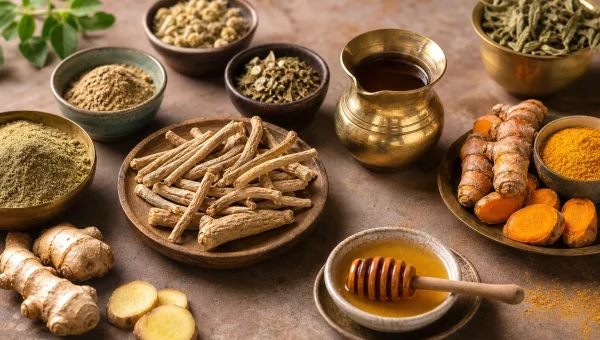
- Ashwagandha (Withania somnifera): The Ayurvedic Pharmacopoeia of India lists Ashwagandha root as balya, rasayana, and Vata-Kapha pacifying, with tikta and kashaya rasa, laghu guna, ushna virya, and madhura vipaka. It is most appropriate for depleted, overtrained, under-recovered Vata-type climbers when digestion is strong and a practitioner considers it suitable.
- Guduchi (Tinospora cordifolia): The Ayurvedic Pharmacopoeia of India lists Guduchi as balya, dipana, rasayana, tridosha-shamaka, and raktashodhaka, with tikta and kashaya rasa, laghu guna, ushna virya, and madhura vipaka. It is often considered when recovery is complicated by sluggish digestion, heaviness, or inflammatory tendencies.
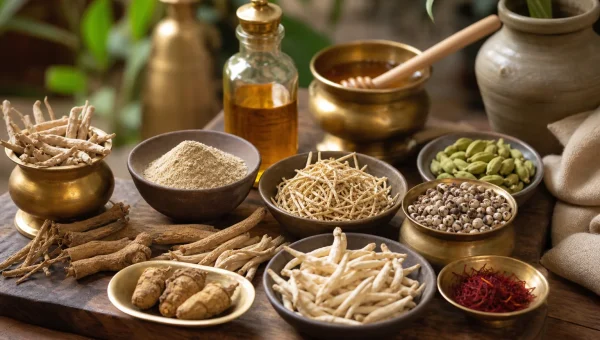
- Shatavari (Asparagus racemosus): The Ayurvedic Pharmacopoeia of India lists Shatavari root as balya and rasayana, with madhura and tikta rasa, guru and snigdha guna, shita virya, and madhura vipaka. It is better suited to dry, lean, depleted Vata patterns than to heavy, ama-dominant digestion.
- Bala-containing preparations: Bala is used traditionally in Vata-supportive formulations, but internal self-prescription of Sida cordifolia products is not appropriate. Some Sida cordifolia material contains sympathomimetic alkaloids, so people with hypertension, heart rhythm vulnerability, stimulant sensitivity, or medication use should avoid unsupervised use.
For most climbers, the safest internal foundation is not a long herb stack but a consistent routine: warm meals, adequate protein, sufficient fats, steady hydration, early sleep, and practitioner-guided herbs only when they match the person’s constitution, digestion, and medical context.
Pre-Climb Warm-Up: Ayurvedic Principles Applied
Ayurveda’s concept of exercise capacity emphasizes training according to one’s strength, season, diet, and recovery rather than forcing maximum effort every day. For climbers, this means the first hard crimp of the session should never be the first serious load the finger pulleys receive.
- Start warm: use 5-10 minutes of general movement before finger loading, especially in cold conditions.
- Use light self-massage: a small amount of sesame oil can be used at home on the forearms and hands before the session, but it must be wiped off completely before touching holds.
- Progress gradually: begin with open-hand grips, large holds, easy traversing, and low-intensity movement before pockets, edges, board climbing, or full crimping.
- Respect warning pain: stiffness that improves with warmth is different from sharp pulley pain. Do not use warm-up to override a finger that is already warning you.
This is the practical form of mardana and measured vyayama: prepare the tissue, test the day’s capacity, and stop before fatigue turns form into strain.
Nutrition for the Climbing Athlete
Tendon-supportive nutrition should be steady rather than extreme. A climbing athlete with active tendon irritation needs enough total food, adequate protein, vitamin-C-rich foods, minerals, hydration, and sleep so that rehabilitation loading can produce adaptation instead of further depletion.
A practical protein range for many exercising adults is about 1.4-2.0 grams per kilogram of body weight per day, adjusted for training volume, digestion, medical status, and professional guidance. In Ayurvedic terms, protein targets matter only when agni can process the food; heavy meals that create bloating, sluggishness, or ama should be simplified before adding more supplements.
- Vitamin C and collagen support: vitamin-C-rich foods such as Amalaki, citrus, guava, and berries can be paired with collagen or gelatin before controlled rehabilitation loading for non-vegetarian athletes who use those foods.
- Vegetarian support: vegetarian climbers can emphasize milk if tolerated, mung preparations, black gram in suitable digestion, sesame, ghee, nuts, legumes, and complete protein combinations according to constitution and appetite.
- Vata-pacifying meals: warm soups, stews, khichari, ghee, sesame, cooked grains, and regular meal timing are more supportive for dry, depleted climbers than cold smoothies, skipped meals, and excessive stimulants.
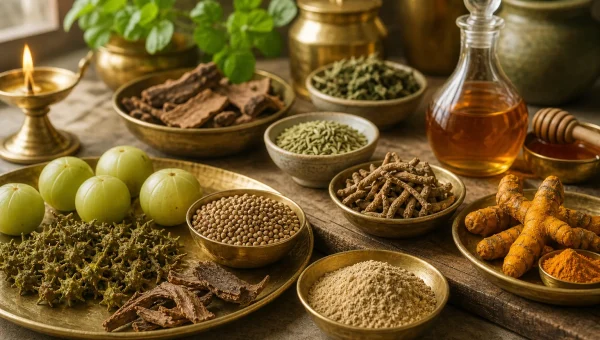
- Amalaki: The Ayurvedic Pharmacopoeia of India lists Amalaki fruit as containing ascorbic acid and tannins and describes it as rasayana and tridosha-balancing. It is a useful Ayurvedic food for athletes who tolerate sour and cooling foods well.
Return-to-Climbing Protocol
Returning too early is one of the easiest ways to convert a manageable pulley irritation into a recurring injury. The Ayurvedic criterion is restoration of comfortable movement, stable strength, and absence of pain-provoking Vata signs; the sports-medicine criterion is pain-free function, appropriate tissue protection, and professional clearance for significant injuries.
Before returning to climbing, daily hand use should be comfortable, gentle finger flexion and extension should be pain-free, direct pulley tenderness should be minimal or absent, and any significant injury should be cleared by a qualified clinician. The first climbing phase should use large holds, open-hand positions, easy routes or traverses, low volume, and long rests. Avoid max hangs, small pockets, full crimping, campus-style loading, and limit bouldering until the finger tolerates easier work without a next-day flare.
Increase only one variable at a time: volume, intensity, hold size, angle, or session frequency. Continue oiling, sleep regularity, warm meals, and deload weeks during the return phase. If swelling, sharp pain, or pulley tenderness returns, step back immediately and reassess rather than pushing through.
Safety: When Not to Use Heat, Oil or Herbs
Ayurvedic tendon care must be stage-appropriate. Heat, oil, massage, and herbs can be helpful in the right context, but they are not appropriate for every injury presentation and should not delay diagnosis.
- Do not massage or heat a finger with fresh bruising, acute swelling, marked warmth, sudden pop, visible bowstringing, suspected rupture, open skin, infection, numbness, or rapidly worsening pain.
- Do not use oil on climbing holds, before gripping equipment, or on skin that is broken, infected, or irritated by the oil.
- Do not self-prescribe strong herbal formulas, mineral preparations, detoxes, basti, or panchakarma for a sports injury without a qualified Ayurvedic practitioner.
- Use tested products from reliable manufacturers, because contaminated Ayurvedic products have been reported with heavy metals such as lead, mercury, or arsenic.
- Consult a healthcare provider before herbs or supplements if pregnant or nursing, managing a medical condition, taking medication, or preparing for surgery.
Medical Disclaimer: This article is for educational purposes only and does not replace professional medical, sports medicine, hand therapy, physiotherapy, or Ayurvedic clinical advice. A2 pulley ruptures, tendon sheath problems, and persistent finger pain require proper assessment by a qualified healthcare professional.
Consult a qualified Ayurvedic practitioner and healthcare provider before starting herbs, supplements, detoxes, basti, panchakarma, medicated oils, or therapeutic protocols, especially if pregnant, nursing, managing a condition, taking medication, or dealing with a suspected tendon or pulley injury.
References
- Biomechanical properties of the crimp grip position in rock climbers (2001), PubMed
- Closed flexor pulley injuries: A literature review and current practice (2022), PubMed Central
- Flexor Tendon Pulley Injuries: A Systematic Review of the Literature and Current Treatment Options (2023), PubMed Central
- Charaka Samhita — Vatavyadhi Chikitsa
- Charaka Samhita — Vyayama
- Ayurvedic Pharmacopoeia of India
- Examining the effect of Withania somnifera supplementation on muscle strength and recovery: a randomized controlled trial (2015), PubMed
- Ayurvedic Pharmacopoeia of India
- Japsonline (japsonline.com)
- Link (link.springer.com)
- Vitamin C-enriched gelatin supplementation before intermittent activity augments collagen synthesis (2017), PubMed Central
- NCCIH