
Every spring, without fail, I remember what my grandmother called “the bitter month.” As late winter loosened in Maharashtra, methi leaves appeared more often, bitter gourd stopped being negotiable, and a little neem-and-jaggery mixture arrived with the new-year season. As children we protested. As an adult, I recognize the seasonal logic beneath that family habit: shifting from rich winter foods toward meals that are lighter, warmer, less oily, and more bitter, pungent, or astringent.
Ayurveda calls spring Vasanta Ritu. Its practical timing should follow local climate rather than fixed modern calendar dates. In the classical account, Kapha accumulated during Shishira is loosened by the increasing warmth of the sun, which may disturb agni, or digestive capacity. This is an Ayurvedic explanatory model, not a biomedical diagnosis for every episode of congestion, fatigue, allergy, rash, or indigestion; persistent or severe symptoms still need appropriate medical assessment.
The Vasanta Ritu Dietary Principles
Ashtanga Hridaya advises a Kapha-reducing spring regimen based on laghu (light) and ruksha (less unctuous) foods, exercise, udvartana or dry powder massage, and meals that may include old barley, wheat, and honey. The same passage advises reducing heavy, cold, oily, sweet, and sour foods and avoiding daytime sleep. Bitter (tikta), pungent (katu), and astringent (kashaya) tastes are favored in Vasanta, while the text also explains that all six tastes remain in the diet in changing proportions.
This is more precise than “eat unlimited bitter food.” Bitter, pungent, and astringent foods can be drying and may aggravate Vata when overused. Honey is a special case: although sweet in taste, classical texts give it a place in Kapha-oriented regimens, but also advise against heating it or mixing it into hot food or drink. Therapeutic emesis, nasal treatment, and other shodhana procedures mentioned in seasonal care are physician-led therapies, never do-it-yourself cleanses.
| Taste or quality | Spring emphasis | Food examples | Limit |
|---|---|---|---|
| Bitter (Tikta) | Favored in Vasanta and commonly light or drying. | Methi, bitter gourd, radish leaves; neem only in tiny traditional culinary amounts. | Excess may worsen dryness, low weight, or Vata symptoms. |
| Pungent (Katu) | Favored for warming, aromatic spring meals. | Ginger, black pepper, mustard seed, garlic, cumin, and hing. | Moderate when there is acidity, burning, ulcers, or marked Pitta aggravation. |
| Astringent (Kashaya) | Favored as an alternative to overly sweet or oily food. | Moong, lentils, chickpeas, pomegranate, and cooked leafy vegetables. | Large dry portions may worsen gas or constipation. |
| Heavy, cold, very sweet, sour, or unctuous | These qualities are reduced in the classical spring regimen. | Large desserts, deep-fried foods, heavy cream dishes, excess curd, and iced drinks. | Reduction does not mean starvation or ignoring age, strength, climate, and illness. |
Recipe 1: Methi-Moong Spring Dal
This is a household adaptation of the classical preference for light pulse soups and bitter vegetables. Mudga yusha, a green-gram soup, is described in Ashtanga Hridaya as wholesome; adding methi makes the bowl more distinctly bitter without turning it into a medicinal dose. Keep the consistency loose and the tempering modest.
Ingredients (serves 4):
- 1 cup split moong dal, washed and soaked for 30 minutes
- 2 cups fresh methi leaves, cleaned and chopped
- 1 to 2 teaspoons ghee
- 1/2 teaspoon mustard seeds (Sarshapa)
- 1 teaspoon cumin seeds (Jiraka)
- 1/2 teaspoon turmeric (Haridra)
- 1/2 teaspoon fresh ginger or 1/4 teaspoon dry ginger (Shunthi)
- A small pinch of hing and salt to taste
- Optional: 1/4 teaspoon jaggery if needed for palatability
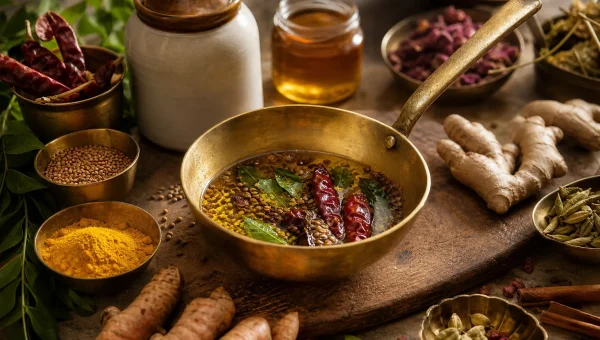
Method: Cook the soaked moong with turmeric and enough water to produce a pourable dal. Heat the ghee, crackle the mustard seeds, then add cumin, hing, and ginger. Add methi and sauté just until wilted. Stir the tempering into the dal and season. Use jaggery sparingly so the meal does not become predominantly sweet merely to hide every trace of bitterness.
Recipe 2: Festival Neem-Jaggery Relish
Neem with jaggery belongs here as a cultural food, not as a daily liver cleanse. Ugadi pachadi and related new-year preparations combine neem flowers with jaggery, raw mango, tamarind, chilli or pepper, and salt to represent life’s varied tastes. The Ayurvedic Pharmacopoeia of India describes neem leaf as bitter, dry, cold in potency, pungent after digestion, and Vata-promoting. That profile calls for restraint, not a cup of raw leaves.
Ingredients (makes 8 small ceremonial portions):
- 1 tablespoon fresh neem flowers, or 4 to 5 tender neem leaves, finely minced
- 2 tablespoons grated jaggery
- 2 tablespoons finely chopped raw mango
- 1 teaspoon diluted tamarind pulp
- A pinch each of black pepper and rock salt
- 2 to 3 tablespoons water, as needed
Method: Rinse the neem material carefully. If using leaves, dry-roast them for 30 to 60 seconds and mince finely. Mix with jaggery, mango, tamarind, pepper, salt, and enough water to make a spoonable relish. Serve only a small spoonful as part of a festival meal. Never substitute neem oil, concentrated extract, capsules, or large quantities of leaf. Children under 12 and pregnant or breastfeeding people should skip oral neem unless a qualified healthcare professional specifically approves it.
Recipe 3: Turmeric-Ginger Rice with Mustard
Barley and wheat are the grains explicitly emphasized in the classical spring passage; this rice dish is therefore a practical adaptation, not a quoted Vasanta formula. It works best as a smaller grain portion beside moong and cooked greens. Its purpose is a warm, freshly cooked meal with modest fat and aromatic spices, not an unsupported promise to “detoxify” the liver.
Ingredients (serves 3-4):
- 1 cup basmati or hand-pounded rice, rinsed
- 1 teaspoon ghee
- 1 teaspoon fresh ginger (Ardraka), grated
- 1/2 teaspoon turmeric powder
- 1/4 teaspoon black pepper
- 6 to 8 curry leaves
- 1/2 teaspoon mustard seeds
- Salt to taste
Method: Cook the rice until tender but not waterlogged. Heat the ghee, crackle the mustard seeds, add curry leaves and ginger, and cook briefly. Lower the heat before adding turmeric and pepper so they do not scorch. Fold the tempering through the rice and serve with thin dal and vegetables rather than cream, cheese, or a second heavy tempering.
Recipe 4: Dry-Cooked Bitter Greens Saag
This recipe follows the spring preference for bitter and less unctuous food without pretending that every green has the same Ayurvedic action. Methi and mustard greens are assertive, spinach is milder, and radish leaves add pungency. Combining them lets the cook adjust the plate to appetite, bowel tendency, and tolerance for bitterness.
Ingredients (serves 3-4):
- 3 packed cups mixed methi, radish leaves, mustard greens, and/or spinach
- 1 to 2 teaspoons ghee or sesame oil
- 1 teaspoon minced garlic (Lasuna)
- 1/2 teaspoon cumin seeds
- 1/2 teaspoon coriander powder (Dhanyaka)
- 1/4 teaspoon black pepper
- Salt to taste
- Optional: a few drops of lemon at serving
Method: Heat the fat, add cumin and garlic, and cook until aromatic. Add the washed, chopped greens and cook uncovered, stirring often, until they collapse and excess water evaporates. Add coriander, pepper, and salt near the end. A Vata-prone person can keep the greens softer and use the full two teaspoons of fat; a Kapha-prone person with good digestion can keep the dish lighter.
Recipe 5: Thin Barley-Moong Gruel
Yava (barley) is specifically named in the Vasanta regimen. This barley-and-moong preparation borrows the form of a light gruel, but it is not a verbatim classical prescription or a complete diet. It can serve as a simple evening meal after a heavier lunch when appetite, strength, and medical needs permit.
Ingredients (serves 2-3):
- 1/4 cup pearl barley, soaked for at least 4 hours
- 2 tablespoons split yellow moong
- 5 cups water
- 1 teaspoon fresh ginger, grated
- 1/4 teaspoon black pepper
- 1/2 teaspoon cumin seeds
- 1 teaspoon ghee
- Rock salt to taste
Method: Simmer the soaked barley and moong until both are very soft, adding hot water if the mixture thickens. Stir in ginger during the final 10 minutes. Temper cumin and pepper in ghee and add with salt. The finished dish should be thinner than khichdi and should be paired with sufficient nourishment elsewhere in the day.
Recipe 6: Cooled Ginger Water with Honey
Ashtanga Hridaya includes spring beverages prepared with dry ginger or honey among alternatives for people not taking wine. The following is a conservative household interpretation: ginger is infused in water, the drink is cooled, and honey is added only when it is no longer hot. It is a beverage, not a purgative, fat-burner, or substitute for breakfast.
Ingredients (1 serving):
- 250 ml water
- 2 thin slices fresh ginger or 1/4 teaspoon dry ginger
- Optional: 1/2 to 1 teaspoon honey
Method: Simmer ginger in water for 3 to 5 minutes, cover, and allow it to cool until merely lukewarm. Strain and add honey only after cooling; do not boil or cook the honey. Skip honey when blood-glucose control, allergy, intolerance, or a clinician’s advice makes it unsuitable. Take the drink with or after food if ginger on an empty stomach causes burning or nausea.
Triphala is not included as a universal spring drink because it is a medicinal formulation whose dose, timing, and suitability depend on the person. Readers can consult our Triphala benefits complete guide, but regular use should be discussed with a qualified Ayurvedic practitioner. For the broader framework, see Ayurvedic Dinacharya and seasonal adaptation. For general Kapha principles, see our Kapha dosha guide.
These recipes are seasonal food ideas, not treatment for allergy, asthma, infection, liver disease, obesity, diabetes, or another condition. Vata-dominant, underweight, older, pregnant, recovering, or highly active people may need more moisture, nourishment, and fat than a generic Kapha-reducing plan provides. Pitta-dominant people should moderate strong ginger, pepper, mustard, garlic, and chilli. Anyone with a medical condition, pregnancy, medication use, or recurrent symptoms should consult a qualified Ayurvedic practitioner and an appropriate healthcare provider before major dietary changes or herbal use.
Actionable tip: Begin with one ordinary change rather than a 21-day cleanse: make the methi-moong dal or thin barley-moong gruel, keep lunch freshly cooked and moderate in oil, avoid sleeping immediately after the meal, and observe appetite, comfort, energy, and bowel response. Classical Ritucharya adjusts proportion and routine; it does not justify fasting, self-induced vomiting, concentrated neem, or unsupervised herbal dosing.
the traditional vs modern standardization point you made is something practitioners argue about a lot.
the recipe in the fourth section is something I can actually prepare at home with pantry ingredients honestly
Several claims here contradict what I’ve read from AYUSH-published guidelines.
does the protocol differ for someone who has already done Shodhana (purification therapy) recently?
how long does a typical course run before someone would expect to see meaningful results honestly
the prep time for home formulations is significant. Most working people can’t commit to that tbh
The jaggery-neem pairing is the one I was most skeptical about but it actually works better than I expected. Is the jaggery here purely for taste or does it have a functional role in the Kapha transition — I’ve seen references to old jaggery being different from fresh jaggery in classical texts and wasn’t sure which applies.
I live in the US and finding fresh methi leaves outside of Indian grocery stores in March is nearly impossible. Do dried methi leaves give anything close to the same Kapha-clearing effect, or is the fresh leaf really non-negotiable for the seasonal transition purpose?
my experience with this approach was expensive and inconclusive after 3 weeks.
The article gives a range, is the lower end sufficient for mild presentations?
Can this protocol run concurrently with a Panchakarma session or should there be a gap?
Useful.
@Rebecca Does the environmental toxin exposure factor mentioned here require additional chelation support?
realistically, most people can’t source high-quality vasa (Adhatoda vasica) at affordable prices. Article ignores this honestly
Made the methi and moong dal recipe last week and my husband, who complains about anything remotely bitter, actually finished the whole bowl. The tempering really does transform it. I’m planning to do the full six recipes across February — has anyone done the complete sequence and noticed a difference compared to doing just two or three of them?
This makes sense for Spring Cleansing Meals. Would be useful to see a short checklist next.
The recipes are solid but I’m curious about portion sizes. Is the idea to replace regular meals entirely or to add these as a component alongside normal eating? The post reads a bit like both at different points and I want to make sure I’m actually doing the Kapha clearing rather than just adding more food overall tbh
not sure how relevant ancient dosage guidelines are for modern bodies with different baseline health honestly
@Shruti my doctor mentioned liver function tests before starting high-dose vasa (Adhatoda vasica). Is that standard here too?
the side effects section is too brief. I had insomnia on vasa (Adhatoda vasica) that isn’t mentioned here.
my Vaidya confirmed this protocol and it’s been 6 weeks of consistent improvement tbh
how long does a typical course run before someone would expect to see meaningful results tbh ✨
The frequency and timing specifics you gave are more actionable than vague ‘take twice daily’ advice.
my liver function slightly elevated after starting this protocol. Stopped and normalized. Worth warning.
what’s the minimum duration before someone can realistically evaluate whether the protocol is working?
I grew up eating bitter gourd and methi every spring without question. Now that I understand the reasoning I’m curious whether the transition out of the Kapha-clearing phase is equally important. Do you just stop the bitter foods abruptly when summer arrives, or is there a gradual shift toward cooling foods that’s supposed to happen over a few weeks?
Started the Vasanta transition diet this year for the first time after reading a few posts on this blog and this one finally gave me the framework I needed. The grandmother story at the beginning is exactly what convinced me — this was clearly working before anyone had words for why. One month in and the spring congestion I get every year was noticeably milder. ❤️
I’m mostly Pitta and usually sit out any spring cleanse that feels heating. Do the bitter recipes here run warming or cooling overall? Methi I know can go either way depending on preparation. Would love to know if a Pitta-dominant person needs to modify the quantities or swap any of the six recipes entirely.
I want to push back gently on something. The post treats the bitter taste as uniformly beneficial during Vasanta but bitter foods can aggravate Vata quite quickly, especially for people who are already irregular in their digestion. Is there any guidance for people who are Kapha-Vata dual dosha — do they do a shortened version of the cleanse, or modify the recipes to include more grounding ingredients alongside the bitter?
Helpful.
This makes sense for Spring Cleansing Meals. The main idea is clear even if someone is new to Ayurveda.
Six weeks on this, no improvement. Might be a diet issue but the article doesn’t address that.
My Vaidya confirmed this protocol and it’s been 6 weeks of consistent improvement. 🌿
i tried this for 6 weeks and while some things improved, others didn’t. Mixed results tbh
Reading about the bitter month my grandmother remembered made me check my pantry for dried methi; I never thought to use it in a simple dal.
my chronic migraine frequency dropped after following the diet modifications outlined here.
the article assumes readers have a nearby Vaidya for supervision. That’s not always the case.
Several claims here contradict what I’ve read from AYUSH-published guidelines ngl
I appreciate that the post includes a note about not overdoing the bitter and pungent foods if you’re already showing Vata signs. Most spring cleanse content I’ve read just pushes bitter everything with no ceiling. My digestion gets very irregular if I go too aggressive, so the caution here was actually the most useful part for me.
Does this protocol require a complete break from coffee and black tea r u?
the anupana (carrier) detail you included here is what most online resources miss completely.
the anupana (carrier) detail you included here is what most online resources miss completely tbh
The bitter gourd recipe with the mustard seed tempering is the one I keep coming back to. Made it twice this week already. Quick question — does the intensity of the Kapha-clearing effect depend on how bitter the gourd is, or is it more about the quantity? The ones I bought varied a lot in bitterness.
My mother-in-law in Rajasthan still makes a methi thepla every single morning in February without fail and refuses to substitute anything for it. We always thought it was just habit. Reading this made me call her and she confirmed her mother did the same — and her mother before that. Would be curious whether the recipes here map to specific regional traditions or are more synthesized from classical texts.
the Vasicine content explanation in the Vasa article helps me understand the mechanism. not just ‘it’s ancient and it works’ but actual chemistry.
The advice around Spring Cleansing Meals is specific enough to be useful. This would be easier to follow with a one-week sample plan.
Been following the Ayurvedic Spring Cleansing Meals approach for 3 months and genuinely notice the difference.
not sure how relevant ancient dosage guidelines are for modern bodies with different baseline health.
I tried the neem-jaggery combination from the recipe section and honestly struggled with the taste even with the jaggery balancing it. Any suggestions for making it more tolerable without undermining the bitter action? Or is the bitterness itself part of what’s supposed to signal the body?
My family always added a pinch of hing to the bitter gourd prep and I assumed it was just for taste. Reading this I wonder if that was actually counterbalancing some of the Vata-aggravating quality of the bitter taste. Is the spice combination in these recipes deliberate in that way, or is it mainly for palatability?
my experience with this approach was expensive and inconclusive after 2 months.
Too optimistic about results. Ayurveda takes months and the article implies weeks.
Doing this.
kSM-66 ashwagandha 600mg at night consistently improved my morning cortisol levels based on 3 lab tests over 6 months.
Does the neem and jaggery relish really work as a festive treat without needing large amounts of neem? I’m curious about the taste balance.
I started the bitter gourd and methi rotation two weeks into spring and the sluggishness I usually carry from January into April genuinely lifted faster than I expected. How many weeks do you typically continue the Kapha-clearing meals before shifting to a more neutral summer diet? I don’t want to overcorrect and end up too light going into the hot months.
My nani did exactly the same bitter month rotation in UP. We dreaded the karela every single evening but she was completely unapologetic about it. I never connected it to Kapha clearing until reading this — I assumed it was just a regional food preference. Trying the methi leaf sabzi this February for the first time as an adult and genuinely curious whether the digestive heaviness I feel every winter actually lifts. Thank you for framing something I grew up with in a way I can finally understand.
where are the actual peer-reviewed citations? I searched PubMed and found mostly small sample studies.
the claims about cellular repair here need much better sourcing to be credible.
The 10ml dose mentioned in the article works well for me, started seeing changes around week 3.
How do you store the medicated oil after preparation? Refrigerated or at room temperature?
Followed the protocol as described and had digestive upset for the first three weeks.
@Anita will try!
I tried the barley moong gruel last week and found it light enough for an evening meal after a heavier lunch, though I added a splash of lemon.
The ‘safe for most people’ qualifier is doing a lot of work here without explaining who should avoid it.
the article is useful as a starting point but needs more referencing before I’d act on it.
the Pitta-aggravating foods list in this article finally explains why my symptoms peaked in summer.
I would like more detail on Spring Cleansing Meals. The examples make the advice less abstract.
aragvadha pod pulp for constipation is gentle and predictable. unlike senna it doesn’t csuse cramping. 💯
the article mentions combining with ghee. Can I use any quality brand or is there a specific one tbh
good to see the contraindication list included. Knew about 3 of them but not the vasa (Adhatoda vasica) one.
I appreciate the caution that these recipes aren’t medical cures; it keeps the focus on seasonal eating rather than overpromising.
I came for Spring Cleansing Meals and this answered the main question. The safety notes could be expanded a little.
aragvadha pod pulp for constipation is gentle and predictable. unlike senna it doesn’t cause cramping.
Expected more from the genomics section. It’s superficial compared to what the title promises.
does the protocol change during the summer Pitta season versus the winter Vata season?
the post-surgical recovery protocol here is something I wish I had found 3 months earlier honestly
the first half covers theory well but the practical protocol section felt rushed tbh
For someone with a Vata tendency, would increasing the ghee in the bitter greens saag help keep the dish grounding, or should I stick to the smaller amount?
For Spring Cleansing Meals, consistency seems like the hard part. The practical details matter more than people think.
tried vasa (Adhatoda vasica) for 3 months with zero noticeable change. Might just not work for my constitution tbh
How many Panchakarma sessions would complement this oral protocol typically?
is Aragvadha safe for Pitta dominant people? it’s sweet-taste dominant but I’ve read conflicting information about its thermal action.
the Kakamachi hepatoprotecrive data is this for the leaf, stem, fruit, or root? the plant part matters enormously for alkaloid content.
Saying ‘research supports’ without linking a single study doesn’t help readers verify anything ngl
where is the evidence that the specific sequence matters versus using the herbs individually?
is there a maintenance dose after the initial 3 weeks course finishes honestly
The article’s note about honey not being heated caught my attention; I usually stir honey into hot tea, so I’ll change that habit.
The first half covers theory well but the practical protocol section felt rushed.
@Divya is Aragvadha safe for Pitta dominant people? it’s sweet-taste dominant but I’ve read conflicting information about its thermal action. ✨
Noted.
Spoke to two Vaidyas and neither confirmed this exact protocal. Where does it come from r u?
Will try.
The third paragraph about Dhatu sequence made the most sense of any Ayurveda explanation I’ve read.
Tried vasa (Adhatoda vasica) for 3 weeks with zero noticeable change. Might just not work for my constitution.
I would like more detail on Spring Cleansing Meals. A few more examples would still help.
The post covers the exact gap between classical texts and modern clinical usage really well.
Finally an article that gives actual prep instructions and not just herb names.
Spoke to two Vaidyas and neither confirmed this exact protocol. Where does it come from?
How does this compare to the Charaka Samhita recommendations for the same condition?
The specific preparation method for vasa (Adhatoda vasica) described here is different from general churna usage, helpful.
the comparison between Churna and Kashayam forms here helped me decide which to ask my Vaidya for.
Not everyone responds the same way to vasa (Adhatoda vasica). The article could use more nuance on individual variation.
i’m Pitta-Kapha dominant, does the dosage for this condition change significantly? 🙏
i have tried 4 different approaches to this issue, this one finally gave consistent results.
Good breakdown of which symptoms respond faster and which need the longer 6 weeks course.
spoke to two Vaidyas and neither confirmed this exact protocol. Where does it come from tbh
Is there seasonal guidance for when to start this protocol for best results?
for Aragvadha, what’s the typical preparation decoction of the pod or the bark? and is 5g or 10g the starting dose?
Followed the 1g guideline before meals, the difference in my sleep quality by week 4 was real.
the preparation method described requires equipment most people don’t have. Not practical.
not everyone responds the same way to vasa (Adhatoda vasica). The article could use more nuance on individual variation honestly
i have autoimmune issues, are there any herbs in this list I should avoid honestly
Following the 3 months course you described, finished last week and planning to continue maintenance.
for Aragvadha, what’s the typical preparation decoction of the ood or the bark? and is 5g or 10g the starting dose?
this protocol would be easier to follow with actual product recommendations, not just herb names tbh
Will try!
the targeted purification protocol for this condition is different from standard Panchakarma, good catch.
Good to see the contraindication list included. Knew about 3 of them but not the vasa (Adhatoda vasica) one r u?
Can this protocal be followed alongside standard medication for hypothyroidism ngl
is there a specific guidance for those living at high altitude where digestion behaves differently tbh
The post specifically answered a question I had about Vata-Pitta constitution adjustments.
Does the environmental toxin exposure factor mentioned here require additional chelation support?
Reading this later and the Spring Cleansing Meals advice still feels relevant. I would still ask a practitioner before changing medicines.
the first section mentions a specific quality marker for vasa (Adhatoda vasica). Where can I verify this at purchase tbh
reading this in 2027, is the dietary protocol still the same or has it been updated?
Saying ‘research supports’ without linking a single study doesn’t help readers verify anything.
what’s the shelf life of the home-prepared version if stored in a cool dry place honestly
is this suitable for someone who is vegetarian and avoids dairy entirely?
Sorry off-topic but anyone here used Ayurveda for hair loss?
the fact that you addressed both classical text references and modern usage gaps is what I needed. 🌿
the article reads like an ad for Ayurveda generally, not a balanced assessment of this specific condition.
anyone here tried this for a family member with Parkinson’s? Any specific considerations tbh
the article mentions benefits for Vata-Pitta types but doesn’t address what to do when it doesn’t work.
the Pitta-balancing part specifically helped my recurring acid issues more than anything else honestly
my doctor is skeptical about combining this with my current prescription. Who takes responsibility?
can this protocol be followed alongside standard medication for hypothyroidism?
my Ayurveda teacher pointed me to this article specifically. The dosage chart is useful tbh 🌿
I liked the practical side of Spring Cleansing Meals. This would be easier to follow with a one-week sample plan.
The prep time for home formulations is significant. Most working people can’t commit to that.
Is there a specific guidance for those living at high altitude where digestion behaves differently?
can this protocol be followed alongside standard medication for hypothyroidism honestly
The safest part of the Spring Cleansing Meals advice is keeping it simple. The practical details matter more than people think.
my doctor is skeptical about combining this with my current prescription. Who takes responsibility honestly
The diet restrictions here are extensive. Most people can’t maintain this alongside a work schedule.
i know two people who tried this approach and neither had the results described here r u?
the classical texts cited don’t always agree with each other. The article presents them as unified.
the scientific rationale section reads like it’s trying to bridge incompatible frameworks honestly ✨
The safest part of the Spring Cleansing Meals advice is keeping it simple. The main idea is clear even if someone is new to Ayurveda.
Can this be given to children between 8 and 12 years? Any age-adjusted dose guidance?
The daily oil application tip for this condition is something no allopathic doctor ever suggested.
what’s the difference between the formulation for acute versus chronic presentations?
does the protocol differ for someone who has already done Shodhana (purification therapy) recently tbh
This helped me understand Spring Cleansing Meals without too much jargon. The main idea is clear even if someone is new to Ayurveda.
Some of these herb interactions aren’t well studied. Feels like we’re being used as test subjects.
my experience with this approach was expensive and inconclusive after 3 weeks r u?
my 8-year-old son’s recurrent cough improved significantly after following the milder version here. 💯
tried the 6 weeks regimen exactly as described, my Vaidya noted improvement at the follow-up.
The Spring Cleansing Meals section feels grounded enough to try carefully. A few more examples would still help.
the third paragraph about Dhatu sequence made the most sense of any Ayurveda explanation I’ve read honestly
Good info.
My experience with this approach was expensive and inconclusive after 3 months.
The Spring Cleansing Meals section feels grounded enough to try carefully. The timing advice is the part I would start with.
What are the signs that Ama is being cleared successfully with this protocal ngl
the practical preparation note about ghee quality saved me from using a substandard brand.
I have been asking my Vaidya about this exact approach for years and she disagrees with the sequence.
I was looking for a plain explanation of Spring Cleansing Meals. The safety notes could be expanded a little.
the way you broke down the Samprapti stages for this condition made the treatment logic clear. 💯
How does the dosage vary between male and female patients for this specific condition?
would appreciate a clearer explanation of why the Vata constitution adjustment is so different tbh
The daily oil application tip for this condition is something no allopathic doctor ever suggested ngl
the anupana (carrier) detail you included here is what most online resources miss completely honestly
What’s the shelf life of the home-prepared version if stored in a cool dry place?
What are the signs that Ama is being cleared successfully with this protocol?
Helpful. ✨
The protocol is well-documented but the expected timeline is unrealistic for a chronic condition.
The practical preparation note about ghee quality saved me from using a substandard brand r u?
this protocol would be easier to follow with actual product recommendations, not just herb names honestly
Will look into this.
Is the protocol appropriate for someone who has just completed chemotherapy?
My Vaidya confirmed this protocol and it’s been 2 weeks of consistent improvement.
the theory is interesting but the practical protocol is too vague to actually implement.
how long should someone stay on the maintenance dose before considering a full stop tbh ✨
vasa durimg pregnancy is sometimes mentioned as contraindicated. the article doesn’t address pregnancy status of the patient.
following this for 2 months now. My Agni feels stronger, confirmed by my Vaidya at last visit tbh
The post-surgical recovery protocol here is something I wish I had found 3 months earlier.
@Amrita is there a specific brand of Vasaka (Vasa) syrup that’s standardized? the raw herb preparations vary wildly in potency.
These preparations aren’t regulated. How do we know the label matches what’s inside?
@Tarun the clinical evidence cited for Vasa is mostly in-vitro or animal studies. RCT data for human bronchitis is thin.
My practitioner approved this protocol and said the 500mg dose is appropriate for my weight. 💯
for Aragvadha, what’s the typical preparation decoction of the pod or rhe bark? and is 5g or 10g the starting dose? tbh
Good one.
Good reminder on Spring Cleansing Meals. The timing advice is the part I would start with.
the dosage range is too wide to be useful. From 750mg to another amount with no explanation of how to choose.
The lifestyle recommendations here are quite specific. Which elements are most critical?
kakamachi grows wild nesr my village in Rajasthan. can I use fresh leaf directly or does it need processing to remove solanine?
The post-surgical recovery protocal here is something i wish i had found 3 months earlier ngl
my doctor mentioned liver function tests before starting high-dose vasa (Adhatoda vasica). Is that standard here too tbh
Realistically, most people can’t source high-quality vasa (Adhatoda vasica) at affordable prices. Article ignores this. 🙌