Stambhana Therapy for Excessive Bleeding: Classical Techniques and Phytochemical Evidence
Stambhana therapy for excessive bleeding is an important Ayurvedic approach for restraining abnormal or excessive flow. In bleeding disorders, this is expressed as Rakta-stambhana, a styptic or checking action used only after assessing the cause, route, strength of the patient, and state of the doshas. The classical Raktapitta framework describes bleeding as a disorder in which aggravated Pitta afflicts Rakta and may move upward, downward, or in both directions, producing presentations that can overlap with epistaxis, heavy menstrual bleeding, urinary bleeding, rectal bleeding, gastrointestinal bleeding, and hemoptysis.
Ayurveda does not treat Stambhana as a blanket first response for every bleeding presentation. Charaka describes situations where early checking of bleeding is inappropriate, especially when aggravated doshas and ama are present in a strong, non-depleted person. In suitable cases, however, the classical logic of Stambhana uses dravyas with kashaya rasa, shita virya, and flow-restraining actions to calm Pitta-Rakta aggravation, reduce excessive discharge, and support tissue containment.
Classical Raktapitta Framework
Raktapitta is explained in the Charaka Samhita as a Pitta-driven disturbance of Rakta. Its causes include excess use of hot, sharp, sour, pungent, salty, and burning-producing substances, as well as heat exposure and dietary patterns that aggravate Pitta. The classical management emphasizes cool, sweet, bitter, and astringent measures, selected according to whether bleeding moves upward, downward, or both ways and whether the patient requires cleansing, nourishment, pacification, or flow-restraining therapy.
In this framework, Stambhana is best understood as a precise clinical measure rather than simple suppression. Astringent and cooling dravyas are especially relevant when the bleeding is excessive, Pitta-dominant, and no longer serving a cleansing role. This is why classical formulas for Raktapitta include herbs such as Lodhra, Durva, Nagakeshara, Chandana, Vasa, Utpala, Padmaka, and other Pitta-Rakta-pacifying substances.
The Classical Stambhana Dravya Pharmacopoeia
The following materia medica list focuses on dravyas with verified classical or pharmacopoeial relevance to Raktapitta, Pradara, Raktarsha, Raktatisara, urinary burning with bleeding tendencies, or related Pitta-Rakta conditions. Their use depends on diagnosis, route of bleeding, patient strength, and professional formulation choice.
| Herb | Part Used | Verified Ayurvedic and Phytochemical Notes | Bleeding-Related Classical Use |
|---|---|---|---|
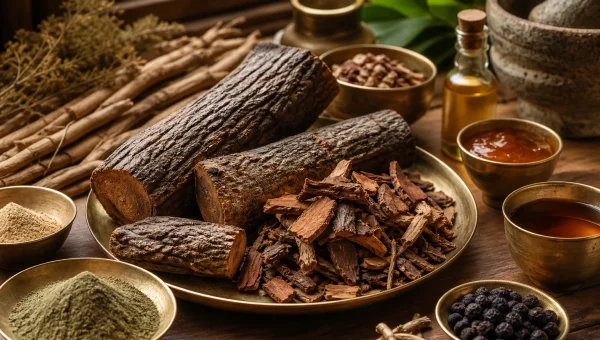
| Lodhra (Symplocos racemosa) | Stem bark | Kashaya rasa, Laghu guna, Shita virya, Katu vipaka; API lists alkaloids including loturine and colloturine. | Raktapitta and Pradara; included in formulations such as Lodhrasava and Pushyanuga Churna. |
| Durva (Cynodon dactylon) | Root and fresh juice preparations | Madhura, Tikta, Kashaya rasa; Laghu guna; Shita virya; Madhura vipaka; API lists phenolic phytotoxins and flavonoids. | Raktapitta, Raktapradara, Daha, Mutra Daha, and Pitta-Rakta presentations. |
| Nagakeshara (Mesua ferrea) | Stamens | Katu, Tikta, Kashaya rasa; Ruksha and Laghu guna; Ushna virya; API lists essential oil and oleo-resin. | Raktapitta and swelling-related disorders; used in classical formulations including Nagakesaradi Churna. |
| Shveta Chandana (Santalum album) | Heartwood | Madhura and Tikta rasa; Laghu and Ruksha guna; Shita virya; API lists volatile oil containing alpha-santalol and beta-santalol. | Daha, Raktapitta, Raktarsha, Raktatisara, Pradara, urinary disorders, and Pitta-dominant burning presentations. |
| Mocharasa / Shalmali exudate (Salmalia malabarica / Bombax ceiba) | Gum resin or exudate | Astringent gum exudate traditionally used as a binding and styptic substance; secondary pharmacognosy descriptions report tannic and gallic acid content in the gum. | Traditional use in bleeding disorders, loose stools with bleeding, hemorrhoidal bleeding, and excessive uterine bleeding patterns. |
| Haritaki (Terminalia chebula) | Fruit pericarp | A classical Triphala fruit used in selected Raktapitta formulations; modern descriptions place Terminalia fruits among tannin-rich plant materials. | Supportive use in Charaka’s Vasa-Mridvika-Haritaki decoction for Raktapitta-associated cough and dyspnea, not as a stand-alone emergency styptic. |
How Kashaya and Shita Support Rakta-Stambhana
Kashaya rasa is central to Rakta-stambhana because its classical action is drying, binding, and flow-restraining. Shita virya is equally important in Pitta-dominant bleeding because heat, burning, redness, irritability, thirst, and inflammatory intensity belong to the Pitta-Rakta pattern. When a dravya combines astringency with cooling action, it can both check excessive flow and calm the hot quality that drives many Raktapitta presentations.
- Astringent containment: Tannin-rich plant materials are capable of binding and precipitating proteins at tissue and mucosal surfaces, which explains part of the traditional styptic logic of Kashaya dravyas.
- Reduction of excessive discharge: The Grahi and Stambhana actions described in Ayurveda are used when flow is abnormal, excessive, or weakening, not when a natural cleansing process is proceeding appropriately.
- Pitta-Rakta cooling: Shita dravyas such as Chandana and Durva are selected when bleeding is associated with burning, heat, thirst, urinary burning, or other Pitta signs.
- Substance-specific action: Different herbs carry different phytochemical profiles, such as alkaloids in Lodhra, flavonoids in Durva, volatile santalols in Chandana, and oleo-resin in Nagakeshara; therefore, they are not interchangeable without clinical judgment.
Classical Clinical Applications
The following patterns describe classical Ayurvedic reasoning and should not be used as self-treatment instructions. Significant, recurrent, unexplained, traumatic, or internal bleeding requires medical evaluation before any herbal or home-based intervention.
Nasa Raktapitta and epistaxis patterns: When bleeding is associated with heat, burning, sun exposure, Pitta aggravation, or repeated nasal bleeding, classical care emphasizes cooling, Pitta-Rakta-pacifying measures. Durva, Chandana, Lodhra, Utpala, Padmaka, and Nagakeshara appear in the Raktapitta context and may be selected in appropriate internal or external forms by a qualified practitioner.
Heavy menstrual bleeding and Raktapradara patterns: Excessive uterine bleeding requires assessment for anemia, pregnancy-related causes, fibroids, hormonal disorders, clotting disorders, and medication effects. In classical Ayurvedic practice, Lodhra, Durva, Chandana, Nagakeshara, and Mocharasa are among the dravyas considered when the presentation is Pitta-Rakta dominant, excessive, weakening, and appropriate for Stambhana or Grahi support.
Gastrointestinal, rectal, and urinary bleeding patterns: Vomiting blood, black stools, fresh rectal bleeding, urinary bleeding, or bleeding with abdominal pain is a medical priority. After diagnosis, Ayurvedic support may be planned according to whether the condition resembles Raktapitta, Raktarsha, Raktatisara, Mutra Daha with Rakta involvement, or another channel-specific disorder. Chandana, Durva, Lodhra, and selected classical combinations may be used only as adjunctive care under professional supervision.
Charaka’s pacificatory Raktapitta combinations: Charaka includes several Pitta-Rakta-calming combinations such as Vasa with Mridvika and Haritaki, Vasa with Priyangu and Lodhra, and groups containing Padmaka, Durva, Utpala, Nagakeshara, and Lodhra. These formulas reflect the classical principle that bleeding care is not merely clotting-focused; it must cool, stabilize, nourish, and guide the disturbed Rakta-Pitta state back toward balance.
Stambhana in Wound and Vrana Care
In wound management, Stambhana is only one aspect of a broader Vrana-care framework. Sushruta’s wound-care tradition is described through Shashti Upakrama, a set of sixty measures for different stages of swelling, wound formation, cleansing, healing, and scar management. Astringent and cooling dravyas may be useful where there is suitable local oozing, excessive discharge, or Pitta-Rakta irritation, but they do not replace cleaning, closure, infection control, tetanus care, or surgical evaluation when needed.
Local bleeding from a minor wound is different from deep laceration, puncture wound, crush injury, animal bite, infected wound, or persistent hemorrhage. The classical idea of Stambhana should therefore be applied with attention to wound type, contamination, tissue damage, pain, swelling, fever, and the need for urgent biomedical care. Inappropriate checking of discharge in an infected or improperly cleaned wound can worsen the clinical picture.
Contraindications and Safety Parameters
Stambhana is a targeted therapy and is unsuitable when the body is still attempting to eliminate aggravated material or when the cause of bleeding has not been identified. The classical caution against premature Stambhana in Raktapitta is especially important in patients with ama, strong dosha aggravation, feverish states, or obstructed pathology.
- Avoid using Stambhana to suppress normal menstruation, appropriate therapeutic purgation or emesis, healthy sweating, or natural cleansing discharges.
- Do not rely on Stambhana herbs in active internal bleeding, vomiting blood, coughing blood, black stools, significant rectal bleeding, traumatic bleeding, or heavy menstrual bleeding with dizziness, fainting, severe pain, or anemia.
- Use professional supervision in pregnancy, postpartum bleeding, children, older adults, liver disease, kidney disease, known clotting disorders, prior thrombosis, or unexplained recurrent bleeding.
- Patients using anticoagulants, antiplatelet drugs, aspirin, warfarin, heparin, DOACs, or clotting-related medicines should consult a physician before taking tannin-rich or styptic herbs.
- Strong astringent herbs can aggravate dryness, constipation, Vata obstruction, or incomplete elimination when used without proper indication.
The broader classical perspective on Rakta, Pitta, and channel involvement connects with the Srotas system framework. Bleeding from the nose, uterus, urine, stool, lungs, or gastrointestinal tract is not managed identically, because the involved srotas, dosha state, tissue strength, and urgency differ.
Medical Disclaimer: Bleeding disorders require diagnosis and evaluation by a qualified healthcare provider. Active internal bleeding, vomiting blood, coughing blood, black stools, rectal bleeding, significant heavy menstrual bleeding, bleeding after trauma, or persistent nosebleed should be assessed urgently. Ayurvedic Stambhana therapies should be used as adjunctive care under a qualified Ayurvedic practitioner and should not replace emergency care, diagnostic testing, prescribed medication, or surgical management when required.
References
- Jaims (jaims.in)
- Charaka Samhita — Raktapitta Chikitsa
- Ayurvedic Pharmacopoeia of India
- Ayurvedic Pharmacopoeia of India
- Ayurvedic Pharmacopoeia of India
- Dravyaguna notes
- Ijapr (ijapr.in)
- Easyayurveda (easyayurveda.com)
- Scialert (scialert.net)
- Scialert (scialert.net)
- Tannins as Hemostasis Modulators (2021), PubMed Central
- Recent Advances in the Production and Applications of Ellagic Acid and Its Derivatives. A Review (2020), PubMed Central
- Easyayurveda (easyayurveda.com)
- Bibliomed (bibliomed.org)
- Bibliomed (bibliomed.org)