
Stress Eating Ayurveda Dosha: Why You Eat What You Eat Under Pressure
Stress eating, viewed through an Ayurvedic dosha lens, is not treated as one generic habit with one generic solution. The craving, timing, texture, emotional tone and after-effect can point toward a vata, pitta or kapha pattern. This does not mean every craving is fixed or that a person belongs permanently to one category; it means the body and mind often express stress through recognizable doshic tendencies that can be addressed with more precise food, routine and self-regulation choices.
Ayurveda connects stress-related eating through both manas, the mind, and the physical doshas. Rajas tends toward agitation, urgency and reactivity, while tamas tends toward heaviness, dullness and avoidance. Vata, pitta and kapha then shape the way appetite, digestion and food preference appear under pressure. In practical terms, emotional eating is not reduced to willpower alone; it is observed through agni, rasa, guna, meal timing, constitution and the state of the mind at the time of eating.
The quickest way to identify the pattern is to observe the stress signal. Vata usually feels scattered and irregular, pitta feels hot and urgent, and kapha feels heavy or emotionally blank. Mixed patterns are common, especially when sleep, work pressure, digestion or seasonal changes are also involved, so the guidance below is best used as a self-observation framework rather than a rigid label.
Vata Stress Eating: The Anxious Nibbler
Vata stress eating commonly appears as grazing, irregular snacking, forgetting meals, eating too little and then nibbling repeatedly, or choosing dry, crunchy and salty foods such as crackers, chips or roasted snacks. The person may eat while standing, walking, driving, scrolling or working, because the underlying state is restless rather than settled. The emotional tone is usually anxiety, worry, fear, uncertainty or a feeling of being ungrounded.
Ayurvedically, vata is associated with movement, irregularity and nervous-system-like functions. When vata is disturbed, the correction is rhythm, warmth, unctuousness, steadiness and nourishment. Since sweet, sour and salty tastes are classically used to pacify vata, the aim is not to suppress appetite with severity but to give the body reliable meals that feel grounding and digestible.
Root cause intervention for vata stress eating:
- Eat at predictable times and sit down for meals. Avoid eating while walking, talking, working or scrolling. Classical Ayurvedic eating guidance emphasizes warm, unctuous food, proper quantity and eating with attention rather than distraction.
- Replace dry-crunchy snacks with warm and slightly oily alternatives: a small bowl of khichari, warm porridge with ghee, soft dates with soaked almonds, stewed fruit with cinnamon, or warm milk with nutmeg if suitable.
- Keep the day anchored with regular meals. For a vata pattern, routine itself is therapeutic because it reduces the irregularity that keeps the craving cycle active.
- Avoid using fasting, skipped meals or very dry diets to “discipline” vata stress eating. These may increase the same light, dry and unstable qualities that created the pattern.
- Ashwagandha is classically described as a rasayana, balya and vata-kapha-pacifying root, but it should be used with guidance rather than treated as a universal stress-eating supplement. Classical powder dosing and modern extract dosing are not interchangeable.
Pitta Stress Eating: The Intensity Eater
Pitta stress eating often feels sharp, urgent and focused. The person may move suddenly from “not hungry” to “I must eat now,” eat quickly, crave hot, sour, salty or strongly flavored foods, and feel irritable until food arrives. Common choices include pickles, spicy snacks, hot sauce, coffee, fried salty foods, sour candy or alcohol. The emotional tone is usually frustration, pressure, anger, competition or impatience.
Ayurvedically, pitta governs digestion, transformation and heat. When pitta is aggravated, intensity increases in both appetite and emotion. Hot, spicy, sour and salty foods may feel satisfying in the moment, but they can continue the same heated loop. The corrective direction is cooling, moderating and softening, especially through sweet, bitter and astringent tastes and through a pause before acting on urgency.
Root cause intervention for pitta stress eating:
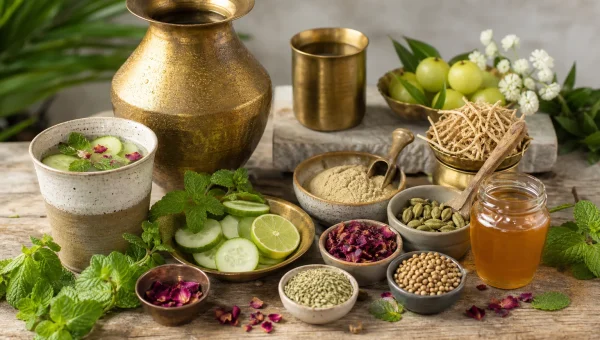
- Keep pitta-soothing foods available before the stress peak: cucumber with mint, sweet fresh fruit, grapes, coconut water, soaked raisins, or a simple meal with rice, ghee and mild vegetables.
- Use a 10-minute pause when the craving feels angry or urgent. Drink room-temperature water or coconut water, sit quietly, and let the sharpness settle before deciding whether the body is truly hungry.
- Reduce the stress-food loop by avoiding the most pitta-provoking choices during pressure: very hot spices, excess sour foods, excess salt, alcohol, and repeated coffee used as emotional fuel.
- Shatavari is classically described as madhura-tikta in taste, cooling in potency, nourishing and pitta-pacifying. It may be considered by a qualified practitioner for a pitta-dominant person, especially when heat and depletion appear together.
- Coriander seed can be used as a gentle digestive support. A simple preparation is to lightly crush the seeds and steep them in warm water; it is traditionally listed for digestion-related uses and for heat-associated discomforts such as thirst and burning sensations.
| Dosha Pattern | Stress Emotion | Common Craving Pattern | Corrective Direction |
|---|---|---|---|
| Vata | Anxiety, worry, groundlessness | Dry, crunchy, salty grazing | Warm meals, oiliness, routine, seated eating |
| Pitta | Frustration, urgency, anger | Spicy, sour, salty, fast eating | Cooling foods, pause, sweet-bitter-astringent tastes |
| Kapha | Boredom, sadness, numbness | Sweet, heavy, creamy, volume eating | Movement, lightness, pungent-bitter-astringent tastes |
Kapha Stress Eating: The Comfort Seeker
Kapha stress eating is the classic comfort-eating pattern: sweets, bread, cheese, creamy foods, pastries, pasta, dairy-heavy meals and large portions. The emotional tone is often sadness, loneliness, boredom, emotional numbness or the wish to feel held and comforted. Unlike vata, which eats from restlessness, or pitta, which eats from intensity, kapha tends to eat to soften or cover heaviness.
Ayurvedically, kapha provides stability, lubrication, strength and calmness when balanced. When excessive, the same qualities can become inertia, dullness and attachment to heaviness. Since pungent, bitter and astringent tastes are used to pacify kapha, the root direction is stimulation, lightness, warmth and movement rather than more dense comfort.
Root cause intervention for kapha stress eating:
- Act before the eating urge becomes automatic. A brisk 10- to 20-minute walk, stair climbing, sun exposure, cleaning, dancing or any appropriate vigorous movement can shift the heavy emotional state before food becomes the main source of stimulation.
- Replace sweet-heavy snacks with lighter, stimulating options: ginger-cardamom tea, roasted pumpkin seeds, lightly spiced chickpeas, vegetable soup with black pepper, or warm water infused with dry ginger if suitable.
- Keep meal gaps clear. Constant nibbling tends to weaken the sense of true hunger in a kapha pattern. Warm, lighter meals with legumes, barley, millet, cooked greens and spices are usually more supportive than cold, creamy or heavy foods.
- Trikatu is a classical pungent combination of dry ginger, black pepper and long pepper. It belongs in the hands of a qualified practitioner, especially because pungent and heating formulas may be unsuitable for people with acidity, burning, ulcers, pregnancy, medication interactions or pitta aggravation.
- Honey is traditionally used in small amounts as a kapha-reducing adjunct, but it should not be heated, boiled or used as a bulk sweetener. If used, add a small amount only after a drink has cooled to lukewarm, and avoid it where medically inappropriate.
How to Tell Which Pattern Is Operating
Stress eating is often mixed, so the most useful clue is not the food alone but the whole sequence: what emotion came first, how quickly the urge rose, what texture or taste felt necessary, and how the body and mind felt afterward.
- Vata signal: “I feel scattered, unsafe or anxious, and I keep nibbling without feeling satisfied.” The correction is steadiness, warmth and a meal rhythm.
- Pitta signal: “I feel hot, urgent or irritated, and I need something sharp or strong right now.” The correction is cooling, pausing and reducing intensity.
- Kapha signal: “I feel heavy, lonely or numb, and I want something dense, sweet or comforting.” The correction is movement, lightness and stimulation.
One practical method is to write down three details after a stress-eating episode: the emotion, the food quality and the after-effect. Dry-crunchy with anxiety points toward vata; hot-sour-salty with anger points toward pitta; sweet-heavy with lethargy points toward kapha. Over a week, the pattern usually becomes easier to see.
The Gut-Emotion Connection
Stress eating is not only about food choice; it is also about the relationship between the mind, digestion and appetite signals. Modern physiology describes stress as capable of altering appetite, reward-driven cravings, gastrointestinal motility, gut comfort and microbiome-related signaling. Ayurveda approaches the same loop through manas and agni: a disturbed mind disturbs digestion, and disturbed digestion can further cloud the mind.
This is why the Ayurvedic correction begins before the food choice. Sitting down, breathing, choosing food by dosha and protecting agni all interrupt the automatic loop. For more background on this relationship, see our guide to the gut-brain axis in Ayurveda and the foundational article on agni as digestive fire.
A simple bridge practice for all three patterns is slow nasal breathing before meals. Nadi shodhana or another gentle, non-forced breath practice can be done for a few minutes before eating, ideally when the stomach is not already full. Vata benefits from the steadiness, pitta from the cooling pause, and kapha from the conscious interruption of automatic eating. More detail is available in our pranayama for stress guide.
General Safety and When to Get Help
Ayurvedic self-observation can be helpful for ordinary stress-related overeating, but persistent binge eating, purging, severe restriction, food fear, rapid weight change, depression, anxiety or loss of control around food should be evaluated by qualified healthcare and mental health professionals. Herbs, supplements and classical formulas should be used with a qualified Ayurvedic practitioner or healthcare provider, especially during pregnancy, breastfeeding, chronic illness, digestive disease, liver or kidney concerns, or when taking medication.
This article is educational and does not diagnose, treat or replace medical care. Do not delay conventional evaluation for eating disorders, mental health concerns or medical symptoms. Consult a qualified Ayurvedic practitioner, physician, registered dietitian or mental health professional for individualized care.
References
- CCRAS
- CCRAS
- CCRAS
- Jaims (jaims.in)
- Easyayurveda (easyayurveda.com)
- Ayurvedic Pharmacopoeia of India
- Ayurvedic Pharmacopoeia of India
- Ijrap (ijrap.net)
- Easyayurveda (easyayurveda.com)
- Stress and eating behaviors (2013), PubMed Central
- Stress, cortisol, and other appetite-related hormones: Prospective prediction of 6-month changes in food cravings and weight (2017), PubMed Central
- Food cravings mediate the relationship between chronic stress and body mass index (2015), PubMed Central
- Stress and the gut: pathophysiology, clinical consequences, diagnostic approach and treatment options (2011), PubMed
- Gut microbes and food reward: From the gut to the brain (2022), PubMed Central
- A structured literature review on the role of mindfulness, mindful eating and intuitive eating in changing eating behaviours: effectiveness and associated potential mechanisms (2017), PubMed
- Eating attentively: a systematic review and meta-analysis of the effect of food intake memory and awareness on eating (2013), PubMed
- Health Impacts of Yoga and Pranayama: A State-of-the-Art Review (2012), PubMed Central
- Banyanbotanicals (banyanbotanicals.com)
- NCCIH


Eating disorders are serious mental health conditions. Dosha-framing without clinical eating disorder expertise can be harmful.