
The Plant Part Problem in Ashwagandha Supplementation
Ashwagandha (Withania somnifera) products are not all the same. A capsule may contain root powder, root extract, whole-plant material, a root-and-leaf extract, or an extract whose plant part is not clearly stated. This distinction matters because the root and leaf have different identities in traditional use and different phytochemical profiles in modern analysis.
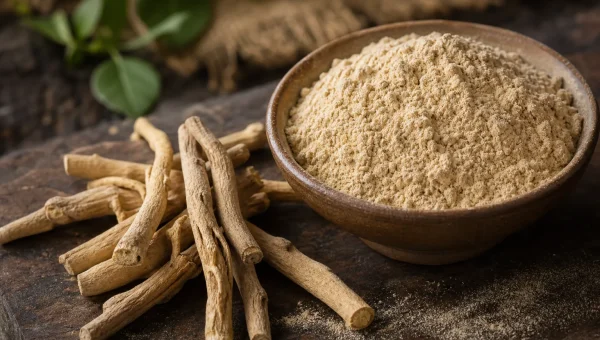
For classical internal rasayana use, the root is the standard reference point. The Ayurvedic Pharmacopoeia of India defines Asvagandha as the dried mature root of Withania somnifera Dunal and gives its pharmacological profile for that root drug. Leaf material may have its own uses and chemistry, but an unspecified “ashwagandha extract” label should not automatically be assumed to mean the same thing as traditional ashwagandha root.
Classical and Pharmacopoeial Position
The pharmacopoeial Ayurvedic identity of Asvagandha is rooted in the moola, the mature dried root. In that form, it is described with the following Ayurvedic properties and actions:
| Ayurvedic Category | Ashwagandha Root Profile | Practical Meaning |
|---|---|---|
| Botanical identity | Dried mature root of Withania somnifera Dunal | The pharmacopoeial drug is the root, not an unspecified aerial-part extract. |
| Rasa | Tikta, Kashaya | Bitter and astringent taste profile. |
| Guna | Laghu | Light quality as listed in the pharmacopoeial monograph. |
| Virya | Ushna | Heating potency. |
| Vipaka | Madhura | Sweet post-digestive effect. |
| Karma | Rasayana, Vatakaphapaha, Balya, Vajikarana | Rejuvenative, Vata-Kapha pacifying, strength-promoting, and reproductive-vitality supporting actions. |
| Therapeutic uses listed | Shotha, Kshaya, Daurbalya, Vataroga, Klaibya | Traditionally directed toward swelling, wasting, debility, Vata disorders, and sexual debility under appropriate guidance. |
| Root powder dose | 3–6 g | Traditional powder dosing should be individualized by a qualified practitioner. |
Phytochemical Differences: Root vs Leaf
Ashwagandha contains alkaloids, steroidal lactones, saponins, and withanolides. Root and leaf material can share some compounds, but they do not present the same chemical pattern. This is why total withanolide percentage alone is not a complete measure of quality for traditional internal use.
| Quality Question | Root | Leaf or Root-and-Leaf Material | Practical Meaning |
|---|---|---|---|
| Classical internal identity | The Ayurvedic pharmacopoeial drug is the mature dried root. | Leaf material is not the pharmacopoeial identity of Asvagandha root. | For rasayana, balya, and vajikarana use, root is the traditional default. |
| Withanolide pattern | Root analyses show a distinct marker profile, including root-enriched withanolides in some chemotypes. | Leaf analyses show a different pattern, often with higher concentration of several withanolides. | A higher total withanolide number does not automatically mean a better root-equivalent product. |
| Withaferin A | Detected in root samples, but not necessarily the dominant marker. | A prominent pharmacologically active withanolide in aerial-part chemistry and preclinical literature. | Withaferin A is not a stand-alone marker for classical rasayana quality. |
| Named extracts | Some named extracts are root-only and should be assessed as such. | Some named extracts are root-and-leaf preparations and should be assessed as their own formulations. | The label should be matched to the exact plant part and extract used in published human trials. |
| Consumer label risk | “Root extract” gives a clearer match to traditional internal use. | “Ashwagandha extract” without plant part leaves room for ambiguity. | Plant part disclosure is essential for informed selection. |
Human Trial Record by Plant Part
The human trial record for stress, sleep, and resistance-training outcomes is concentrated around specific root extracts and specific proprietary root-and-leaf extracts. These should not be treated as interchangeable unless the plant part, dose, standardization, and preparation are clearly matched.
Root Extracts for Stress, Sleep, and Strength
Several widely cited human trials used ashwagandha root extract. A 60-day randomized trial in adults with chronic stress used a high-concentration full-spectrum root extract at 300 mg twice daily. An insomnia trial used ashwagandha root extract at 300 mg twice daily for 10 weeks. A resistance-training trial in healthy young men used root extract at 300 mg twice daily for 8 weeks and reported improvements in strength and body-composition measures alongside training.
Root-and-Leaf Extracts
Some proprietary extracts used in human trials are root-and-leaf preparations rather than root-only preparations. These may have their own clinical profile, but they should be understood as specific standardized formulations, not as proof that any unspecified leaf-heavy or whole-plant extract is equivalent to traditional ashwagandha root.
Pure Leaf Extracts
Leaf material has meaningful chemistry and has been associated in traditional and ethnobotanical sources with external uses such as pastes for local swelling, boils, wounds, and skin conditions. That is different from using the root internally as a rasayana. For routine internal supplementation aimed at stress support, sleep support, strength, general debility, or reproductive vitality, leaf-only extracts should not be assumed to be interchangeable with root powder or root extract.
Safety Considerations
Ashwagandha is widely used, but it is not suitable for everyone. Safety depends on the person, the preparation, dose, duration, medical history, and medications. Plant part disclosure helps selection, but it does not remove the need for clinical judgment.
- Liver safety: Rare cases of clinically apparent liver injury have been reported with ashwagandha-containing supplements. People with liver disease, cirrhosis, or unexplained liver-test abnormalities should avoid self-prescribing it. Stop use and seek medical care if jaundice, dark urine, intense itching, abdominal pain, unusual fatigue, or persistent nausea develops.
- Thyroid and autoimmune conditions: People with thyroid disorders, autoimmune disease, or hormone-sensitive prostate cancer should use ashwagandha only with professional supervision.
- Medication interactions: Caution is needed with thyroid hormone, sedatives, anti-seizure medicines, diabetes medicines, blood-pressure medicines, and immunosuppressants.
- Pregnancy, breastfeeding, and surgery: Ashwagandha should be avoided during pregnancy and breastfeeding. It should also be stopped before surgery unless the treating clinician advises otherwise.
- Drowsiness and digestion: Some people may experience drowsiness, stomach upset, diarrhea, or vomiting. Dose and timing should be individualized.
- Duration: Short-term use is better characterized than long-term continuous use. Periodic review by a qualified practitioner is advisable, especially for daily supplementation.
Practical Guidance: Choosing the Right Extract
The practical choice should begin with the intended use. For classical Ayurvedic internal use, root remains the most appropriate default. Root-and-leaf extracts may be appropriate only when the product is a clearly defined standardized preparation and the user understands that it is not the same as root-only ashwagandha.
| Goal | Best-Matched Form | Commonly Used Range | Important Note |
|---|---|---|---|
| Classical rasayana and general debility support | Ashwagandha root powder or root-based formulation | 3–6 g root powder in pharmacopoeial guidance | Use with suitable anupana and practitioner guidance. |
| Stress support | Clearly labeled root extract or a clearly identified standardized root-and-leaf extract | Human trials commonly use hundreds of milligrams per day of standardized extract | Do not substitute an unspecified extract for a studied preparation. |
| Sleep support | Root extract is the closest match to the root-based insomnia trial record | One trial used 300 mg twice daily for 10 weeks | Avoid combining with sedatives unless supervised. |
| Resistance training and strength support | Root extract | One resistance-training trial used 300 mg twice daily for 8 weeks | Benefits were assessed alongside structured training. |
| External local applications | Traditional paste or topical preparation under practitioner guidance | Not the same as internal supplement dosing | Leaf or leaf-root topical use should not be converted into an oral supplement assumption. |
How to Verify What You Are Getting
A good ashwagandha label should tell you what part of the plant is used and how the extract is standardized. Without that information, the product cannot be confidently matched to classical Ayurvedic use or to a specific human trial record.
- Look for the plant part. Prefer labels that clearly say “root powder,” “root extract,” “root and leaf extract,” or “whole plant.” Avoid products that say only “ashwagandha extract” without plant-part disclosure.
- Do not judge by withanolide percentage alone. A high withanolide percentage may reflect a different plant-part profile rather than a stronger version of traditional root ashwagandha.
- Ask for a Certificate of Analysis. A useful CoA should address identity, plant part, marker profile, heavy metals, pesticides, microbial limits, and adulterants.
- Match named extracts correctly. Root-only extracts and root-and-leaf extracts should be evaluated as different preparations, even when both are sold under the broad name “ashwagandha.”
- Use caution with medical conditions. Anyone with liver disease, thyroid disease, autoimmune disease, pregnancy, breastfeeding, planned surgery, or regular medication use should consult a qualified healthcare provider before use.
The Ayurvedic Perspective: Why the Part Used Matters
The Ayurvedic preference for the root in internal rasayana use is not a minor labeling detail. It is part of the identity of the drug. The root is the pharmacopoeial Asvagandha used for rasayana, balya, vajikarana, and Vata-Kapha pacifying purposes. Leaf material and root-and-leaf extracts may have their own applications, but they should not be silently substituted for root when the goal is classical internal ashwagandha therapy.
This plant-part distinction is a practical example of why traditional identity and modern quality control must work together. For more on how classical observation can guide modern validation, see Reverse Pharmacology in Ayurveda. For understanding how the carrier substance affects herb use, see The Science of Anupana.
Medical Disclaimer: This article is for educational purposes only and does not constitute medical advice. Ashwagandha should be used under the guidance of a qualified Ayurvedic practitioner or healthcare provider, especially if you are pregnant, breastfeeding, taking medication, preparing for surgery, or living with liver disease, thyroid disease, autoimmune disease, hormone-sensitive prostate cancer, diabetes, high blood pressure, anxiety, insomnia, or any chronic medical condition.
References
- Ayurvedic Pharmacopoeia of India
- Webprod (webprod.hc-sc.gc.ca)
- Webprod (webprod.hc-sc.gc.ca)
- NIH Office of Dietary Supplements
- Staff (staff.cimap.res.in)
- Frontiersin (frontiersin.org)
- A prospective, randomized double-blind, placebo-controlled study of safety and efficacy of a high-concentration full-spectrum extract of ashwagandha root in reducing stress and anxiety in adults (2012), PubMed
- Efficacy and Safety of Ashwagandha (Withania somnifera) Root Extract in Insomnia and Anxiety: A Double-blind, Randomized, Placebo-controlled Study (2019), PubMed
- Examining the effect of Withania somnifera supplementation on muscle strength and recovery: a randomized controlled trial (2015), PubMed
- Supplements (supplements.kerry.com)
- Utep (utep.edu)
- Evaluating anticancer properties of Withaferin A-a potent phytochemical (2022), PubMed Central
- NCCIH
- NCBI
- Precedenceresearch (precedenceresearch.com)
the withaferin A content in leaf vs root does this compound have a specific therapeutic window or is more always better?
That is a really important question about withaferin A. From what I have read, it does seem dose-dependent — higher concentrations show more cytotoxic activity, which is why some researchers are interested in it for oncology, while lower amounts may do different things entirely. The root vs leaf distinction the article makes is probably key here since leaf extract concentrates withaferin A much more than root.
comparing root vs leaf extracts without controlling for extraction solvent (water vs ethanol) makes the comparison incomplete. ठीक है
the article doesn’t address ashwagandha-induced thyroid T3/T4 elevation which has been documented in several case reports. for hyperthyroid patients this is critical.
for thyroid patients (hypothyroid), is the root or leaf extract safer? I’ve seen conflicting advice about ashwagandha and thyroid function.
at what withanolide percentage is an extract considered ‘standardized’? I see brands claiming anywhere from 2.5% to 35%. ठीक है
the ‘clinical trials reveal’ framing oversells the evidence base. most trials are small, short-duration, and industry-funded. ठीक है
Will try!
root vs leaf extract is important. people buy ashwagandha without checking plant part
The root seems to be the part linked to stress relief in the trials they cited.
does the adaptogenic benefit plateau at a certain dose, or do higher doses continue to show additional stress-reduction benefits?
clinical trials should separate sleep, stress and testosterone outcomes. all get mixed online
the article correctly identifies that most Indian clinical trials use whole root decoction, not extracts. context matters enormously for interpreting results.
the article doesn’t addeess ashwagandha-induced thyroid T3/T4 elevation which has been documented in several case reports. for hyperthyroid patients this is critical.
is the 8-week trial period standard for ashwagandha research, or have longer trials (6 months+) been done on the root extract specifically?
at what withanolide percentage is an extract considered ‘standaedized’? I see brands claiming anywhere from 2.5% to 35%. tbh
I found the table comparing withanolide concentrations really helpful for picking a supplement.
KSM-66 (root extract) vs Sensoril (leaf/root mix) the clinical comparison in this article finally explains why my root extract performs differently than what my friend takes.
Does anyone know if Sensoril actually lists the root leaf ratio on its label?
ksm-66 (root extract) vs Sensoril (leaf/roor mix) the clinical comparison in this article finally explains why my root extract performs differently than what my friend takes.
for thyroid patients (hypothyroid), is the root or leaf extract safer? Ive seen conflicting advice about ashwagandha and thyroid function.
It’s surprising that leaf extract can have higher total withanolides but a different activity profile.
switched from leaf to root-standardized KSM-66 after reading this and the sleep improvement was noticeably better over 6 weeks.
I’ve seen some products label just ‘ashwagandha extract’ and wonder what part they actually use.
is the 8-week trial period standard for ashwagandha resesrch, or have longer trials (6 months+) been done on the root extract specifically?
One question I have is whether the sleep benefits seen with root extract hold up at lower doses.
The safety notes about withaferin A and liver injury made me pause before buying a new bottle.
The market size figure at the start is striking given how little labeling transparency there is. I have bought three different ashwagandha products this year and not one clearly states whether it is root or leaf or a blend. Shouldn’t that be a basic labeling requirement at this point?
It looks like traditional Ayurvedic texts were right about using the root for internal use.
How do practitioners decide when to recommend leaf extract for topical use only?
@Naveen at what withanolide percentage is an extract considered ‘standardized’? I see brands claiming anywhere from 2.5% to 35%.
Helpful.
I think checking for a Certificate of Analysis is a smart step before trusting any brand.
@Naveen the article doesn’t address ashwagandha-induced thyroid T3/T4 elevation which has been documented in several case reports. for hyperthyroid patients this is critical.
@Naveen that is a really important safety gap in the article. I have a subclinical hyperthyroid condition and my integrative doctor specifically warned me away from ashwagandha for this reason. The root-vs-leaf distinction the article focuses on becomes even more relevant here since the two extracts likely have different effects on thyroid axis.
The market being over a billion dollars explains why some manufacturers might cut corners with leaf material.
If the goal is anxiety reduction, sticking to a full spectrum root extract seems wise based on the data.
It’s interesting that the leaf’s higher withaferin A content links it to cytotoxic research rather than everyday adaptogenic use.
the ‘clinical trials reveal’ framing oversells the evidence base. most trials are small, shorr-duration, and industry-funded.
@Pooja will try!
withania leaf extract worries me more than root. safety section needs to be very direct
at what withanolide percentage is an extract considered ‘standardized’? I see brands claiming anyehere from 2.5% to 35%.
@Ryan does the adaptogenic benefit plateau at a certain dose, or do higher doses continue to show additional stress-reduction benefits?
Doing this.
@Smita at what withanolide percentage is an extract considered ‘standardized’? I see brands claiming anywhere from 2.5% to 35%.
root powder vs standardized extract is where most confusion starts. this post should say labels carefully
Makes sense.