
A 42-year-old woman arrived at the clinic with a seven-year history of lichen sclerosus. She had been through multiple courses of potent topical corticosteroids, which controlled symptoms temporarily but caused progressive skin thinning and architectural changes that made the condition harder to manage over time. She was frustrated, embarrassed, and in chronic discomfort. When she asked about Ayurvedic options, she was not expecting a systematic treatment framework. But classical Ayurveda offers exactly that, under the broad category of Yoni Vyapad, the vaginal and vulvar disorders described in Ayurveda’s classical compendia. The surviving Charaka and Sushruta material is best understood as layered work, compiled and repeatedly redacted over many centuries rather than fixed in a single ancient moment, and it preserves a remarkably structured approach to gynaecological disease.
Yoni Vyapad: Ayurveda’s Classification of Vulvovaginal Disorders
The Charaka Samhita (Chikitsa Sthana, chapter 30) and the Sushruta Samhita (Uttara Tantra) describe twenty distinct Yoni Vyapad (uterovaginal and vulvar disorders). Charaka classifies them chiefly by the predominant dosha — Vataja, Pittaja, Kaphaja, Sannipataja and Raktaja — and by named clinical presentations, not by any modern notion of the “tissue layer affected.” The causes given are mithya ahara-vihara (faulty diet and conduct), pradushta artava (vitiated menstrual physiology), beeja dosha (constitutional or seed factors) and karma.
Lichen sclerosus has no exact classical counterpart, so any correlation is interpretive rather than a fixed textual equivalence. Its dryness, hardening, loss of elasticity and tissue atrophy correspond most closely to Vata predominance, with Pitta and Rakta involvement where there is burning, itching or inflammatory change. Reading the condition this way lets the practitioner select treatment by dosha and dushya rather than forcing a single protocol onto every vulvar skin disease.
Other vulvar dermatoses are read similarly. Erosive lichen planus, with its burning, erythema and erosions, maps primarily to Pittaja involvement with Rakta vitiation. Contact dermatitis of the vulva is best understood as an externally triggered (agantu or bahya nidana) Pitta-Rakta vidaha — provoked from outside rather than being one of Charaka’s twenty named Yoni Vyapad. This distinction matters: the twenty types are a defined classical list, and external irritant reactions belong to general Agantuja disease, not to that list.
Dosha Analysis of Common Vulvar Disorders
The table below summarises how these conditions may be interpreted through dosha and dushya. The correlations are clinical aids, not literal classical diagnoses; the Charaka and Sushruta categories predate the modern dermatological labels and cannot be mapped onto them one to one.
| Condition | Ayurvedic Correlation (interpretive) | Primary Dosha | Dushya / Dhatu | Treatment Focus |
|---|---|---|---|---|
| Lichen sclerosus | Vata-predominant Yoni Vyapad | Vata, Pitta | Rasa, Mamsa (kshaya) | Vata-Pitta pacification, brimhana (tissue nourishment) |
| Lichen planus (erosive) | Pittaja Yoni Vyapad with Rakta dushti | Pitta, Rakta | Rakta, Twak | Rakta prasadana, Pitta pacification |
| Contact dermatitis | Externally triggered Pitta-Rakta vidaha (agantu nidana) | Pitta, Rakta (externally triggered) | Twak, Rakta | Trigger removal, cooling, anti-inflammatory |
| Vulvar psoriasis | Ekakushtha (a Kshudra Kushtha) | Vata, Kapha | Twak, Rakta, Mamsa, Lasika (ambu) | Rakta shodhana, Vata-Kapha balance |
| Chronic vulvar itching | Kandu (symptom; Kapha-Pitta with Ama) | Kapha, Pitta, Ama | Twak | Kandughna, anti-ama, kapha-hara |
Core Herbs for Vulvar Skin Disorders
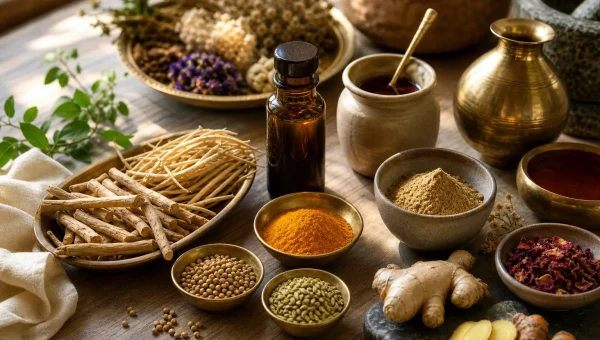
Herb selection in Ayurveda follows rasa (taste), guna (quality), virya (potency), vipaka (post-digestive effect) and karma (action), matched to the doshas and dushyas at work. For vulvar skin disease the working aims are to pacify aggravated Vata and Pitta, purify vitiated Rakta, and nourish and rebuild thinned, dry tissue. The herbs below are chosen on those classical grounds.
1. Shatavari (Asparagus racemosus)
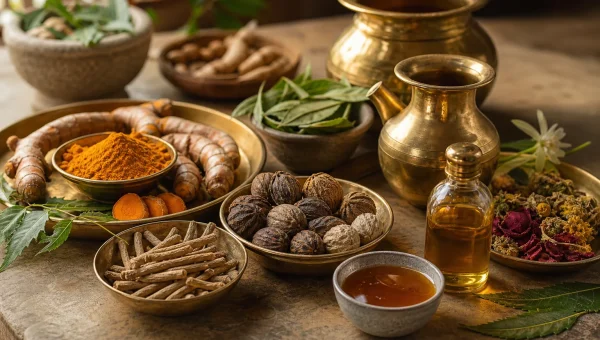
Shatavari is Ayurveda’s premier rasayana and balya tonic for female reproductive and vulvovaginal tissue. Its rasa is madhura and tikta, guna snigdha and guru, virya shita and vipaka madhura — a profile that directly counters the dryness, heat and depletion of Vata-Pitta atrophy. It contains steroidal saponins known as shatavarins, and classical practice values it as a Vata-Pitta pacifier and nourisher of artava and reproductive tissue. In dry, atrophic vulvar conditions its snigdha-shita-madhura action supports moisture and tissue integrity. Dosage: 5 grams of Shatavari powder in warm milk, twice daily. Read our comprehensive article on Shatavari for women’s health.
2. Manjistha (Rubia cordifolia)
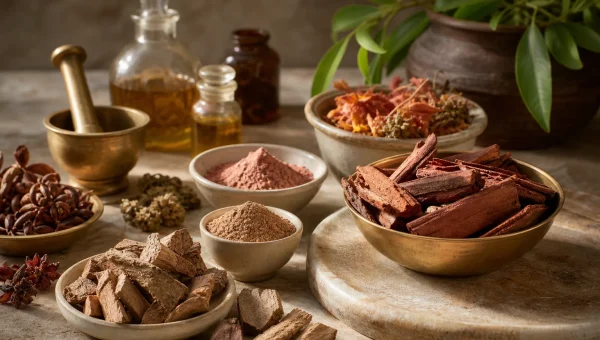
For Pittaja and Rakta-vitiated vulvar conditions — erosive lichen planus, or contact dermatitis with erythema and burning — Manjistha is the foremost rakta-prasadana (blood-purifying) and varnya (complexion-restoring) herb of the materia medica. Its rasa is tikta, kashaya and madhura, virya ushna and vipaka katu. Its anthraquinone constituents (such as purpurin and munjistin) underlie its characteristic colouring and astringent quality, and classically it cools and clears vitiated Rakta-Pitta while its kashaya (astringent) action supports skin tissue. Dosage: 3 grams powder in warm water, twice daily for up to 90 days in active inflammatory conditions. Find more on Manjistha’s blood-purifying actions.
3. Yashtimadhu (Glycyrrhiza glabra, Licorice Root)
Yashtimadhu is among the most versatile herbs in Ayurvedic gynaecology and dermatology. Its rasa is madhura, guna snigdha and guru, virya shita and vipaka madhura, and its principal karmas are vrana ropana (wound healing), varnya, and Vata-Pitta pacification. It is widely used in medicated oils and pastes for inflamed, raw or atrophic tissue. A point of pharmacognosy is worth correcting here: licorice’s major saponin, glycyrrhizin, is a triterpenoid with anti-inflammatory rather than estrogenic action; the weakly phytoestrogenic compounds in the root are flavonoids such as liquiritigenin, isoliquiritigenin and glabridin. Internally it soothes and supports mucosal and skin tissue; topically it calms inflammation. Dosage: 2 grams powder in warm water, twice daily. Caution: glycyrrhizin can raise blood pressure and deplete potassium, so avoid long-term or high doses, especially in hypertension.
4. Haridra (Curcuma longa, Turmeric)
Haridra is a primary kushtaghna (anti-dermatosis), kandughna (anti-itch), varnya and rakta-prasadana herb, classically indicated across skin disease and especially relevant where lichen sclerosus is regarded, in modern terms, as an inflammatory and autoimmune-associated condition. Its rasa is tikta and katu, virya ushna and vipaka katu. Its active principle, curcumin, is widely recognised for anti-inflammatory and immunomodulatory activity, which is consistent with the herb’s long traditional use in chronic inflammatory skin disorders. Dosage: 500 mg curcumin extract with piperine, twice daily.
5. Kushtha (Saussurea lappa, Costus Root)
Kushtha is named in the classical texts for skin and Vata-Kapha disorders and features in many medicated oils. Its rasa is tikta, katu and madhura, virya ushna, and its karmas include vata-kapha shamana, kandughna (anti-itch) and vedanasthapana (pain-relieving). Its sesquiterpene lactones (such as costunolide and dehydrocostus lactone) are consistent with its traditional anti-inflammatory reputation. It is used here chiefly in medicated oils for external application rather than as a primary internal remedy.
Topical Protocols: Yoni Lepa and Medicated Oils
Sthanika chikitsa (local treatment) is central to managing vulvar skin disease. Ayurveda applies medicated oils (taila), pastes (lepa) and immersion therapies directly to the affected area to deliver shodhana (cleansing), ropana (healing) and shamana (soothing) actions where the disease is expressed. The protocols below adapt classical formulations to the delicate, often fragile vulvar skin, and all of them assume prior diagnosis and practitioner oversight.
Classical Jatyadi Taila Application
Jatyadi Taila is a classical medicated oil containing Jati (Jasminum grandiflorum), Nimba (neem), Patola (Trichosanthes dioica), Haridra and several other herbs in a sesame oil base. Its classical indications are wound-related: Vrana (wounds and ulcers), dushta and nadi vrana (non-healing and sinus ulcers), bhagandara (fistula-in-ano) and dagdha (burns) — it is a vrana-shodhana and vrana-ropana (wound-cleansing and wound-healing) oil. The classical texts do not list it specifically for Yoni roga, so its use on vulvar skin is an extension by analogy, justified by its wound-healing and soothing profile and best undertaken with practitioner guidance.
Application method: warm a small amount (3 to 5 ml) of Jatyadi Taila between the palms, apply gently to the affected vulvar area with clean fingertips after bathing. Do not rub aggressively on fragile atrophic skin. Leave on for two to four hours before wiping off gently.
Neem-Turmeric Paste for Inflammatory Conditions
For lichen planus and contact dermatitis with active inflammation, a simple Lepa (paste) of Nimba (neem) powder and Haridra powder in fresh aloe vera gel can help reduce erythema and burning, drawing on neem’s kushtaghna and krimighna action and turmeric’s kandughna and varnya action. Mix 1 teaspoon each of Neem powder and Haridra powder in 2 tablespoons of fresh aloe vera gel. Apply to external vulvar skin only for 15 to 20 minutes, then rinse with lukewarm water. Perform daily for four to six weeks during active flares.
Sitz Bath Protocols
Classical Avagaha Sweda (immersion therapy) is readily adapted as therapeutic sitz baths for vulvar disorders. Prepare an infusion of Triphala (10 grams), Neem leaves (10 grams) and Dashamula (10 grams) in 3 litres of water. Simmer for 20 minutes, cool to a comfortable temperature (36 to 38 degrees Celsius), pour into a shallow basin, and sit immersed for 15 to 20 minutes. Perform three to four times per week for chronic conditions. This delivers local soothing, cleansing and tissue-toning benefits together.
Internal Treatment Protocol by Condition
Internal treatment supports the local protocols by correcting the systemic doshic disturbance. The combinations below pair the core herbs with established classical formulations; the doses are general guidance and should be tailored by a qualified vaidya to the individual’s constitution, agni and condition.
| Condition | Primary Herbs | Supporting Formula | Dosage | Duration |
|---|---|---|---|---|
| Lichen sclerosus | Shatavari, Yashtimadhu, Haridra | Chandraprabha Vati 2 tabs twice daily | As described above | 6 months minimum |
| Lichen planus (erosive) | Manjistha, Haridra, Guduchi | Mahamanjisthadi Kwatha 30 ml twice daily | As described above | 3-4 months |
| Vulvar contact dermatitis | Sariva, Haridra, Neem | Gandhaka Rasayana 500 mg twice daily | As described above | 6-8 weeks |
| Chronic vulvar pruritus | Kushtha, Haridra, Haritaki | Triphala churna 5 g at night | As described above | 2-3 months |
Dietary Guidance
For lichen sclerosus and chronic inflammatory vulvar conditions, an anti-Pitta, anti-ama diet (pathya) is foundational. Avoid fermented foods, alcohol, excessively spicy food, nightshades and refined sugar, which aggravate Pitta-Rakta and feed ama and systemic inflammation. Favour cooked vegetables, old rice, moong dal, ghee, warm soups and pomegranate, which are easy to digest and support tissue repair.
Hydration with room-temperature water infused with Coriander (dhanyaka) seeds or a little Shatavari powder supports tissue moisture without aggravating Pitta. Classical dietetics treats this kind of cooling, easily digested ahara as part of treatment itself, since correcting agni and reducing ama are held to lessen the inflammatory burden on the skin.
Complementary Practice: Abhyanga and Marma Points
Full-body Abhyanga (oil self-massage) with Dhanwantaram Taila three to four times per week helps pacify systemic Vata, the chief driver of dry, atrophic skin conditions. Marma points relevant to pelvic and vulvovaginal tissue health include Guda marma (perineal region), Basti marma (lower abdomen) and Nabhi marma (navel). Gentle circular pressure over the lower-abdominal marma after Abhyanga is traditionally said to improve local circulation and ease Vata-driven tissue dryness. See our guide on Abhyanga oil massage.
Safety and Disclaimer
Vulvar skin disorders, especially lichen sclerosus, require accurate diagnosis by a qualified dermatologist or gynaecologist before any treatment, Ayurvedic or conventional. Lichen sclerosus carries a small but real risk of progressing to squamous cell carcinoma and requires regular surveillance. The Ayurvedic protocols described here are supportive measures, not replacements for appropriate medical evaluation and follow-up, and should be used alongside conventional care under the supervision of a qualified Ayurvedic practitioner (vaidya). Do not apply essential oils, undiluted herbal extracts or commercial herbal products to the vulvar region without professional guidance. Always patch-test any topical preparation on a small area of forearm skin before applying it to sensitive genital tissue. Shatavari and Yashtimadhu are traditionally used as hormone-supportive reproductive tonics; if you have a history of estrogen-sensitive cancer, consult your physician before using them.
One Actionable Step
Begin a daily Shatavari protocol: stir 5 grams of high-quality Shatavari powder into a cup of warm whole milk with a pinch of cardamom and 1 teaspoon of ghee each evening before bed. Continue for 90 days and review symptoms monthly. As a madhura-shita-snigdha, Vata-Pitta–pacifying rasayana, Shatavari offers nourishing tissue support and a calming effect well suited to dry, atrophic vulvar conditions, and it is among the safest starting points for home-based Ayurvedic support — undertaken, as always, alongside proper medical diagnosis and follow-up.
My experience mirrors the case study in some ways but I want to flag something the article doesn’t fully address: lichen sclerosus can be quite different in presentation from one person to the next. I tried a locally recommended Yoni Vyapad approach for about four months and saw partial improvement, but it plateaued. The article seems to suggest a course of treatment is reasonably conclusive. For a chronic autoimmune-type condition like this, I think managing expectations around duration matters a lot.
Could you address how Ayurvedic protocols interact with anticoagulant medications? Several herbs described across this site, including ginger and garlic, have blood-thinning properties that could potentiate Warfarin or other anticoagulants.
Seven years with lichen sclerosus. I have been through the same corticosteroid cycle described here and the skin thinning is real and cumulative and nobody warned me about it at the beginning. The fact that classical Ayurveda has a systematic framework for these conditions under Yoni Vyapad is genuinely news to me.
LS diagnosis at 39. Two years of various treatments before finding an Ayurvedic physician who took it seriously. The combination of internal herbs for Vata and Pitta management alongside topical preparations has genuinely changed my quality of life. Not a cure but the itch and inflammation are manageable in a way they never were on steroids alone.
The safest part of the Vulvar Skin Disorders in Ayurveda advice is keeping it simple. I would like to know how long to try it before judging results.
I appreciated how the article explained the dosha mapping for lichen sclerosus, especially the Vata Pitta angle.
I was skeptical when my vaidya first suggested classical but six weeks in and I can tell something has shifted. Not placebo either, my blood work confirmed it.
My concern is that this could lead patients to delay seeking the diagnosis. LS specifically has a small but real increased risk of vulvar squamous cell carcinoma if undertreated or unmonitored. I would want to see a very clear statement that any Ayurvedic protocol for LS should be conducted alongside, not instead of, dermatological monitoring.
The case study of the 42-year-old who had been through multiple corticosteroid courses is exactly my history. I am 44. I asked my dermatologist about Ayurvedic options and she said she had no information on them but was open to me exploring if I continued monitoring with her. That combination of openness and supervision feels like the right approach.
The section on Shatavari dosage with warm milk and cardamom sounded like something I could try at home.
The Pitta-Vata aggravation pattern makes sense for lichen sclerosus given its inflammatory and atrophic character. The treatment approach of cooling Pitta while nourishing depleted tissue with Vata-pacifying preparations is conceptually coherent. What I would want to know is the timeline. How long before there is meaningful symptom reduction in a typical case?
I wonder if the sitz bath recipe with Triphala and neem leaves would be safe for sensitive skin without irritation.
Are there food interactions with classical that I should be aware of? My Ayurvedic doctor mentioned something about dairy but wasn’t specific.
The sesame oil base for the topical preparation is interesting because sesame has well-documented anti-inflammatory and antimicrobial properties. The Ayurvedic rationale for using it for Vata-Pitta tissue is consistent with its pharmacological profile. Combined with guduchi and licorice it sounds like a genuinely coherent topical approach.
It was helpful to see the distinction between external irritant reactions and the twenty classical Yoni Vyapad types.
I’m a dermatologist and I have been looking for integrative resources to share with patients who ask about alternatives to steroids for LS. This article is the most responsibly written Ayurvedic piece on the topic I have found. The explicit recommendation for concurrent dermatological monitoring is crucial and I appreciate it being in the article.
The note about avoiding long term licorice use due to blood pressure concerns is a good reminder.
just started exploring ayurveda after years of allopathy, still a lot to absorb
@Vikram bookmarked this to share with my mother who has been struggling with the same issue
The evidence for Ayurvedic interventions in lichen sclerosus specifically is essentially case reports, needs more rigorous study.
where are the actual clinical trials? i need rct data before trying anything
The Pitta-Rakta pathology framework for lichen sclerosus was something my gynecologist hadn’t considered, I’m now exploring integrative options.
the dosage here seems higher than what my ayurvedic doctor recommended
The Jatyadi oil application protocol for vulvar dermatoses significantly reduced my discomfort between flares.
Good reminder on Vulvar Skin Disorders in Ayurveda. The main idea is clear even if someone is new to Ayurveda.
would this protocol work if i travel frequently and cant maintain a fixed routine ❤️
Seven months on the protocol described here, working with an Ayurvedic physician in Kolkata. The itching has reduced by at least 70 percent. The architectural changes are still there but the active inflammatory symptoms are much better controlled than they were on topical steroids alone. My dermatologist noted improvement at my last check.
Can the topical formulations here be used alongside prescription steroid ointments?
starting this next week, will report back in about a month
my functional medicine doctor mentioned something similar, helpful to have teh ayurvedic framing too 🌿
I found the table linking erosive lichen planus to Pitta and Rakta useful for thinking about my own symptoms.
My constitution is Vata-Pitta, the article seems focused on one or the other.
Reading this after finding it on Google, is this dosage still recommended?
some of these claims are very strong for what is essentially anecdote-level evidence
The specific morning timing recommendation is practical, most articles skip that detail. धन्यवाद
my vaidya recommended something similar last month, good to see the reasoning explained ❤️
Packaging this as science when most of it is tradition makes me skeptical.
is this suitable for pitta dominant people or mainly vata?
Would this protocol work if I travel frequently and can’t maintain a fixed routine. ❤️
@Nandini tried teh morning routine for 2 months, gave up the timing is impossible wth kids and a job
Seven years on corticosteroids with progressive skin thinning — that case really hits home. My wife was in a nearly identical situation with lichen sclerosus and her dermatologist basically told her long-term steroid use was the only option. Could you share what the Yoni Vyapad assessment process actually looks like in practice? Is it done by a general Ayurvedic practitioner or is this a subspecialty?
@Kavita where can u source the herbs in india outside of major cities? i’m in a tier-2 town
@Aarti My constitution is Vata-Pitta, the article seems focused on one or the other. 🙏
the sourcing section was a surprise, didnt know the extract grade mattered this much 🙏
tried the morning routine for 2 months, gave up the timing is impossible with kids and a job
quick question: does the dosage change if someone is also on other medication?
I came for Vulvar Skin Disorders in Ayurveda and this answered the main question. Would be useful to see a short checklist next.
Will try
How long before seeing results? the article mentions 4 to 6 weeks but is that for everyone. धन्यवाद
Vulvar disorders are complex and need proper dermatological or gynecological diagnosis before any herbal application.
Appreciate that this goes into contraindications, most blog posts skip that part.
Is this suitable for Pitta dominant people or mainly Vata? धन्यवाद
where can you source the herbs in india outside of major cities? im in a tier-2 town
my vaidya recommended something similar last month, good to see the reasoning explained
The advice to patch test any topical paste on the forearm before applying it vulvovaginally makes sense.
is this protocol suitable for postmenopausal lichen sclerosus or mainly premenopausal presentations?
I came for Vulvar Skin Disorders in Ayurveda and this answered the main question. This would be easier to follow with a one-week sample plan.
This works in theory but practically very hard to source authentic herbs. नमस्ते
the evidence for ayurvedic interventions in lichen sclerosus specifically is essentially case reports, needs more rigorous study
tried this for 6 weeks and saw no difference, maybe im applying it wrong
the jatyadi oil application protocol for vulvar dermatoses significantly reduced my discomfort between flares
@Rohit Is this suitable for Pitta dominant people or mainly Vata? ✨
late to this but wanted to ask, do these recommendations still hold in 2027?
I liked that the article stresses needing a dermatologist’s diagnosis before starting any Ayurvedic regimen.
the specific morning timing recommendation is practical, most articles skip that detail
the pitta-rakta pathology framework for lichen sclerosus was something my gynecologist hadn’t considered, im now exploring integrative options
I have had lichen sclerosus for about three years now and the architectural changes from steroids the article mentions are something my doctor warned me about but never gave me an alternative for. Reading this for the first time and feeling cautiously hopeful. Did the 42-year-old patient in the case study continue HRT alongside the Ayurvedic treatment or was she managing without it by that point?
Would this protocol work if I travel frequently and can’t maintain a fixed routine.
tried the morning routine from this article and noticed a difference by day 5
The dietary tip to favor cooked vegetables and pomegranate while cutting nightshades felt practical.
just found this post, the section 3 protocol seems intensive for a beginner, any lighter version?
Just started exploring Ayurveda after years of allopathy, still a lot to absorb. 💯
how long before seeing results? the article mentions 4 to 6 weeks but is that for everyone
Tried the morning routine for 2 months, gave up the timing is impossible with kids and a job.
the part about adjusting based on prakriti was exactly what i needed
This makes sense for Vulvar Skin Disorders in Ayurveda. A few more examples would still help.
the jatyadi oil application protocol for vulvar dermatoses significantly reduced my discomfort between flares 🙏
just found this post, the section 3 protocol seems intensive for a beginner, any lighter version? 🌿
as someone managing lichen planus the cooling herbal protocol here complemented my conventional treatment well
Late to this but wanted to ask, do these recommendations still hold in 2027? ❤️
Using Jatyadi Taila as a wound healing oil for vulvar skin seems like a logical extension from its traditional uses.
Where are the actual clinical trials? I need RCT data before trying anything. 🙏
followed the dosage table for 10 days and my sleep improved, will continue 🙏 🙌
Off topic but has anyone here tried this approach for hair loss? धन्यवाद
been following this for 3 weeks and my energy levels are much better, the protocol described here really clicked for me धन्यवाद
the pitta protocol here caused a lot of heat and skin irritation for me
tried this for 6 weeks and saw no difference, maybe i’m applying it wrong 🌿
Where can you source the herbs in India outside of major cities? I’m in a tier-2 town. 🌿
This makes sense for Vulvar Skin Disorders in Ayurveda. Good starting point for a cautious reader.
appreciate that this goes into contraindications, most blog posts skip that part
I’m curious how often the Chandraprabha Vati dosage would need adjustment based on individual constitution.
would this protocol work if i travel frequently and cant maintain a fixed routine
Just started exploring Ayurveda after years of allopathy, still a lot to absorb.
Reading this after finding it on Google, is this dosage still recommended? ✨
The part about adjusting based on prakriti was exactly what I needed.
tried teh morning routine from this article and noticed a difference by day 5
My functional medicine doctor mentioned something similar, helpful to have the Ayurvedic framing too.
I would like more detail on Vulvar Skin Disorders in Ayurveda. This is the kind of detail readers can test slowly.
@Maria Bookmarked this to share with my mother who has been struggling with the same issue.
the sourcing section was a surprise, didnt know the extract grade mattered this much
this works in theory but practically very hard to source authentic herbs
packaging this as science when most of it is tradition makes me skeptical
Tried this for 6 weeks and saw no difference, maybe I’m applying it wrong.
My vaidya recommended something similar last month, good to see the reasoning explained.
Good info
This works in theory but practically very hard to source authentic herbs.
Some of these claims are very strong for what is essentially anecdote-level evidence.
been following this for 3 weeks and my energy levels are much better, teh protocol described here really clicked for me
my constitution is vata-pitta, the article seems focused on one or the other
I am 3 months into the Yoni Vyapad protocol and my lichen sclerosus is not significantly better. I want to be honest about this because the case study makes it sound like improvement should be apparent by now. I am continuing but the timeline seems more individual than the article implies.
Starting this next week, will report back in about a month.
vulvar disorders are complex and need proper dermatological or gynecological diagnosis before any herbal application
Where are the actual clinical trials? I need RCT data before trying anything.
What’s the difference between Ashwagandha root powder and the standardized extract for this application? Both are available but at very different price points.
tried this for 6 weeks and saw no difference, maybe im applying it wrong 🌿
Tried the morning routine from this article and noticed a difference by day 5.
Useful post on Vulvar Skin Disorders in Ayurveda. Good starting point for a cautious reader.
For Vulvar Skin Disorders in Ayurveda, consistency seems like the hard part. A few more examples would still help.
just found this post, the section 3 protocol seems intensive for a beginner, any lighter version? 🙏
The Pitta protocol here caused a lot of heat and skin irritation for me.
some of these claims are very strong for what is essentially anecdote-level evidence 💯
Doing this
Appreciate that this goes into contraindications, most blog posts skip that part. 🙏
Been following this for 3 weeks and my energy levels are much better, the protocol described here really clicked for me.
Does the protocol described here require a full Ayurvedic consultation first or can it be self-administered based on the information in the article?
The Pitta-Rakta pathology framework for lichen sclerosus was something my gynecologist hadn’t considered, I’m now exploring integrative options. ठीक है
Followed the dosage table for 10 days and my sleep improved, will continue 🙏.
been following this for 3 weeks and my energy levels are much better, the protocol described here really clicked for me