
My grandmother performed Suvarna Prashan on all seven of her grandchildren. I was one of them. Every month, on the day of Pushya Nakshatra, she would have us sit quietly, touch a tiny dab of gold-infused honey-ghee medicine to our tongues with a silver spoon, chant under her breath, and tell us this was our “gold medicine” — the thing that would make our minds sharp and our bodies strong. I remember the faint sweetness of the honey and the weight of the ritual. What I did not know until I studied Kaumarabhritya, the Ayurvedic discipline of child health, was that she was practicing a form of lehana described in the paediatric tradition of Ayurveda.
Suvarna Prashan — also written as Swarna Prashana or Suvarnaprashana — is the administration of properly processed gold, usually in the form of Svarna Bhasma, with suitable anupana such as ghee, honey, and medhya herbs. The best-known classical reference is in the Lehana Adhyaya of Kashyapa Samhita, where Suvarna Prashana is praised as medhā-agni-bala-vardhana: supportive of intellect, digestive fire, and strength. Related gold-and-herb lehana combinations are also described in the child-care section of Aṣṭāṅga Hṛdaya, Uttarasthāna.
What Is Suvarna Prashan, Exactly?
Suvarna Prashan is not the casual swallowing of metallic gold or jewellery. In contemporary Ayurvedic practice, it usually means a measured dose of Svarna Bhasma, a classical gold preparation made through Shodhana and Marana procedures, administered with a carrier such as ghrita and, for children old enough to receive it, honey. It is a physician-guided medicine, not an ordinary nutritional supplement.
The base preparation commonly includes:
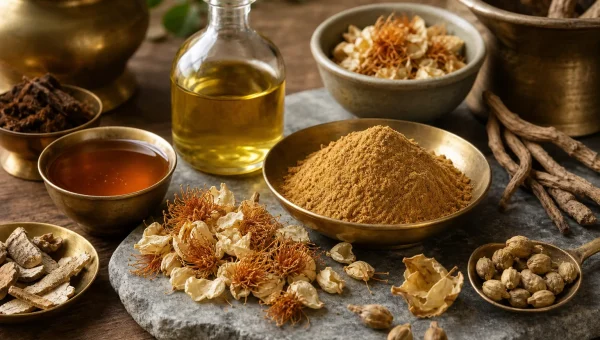
- Svarna Bhasma — processed gold prepared according to classical Rasa Shastra procedures; the Ayurvedic Formulary of India lists Svarna Bhasma with honey or butter as an anupana and describes it as Rasayana, Medhya, and Smritivardhaka.
- Ghrita — the classical sneha medium used to prepare and carry medhya herbs.
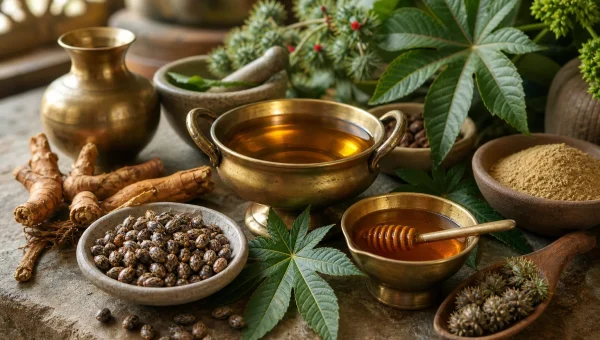
- Madhu — honey, used traditionally as an anupana, but not given to children below 12 months of age because of modern infant-safety guidance.
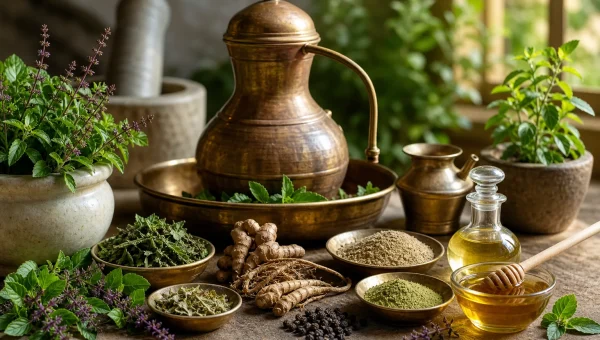
- Medhya and Rasayana herbs — formulations may use Brahmi, Vacha, Shankhapushpi, Jatamansi, Ashwagandha, Guduchi, Yashtimadhu, Pippali, or Maricha depending on the physician’s formulation and the child’s constitution.
The Pushya Nakshatra Timing: Practical Monthly Protocol
Pushya Nakshatra is the traditional monthly timing used by many families and Ayurvedic clinics for Suvarna Prashan. In practical terms, it gives parents a disciplined calendar rhythm: a measured dose once in the lunar month, rather than irregular or excessive use. Published Ayurvedic public-health protocols have also used once-monthly administration on Pushya Nakshatra as the organizing schedule for children.
Some physicians use Suvarna Prashan as a monthly Rasayana practice, while others prescribe a short daily course for a defined paediatric indication such as recurrent respiratory or digestive complaints. The monthly and daily approaches should not be mixed casually; the schedule, dose, and formulation strength need to match the child’s age, agni, prakriti, health condition, and the concentration of Svarna Bhasma in the preparation.
Classical Benefits and Ayurvedic Rationale
Kashyapa Samhita presents Suvarna Prashan in the language of paediatric Rasayana. The classical verse describes it as supportive of medha, agni, and bala, and also connects it with ayushya, mangala, varnya, and graha-related protection. In Ayurvedic terms, this places the practice in the overlapping area of intellect support, digestive-strength support, vitality, and protection of the child’s developing constitution.
The logic is not simply “gold is good.” Ayurveda gives importance to the form, processing, carrier, timing, dose, and recipient. Svarna Bhasma is treated as a potent Rasayana substance; ghrita is used as a nourishing sneha medium; honey is used as an anupana only when age-appropriate; and medhya herbs are chosen to support the child’s mind, digestion, and resilience. This is why Suvarna Prashan belongs under Kaumarabhritya supervision rather than home experimentation.
The Pharmacology of Svarna Bhasma
Modern analytical work on Svarna Bhasma describes it as a calcined gold preparation whose particle characteristics depend on the classical process, number of putas, grinding media, and the accompanying substances used during preparation. Some analyses describe fine particles, agglomerates, and micro-to-nano-scale features rather than a single uniform particle size. This is one reason a physician should insist on a well-prepared, tested product rather than powdered gold or an unlabeled commercial drop.
A human bioavailability assessment of Ayurvedic gold bhasma compared different anupanas after a 30 mg oral dose and detected gold only in trace blood levels over the measured period, with honey producing the highest measured Cmax among the tested carriers. This supports the classical emphasis on anupana selection while also reminding us that dose and preparation quality matter greatly.
Clinical Ayurvedic protocols have used much smaller paediatric doses than the adult/general monograph range. For example, one monthly Swarnamrita Prashana protocol used a four-drop dose containing about 2 mg of Svarna Bhasma, while another 30-day paediatric protocol for children aged 3 to 10 used 1 mg daily up to 5 years and 2 mg daily above 5 years, combined with honey and ghrita. These are reference points for practitioners, not universal self-dosing instructions.
Traditional Preparation vs Commercial Products
The quality of Suvarna Prashan depends on the quality of its Svarna Bhasma, the preparation method, the carrier, the dose calculation, and the professional supervision behind it. Two bottles with the same label may differ widely if one uses properly prepared bhasma and the other uses poorly documented material.
- Use only authentic Svarna Bhasma: It should come from a licensed Ayurvedic pharmacy with batch information and preparation standards consistent with recognized Ayurvedic formularies and pharmacopoeial expectations.
- Prefer physician-prepared or physician-approved formulations: Classical ghrita preparation with medhya herbs requires controlled heating and correct paka; honey is added separately and should not be treated like an ordinary sweetener.
- Know the concentration: Parents should know how much Svarna Bhasma is present per drop or per millilitre, because a “drop” is not a dose unless the concentration is known.
- Avoid unlabeled online products: Do not use products that lack batch number, manufacturer licence details, ingredient clarity, or professional dosing guidance.
- Follow age safety: Honey-containing preparations are not suitable for infants below 12 months of age.
Dosage by Age
The safest way to think about Suvarna Prashan dosage is concentration-based, not spoon-based. A physician calculates the dose from the strength of the preparation and the child’s age, weight, digestion, constitution, season, and clinical need. The following table keeps the practical age framework while using verified dosage reference points from published Ayurvedic protocols.
| Age Group | Practical Protocol Frame | Svarna Bhasma Reference Point | Frequency |
|---|---|---|---|
| Birth to 12 months | Only under direct supervision of a qualified Ayurvedic physician and the child’s healthcare provider; do not use honey-containing home preparations. | Individualized by physician; no home dose should be assumed. | Only if specifically prescribed. |
| 1-5 years | Measured drops from a known-concentration preparation; honey may be used only after 12 months of age. | Published daily clinical protocol used 1 mg Svarna Bhasma with honey and ghrita up to 5 years; monthly Swarnamrita protocol used about 2 mg per four-drop dose. | Monthly on Pushya Nakshatra for Rasayana use; daily courses only if prescribed. |
| 5-10 years | Measured drops from a known-concentration preparation, adjusted by the physician according to the child’s condition. | Published daily clinical protocol used 2 mg Svarna Bhasma with honey and ghrita above 5 years; monthly protocol used about 2 mg per four-drop dose. | Monthly on Pushya Nakshatra, or a short practitioner-directed daily course. |
| 10-16 years | Adolescent dosing should remain physician-calculated and product-specific. | Do not copy the adult/general Svarna Bhasma monograph range for adolescents without prescription. | Monthly or as prescribed after examination. |
Administration: In common practice, the dose is given in the morning on an empty stomach, followed by a food gap of about 30-60 minutes. Some families include the traditional ritual elements of a clean setting, mantra, and facing east, but the essential medical points are correct formulation, correct dose, age safety, and professional supervision.
Safety Considerations for Parents
Suvarna Prashan is a medicinal intervention for children and should be treated with the seriousness of medicine. It should be administered only by, or under the direct supervision of, a qualified Ayurvedic physician using a properly prepared formulation from a licensed source. Parents should also involve the child’s paediatric healthcare provider when the child is an infant, has chronic illness, takes regular medicines, has kidney or liver disease, has a history of metal allergy, has an immune disorder, or is on immunosuppressive treatment.
Do not give honey to children below 12 months of age. Do not use Suvarna Prashan during acute fever, severe illness, vomiting, diarrhoea, or any condition in which the physician has asked the family to pause oral medicines. Stop and seek professional care if the child develops rash, swelling, breathing difficulty, persistent vomiting, unusual drowsiness, or any concerning reaction after administration.
Quality control is a major safety issue. Some Ayurvedic products sold outside proper regulatory channels have been associated with heavy-metal contamination or unsafe manufacturing. This is not a reason to abandon classical medicine; it is a reason to use it only through trained practitioners, licensed pharmacies, batch-documented products, and rational paediatric dosing.
My Grandmother’s Wisdom, Revisited
The more I study Suvarna Prashan, the more I respect the discipline behind my grandmother’s monthly ritual. She did not treat it like candy, a vitamin, or a fashionable immunity drop. She treated it as a samskara-like medicine: small in quantity, carefully timed, given with reverence, and never used recklessly. That is the spirit in which Suvarna Prashan still makes the most sense today — a classical paediatric Rasayana practice, guided by a qualified vaidya, using properly prepared Svarna Bhasma and age-appropriate anupana.
This article is educational. Suvarna Prashan should only be administered by or under the direct supervision of a qualified Ayurvedic physician, with appropriate paediatric healthcare guidance when needed. Never substitute unlabeled commercial drops or home-prepared gold mixtures for professional care.
References
- A critical appraisal on Swarnaprashana in children (2014), PubMed Central
- Ayurvidhiclinic (ayurvidhiclinic.com)
- Wjarr (wjarr.com)
- Dravyaguna notes
- Ijrap (ijrap.net)
- Ijrap (ijrap.net)
- Researchgate (researchgate.net)
- Aamjournal (aamjournal.in)
- Preparation and Characterization of Suvarna Bhasma Parada Marit (2017), PubMed Central
- CDC
- Pib (pib.gov.in)
- Pib (pib.gov.in)
- NCCIH
🌿 The Pushya nakshatra timing correlation with lunar immunity cycles is an area I’d love to see researched
started at 3 months, now 18 months, my daughter has not been hospitalised once. anecdotal but encouraging 🙌
My Ayurvedic doctor recommended the same thing last month. Good to find it confirmed here.
We give Suvarna Prashan to our son on each Pushya nakshatra. The difference in immunity compared to his classmates is noticeable.
where to get properly certified Suvarna Prashan in Hyderabad? most places are making it without proper Shodhana
My pediatrician said no scientific evidence. I understand but also the risk profile seems very low with properly prepared Suvarna Prashan.
Suvarna Prashan needs practitioner guidance. parents should not DIY anything with metals for kids
Gold in any form given to an infant raises red flags for me. What is the actual gold concentration in these preparations?
Useful
नमस्ते, longtime reader first comment. This post finally convinced me to start.
That’s wonderful! Did you find a practitioner who follows the Pushya Nakshatra schedule, or are you doing it at home? I’ve been trying to locate someone in my city who still prepares the gold-honey mixture the traditional way.
The historical texts you cite are 1500 years old. Immunity science has changed somewhat since then.
That’s a fair point about the age of the texts, but I’d push back a little — the question isn’t whether Kashyapa Samhita knew about T-cells, it’s whether the observed outcomes over centuries have any biological basis we can now explain. Some of the herb combinations used in the ghrita are getting real immunomodulatory research attention now. That gap between old observation and modern mechanism is worth taking seriously rather than dismissing either side.
The classical references you include make this more credible than most Ayurveda blogs.
Just found this. Really helpful for my situation.
The story about your grandmother performing this every Pushya Nakshatra for all seven grandchildren really stayed with me. There’s something about the consistency of the ritual — the east-facing, the silver spoon, the specific verse — that feels inseparable from the practice itself. Do you think the ceremonial structure has its own therapeutic value beyond the gold-honey preparation?
Doing this
धन्यवाद for explaining this so clearly
✨ Same here
My son is four years old and we’ve been doing Suvarna Prashan since he was about eight months. Honestly the hardest part was finding a vaidya who sources the swarna bhasma properly — the quality varies so much. Has anyone else run into this problem?
What struck me most was the Kashyapa Samhita passage and how specific it is about timing — not just the nakshatra but the direction the child faces. I always assumed that kind of detail was ceremonial, but the article made me think about whether there’s a circadian or seasonal logic embedded in those instructions.
I grew up in a family that did this but I never understood the reasoning until reading this. The connection to Medhya rasayanas and cognitive development specifically — that part I hadn’t seen explained anywhere else. Sharing this with my sister who has a toddler. ❤️
Same, we started last year and the part about the ghrita base being essential for fat-soluble absorption really clicked for me — our vaidya had mentioned it but never explained the pharmacology behind it the way this post does.
We’ve been navigating frequent respiratory infections with our daughter since 2022 and this was the most thorough explanation of the immune-support rationale I’ve come across. The section on how the Medhya action complements the immune action — not just one or the other — was new to me.
Found tjis helpful. The Suvarna Prashan section was particularly useful for my situation.
Been researching this since my nephew was born in 2024 and couldn’t find a single source that addressed the honey-before-one-year concern in the context of Suvarna Prashan. Really glad this post tackled it directly instead of just dodging the question. 🌿
Started looking into this in 2024 when my daughter’s pediatrician kept dismissing it without actually knowing anything about it. The historical continuity of this practice across so many generations is hard to ignore — this post laid that out better than anything I’d read. 🙌
Been following traditional Ayurvedic practices for my kids since 2020 and this is one of the more honest assessments I’ve read. Most write-ups either oversell it or dismiss it. The acknowledgment that the research is still limited while the classical tradition is robust — that balance is refreshing. 🙏
The detail about performing it specifically on Pushya Nakshatra rather than any arbitrary date — I’ve never seen anyone explain the astronomical reasoning behind that choice. Is there a follow-up post or resource on the nakshatra-timing aspect? 💯
We started this for our twin boys in 2020 and the biggest surprise was how much they actually look forward to it each month — the ritual itself seems to matter to them in a way I didn’t expect. The post captures that dimension of the practice, the relational and ceremonial side, which usually gets left out of clinical discussions. ❤️
The description of the grandmother’s ritual made me think about family traditions that blend everyday actions with deeper meaning.
Been doing this since 2021 and I appreciated that the post doesn’t shy away from the sourcing problem. Swarna bhasma quality is genuinely inconsistent across suppliers and that’s a real safety and efficacy concern — I’m glad it got acknowledged rather than glossed over. 💯
Just started researching this in 2024 before my daughter’s first birthday. The part that gave me pause was the note about ensuring proper Shodhana purification of the gold — how do parents actually verify that when buying a prepared product? Is there a testing standard or do you just have to trust the vaidya? 🙏
Found this helpful. The Suvarna Prashan section was particularly useful fpr my situation. (asking as someone dealing with this since 2020)
I wonder how the Pushya Nakshatra timing influences the preparation’s effectiveness compared to giving it on any other day.
A question about the dosage table: does the honey amount stay the same if the child is already receiving breast milk or formula?
Found tjis helpful. The Suvarna Prashan section was particularly useful for my situation. (asking as someone dealing with this since 2021)
It’s interesting that the article mentions the nanoparticle size of Swarna Bhasma and links it to modern gold nanoparticle research.