
Many women first notice perimenopausal skin change in photographs rather than in the mirror: a softer jawline, thinner-looking cheeks, drier texture, and less spring in the skin around the eyes and neck. These changes are not only cosmetic. They often reflect the combined effect of estrogen decline, Vata increase, reduced tissue nourishment, sun exposure, stress, sleep disturbance, and the slower repair rhythm of midlife.
The Ayurvedic goal is not to freeze the face or imitate injectable results. The goal is to nourish Rasa and Mamsa, calm aggravated Vata, protect the skin from avoidable collagen loss, and use daily oiling, lepa, food, sleep, and herbs to help the skin age with better strength, softness, and resilience.
Why Skin Firmness Changes Around Perimenopause and Menopause
Estrogen helps maintain dermal collagen, skin thickness, hydration, vascularity, and fibroblast activity. Around menopause, lower estrogen is associated with reduced collagen content and thinner skin; dermatology literature commonly describes a loss of up to about 30% of skin collagen in the first five postmenopausal years, followed by a slower yearly decline. This is one reason the face, neck, and hands may look suddenly drier or less firm during the menopausal transition.
Ayurveda describes life in broad doshic phases: childhood is Kapha-dominant, the middle years are more Pitta-dominant, and later life is more Vata-dominant. Perimenopause sits at the edge of this shift. When Vata qualities increase, the skin may become dry, thin, rough, crepey, or less elastic. When tissue nourishment is insufficient, the skin and underlying facial support may lose fullness. When Bhrajaka Pitta in the skin is disturbed, complexion, radiance, and tolerance to topical applications may also change.
- Vata increase: dryness, roughness, fine lines, crepey texture, and loss of elasticity.
- Rasa Dhatu weakness: reduced hydration, dullness, and a feeling that the skin no longer looks nourished.
- Mamsa Dhatu weakness: reduced tone and support beneath the facial skin, especially around the cheeks, jawline, and neck.
- Bhrajaka Pitta imbalance: changes in complexion, radiance, and the skin’s response to oils, lepas, heat, and sunlight.
The Internal Protocol: Nourishing Rasa, Mamsa, and Ojas
The internal protocol focuses on steady nourishment rather than aggressive stimulation. Herbs should be chosen according to prakriti, vikriti, digestion, medications, menstrual history, thyroid status, liver health, and whether there are hormone-sensitive conditions. The following framework is educational and should be individualized by a qualified Ayurvedic practitioner.
Shatavari for Midlife Female Nourishment
Shatavari (Asparagus racemosus) is traditionally valued as a female rasayana and nourishing herb. In a perimenopausal skin protocol, its role is to support cooling, unctuous, rebuilding nourishment when Vata and Pitta are both involved. It is especially suited to dryness, heat, irritability, disturbed sleep, and depleted tissue tone when digestion can tolerate it. It is not a substitute for hormone therapy and should be used cautiously in hormone-sensitive conditions unless supervised.
Amalaki for Collagen Cofactors and Rasayana Support
Amalaki (Emblica officinalis/Phyllanthus emblica) is a classical rasayana and a naturally vitamin-C-rich fruit. Vitamin C is required for the hydroxylation steps that stabilize collagen structure, while Amalaki’s sour, cooling, and rejuvenative profile makes it useful when skin dullness, heat, and tissue depletion overlap. It is often gentler as a daily fruit, powder, chyawanprash ingredient, or practitioner-selected extract than as a harsh “detox” approach.
Guduchi for Inflammatory Heat and Tissue Protection
Guduchi (Tinospora cordifolia) is used in Ayurveda as a rasayana with relevance to Pitta, Rakta, immunity, and inflammatory heat. In a collagen-supportive protocol, its place is not as a direct “collagen builder” but as a balancing herb when skin changes are accompanied by heat, reactivity, irritation, poor recovery, or inflammatory tendencies. It should be avoided or used only under medical supervision in people with liver disease, autoimmune conditions, or unexplained jaundice.
Ashwagandha for Stress, Sleep, and Vata Depletion
Ashwagandha (Withania somnifera) is traditionally used as a balya and rasayana herb, especially when Vata depletion appears as poor sleep, stress sensitivity, fatigue, muscle loss, nervous tension, or poor recovery. For skin firmness, its value is indirect: better sleep, steadier stress response, and improved tissue-building capacity all support healthier repair. It is warming and may not suit everyone, especially those with excess heat, pregnancy, liver concerns, or certain thyroid and sedative medications.
Ghee and Unctuous Foods for Vata-Calming Nourishment
Ghee is used in Ayurveda as a nourishing, unctuous food and carrier when digestion is strong enough. In a midlife skin protocol, small amounts of ghee in warm meals can support oleation, Vata calming, and the delivery of fat-soluble nourishment. It should be adjusted for appetite, cholesterol concerns, gallbladder history, and overall diet.
| Support | Protocol Role | Best Taken With | Use With Caution When |
|---|---|---|---|
| Shatavari | Nourishing female rasayana for dryness, heat, and depletion | Warm milk, warm water, or ghee as advised | Hormone-sensitive conditions, asparagus allergy, poor digestion |
| Amalaki | Rasayana and vitamin-C-rich collagen cofactor support | Warm water, honey at room temperature, or food | Acid reflux, loose stools, sensitive digestion |
| Guduchi | Rasayana support for inflammatory heat and recovery | Warm water or as prescribed | Liver disease, autoimmune conditions, immunosuppressive medicines |
| Ashwagandha | Vata support for stress, sleep, strength, and recovery | Warm milk or warm water, often later in the day | Pregnancy, liver concerns, hyperthyroid tendency, sedative medicines |
| Ghee | Unctuous nourishment and Vata-calming food support | Warm meals | Weak digestion, gallbladder issues, lipid disorders unless supervised |
The Topical Protocol: Lepa, Sneha, and Gentle Stimulation
Topical care cannot replace internal nourishment, but it can reduce dryness, improve the feel of the skin, support barrier comfort, and give the face consistent mechanical stimulation. In Ayurveda, external therapies such as abhyanga and lepa are especially relevant because Bhrajaka Pitta is associated with the skin and with the processing of substances applied externally.
Weekly Nourishing Lepa
This lepa is designed for dry, dull, or Vata-affected skin. It should be soft, moist, and easy to rinse; a firming protocol should never leave the face irritated, burning, or excessively tight.
- 1 teaspoon Shatavari powder
- 1/2 teaspoon Yashtimadhu powder
- 1 teaspoon fresh Aloe vera gel
- 1/2 teaspoon fine almond powder or oat flour
- Rose water or plain water to make a smooth paste
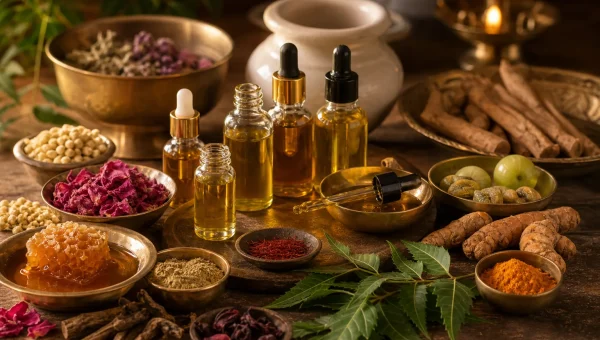
- 2–3 drops Kumkumadi Taila or plain sesame oil if tolerated
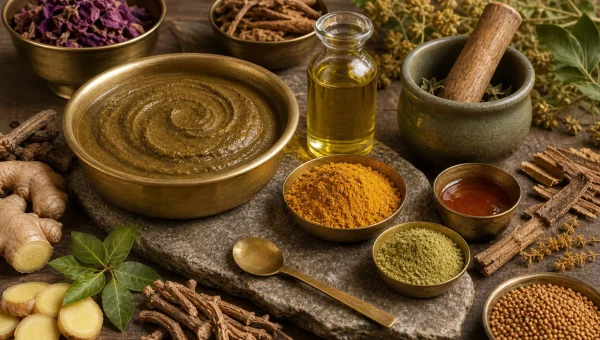
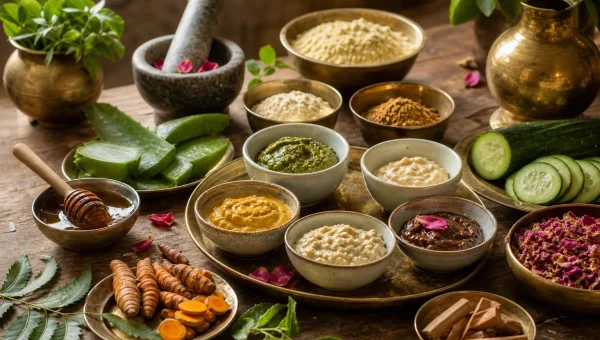
Apply to clean skin on the face and neck, avoiding the eyelids. Leave for 10–15 minutes, keeping it slightly moist rather than allowing it to crack dry. Rinse with lukewarm water and follow with a few drops of oil or a simple moisturizer while the skin is still damp. Yashtimadhu and Aloe are used here for soothing support, while Shatavari and oil provide a more unctuous, Vata-calming quality.
Clarifying and Firming Lepa Twice Monthly
This lepa is for skin that feels dull, congested, or heavy but still needs protection from over-drying. It gives a temporary tightening feel while supporting a cleaner, smoother surface; it should not be used on very dry, inflamed, peeling, or sensitized skin.
- 1 teaspoon Multani Mitti
- 1/2 teaspoon Manjistha powder
- 1 teaspoon honey
- 1 teaspoon Aloe vera gel
- Rose water as needed
Apply a thin layer to the face and neck for 8–12 minutes. Rinse before it becomes fully hard or uncomfortable. Manjistha is traditionally used in skin and Rakta-related contexts, honey offers humectant and soothing qualities, and Aloe helps prevent the clay from becoming too drying. Follow with gentle oiling or moisturizer.
Daily Mukha Abhyanga
A short nightly facial oil massage is the foundation of the topical protocol. The purpose is not to pull the skin aggressively but to combine oil, warmth, rhythm, and gentle upward movement so that Vata is soothed and the skin receives consistent mechanical stimulation.
- Cleanse the face and leave the skin slightly damp.
- Warm 4–6 drops of Kumkumadi Taila, sesame oil, almond oil, or another suitable facial oil between the palms.
- Press the palms gently over the cheeks, forehead, and chin.
- Sweep upward from the jawline toward the ears using light pressure.
- Massage upward along the nasolabial folds with the middle and ring fingers.
- Tap gently around the under-eye area using the ring finger only.
- Massage the neck upward from the collarbone to the jaw, avoiding pressure over the throat.
- Finish by resting warm palms over the face for a few breaths.
Mechanical stimulation of skin and underlying connective tissue is associated with changes in fibroblast behavior and extracellular matrix signaling. In practical terms, this means gentle, consistent massage may be a useful companion to nutrition, sleep, sun protection, and Vata-calming care.
Lifestyle Factors That Protect Collagen
Herbs and lepas work best when the daily routine protects existing collagen. The biggest accelerators of visible laxity are often ordinary habits repeated for years: excess ultraviolet exposure, smoking, high refined sugar intake, poor sleep, chronic stress, dehydration, and under-eating protein during weight-loss attempts.
- Protect from UV exposure: Use broad-spectrum sunscreen, shade, hats, and sensible sun timing. UV exposure activates enzymes that degrade collagen and contributes strongly to photoaging.
- Reduce refined sugar: Excess sugar promotes advanced glycation end products, which stiffen and cross-link collagen fibers and contribute to dull, less elastic skin.
- Avoid smoking: Smoking constricts skin blood vessels, reduces oxygen delivery, and accelerates visible skin aging.
- Prioritize sleep: Ayurveda treats nidra as a pillar of health. For perimenopausal skin, sleep supports repair, stress balance, and steadier appetite and hormone rhythms.
- Avoid crash dieting: Rapid weight loss can make facial laxity more visible by reducing facial fat support while the skin is already adapting to collagen decline.
- Train muscle steadily: Strength training supports Mamsa Dhatu in Ayurvedic language and helps preserve body composition during midlife.
Dietary Collagen Building Blocks
Collagen formation requires amino acids such as glycine, proline, hydroxyproline, and lysine, along with vitamin C and adequate total protein. An Ayurvedic approach does not need to rely on collagen powders; it can focus on digestible, warm, protein-containing meals with enough healthy fat and mineral-rich foods.
- Mung dal, urad dal, lentils, and beans: provide plant protein when cooked well with digestive spices.
- Milk, paneer, curd, or buttermilk: can support tissue nourishment when tolerated and suited to digestion.
- Sesame seeds and tahini: offer minerals, healthy fats, and protein in small daily quantities.
- Soaked almonds: provide fat, protein, and vitamin E as part of a Vata-supportive routine.
- Amalaki, citrus, guava, and leafy greens: provide vitamin C to support collagen formation.
- Eggs, fish, or meat broths: may be used by non-vegetarians when appropriate to constitution, culture, and digestion.
- Warm cooked meals with ghee or sesame oil: help counter dryness and support Vata balance better than cold, dry, irregular eating.
The 12-Week Practice Rhythm
Skin repair is slow, so this protocol should be practiced as a 12-week rhythm rather than judged after a few days. The most realistic early changes are improved comfort, hydration, glow, and texture. Firmer appearance takes longer and depends on age, hormones, sun history, sleep, diet, weight change, genetics, and consistency.
| Weeks | Primary Focus | What May Improve | What to Watch |
|---|---|---|---|
| 1–3 | Digestion, hydration, oiling, sleep rhythm | Less dryness, smoother makeup application, calmer texture | Acidity, heaviness, breakouts, or intolerance to oils or herbs |
| 4–6 | Consistent herbs, protein, lepa, and sun protection | More glow, better softness, reduced roughness | Whether the protocol is too heating, too heavy, or too drying |
| 7–9 | Strength training, steady meals, nightly mukha abhyanga | Better facial comfort, more resilient skin feel, improved neck care routine | Over-massage, harsh masks, or skipping sunscreen |
| 10–12 | Maintenance and personalization | More consistent tone, healthier barrier feel, better-supported aging | Need for practitioner adjustment based on hormones, sleep, and digestion |
This is not a promise to reverse age. At 44, 48, or 52, skin will not behave exactly as it did at 30. The Ayurvedic aim is wiser maintenance: nourish what is depleted, oil what is dry, cool what is inflamed, strengthen what is weak, and protect the collagen that remains. Done steadily, this can make the skin look better cared for, more comfortable, and more resilient through the menopausal transition.
Disclaimer: This article is for educational purposes only and is not a substitute for medical, dermatological, gynecological, or individualized Ayurvedic advice. Consult a qualified Ayurvedic practitioner and healthcare provider before beginning herbs, supplements, medicated oils, or therapeutic protocols, especially if pregnant, breastfeeding, taking medication, using hormone therapy, managing thyroid disease, liver disease, autoimmune illness, cancer history, or hormone-sensitive conditions. Patch-test topical preparations for 24 hours before full facial use and stop anything that causes burning, swelling, rash, itching, wheezing, jaundice, severe digestive upset, or other concerning symptoms.
References
- Estrogens and aging skin (2013), PubMed Central
- A study of the decrease of skin collagen content, skin thickness, and bone mass in the postmenopausal woman (1987), PubMed
- Link (link.springer.com)
- Ovid (ovid.com)
- Easyayurveda (easyayurveda.com)
- Importance of Ayu Pareeksha for the Management of Diseases (2017), PubMed Central
- NCBI
- Jaims (jaims.in)
- Charaka Samhita — Mamsa dhatu
- Ayushdhara (ayushdhara.in)
- Plant profile, phytochemistry and pharmacology of Asparagus racemosus (Shatavari): A review (2013), PubMed Central
- Shatavari Supplementation in Postmenopausal Women Improves Handgrip Strength and Increases Vastus lateralis Myosin Regulatory Light Chain Phosphorylation but Does Not Alter Markers of Bone Turnover (2021), PubMed Central
- Efficacy and Safety of Shatavari Root Extract for the Management of Menopausal Symptoms: A Double-Blind, Multicenter, Randomized Controlled Trial (2024), PubMed Central
- Functional and Nutraceutical Significance of Amla (Phyllanthus emblica L.): A Review (2022), PubMed Central
- Mdpi (mdpi.com)
- Efficacy of Vitamin C Supplementation on Collagen Synthesis and Oxidative Stress After Musculoskeletal Injuries: A Systematic Review (2018), PubMed Central
- Tinospora cordifolia (Willd.) Hook. f. and Thoms. (Guduchi) – validation of the Ayurvedic pharmacology through experimental and clinical studies (2010), PubMed Central
- Anti-inflammatory activity of Guduchi Ghana (aqueous extract of Tinospora Cordifolia Miers.) (2014), PubMed Central
- NCBI
- NCCIH
- A prospective, randomized double-blind, placebo-controlled study of safety and efficacy of a high-concentration full-spectrum extract of ashwagandha root in reducing stress and anxiety in adults (2012), PubMed Central
- NCBI
- Frontiersin (frontiersin.org)
- Mdpi (mdpi.com)
- Aloe vera: a short review (2008), PubMed Central
- A comprehensive review of Rubia cordifolia L.: Traditional uses, phytochemistry, pharmacological activities, and clinical applications (2022), PubMed Central
- Honey in wound healing: An updated review (2021), PubMed Central
- Journals (journals.plos.org)
- Mécano-Stimulation™ of the skin improves sagging score and induces beneficial functional modification of the fibroblasts: clinical, biological, and histological evaluations (2015), PubMed Central
- Matrix-degrading metalloproteinases in photoaging (2009), PubMed Central
- Mayoclinic (mayoclinic.org)
- Advanced glycation end products: Key players in skin aging? (2012), PubMed Central
- Derma (derma.jmir.org)
- NCBI
- Roles of dietary glycine, proline, and hydroxyproline in collagen synthesis and animal growth (2018), PubMed
- The intensity and effects of strength training in the elderly (2011), PubMed Central
- Aad (aad.org)
The 30% collagen loss in first five years post-menopause statistic is the number that made me take this seriously. I’m 46. If I don’t address this now, I’m not preventing anything, I’m just slowing the inevitable loss more than if I do nothing.
The phytoestrogen pathway for collagen support is the mechanism that makes Shatavari and Amla’s role in perimenopause skin health make biological sense. They’re not moisturizers applied to the surface. They’re supporting the hormonal environment in which collagen synthesis occurs.
I bought this for my wife because she’s been worried about her skin changes at 47. She said this was the first thing she’d read that actually acknowledged what she was experiencing rather than trying to sell her a cream.
The Manjistha for Rakta Dhatu purification and skin brightness alongside the collagen support protocol is the ingredient combination I’ve started. Three months in and people are commenting on my skin without me mentioning I’m doing anything different.
The Abhyanga with sesame oil for improving skin thickness is the traditional practice I’d been doing for years without knowing it had relevance to collagen specifically. The article connects an established Ayurvedic daily practice with a specific modern clinical benefit.
How does the Ayurvedic collagen protocol compare to marine collagen peptide supplementation which has the strongest clinical evidence base for skin thickness improvement? Are these complementary or is one approach sufficient?
The drop in collagen numbers really puts the perimenopause changes into perspective.
My wife tried HRT at 44 and had side effects she couldn’t tolerate. The Shatavari and Amla protocol became her alternative. Her gynecologist monitors her hormonal panel quarterly and her estrogen-related tissue changes have slowed relative to what her bone density trajectory was predicting.
The Amla Vitamin C content being a cofactor for collagen synthesis is basic biochemistry that somehow doesn’t appear in most skin health conversations. Vitamin C deficiency slows collagen production and Amla at therapeutic doses is one of the most potent whole-food sources.
The part about Perimenopause Skin Sagging feels realistic. This is the kind of detail readers can test slowly.
Has anyone tried the Shatavari dosage mentioned and noticed a difference in skin hydration?
The jawline change in photographs before you see it clearly in the mirror is the exact early warning sign I recognized immediately. My face in photos started looking softer at 43. This article describing that same experience made me feel seen rather than anxious about it.
I appreciate the breakdown of how estrogen affects fibroblasts; it clarifies why creams alone aren’t enough.
The weekly lepa recipe sounds doable, though sourcing Kumkumadi Taila might be tricky for some.
Did the author mention any side effects from taking Guduchi long term?
I find the comparison of collagen loss to a cliff striking; it matches what I’ve seen in my own photos.
The advice to limit refined sugar to under 25g daily feels realistic and easy to track.
Is the egg white mask safe for people with sensitive skin, or should they do a patch test first?
Seeing the timeline table helped me set expectations for when to expect firmer jawline.
i asked my dr about this. she said she doesnt have enough info on it but didnt say no
can someone here who has tried this protocol confirm the timeline? Two weeks vs six weeks?
finally something that explains the why, not just the what.
Some of the preparation methods are too time-intensive for working adults. Needs a quick-version alternative.
the practical implementation section is what separates this from other Ayurveda sites.
Some of the preparation methods are too time-intensive for working adults. Needs a quick-version alternative. ✨
my western trained MD friend looked at this and said the pharmacology section was reasonable.
I liked the practical side of Perimenopause Skin Sagging. The article avoids making it sound like a quick fix.
The writing assumes India-based readers. Temperature/herb availability differs greatly outside India.
The reference to Ashtanga Hridayam which Sutrasthana chapter? Would like to read the original.
the DIY face pack recipe worked better than the expensive branded version I was using.
Same here
does this protocol need modification for someone who is fasting during Navratri?
the Hindi terms alongside English make this usable in both languages.
too theoretical without enough concrete steps. The ‘what’ is clear but the ‘how exactly’ is missing.
Just found this through Google. Is this still the current recommendation?
Pitta burning its way through this article and finding useful info 🔥 just kidding but yes helpful.
the dose specificity here is what makes this actionable. Vague ‘take regularly’ instructions are useless.
The safest part of the Perimenopause Skin Sagging advice is keeping it simple. This is the kind of detail readers can test slowly.
How long does a typical protocol like this take to show results?
my grandma was right about all of this. just didnt have the explanation.
does ghee quality affect results significantly? I use store-bought A2 ghee.
my yoga teacher recommended this site and now I see why.
going to share this at my wellness group meeting next week. Very useful.
Tried. Liked. Continuing.
Found this searching for answers, brilliant breakdown. Forwarding this.
is there a children’s version of this protocol? My daughter has a similar issue.
i took notes from this and created a personal protocol. Three weeks in, positive changes.
could u address the quality certification issue in a future article? Third-party tested herbs r hard to find.
for darker skin tones does the brightening effect of kumkumadi work the same way?
i dont comment usually but this was actually helpful
as someone who does both allopathy and Ayurveda I appreciate that this article doesnt demonize either.
will try for a month and report back here.
The Perimenopause Skin Sagging section feels grounded enough to try carefully. Small daily changes are easier to follow than a perfect plan.
The Perimenopause Skin Sagging section feels grounded enough to try carefully. I would still ask a practitioner before changing medicines.
practical + scientific = rare combo in Ayurveda content. Good work.
for an old post this is still very relevant. good information doesn’t expire. ✨
Too many ingredients that are hard to source outside India. Needs a substitution guide.
Makes sense
the ubtan recipe sounds good but saffron is expensive. Is there a substitute that achieves similar results?
could you address the quality certification issue in a future article? Third-party tested herbs are hard to find. 💯
do the ratios change if u r doing this as preventive cr versus active treatment?
tried this for 6 weeks without the results described. Maybe the protocol needs personalizing.
My experience perfectly matches what is described in the long-term use section.
brilliant breakdown. Forwarding this.
Good info
been following this blog for six months and the quality is consistently high.
how does weather and season affect the protocl? im in a hot humid climate.
my doctor actively discouraged this after I mentioned it. Getting conflicting guidance is difficult to navigate.
for men with sensitive skin is the protocl different from what’s described here?
the depth here is unusual for a blog. reads more like a textbook chapter.
Helpful
Will try
What’s the shelf life of homemade preparations? The article doesn’t mention storage.
my Ayurvedic practitioner told me something different abuot the timing. Confusing to get conflicting guidance.
started following this a month ago. small but real difference. thank u
Real information. Not fluff. Rare.
is the preparation method different if using organic versus conventional turmeric?
For men with sensitive skin is the protocol different from what’s described here?
does this protocl need modification for someone who is fasting during Navratri?
this site is different from other ayurveda blogs. feels researched not just copied.
The Perimenopause Skin Sagging angle is useful here. The main idea is clear even if someone is new to Ayurveda.
first comment here. been lurking for months. this is the one that made me want to say thank u
the language is accessible which is rare for classical Ayurveda writing
Would like to see the contraindications section expanded. Too brief for something being suggested for health issues.
the balance between Sanskrit terminology and plain English is really well done.
does anyone know a practitioner in Hyderabad who works with this kind of protocol?
have been searching for this explanation for years. Saved. Sharing.
finally found a routine that works for my Vata-dry skin type. This is now my daily practice.
the dose specificity here is what makes this actionable. Vague ‘take regularly’ instructions are useless. धन्यवाद
tried the protocol. Week 2 no change yet but following through to the full period.
This is now my reference article for explaining this topic to friends.
I came for Perimenopause Skin Sagging and this answered the main question. The practical details matter more than people think.
would love a video version of the preparation method
u said it better than my 45-min consult with the vaidya tbh
can this be done alongside an allopathic treatment or should there be a gap?
Do the ratios change if you are doing this as preventive care versus active treatment?
my constitution is Vata-Pitta so some of this applies and some doesnt. A chart for dual types would help.
would like to see the contraindications section expanded. Too brief for something being suggested for health issues. 🙌
thanks for the clear writing. This isnt easy material to explain simply.
The dosage for children per kg bodyweight would be useful to add.
starting today. Fingers crossed.
nani used to say the same things in different words. There’s real wisdom here.
The part about Perimenopause Skin Sagging feels realistic. I appreciate that it does not oversell the result.
for an old post this is still very relevant. good information doesn’t expire.
The morning versus evening split for herbs is something I always get confused about. Clear here.
three herbs three outcomes surprisingly simple when laid out like this
The dosage for children per kg bodyweight would be useful to add. ठीक है
the classical text reference to Charaka Samhita gave this article more credibility in my eyes.
How does weather and season affect the protocol? I’m in a hot humid climate.
finally an article that doesn’t treat Ayurveda as magic and also doesn’t dismiss it entirely
The seasonal protocol is smart. Most people try to use the same routine all year.
so much misinformation out there. Good to find something grounded.
what’s the shelf life of homemade preparations? The article doesnt mention storage.
Will come back to this when I hit the cooling phase very detailed.
Quality content. Keep writing like this.
the dose specificity here is what makes this actionable. Vague ‘take regularly’ instructions r useless.
any recommendation for online vaidya consultations for those of us not near an Ayurvedic clinic?
Just found this via Google, the article doesn’t mention patch testing before applying these preparations. That seems like a safety oversight.
found this searching for answers, late to this discussion but the question in the first comment is still unanswered anyone have more info?
I would like more detail on Perimenopause Skin Sagging. The timing advice is the part I would start with.
my Ayurvedic practitioner told me something different about the timing. Confusing to get conflicting guidance.
Late to this but the classical text reference to Charaka Samhita gave this article more credibility in my eyes. 🙌
Useful post on Perimenopause Skin Sagging. I appreciate that it does not oversell the result.
i wish there were more clinical studies cited here. Traditional use is valuable but not sufficient evidence alone.
going to shr this at my wellness group meeting next week. Very useful.
what brand of triphala do you recommend? So many options and quality varies greatly.
Will try 🙏
Sharing this
The multani mitti tip was a game changer for my oily T-zone. Used it twice a week for a month.
this article connected the dots between things my vaidya told me over several years.
i broke out badly after trying the recommended oil. It may not suit all skin types.
i was prescribed this by a practitioner 2 years back but never understood why. now i do.
i’m in the US and getting authentic herbs here is hard. Any trusted online sources?
What’s the shelf life of homemade preparations? The article doesn’t mention storage. ✨
Found this article after searching for 3 days. Exactly what I needed.
is the guidance here applicable for elderly patients or is it designed for younger adults? ठीक है
Reading this later and the Perimenopause Skin Sagging advice still feels relevant. This would be easier to follow with a one-week sample plan.
any reccomendation for online vaidya consultations for those of us not near an Ayurvedic clinic?
Late to this but the classical text reference to Charaka Samhita gave this article more credibility in my eyes.
the classical text quotes are helpful context but I’d like to understand the modern interpretation better.
My doctor actively discouraged this after I mentioned it. Getting conflicting guidance is difficult to navigate. 🙏
how does weather and season affect the protocol? Im in a hot humid climate.
This is the clearest explanation of this topic I’ve found. Bookmarked for reference.
i was prescribed this by a practitioner 2 years back but never understood why. now i do. 🙏
thanks for the clear writing. This isnt easy material to explain simply. ✨
Just found this via Google, for men with sensitive skin is the protocol different from what’s described here?
can pregnant women use all the ingredients mentioned? Some herbs rn’t safe in pergnancy.
been meaning to try this for two years. This article finally pushed me to start.
Found this searching for answers, three months later: the results held. Happy to report.
forwarded to my whole family WhatsApp group. Three replies already asking for more details. 🙏
can this be taken in summer or only winter months?
Skeptical about Ayurveda in general but this is presented honestly enough that I’ll try it.
the classical text quotes r helpful context but I’d like to understand the modern interpretation better.
what brand of triphala do you recommend? So many options and quality varies greatly. नमस्ते
skeptical but curious. trying the minimal version first.
I appreciate the acknowledgment that this isn’t a substitute for professional consultation.
can pregnant women use all the ingredients mentioned? Some herbs aren’t safe in pregnancy.
i broke out badly after trying the recommended oil. It may not suit all skin types. ✨
finally something that explains the why, not just the what. 💯
the sourcing of quality herbs in my city is impossible. Makes these protocols academic for many readers.
the combination of classical reasoning and practical steps is exactly what I was looking for.
The safest part of the Perimenopause Skin Sagging advice is keeping it simple. I appreciate that it does not oversell the result.
Old post but still helpful. the combination of theory and practical steps is what I appreciate most about this blog.
for darker skin tones does the brightening effect of kumkumadi work the same way? 🙌
For Kapha-dominant types is the warm water recommendation essential or can it be room temp?
how long before seeing results with the kumkumadi protocol? Ive been using it 2 weeks with no change yet. नमस्ते
the question about brand quality is important. not all suppliers are equal.
As someone who does both allopathy and Ayurveda I appreciate that this article doesn’t demonize either.
the section on seasonal skincare adjustment was something I hadn’t seen anywhere else. Very practical.
This helped me understand Perimenopause Skin Sagging without too much jargon. The safety notes could be expanded a little.
does this work for people over 60? The age range in the examples skews younger.
Is the guidance here applicable for elderly patients or is it designed for younger adults?
Reading this in 2027 are the herb sourcing recommendations still valid?
For Pitta-Kapha dual constitution which aspects of the protocol take priority?
My Ayurvedic practitioner of 12 years said this is one of the better online resources she’s seen on the topic.
my constitution is Vata-Pitta so some of this applies and some doesnt. A chart for dual types would help. 🙏
Will try for a month and report back here. ❤️
The Q&A format at the end would make this even more useful. Would love a FAQ section.
never thought I’d become an Ayurveda convert but here I am reading every article.
found this article after searching for 3 days. Exactly what I needed. ❤️
can pregnant women use all the ingredients mentioned? Some herbs rn’t safe in pregnancy.
The sourcing of quality herbs in my city is impossible. Makes these protocols academic for many readers. 🌿
Reading this in 2027, i broke out badly after trying the recommended oil. It may not suit all skin types.
found this article after searching for 3 days. Exactly what I needed. धन्यवाद
found this searching for answers, been doing oil cleansing for a month. skin is softer and my makeup goes on better now. 🌿
i have the same question as the previous commenter. Also want to know abuot interaction with metformin.
I broke out badly after trying the recommended oil. It may not suit all skin types. 🙏
Just found this through Google. Is this still the current recommendation? नमस्ते