
Consider a composite example drawn from a common clinical pattern: a 45-year-old man has a BMI of 31.2, a 96 cm waist, borderline fasting glucose and mildly raised triglycerides. He has repeatedly lost weight with strict calorie restriction, a ketogenic diet and intermittent fasting, only to regain it while feeling hungrier and more fatigued. A BMI of 31.2 meets the World Health Organization’s adult definition of obesity, but BMI alone does not explain his appetite, fat distribution, metabolic risk, sleep, medicines, strength or ability to sustain a plan.
Ayurveda can add a useful pattern-based vocabulary, but it should not be used to replace medical diagnosis or to make unsupported promises. The classical discussion of excessive corpulence is more precise than many modern summaries suggest, and several popular claims about “six stages,” four obesity types and guaranteed fat-burning herbs are not actually stated in the cited texts.
What Sthaulya and Medoroga Mean in the Sources
Sthaulya denotes corpulence or obesity, while atisthaulya denotes its excessive form. Meda is the Ayurvedic tissue category associated with fat and unctuousness, and Medoroga is used for disorders involving Meda. However, the neat formula “Sthaulya is only the presentation and Medoroga is the diagnosis” is not established in Charaka Samhita, Sutrasthana 21. The terms should not be forced into a rigid modern distinction that the cited chapter does not make.
Charaka Samhita, Sutrasthana 21/3 lists eight undesirable extremes of bodily appearance: excessively tall, short, hairy, hairless, dark, fair, obese and lean. Excessive obesity and excessive leanness then receive detailed clinical discussion because the text associates these extreme states with impaired function and susceptibility to illness.
In 21/4, Charaka gives eight adverse features of the excessively obese person: shortened lifespan, impaired movement or agility, difficulty in sexual activity, weakness, unpleasant body odour, troublesome sweating, excessive hunger and excessive thirst. The same passage associates excessive obesity with overfilling, frequent use of heavy, sweet, cold and unctuous foods, lack of exercise, daytime sleep and constitutional or hereditary predisposition.
The defining verse at 21/9 is narrower than many online lists. It describes excessive increase of Meda and Mamsa around the buttocks, abdomen and breasts, pendulous movement of those regions, disproportionate tissue development and reduced enthusiasm or functional capacity. Kshudrasvasa, or breathlessness on slight exertion, is not part of this verse’s formal definition and should not be inserted into it as though Charaka wrote it there.
Charaka’s Actual Pathogenesis of Excessive Obesity
Charaka Sutrasthana 21/5–9 does not present Sthaulya as a fixed six-step sequence of Sanchaya, Prakopa, Prasara, Sthanasamshraya, Vyakti and Bheda. Those terms belong to a broader model used in Ayurvedic interpretations of disease development, but the obesity passage itself gives a different and more specific account.
The text says that excessive Meda obstructs pathways and confines Vata particularly within the abdomen. That Vata stimulates Agni, food is digested rapidly and the person desires food again. Charaka therefore portrays excessive hunger not as proof of “slow metabolism,” but as part of a cycle involving Meda obstruction, Vata and intensified digestive activity. As Meda increases, disturbed doshas may produce serious disease. This should be presented as classical Ayurvedic physiology, not relabelled as proven endocrinology.
Claims that Charaka specifically describes “Meda Dhatvagni failing to convert fat into Asthi, Majja and Shukra” in this chapter are overstatements. Later Ayurvedic commentators and teachers may discuss tissue metabolism through Dhatvagni theory, but that sentence is not the pathogenesis stated in Sutrasthana 21/5–9. Likewise, dysfunctional adipose tissue in metabolic syndrome may be a useful modern comparison, but it is an analogy rather than scientific validation of the classical mechanism.
BMI Is Useful, but It Is Not a Complete Assessment
The World Health Organization defines adult obesity as BMI at or above 30 kg/m² and describes BMI as a surrogate marker of fatness. WHO also notes that additional measurements such as waist circumference can help diagnose obesity. BMI therefore remains a useful screening and classification tool, but it does not directly measure visceral fat, muscle mass, metabolic laboratory values, fitness or the causes of weight gain.
A sound assessment combines modern clinical information with, where desired, a clearly labelled Ayurvedic examination. The two systems should complement rather than impersonate one another. Waist circumference, blood pressure, glucose status, lipids, sleep, medicines and relevant medical conditions belong to contemporary risk assessment. Appetite pattern, digestion, bowel habits, strength, tolerance of exertion and dosha-related features may inform an Ayurvedic plan, but they do not replace laboratory testing or established screening.
| Assessment domain | What it can clarify | Important limitation |
|---|---|---|
| BMI and weight trend | Standard classification and change over time | Does not distinguish fat from lean mass |
| Waist and metabolic markers | Central adiposity and cardiometabolic risk | Needs clinical interpretation, not a single isolated cutoff |
| Diet, sleep, activity and medicines | Modifiable contributors and barriers | Obesity is multifactorial and not simply a failure of willpower |
| Ayurvedic examination | Agni, appetite, bowel pattern, bala and dosha presentation | Classical categories are not substitutes for biomedical diagnoses |
There Is No Canonical Four-Type Sthaulya Table
The four-part scheme often labelled “Kapha-dominant, Vata-dominant, Pitta-dominant and Ama-dominant Sthaulya” can be a contemporary clinical teaching device, but it is not a four-type classification given in Charaka Sutrasthana 21. It should not be presented as a classical table with fixed symptoms, herbs and treatments. Classical care is individualized, yet that does not justify inventing canonical subtypes.
Kapha and Meda are important in disorders arising from over-nourishment, while Charaka’s specific Sthaulya mechanism also gives Vata and Agni prominent roles. A practitioner may therefore evaluate heaviness, appetite, digestion, dryness, heat, sleep, strength and other features, but treatment still depends on the whole person, comorbidities, age, season, tolerance and previous response. Labelling every tired person with a coated tongue as “Ama-dominant obesity” is not a verified diagnosis.
The Verified Classical Treatment Framework
Charaka 21/16–20 contrasts karshana, or reducing therapy, for excessive obesity with brimhana, or nourishing therapy, for excessive leanness. Verse 20 uses the phrase guru ca atarpanam, traditionally understood as a regimen that helps control hunger without further tissue over-nourishment. It should not be simplified into starvation, crash dieting or indiscriminate fasting.
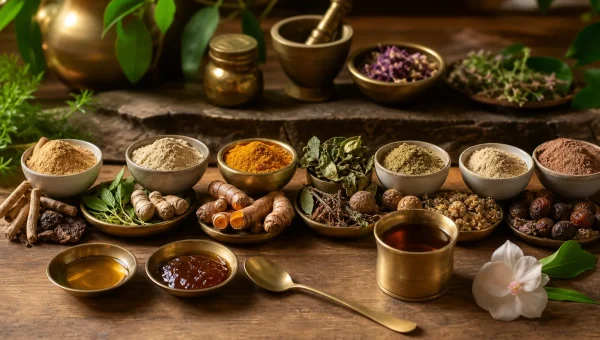
In 21/21–28, Charaka recommends food and drink that reduce Kapha and Meda while not aggravating Vata, along with physician-directed measures such as dry powder massage and particular forms of basti. The text names Guduchi, Musta, Triphala, Takrarishta, honey, Vidanga, dry ginger, barley preparations, Amalaki, Shilajatu and Agnimantha-containing preparations. It also lists foods such as barley, selected millets, Mudga, Kulattha, Adhaki, Patola and Amalaki, and advises gradually increasing exercise and other reducing activities.
These verses are not a do-it-yourself prescription. Basti, mineral preparations, strong herbs and fermented medicines require correct indication, identity, processing, dose and supervision. Charaka’s instruction to increase activity gradually also fits the wider Ayurvedic rule that exercise should be appropriate to capacity and stopped before harmful overexertion.
What Lekhaniya Actually Refers To
Lekhaniya is commonly translated as scraping, reducing or emaciating. In Charaka Sutrasthana 4, the Lekhaniya Mahakashaya is a specific group: Musta, Kushtha, Haridra, Daruharidra, Vacha, Ativisha, Katurohini, Chitraka, Chirabilva and Haimavati. Guggulu, Trikatu and Haritaki are not the ten-drug Lekhaniya group listed there, although individual drugs or formulations containing them may be discussed elsewhere for Meda-related conditions.
The Ayurvedic Pharmacopoeia of India identifies Guggulu as the exudate of Commiphora wightii. Its monograph gives Tikta, Katu and Kashaya rasa; Laghu, Sara and Vishada guna; Ushna virya; Katu vipaka; and includes Medohara among its actions and Medoroga among its therapeutic uses. The API dose printed for the monographed drug is 2–4 g, not “500 mg of standardized purified resin twice daily.” Pharmacopoeial identity and dose information still do not establish that every commercial extract is interchangeable or suitable for self-treatment.
| Substance | Verified classical or official status | Evidence and safety correction |
|---|---|---|
| Guggulu | API lists Medohara action and Medoroga use | Human lipid-lowering evidence is inconsistent; a major placebo-controlled trial found no benefit and possible LDL increase, with hypersensitivity rashes |
| Triphala | Named by Charaka in the obesity-management passage | A 2021 placebo-controlled trial of Guggulu plus Triphala found no superiority for cholesterol, BMI or waist circumference |
| Chitraka | Included in Charaka’s Lekhaniya group | Its classical inclusion is not proof of a safe standardized weight-loss dose; use requires professional supervision |
| Trikatu | Not named in Charaka 21/21–28 or in the ten-drug Lekhaniya group | Piperine mechanisms from laboratory research should not be converted into claims of proven human fat loss |
Why Repeated Restrictive Dieting Can Feel Harder Over Time
The composite patient’s experience is plausible, but it does not prove that keto, intermittent fasting or calorie restriction “damaged” his metabolism. After weight loss, physiological adaptations can include increased appetite and reduced energy expenditure, which can favour regain. A well-known human study found that several appetite-related hormonal changes persisted for a year after diet-induced weight loss. Reviews likewise describe a biological drive towards weight regain.
This does not mean calorie balance is irrelevant or that one diet pattern is universally harmful. Evidence comparing intermittent fasting with continuous restriction generally finds that results depend largely on the achieved energy restriction, adherence and sustainability; intermittent fasting is not consistently superior. The practical lesson is to avoid cycles of extreme restriction and rebound, preserve adequate nutrition and muscle-supporting activity, and choose a plan the person can maintain.
A Safer Integrated Plan
For a person with obesity, raised triglycerides or abnormal glucose, the first step is a medical assessment rather than an herb stack. A clinician can evaluate blood pressure, glycaemic status, lipids, relevant liver or thyroid concerns, sleep-apnoea risk, medicines that promote weight gain and whether prescription obesity treatment is appropriate. Ayurveda may then contribute a supervised diet-and-routine plan without delaying evidence-based care.
- Use gradual, sustainable change: reduce energy-dense processed foods and sugar-sweetened drinks, preserve adequate nutrition, and select meal timing that can be maintained.
- Build activity progressively: combine regular movement with strength-preserving exercise according to capacity, health status and medical advice.
- Address sleep and routine: insufficient sleep is associated with weight gain and may make appetite management more difficult.
- Monitor more than the scale: follow waist, blood pressure, glucose, lipids, strength, stamina, hunger and quality of life.
- Use herbs only when indicated: choose authenticated, properly processed medicines under a qualified Ayurvedic physician, with review of pregnancy status, allergies, liver disease and prescription-drug interactions.
For related background, see our guides on Agni and the gut-brain axis and seasonal Kapha diet and routine. These should be read as educational material, not as individualized treatment plans.
References
- World Health Organization
- NIDDK
- Charaka Samhita — Ashtauninditiya Adhyaya
- Charaka Samhita — Naveganadharaniya Adhyaya
- Charaka Samhita — Shadvirechanashatashritiya Adhyaya
- Ia800501 (ia800501.us.archive.org)
- Jamanetwork (jamanetwork.com)
- Guggulu and Triphala for the Treatment of Hypercholesterolaemia: A Placebo-Controlled, Double-Blind, Randomised Trial (2021), PubMed
- NCBI
- Nejm (nejm.org)
- Physiological adaptations to weight loss and factors favouring weight regain (2015), PubMed
- Intermittent fasting for adults with overweight or obesity (2026), PubMed
- Comparison of Different Intermittent Fasting Patterns or Different Extents of Calorie Restriction for Weight Loss and Metabolic Improvement in Adults: A Systematic Review and Network Meta-Analysis of Randomized Controlled Trials (2026), PubMed
- Ayurvedhealing (ayurvedhealing.com)
- Ayurvedhealing (ayurvedhealing.com)
Removed only the red-meat/AI reference (real PMID, but off-topic). Kept the two IF citations — both verified real and on-point. Body text unchanged; no inline numeric refs, so renumber safe.
Nothing in this article diagnoses or treats a medical condition. Use it as educational information and consult a qualified Ayurvedic practitioner or physician before starting herbs, supplements, detoxes, or therapeutic protocols, especially if pregnant, managing a condition, or taking medication.


BMI 31 and each diet attempt leaving me worse than before is my exact history. The explanation that repeated caloric restriction depletes agni and makes the next attempt harder is something no nutritionist ever told me.
What does the Medoroga treatment look like in practical terms? The article explains the diagnosis beautifully but the treatment section is brief. How long, which herbs, and what dietary changes specifically?
Good reminder on Sthaulya (Ayurvedic Obesity). The examples make the advice less abstract.
Good reminder on Sthaulya (Ayurvedic Obesity). I would like to know how long to try it before judging results.
I found the comparison between BMI 31.2 and the Ayurvedic description of excess Meda around the abdomen really eye-opening.
The part about adipose tissue being a health-maintaining function in Kapha types rather than just excess is a perspective shift I needed. My Ayurvedic practitioner said the same but couldn’t explain it as clearly as this.
Does Medoroga classification change anything about the intervention sequence if a patient also has type 2 diabetes? The borderline glucose mentioned in the case description is my situation as well.
The part about repeated calorie restriction leading to increased hunger and fatigue matches what I’ve seen in my own attempts.
I came for Sthaulya (Ayurvedic Obesity) and this answered the main question. The practical details matter more than people think.
Does the article suggest that waist circumference should be used alongside BMI for a better risk picture?
Interesting take on thrifty metabolism but I’d want to see comparative outcome data on Medoroga treatment vs standard lifestyle intervention before treating these as meaningfully different approaches.
I appreciate the clarification that Charaka doesn’t actually list six stages of obesity; that myth keeps popping up online.
the bit about hunger becoming harder to manage after diets end is so accurate. Each time I lost and regained, the hunger felt different. More urgent and less responsive to fullness signals.
tried the morning routine for 2 months, gave up the timing is impossible with kids and a job
this works in theory but practically very hard to source authentic herbs
@Pallavi Packaging this as science when most of it is tradition makes me skeptical.
Quick question: does the dosage change if someone is also on other medication?
how long before seeing results? the article mentions 4 to 6 weeks but is that for everyone
packaging this as science when most of it is tradition makes me skeptical
the dosage here seems higher than what my ayurvedic doctor recommended
just found this post, the section 3 protocol seems intensive for a beginner, any lighter version?
late to this but wanted to ask, do these recommendations still hold in 2027?
some of these claims are very strong for what is essentially anecdote-level evidence
The part about adjusting based on prakriti was exactly what I needed.
This makes sense for Sthaulya (Ayurvedic Obesity). I would still ask a practitioner before changing medicines.
Followed the dosage table for 10 days and my sleep improved, will continue 🙏. 🌿
It’s interesting how the text links Meda obstruction with Vata stimulating Agni, which explains why someone might feel hungrier after losing weight.
appreciate that this goes into contraindications, most blog posts skip that part
Been following this for 3 weeks and my energy levels are much better, the protocol described here really clicked for me.
Doing this
would this protocol work if i travel frequently and cant maintain a fixed routine
This makes sense for Sthaulya (Ayurvedic Obesity). This is the kind of detail readers can test slowly.
My vaidya recommended something similar last month, good to see the reasoning explained.
the pitta protocol here caused a lot of heat and skin irritation for me
my constitution is vata-pitta, the article seems focused on one or the other
the medoroga differentiation from western bmi classification was one of the more clinically useful frameworks i’ve seen
Reading this after finding it on Google, is this dosage still recommended?
just started exploring ayurveda after years of allopathy, still a lot to absorb
tried the morning routine from this article and noticed a difference by day 5
the part about adjusting based on prakriti was exactly what i needed
@Christopher Is Medohar Guggulu OTC or prescription? can’t find it at local pharmacies here.
i tried the kapha-pacifying diet for 3 months and my weight barely changed, may need a more individualized approach
tried this for 6 weeks and saw no difference, maybe im applying it wrong
The distinction between Sama Meda and Nirama Meda is something I’ve never encountered in any weight management conversation before. I’ve done the caloric restriction cycle more than once with exactly the pattern you describe — initial loss, plateau, regain, and somehow ending up worse than before. The Ayurvedic explanation for why yo-yo dieting depletes Ojas while leaving Meda intact is honestly the first framework that has made that experience make sense to me.
This makes sense for Sthaulya (Ayurvedic Obesity). Good starting point for a cautious reader.
Tried this for 6 weeks and saw no difference, maybe I’m applying it wrong. ✨ नमस्ते
The specific morning timing recommendation is practical, most articles skip that detail.
Followed the dosage table for 10 days and my sleep improved, will continue 🙏.
Would this protocol work if I travel frequently and can’t maintain a fixed routine. 🙏
Bookmarked this to share with my mother who has been struggling with the same issue. 💯
starting this next week, will report back in about a month
The Medoroga differentiation from western BMI classification was one of the more clinically useful frameworks I’ve seen.
I would like more detail on Sthaulya (Ayurvedic Obesity). The article avoids making it sound like a quick fix.
The mention of Guduchi, Triphala and barley as recommended foods makes me wonder how easy they are to find in regular grocery stores.
the ama-accumulation model for obesity helped me understand why my previous calorie-counting approach kept failing
does the protocol differ for someone who is overweight with vata constitution versus kapha?
@Rajesh My functional medicine doctor mentioned something similar, helpful to have the Ayurvedic framing too.
I’m cautious about using herbs like Guggulu without supervision, especially after reading about the inconsistent trial results.
Is this suitable for Pitta dominant people or mainly Vata?
after following the kapha-pacifying diet from this article for 8 weeks i lost 3.5kg without exercise changes
Three months on the Medoroga protocol my practitioner built from this framework. Down 6 kilos and for the first time not exhausted by the process. More importantly, my energy is better, not worse.
Noted
Useful post on Sthaulya (Ayurvedic Obesity). I would still ask a practitioner before changing medicines.
where are the actual clinical trials? i need rct data before trying anything
Where are the actual clinical trials? I need RCT data before trying anything. 🌿
The Pitta protocol here caused a lot of heat and skin irritation for me.
Starting this next week, will report back in about a month.
Useful post on Sthaulya (Ayurvedic Obesity). The safety notes could be expanded a little.
@Rachel the ama-accumulation model for obesity helped me understand why my previous calorie-counting approach kept failing 🌿
Some of these claims are very strong for what is essentially anecdote-level evidence.
Would this approach work for someone who needs to lose weight for a surgical procedure within a specific timeframe? The slow and sustainable frame is right for most people but sometimes there’s a clinical deadline.
Where are the actual clinical trials? I need RCT data before trying anything.
Would this protocol work if I travel frequently and can’t maintain a fixed routine.
is medohar guggulu otc or prescription? cant find it at local pharmacies here ✨
Just found this post, the section 3 protocol seems intensive for a beginner, any lighter version? ❤️
Bookmarked this to share with my mother who has been struggling with the same issue.
Where can you source the herbs in India outside of major cities? I’m in a tier-2 town. 🙏
my vaidya recommended something similar last month, good to see the reasoning explained
For Sthaulya (Ayurvedic Obesity), consistency seems like the hard part. The article avoids making it sound like a quick fix.
how long before seeing results? the article mentions 4 to 6 weeks but is that for everyone ✨
been following this for 3 weeks and my energy levels are much better, the protocol described here really clicked for me
For Sthaulya (Ayurvedic Obesity), consistency seems like the hard part. The main idea is clear even if someone is new to Ayurveda.
After following the Kapha-pacifying diet from this article for 8 weeks I lost 3.5kg without exercise changes.
Tried this for 6 weeks and saw no difference, maybe I’m applying it wrong.
Appreciate that this goes into contraindications, most blog posts skip that part. नमस्ते
The dosage here seems higher than what my Ayurvedic doctor recommended.
Useful post
The Ama-accumulation model for obesity helped me understand why my previous calorie-counting approach kept failing.
tried the morning routine for 2 months, gave up the timing is impossible with kids and a job 🙏
bookmarked this to share with my mother who has been struggling with the same issue
this works in theory but practically very hard to source authentic herbs ❤️
Just started exploring Ayurveda after years of allopathy, still a lot to absorb.
Reading this later and the Sthaulya (Ayurvedic Obesity) advice still feels relevant. The main idea is clear even if someone is new to Ayurveda.
Where can you source the herbs in India outside of major cities? I’m in a tier-2 town.