
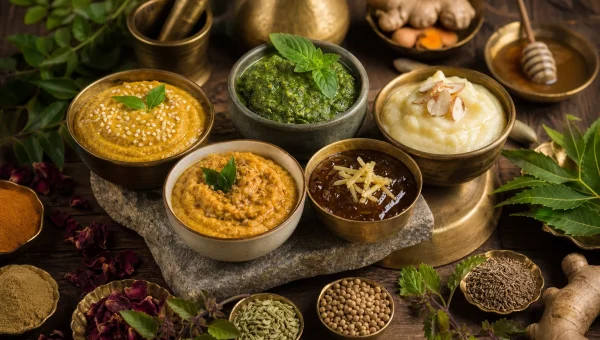
My grandmother had a small ceramic pot on the bottom shelf of her kitchen – nothing fancy, just an old pickle jar she had repurposed. Inside was a thick, dark paste that smelled of roasted coriander, black pepper, and something deeper underneath that I could never quite identify as a child. Every Sunday morning she would scoop a small amount into the dal, or rub a little onto fish before it went into the pan. That paste was her summer paste, and she made fresh portions as the Kerala heat arrived. She had others lined up beside it: one for the rains, one for cold weather, and a few everyday pastes whose purpose I have only come to understand as an adult studying Ayurvedic nutrition.
That image stayed with me. And over twenty years of working as an Ayurvedic lifestyle coach and food therapist, I have refined what she instinctively knew into a practical system that anyone can build and maintain: a seasonal spice paste library. Six jars, made in small refrigerator batches or frozen in teaspoon portions. Endless applications. This post walks you through every paste, every measurement, and every step of making them at home safely.
Before we get to the recipes, a quick note on the concept behind them. In Ayurveda, spices are not just flavor agents; they are part of diet, digestion, seasonal routine, and household food intelligence. The concept of Ritucharya teaches that food and daily habits should shift with season, climate, strength, appetite, and constitution. Our full guide to Ritucharya and seasonal living gives the broader framework. What I am offering here is the practical kitchen application: concentrated paste forms of herb-spice combinations for each season, ready to use in minutes.
Why Paste Form? The Advantage and the Caution
Traditional Ayurvedic preparation distinguishes between churna, a fine dry powder, and kalka, a paste. Classical medicated oils and ghees are prepared by cooking a paste with liquid and fat until the proper stage is reached; the raw kitchen pastes below are culinary preparations, not shelf-stable classical medicines. They are useful because they fold into dal, soups, porridges, vegetables, raita, marinades, and drinks faster than loose powders.
- Better cooking integration: A paste disperses evenly through dal, curry, soups, and warm grains.
- Better aroma control: Roasting and grinding spices together lets you build a rounded flavor base before the meal is cooked.
- Easy seasonal rotation: A labeled jar reminds you which flavors suit the season and prevents everyday cooking from becoming random.
- Safer when made small: Fresh roots, fresh herbs, and oil should be treated as short-life refrigerator foods, not long-life preserves.
For these recipes, use a stone mortar and pestle or a high-powered blender. For small batches, the mortar gives better texture. For larger batches, a blender works well, but freeze the extra paste in teaspoon-sized portions. Use clean, dry glass jars with tight-fitting lids, label each jar with the name and date made, and keep only a three- to four-day portion in the refrigerator.
Paste 1: Summer Pitta-Calming Coriander-Fennel Paste
Summer, or Grishma Ritu, is hot and drying. Classical seasonal guidance for the heat emphasizes gentle, cooling, nourishing, and fluid-supporting foods while avoiding excess pungency. This paste uses coriander, fennel, cardamom, rose, and coconut oil to create a fragrant paste that can be stirred into cooling dishes without extinguishing appetite.
Ingredients
Use dried spices for the base and add any fresh souring ingredient, such as lime, only at the time of serving if it suits your digestion.
| Ingredient | Sanskrit/Botanical Name | Amount | Kitchen Role |
|---|---|---|---|
| Coriander seeds, lightly roasted | Dhanyaka / Coriandrum sativum | 4 tablespoons | Gentle digestive, aromatic base |
| Fennel seeds | Mishreya / Foeniculum vulgare | 3 tablespoons | Sweet, cooling aroma; useful after meals and in summer foods |
| Dried food-grade rose petals | Shatapatri / rose petals | 2 tablespoons | Fragrance and softness |
| Cardamom seeds | Sukshma Ela / Elettaria cardamomum | 1 tablespoon | Aromatic digestive note |
| Dry grated coconut, unsweetened | Narikela | 2 tablespoons | Softens sharpness and gives body |
| Coconut oil | Narikela Taila | 3-4 tablespoons, as needed | Carrier and texture |
| Rock salt | Saindhava Lavana | 1/2 teaspoon | Balances taste |
Method
Keep the heat low and the roast gentle; the summer paste should smell sweet and aromatic, not smoky or sharp.
- Dry roast coriander seeds over medium-low heat for 2-3 minutes until fragrant. Cool completely.
- Add coriander, fennel, cardamom seeds, dried rose petals, dry coconut, and rock salt to a blender or mortar.
- Grind to a coarse powder first, then add coconut oil one tablespoon at a time.
- Continue grinding until the mixture forms a thick paste that holds together on a spoon.
- Transfer a three- to four-day portion to a clean, dry glass jar. Freeze the rest in teaspoon portions.
Usage: Stir 1/2 to 1 teaspoon into cucumber raita, coconut curry, warm rice, grilled paneer, or fish at the end of cooking. Add fresh lime only at serving if desired. Storage: Keep the refrigerator jar for 3-4 days. Freeze extra portions for up to 3 months for best quality.
Paste 2: Monsoon Agni-Kindling Paste
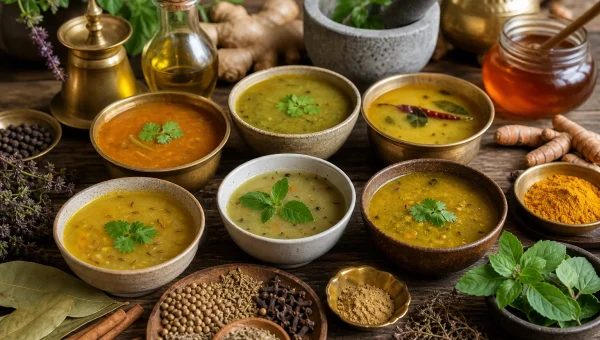
The monsoon season, or Varsha Ritu, is traditionally treated as a difficult time for digestion because dampness, irregular appetite, and Vata disturbance can make food feel heavier. This paste is the most pungent jar in the library, built around ginger, black pepper, long pepper, cumin, turmeric, and asafoetida. Use it as a cooking paste rather than as a strong stand-alone remedy.
Ingredients
The core inspiration is the familiar Ayurvedic use of pungent digestive spices, including the Trikatu trio of ginger, black pepper, and long pepper.
| Ingredient | Amount | Preparation |
|---|---|---|
| Fresh ginger root (Ardraka) | 100 g | Peeled and chopped |
| Black pepper (Maricha) | 1 tablespoon whole peppercorns | Dry roasted |
| Long pepper (Pippali / Piper longum) | 1-2 teaspoons | Dry roasted briefly |
| Cumin seeds (Shveta Jiraka) | 3 tablespoons | Dry roasted |
| Asafoetida (Hingu) | 1/4 teaspoon | Use powdered, food-grade asafoetida |
| Turmeric powder (Haridra) | 2 tablespoons | Use dry powder |
| Mustard seeds | 1 tablespoon | Dry roasted until aromatic |
| Sesame oil (Tila Taila) | 4-5 tablespoons | Carrier oil |
| Rock salt | 1 teaspoon | For taste balance |
Method
This paste should be darker, sharper, and more warming than the summer paste; use modest quantities at first.
- Blend fresh ginger with 2 tablespoons sesame oil until smooth.
- Grind the roasted black pepper, long pepper, cumin, and mustard seeds to a fine powder.
- Combine ginger paste, roasted spice powder, asafoetida, turmeric, rock salt, and the remaining sesame oil.
- Blend until uniform, scraping the sides as needed.
- Keep a small jar in the refrigerator and freeze the rest in teaspoon portions.
Usage: Add 1/2 teaspoon to dal, rasam, vegetable stir-fries, khichdi, or rice dishes while cooking. For sensitive digestion, start with 1/4 teaspoon. Storage: Keep the refrigerator jar for 3-4 days. Freeze extra portions for up to 3 months for best quality.
Paste 3: Cold-Season Vata-Grounding Paste
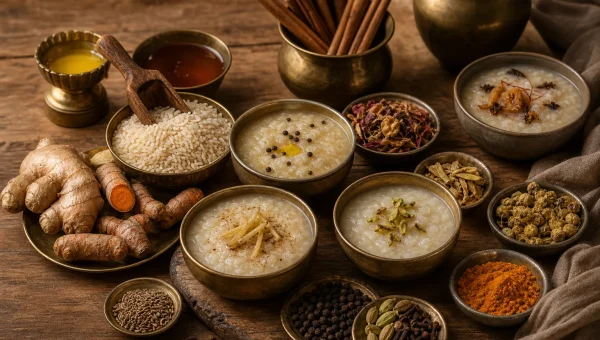
Hemanta and Shishira are cold seasons, and many people naturally turn toward warm, unctuous, well-spiced foods. Classical seasonal guidance treats winter strength and appetite as generally stronger than in summer, but cold and dryness still call for food that is steady, warm, and nourishing. This paste is warming, nutty, and ghee-based.
Ingredients
These ingredients are chosen for warm aroma, unctuousness, and compatibility with porridge, root vegetables, warm milk preparations, and winter dals.
- Sesame seeds (Tila): 4 tablespoons, dry roasted until golden
- Ajwain seeds (Yavani): 2 tablespoons, dry roasted
- Fenugreek seeds: 1 tablespoon, dry roasted gently
- Cinnamon bark: 2 small sticks, broken and warmed briefly in the pan
- Cloves: 6-8 whole cloves
- Dried ginger powder (Shunthi): 2 tablespoons
- Ghee (Ghrita): 4 tablespoons, softened but not hot
- Jaggery powder: 1 tablespoon, optional
- Rock salt: 1/2 teaspoon
Method
Roast the seeds gently; fenugreek becomes unpleasantly bitter if overheated.
- Dry roast sesame, ajwain, and fenugreek separately until aromatic. Cool completely.
- Grind the roasted seeds with cinnamon, cloves, dried ginger, salt, and optional jaggery.
- Add softened ghee gradually and grind until a thick, slightly granular paste forms.
- Transfer a small working portion to a clean, dry jar and freeze the remainder in teaspoon portions.
Usage: Stir 1 teaspoon into warm oatmeal, millet porridge, root vegetable mash, winter squash, or warm milk with dates. It also works as a ghee-spice base for sautéing carrots, beets, or sweet potato. Storage: Keep the refrigerator jar for 3-4 days. Freeze extra portions for up to 3 months for best quality.
Paste 4: Universal Digestive Paste Inspired by Hingvashtaka
This is the workhorse paste – the one to reach for when no season-specific paste is needed. It is inspired by the classical Hingvashtaka Churna, an eight-ingredient asafoetida formulation containing Shunthi, Maricha, Pippali, Ajamoda, Saindhava Lavana, Shveta Jiraka, Krishna Jiraka, and purified Hingu. This kitchen version keeps the same digestive direction but uses gentler household proportions.
Ingredients
For a closer classical direction, use Ajamoda; for a household culinary version, ajwain may be used when Ajamoda is not available.
- Dried ginger powder (Shunthi): 1 tablespoon
- Black pepper powder (Maricha): 1 tablespoon
- Long pepper powder (Pippali): 1 teaspoon
- Ajamoda or ajwain: 1 tablespoon
- White cumin (Shveta Jiraka): 2 tablespoons, roasted
- Black cumin or caraway (Krishna Jiraka): 1 tablespoon, roasted
- Asafoetida (Hingu): 1/4 teaspoon
- Rock salt (Saindhava Lavana): 1 teaspoon
- Ghee or sesame oil: 4 tablespoons, as needed
Method
Make the dry powder first, then bind only the amount you plan to use within a few days.
- Grind all dry ingredients into a fine powder.
- Mix 4 tablespoons of the powder with ghee or sesame oil until it forms a paste.
- Store remaining dry powder in an airtight jar away from heat and moisture.
- Keep only a small paste portion in the refrigerator.
Usage: Use 1/4 to 1/2 teaspoon in dal, khichdi, sautéed vegetables, buttermilk seasoned with roasted cumin, or warm rice with ghee. Storage: Keep the paste portion for 3-4 days refrigerated. The dry powder base keeps longer when protected from moisture. For more on classical spice combinations and their kitchen use, see our deep-dive into Ayurvedic churna recipes and spice blends.
Paste 5: Tulsi-Turmeric Respiratory Comfort Paste
This paste is for the Pranavaha Srotas, the respiratory channels, and is most useful as a culinary support during damp, cold, or Kapha-heavy weather. It is not a treatment for asthma, infection, allergy, fever, or breathing difficulty. Think of it as a small food-grade concentrate for soups, teas, and lentils.
Ingredients
Use dried tulsi when you want a longer-lasting dry base, and fresh tulsi only for a short refrigerator batch.
- Tulsi leaves (Ocimum tenuiflorum / Ocimum sanctum): 1 cup fresh leaves or 3 tablespoons dried leaves
- Turmeric root: 50 g fresh, or 3 tablespoons turmeric powder
- Black pepper (Maricha): 1 teaspoon
- Ginger: 50 g fresh, or 2 tablespoons dried ginger powder
- Licorice root powder (Yashtimadhu / Glycyrrhiza glabra): 1 teaspoon, optional
- Coconut oil or ghee: 3 tablespoons
- Honey: 1 tablespoon, optional, added only after the paste is cool
Method
Because this recipe can include fresh leaves and fresh roots, treat it as a short-life food and freeze what you will not use quickly.
- If using fresh tulsi, rinse and dry the leaves thoroughly, then wilt them in a dry pan for about 15 seconds.
- Blend tulsi, turmeric, black pepper, ginger, and the chosen fat until smooth.
- If using honey, stir it in only after the paste is cool.
- Transfer a small portion to a clean, dry jar and freeze the rest in teaspoon portions.
Usage: Stir 1/2 teaspoon into warm tulsi tea, vegetable soup, rasam, or lentil soup. Use 1 teaspoon in cooking for a family pot. Storage: Keep the refrigerator jar for 3-4 days. Freeze extra portions for up to 3 months for best quality. Safety: Omit licorice unless practitioner-approved if you are pregnant, breastfeeding, managing high blood pressure, have heart or kidney disease, or take medicines that may interact with herbs.
Paste 6: Rasayana-Style Nourishing Paste
The Rasayana tradition in Ayurveda includes preparations used for nourishment, strength, and vitality when they suit the person, season, digestion, and stage of life. This kitchen paste is not a substitute for a prescribed Rasayana formula, but it gives a practical household way to use amalaki, ghee, honey, and small amounts of warming digestives.
Ingredients
Keep this paste simple unless a qualified practitioner has advised stronger herbs for your constitution.
- Amalaki powder (Amalaki / Emblica officinalis): 4 tablespoons
- Turmeric powder (Haridra): 1 tablespoon
- Pippali powder (Piper longum): 1/2 teaspoon
- Ghee (Ghrita): 2 tablespoons
- Raw honey: 4-6 tablespoons, enough to bind into a thick paste
- Optional practitioner-guided additions: ashwagandha powder (Withania somnifera) or shatavari powder (Asparagus racemosus)
Method
This is closest in kitchen texture to an avaleha, a thick lickable preparation, but it is still a home food paste rather than a formal medicine.
- Combine amalaki, turmeric, and pippali in a clean, dry bowl.
- Add ghee and mix until the powder is evenly coated.
- Add honey gradually until the mixture becomes dense, smooth, and spoonable.
- Transfer a small portion to a clean, dry jar. Use a clean, dry spoon every time.
Usage: Take 1/4 to 1/2 teaspoon with warm water or warm milk when it suits your digestion, or stir a small amount into warm porridge after cooking. Storage: Make small batches, refrigerate the working jar, and finish within a few days. Freeze extra portions if making more. Avoid this paste as a daily routine if it feels heavy, heating, irritating, or unsuitable for your current condition.
Storage System: Setting Up Your Paste Library
The organizational system matters as much as the recipes. These pastes are most useful when the dry bases, refrigerator portions, and freezer portions are handled separately and clearly labeled.
- Jars: Use 100-200 ml wide-mouth glass jars. Wash, rinse, and dry them thoroughly before filling.
- Labeling: Label with the paste name, date made, and whether it is a refrigerator portion or freezer portion.
- Refrigerator rule: Keep only a three- to four-day portion in the refrigerator, especially when fresh herbs, fresh roots, or oil are involved.
- Freezer rule: Freeze extra paste in teaspoon portions, then transfer the frozen portions to a labeled freezer-safe container.
- No oil-seal dependence: A layer of oil on top is not a reliable safety method for fresh herb or root pastes. Use refrigeration, freezing, clean utensils, and short storage instead.
- Discard signs: Throw away any paste that develops mould, bubbling, sliminess, off odour, unusual colour change, or a swollen lid.
- The rotation: Make the summer paste in April or May, the monsoon paste in June or July, and the cold-season paste in October or November. Keep the universal, respiratory comfort, and Rasayana-style pastes as small-batch year-round options.
The spice box itself is a subject worth studying separately. Our guide to the 12 essential healing spices for your Ayurvedic spice box covers sourcing, quality identification, and storage of the individual spices that go into these pastes. And if you want to understand the craft of tempering spices in fat, our piece on Ayurvedic tadka and spice tempering is a useful companion.
Making It a Ritual
My grandmother did not think of her paste-making as a health practice. It was just cooking. It was what you did at the turn of each season, the way you rotated your wardrobe or checked the roof before the rains. There was sensory pleasure in it – the smell of dry roasting spices filling the kitchen on a Sunday morning, the satisfying weight of a full mortar, the bright colour of a fresh paste going into a clean jar.
That is ultimately what I want to restore with this system. Not another wellness routine. Not a supplement protocol. Just a connection to seasonal cooking intelligence that has been embedded in Indian kitchens for generations, made practical for a modern life where Sunday morning is the only time you have. Make small jars. Freeze the extra. Rotate with the seasons. Cook with them often. That is the whole practice.
Rohan Kapoor is an Ayurvedic lifestyle coach and food therapist based in Kochi. He grew up in a household of traditional healers in Kerala and now works with individuals and families to reconnect with food-as-medicine traditions. He runs seasonal cooking workshops and online programs.
Nothing in this article diagnoses, treats, cures, or prevents a medical condition. Use it as educational information and consult a qualified Ayurvedic practitioner or healthcare provider before starting herbs, supplements, detoxes, or therapeutic protocols, especially if pregnant, breastfeeding, managing a condition, or taking medication.
The seasonal paste library concept is exactly what I’ve been trying to implement for two years without a framework. The five paste lineup matching the five seasons in Kerala is how my family has always thought about cooking.
What is the shelf life of each paste and does refrigeration change the therapeutic properties? I want to make a month’s worth at a time but am unsure about storage.
The monsoon paste recipe with Trikatu base is something my Ayurvedic cooking teacher has been trying to explain to our class for months. The explanation here is clearer than what I’ve heard in person.
Can the churna pastes be used in non-Indian cooking? I cook a mix of cuisines and want to use these therapeutically without making everything taste specifically Indian.
The summer paste sounds perfect for grilled fish when the heat rises.
The summer paste to reduce internal heat built with cooling herbs makes sense. I made a simplified version with coriander seed, fennel, and a little Chandana powder. The dishes taste different and I feel noticeably less reactive after eating.
What is the unidentified deeper smell in the summer paste your grandmother made? You say you couldn’t identify it as a child. Did you ever figure out what it was?
I wonder how the rose petals affect the flavor of the summer paste.
Making the monsoon paste feels like a kitchen experiment with all those roasted spices.
I’ve been making my own churnas but not in paste form. The paste stays fresher longer in my experience and distributes more evenly in cooking. Good practical addition to the dry powder approach.
The oil seal tip is something I hadn’t considered before for preserving pastes.
The winter paste with Pippali and Ashwagandha is something I started making last November. It’s made my cooking more consistent in supporting the family’s immunity through the season.
Does the winter paste really stay good for ten to twelve weeks in the fridge?
I tried a spoonful of the immunity churna paste with warm milk and liked the texture.
Which paste is most appropriate for a child’s diet? The Pippali and pepper content of some of the pastes seems like it might be too strong for young children.
The universal digestive paste seems like a handy shortcut for everyday lentils.
It’s interesting that the respiratory paste uses fresh tulsi and liquorice root together.
One thing I’d like to know is whether the paste layers separate after a few weeks.
Just a note: labeling jars with date made really helps avoid guesswork later.
Really appreciate the breakdown of why wet grinding improves bioavailability.
Honestly, the idea of a seasonal spice library makes meal prep feel more intentional.
Sure, the shelf life numbers vary, but keeping them cold seems key.
does the ratio of spices change for someone with Pitta dominance in these recipes
the kitchari recipe in this article is the simplest ratio ive tried. ghee quantity was spot on
I have been making spice pastes for years but always improvised. The idea of building a deliberate seasonal library so the hard work is done on Sunday and you just reach for the right jar — that is genuinely going to change my weekday cooking. Which of the six do you recommend starting with for someone new to this?
My grandmother did something nearly identical with a winter paste — mustard, dried ginger, a bit of fenugreek — and kept it in an old ghee tin. I thought it was just her quirk. Reading this made me realise she was working from an actual seasonal logic. Do you cover a winter version of this kind of base paste anywhere on the site? 🌿
The concept of aligning spice mixes with ritucharya clicks after reading about each season’s dosha.
🙌 does the ratio of spices change for someone with Pitta dominance in these recipes
how long do these herbal jams keep at room temperature vs refrigerated 🙌
नमस्ते, the recipes are good but quantities are not metric. tablespoons vary wildly. gram weights would help accuracy
I tried the bath bomb recipe 3 and the citric acid amount caused effervescence before getting in water
for the churna paste, does grinding fresh spices vs pre-ground change the efficacy significantly
these laddoos are too calorie dense for someone managing weight. a lighter version would be more accessible
for the churna paste, does grinding fresh spices vs pre-ground change the efficacy significantly asked this earlier
how long do these herbal jams keep at room temperature vs refrigerated asked this last week
the kitchari recipe in this article is the simplest ratio I’ve tried. ghee quantity was spot on
The part about How to Build a Seasonal Spice Paste feels realistic. The main idea is clear even if someone is new to Ayurveda.
the recipes are good but quantities are not metric. tablespoons vary wildly. gram weights would help accuracy
This makes sense for How to Build a Seasonal Spice Paste. The main idea is clear even if someone is new to Ayurveda.
how long do these herbal jams keep at room temperature vs refrigerated
for the shatavari laddoo, can I substitute dates for jaggery if I’m watching glycemic index asked this earlier
for the shatavari laddoo, can I substitute dates for jaggery if I’m watching glycemic index asked this last week
the churna paste library concept is brilliant. I made the Vata paste and used it in soups all week
Any side effects?
for the churna paste, does grinding fresh spices vs pre-ground change the efficacy significantly asked this last week
the recipes are good but quantities are not metric. tablespoons vary wildly. gram weights would help accuracy 🙌
the kitchari recipe in this article is the simplest ratio ive tried. ghee quantity was spot on asked this just now
how long do these herbal jams keep at room temperature vs refrigerated asked this earlier
🌿 how long do these herbal jams keep at room temperature vs refrigerated
the churna paste library concept is brilliant. I made the Vata paste and used it in soups all week asked this last week
i tried the bath bomb recipe 3 and the citric acid amount caused effervescence before getting in water asked this just now
for the shatavari laddoo, can I substitute dates for jaggery if I’m watching glycemic index asked this just now