
Scalp Psoriasis Ayurvedic Treatment: Why the Scalp Needs a Separate Strategy
Scalp psoriasis is not simply body psoriasis placed on the head. It develops on hair-bearing skin, where dense hair, sebum, adherent scale, and styling or washing habits can make direct contact with medicines difficult. It may remain within the hairline or extend to the forehead, ears, neck, and back of the head, and it is often itchy, flaky, chronic, and relapsing. For this reason, scalp psoriasis Ayurvedic treatment is best approached as a scalp-specific protocol: local scalp applications, gentle head-region care, diet and digestion work, internal kushtha herbs, and practitioner-supervised purification when indicated.
In Ayurveda, psoriasis-like plaque conditions are considered within the broad kushtha framework rather than as a single fixed diagnosis. When thick, extensive, fish-scale-like plaques dominate, the presentation is commonly discussed through the Eka-kushtha pattern; when burning, redness, tenderness, or heat is prominent, pitta and rakta require stronger attention; when itching, heaviness, oiliness, and thick adherent scale dominate, kapha is more visible; when dryness, tightness, cracking, roughness, and flaking dominate, vata is also active. A useful scalp protocol therefore avoids one-size-fits-all treatment and adjusts the lepa, washing method, internal herbs, and purification plan to the actual scalp presentation.
Shiro Lepa: Foundational External Scalp Care
Shiro lepa is the use of a medicated paste on the scalp. In scalp psoriasis, its purpose is to place appropriate herbs directly on the plaque-bearing skin, soften and loosen scale without scraping, calm itching and heat when present, and make later washing or prescribed topical treatment easier. The paste must reach the scalp, not merely coat the hair shafts.
A practical base formula can be adjusted by a qualified practitioner according to whether the scalp is hot, dry, oily, tender, or heavily scaled:
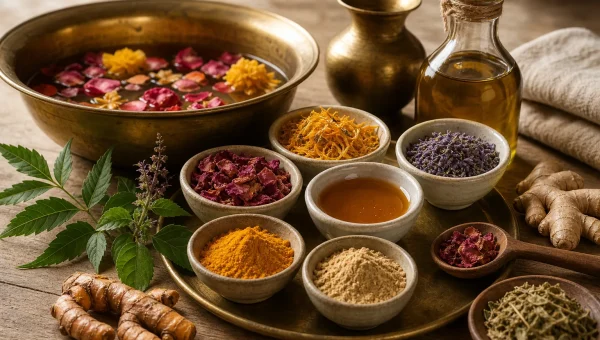
- Nimba leaf (Azadirachta indica) powder: 2 parts. Nimba is tikta in rasa, ruksha in guna, shita in virya, and is classically listed for kushtha, krimi, jvara, prameha, and vrana.
- Bhringaraja (Eclipta alba) powder: 1 part. Bhringaraja is listed as keshya and tvachya, making it a useful scalp-supporting herb when dryness, flaking, or hair-care concerns accompany the plaques.
- Prapunnada seed (Cassia tora) powder: 1 part. Prapunnada seed is katu, laghu, ruksha, ushna, kaphavatashamaka, lekhana, krimighna, and kushthaghna; it suits thick, itchy, kapha-vata plaque presentations when tolerated.
- Haridra (Curcuma longa) powder: 1/2 part. Haridra contains curcumin and is classically described as kaphapittanut, kushtaghna, krimighna, and varnya. Use a smaller amount because it is heating and strongly stains.
- Mixing liquid: plain water, nimba leaf decoction, or khadira decoction. When the scalp is very dry and tight, a practitioner may add a small amount of suitable medicated oil; when the scalp is hot, red, or oily, keep the base lighter and more aqueous.
To apply, part the hair in narrow sections and press the paste onto the visible scalp plaques. Do not rub, scratch, or forcibly lift scale. Leave the paste only as long as it remains comfortable, then rinse with lukewarm water. Avoid hot water, harsh exfoliation, acidic rinses, fragranced products, and aggressive combing during active inflammation. Do not apply herbal paste over bleeding, infected, or severely cracked skin, and stop any application that causes burning, swelling, or increased redness.
Choosing the Lepa Base by Scalp Presentation
The same herbal paste is not appropriate for every scalp. The table below keeps the protocol scalp-specific while matching the lepa to the visible dosha pattern.
| Scalp Presentation | Dominant Pattern | Preferred Lepa Base | Mixing Liquid |
|---|---|---|---|
| Thick, adherent plaques with little heat or tenderness | Kapha-vata | Nimba + Prapunnada + small Haridra | Warm water or nimba decoction |
| Bright red, burning, tender scalp with thinner scale | Pitta-rakta | Khadira + Manjistha + a small amount of Nimba | Cool water or khadira decoction |
| Dry flaking, scalp tightness, roughness, and itching | Vata with kapha | Bhringaraja + Nimba + Manjistha | Water with a small amount of practitioner-selected medicated oil |
| Oily scale, itching, and dandruff-like flaking mixed with plaques | Kapha-pitta | Nimba + Haridra + Prapunnada | Nimba decoction or plain water |
Nasya Therapy: Supportive Care for the Head Region
Nasya is the Ayurvedic administration of medicine through the nostrils and is classically indicated for disorders of the head and associated structures. In scalp psoriasis care, gentle nasya is best understood as supportive head-region care rather than as a stand-alone plaque-clearing treatment. It is most appropriate when the scalp condition is accompanied by dryness, head heaviness, disturbed sleep, stress-related aggravation, or other upper-clavicular complaints assessed by an Ayurvedic practitioner.
For home use, the gentler form is pratimarsha nasya, a low-dose use of an unctuous substance such as Anu Taila or another oil selected for the person. Apply only a small amount to the inner nostrils, avoid forceful inhalation, and spit out any excess that reaches the throat. Avoid nasya during active rhinitis, acute congestion, intoxication, or when it has not been individually advised. The detailed application technique and indications for different nasya types are covered in the nasya therapy complete guide.
Internal Treatment: Rakta, Pitta, Kapha, and Ama Management
External scalp care is only one layer of Ayurvedic management. Kushtha is described through the involvement of dosha along with skin-related tissues such as twak, rakta, mamsa, and ambu or lasika, so internal treatment is chosen according to digestion, bowel pattern, heat, itching, plaque thickness, recurrence, and the person’s strength. The internal plan should be prescribed rather than self-assembled.
Phase 1 – Agni and ama management: Begin by simplifying the diet and improving digestive regularity. Classical kushtha guidance favors light, digestible food and bitter vegetables while avoiding heavy-to-digest food, sour food, milk, curd, fish, jaggery, and sesame during active management. This phase is especially important when plaques worsen after heavy meals, incompatible foods, alcohol, excess sugar, or irregular digestion.
Phase 2 – Rakta and skin herb selection: The core herbs are selected from classical kushtha and rakta-oriented materia medica, not from a fixed capsule stack. Commonly used choices include:
- Khadira (Acacia catechu heartwood): tikta-kashaya, laghu, ruksha, shita, raktashodhaka, kaphapittahara, and kushthaghna; often chosen when pitta-kapha signs, itching, and chronic plaques are present.
- Manjistha (Rubia cordifolia stem): madhura-tikta-kashaya, guru, ushna, kaphapittashamaka, varnya, shothaghna, kushthaghna, rasayana, and shonitasthapana; often used when rakta involvement, discoloration, heat, or recurrent inflammation is part of the picture.
- Nimba leaf (Azadirachta indica): tikta, ruksha, shita, pittanashaka, and classically listed for kushtha and krimi; useful where itching, heat, or kapha-pitta skin involvement is prominent.
- Guduchi (Tinospora cordifolia stem): tikta-kashaya, laghu, ushna, madhura vipaka, rasayana, tridoshashamaka, raktashodhaka, and jvaraghna; often selected when chronicity, low resilience, seasonal recurrence, or inflammatory tendency accompanies the skin condition.
- Haridra (Curcuma longa rhizome): katu-tikta, ruksha, ushna, kaphapittanut, krimighna, kushtaghna, and varnya; best used carefully in very hot, burning presentations.
Phase 3 – Maintenance: Once the scalp is calmer, the protocol usually shifts away from multiple strong interventions and toward a simpler maintenance plan: suitable diet, stress and sleep support, scalp-safe hair care, occasional lepa, and periodic review of herbs. Long continuous use of bitter, drying herbs is not appropriate for every constitution, especially when vata signs such as dryness, cracking, insomnia, constipation, or depletion become more prominent.
Bakuchi: Practitioner-Only Use in Psoriasis-Like Conditions
Bakuchi (Psoralea corylifolia fruit) is a potent kushtha and shvitra herb in Ayurveda and contains psoralen, isopsoralen, psoralidin, and bakuchiol. Because psoralens are photosensitizing compounds and dermatological PUVA therapy requires controlled UVA exposure, bakuchi is not a casual home remedy for scalp psoriasis. Internal use, strong topical use, and any combination with sunlight or UV exposure should be done only under qualified supervision.
Bakuchi is especially unsuitable for self-care when the scalp is bright red, burning, photosensitive, blistering, or already irritated by topical medicines. It also requires caution in pregnancy, liver disease, history of skin cancer, photosensitivity disorders, eye-risk conditions, and when using medicines or treatments that increase light sensitivity. In many scalp cases, safer scalp lepa, diet, khadira, manjistha, nimba, guduchi, and dermatologist-directed topical care are considered before bakuchi.
Virechana for Persistent or Recurrent Scalp Psoriasis
For persistent, widespread, or repeatedly relapsing scalp psoriasis, a practitioner may consider panchakarma rather than simply increasing topical strength. Charaka’s kushtha management emphasizes purification, internal and external shamana, and pitta-oriented measures such as virechana when pitta signs are prominent. In scalp disease with marked redness, burning, heat, and rakta-pitta involvement, virechana may be considered as part of a supervised plan.
Virechana is not a home laxative routine. It requires assessment of strength, digestion, dosha dominance, season, medicines, preparation, and post-procedure diet. Excessive or poorly timed elimination can aggravate vata and weaken the patient. The full panchakarma framework is detailed in the panchakarma complete guide.
Hair Care During Active Treatment
Hair care must protect the scalp barrier while allowing medicines to reach the skin. Rubbing, scrubbing, scratching, and aggressive scale removal can worsen psoriasis and irritate the scalp. When applying any topical medicine or herbal paste, lift the hair and apply directly to the scalp. Thick scale may need softening before treatment can contact the plaque surface, and dermatologist-prescribed scale softeners, medicated shampoos, corticosteroid preparations, vitamin D analogues, coal tar, or other treatments may be part of the medical plan.
Choose gentle, fragrance-free, non-irritating products and wash with lukewarm water. Avoid hair dye, harsh chemical treatments, heat styling, tight hairstyles, and vigorous combing during active flares. If the scalp is dry and tight, a small amount of practitioner-selected medicated oil before washing may help soften scale; if the scalp is oily, tender, weeping, infected, or very hot, heavy oiling can be counterproductive. The complete guide to Ayurvedic hair oiling by dosha provides additional context for choosing oils conservatively.
Classical Dose References and Use Summary
The quantities below are Ayurvedic Pharmacopoeia of India crude-drug references, not automatic capsule, extract, or self-treatment doses. Actual use depends on constitution, age, digestion, medicines, pregnancy status, liver and kidney status, disease severity, and practitioner judgment.
- Nimba leaf: API reference dose is 1-3 g powder or 10-20 ml decoction.
- Haridra rhizome: API reference dose is 1-3 g powder.
- Khadira heartwood: API reference dose is 20-30 g crude drug for decoction preparation.
- Manjistha stem: API reference dose is 2-4 g powder.
- Guduchi stem: API reference dose is 3-6 g powder or 20-30 g crude drug for decoction preparation.
- Prapunnada seed: API reference dose is 1-3 g powder; in this scalp protocol it is primarily considered for external paste unless specifically prescribed internally.
- Bakuchi fruit: API reference dose is 3-6 g powder, but it is practitioner-only in psoriasis-like conditions because of its photosensitizing constituents.
- Pratimarsha nasya: classical low-dose nasya uses a small quantity measured as two bindu; the oil and timing should be selected for the individual.
Expected Course and Maintenance
Scalp psoriasis is typically chronic and relapsing, so the first goals are reduced itching, less aggressive flaking, softer scale, less scalp irritation, and better tolerance of washing and topical care. Thick plaques on the scalp often improve gradually because hair and adherent scale make treatment contact difficult. The timeline is individualized and depends on plaque thickness, medical treatment, diet, stress, scratching, hair-care practices, and whether psoriasis is present elsewhere on the body.
Maintenance usually works best when it is simpler than the active protocol: gentle washing, avoidance of scratching and harsh products, suitable diet, sleep and stress care, periodic scalp lepa when tolerated, and review with both a dermatologist and an Ayurvedic practitioner. Seek medical evaluation promptly if there is rapid worsening, pus, bleeding, severe pain, sudden hair loss, fever, widespread psoriasis, joint pain or swelling, or failure to respond to prescribed treatment.
Medical Disclaimer: This content is provided for educational purposes only and is not a substitute for professional medical advice. Scalp psoriasis is a medical condition requiring dermatological evaluation. Ayurvedic treatments described here are intended as complementary approaches. Consult your dermatologist, a qualified Ayurvedic practitioner, and your healthcare provider before implementing herbs, nasya, bakuchi, or panchakarma, especially if you are pregnant, nursing, immunocompromised, taking prescription medicines, using phototherapy, or have liver disease, kidney disease, photosensitivity, eye disease, or a history of skin cancer.
I applied a concentrated Neem preparation and had a severe scalp reaction. Concentration variability in commercial oils is not flagged here.