
Ayurvedic Endometriosis Pain Management: Vata-Calming Protocols That Complement Modern Treatment
Endometriosis is a chronic, often painful condition in which tissue similar to the uterine lining grows outside the uterus. It commonly brings cyclical pelvic pain, painful periods, pain with intercourse, bowel or bladder discomfort, fatigue, and digestive disturbance. Modern care remains essential, especially for diagnosis, fertility planning, severe pain, endometriomas, and disease monitoring. At the same time, many women look for complementary support for the recurring pain, fatigue, digestion changes, stress, and premenstrual anticipation that may persist even when conventional treatment is already in place.
Endometriosis affects about 10% of reproductive-age women and girls globally, roughly 190 million people. Diagnosis is often delayed for several years, which is one reason a structured, symptom-focused support plan matters. Ayurvedic endometriosis pain management is best understood as a complementary approach: it does not replace gynecological care, hormonal therapy, excision surgery, or prescribed pain management, but it can provide a coherent framework for supporting Apana Vayu, calming aggravated Vata, reducing lifestyle triggers, and improving day-to-day resilience.
Endometriosis Through the Ayurvedic Lens: Vata and Apana Vayu
In Ayurveda, the pelvic region, menstruation, elimination, and childbirth are closely connected with Apana Vayu, the downward-moving function of Vata. When menstrual pain is sharp, cramping, dragging, variable, or accompanied by constipation, bloating, anxiety, disturbed sleep, or worsening before the period, an Ayurvedic practitioner often evaluates Apana Vayu and Vata as central treatment targets.
This Ayurvedic model does not diagnose endometriosis by itself. Diagnosis and staging belong to modern gynecology. Ayurveda adds a pattern-based layer: Vata is addressed where pain, spasm, dryness, irregularity, fear, and exhaustion dominate; Pitta and Rakta are considered when heat, inflammation, burning pain, irritability, heavy bleeding, or intense redness are present; Kapha and Ama are considered when heaviness, sluggish digestion, thick discharge, cystic tendencies, or a sense of stagnation predominate. Treatment is then individualized rather than reduced to a single herb for every patient.
A published Ayurvedic case report described management of a large endometrioma using a supervised plan that included Yoga Basti and internal Ayurvedic medicines. A case report is not a universal protocol, but it illustrates how practitioners apply Vata-focused pelvic therapy in an integrative setting while continuing appropriate medical observation.
Core Herbs for Ayurvedic Endometriosis Pain Management
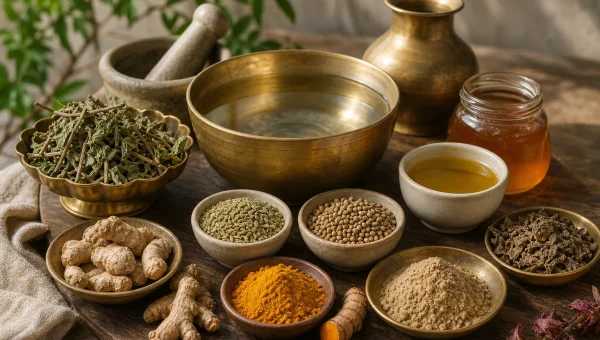
Herbs for endometriosis-related symptoms must be selected according to constitution, digestive strength, menstrual pattern, medications, fertility plans, and the presence of endometrioma, adenomyosis, fibroids, anemia, thyroid disease, liver concerns, or pregnancy. The herbs below are not a self-prescription list; they are commonly discussed because they match the major Ayurvedic patterns often seen with chronic cyclical pelvic pain.
Shatavari (Asparagus racemosus)
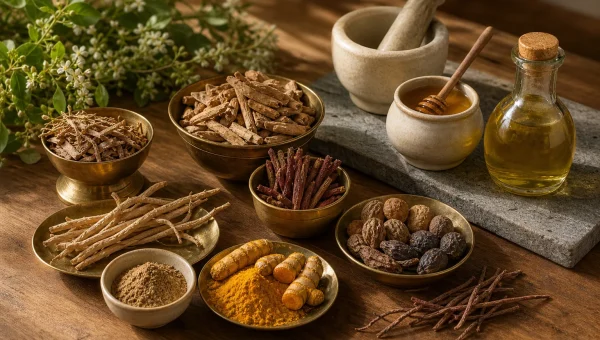
Shatavari is a classical female reproductive tonic and rasayana. The Ayurvedic Pharmacopoeia of India describes Shatavari root as having madhura and tikta rasa, guru and snigdha guna, shita virya, madhura vipaka, and actions including rasayana, balya, vrishya, pittahara, vatahara, and stanyakara. In an endometriosis-support plan, this makes Shatavari especially relevant when Vata and Pitta signs appear together: pelvic depletion, burning irritation, dryness, post-bleeding weakness, poor recovery, and nervous exhaustion. For a broader herb profile, see our Shatavari benefits for women guide.
Dashamula (Ten-Root Formulation)
Dashamula means “ten roots” and classically combines the Brihat Panchamula group—Bilva, Agnimantha, Shyonaka, Patala, and Gambhari—with the Laghu Panchamula group—Shalaparni, Prishnaparni, Brihati, Kantakari, and Gokshura. It is a central Vata-oriented formulation in Ayurvedic practice. For endometriosis pain patterns, Dashamula is most relevant when the presentation includes lower abdominal dragging, low back pain, pelvic spasm, gas, constipation, and the sense that Apana Vayu is obstructed or moving irregularly.
Haridra (Curcuma longa)
Haridra, or turmeric, is described in the Ayurvedic Pharmacopoeia of India with katu and tikta rasa, ruksha guna, ushna virya, katu vipaka, and kapha-pitta-shamaka action. Its curcumin fraction is widely discussed in endometriosis literature for inflammatory, angiogenic, oxidative-stress, adhesion, and cell-survival pathways in laboratory and preclinical models. In Ayurvedic prescribing, Haridra is most useful when the practitioner sees Kapha-Pitta features such as inflammatory heaviness, sluggish metabolism, skin congestion, or Ama signs alongside pelvic pain.
Ashwagandha (Withania somnifera)
Ashwagandha is a Vata-Kapha-pacifying rasayana and balya herb. The Ayurvedic Pharmacopoeia of India describes Ashwagandha root as tikta-kashaya in rasa, laghu in guna, ushna in virya, madhura in vipaka, and rasayana, balya, vajikarana, and vatakaphapaha in action. It is not a direct endometriosis cure; its role is supportive when chronic pain is accompanied by stress reactivity, poor sleep, fatigue, depleted strength, and nervous-system strain.
Guggulu and Kanchanara
Guggulu is a classical resin used where the practitioner identifies Ama, swelling, heaviness, or obstructive Vata-Kapha patterns. The Ayurvedic Pharmacopoeia of India lists Guggulu actions including rasayana, medohara, vatabalasajit, and uses that include granthi and shotha. Kanchanara is an astringent, light, dry bark drug, and Kanchanaraguggulu is listed as an important formulation in its official monograph. In an endometriosis-support plan, this family of medicines belongs under professional supervision, especially when cystic, nodular, swollen, or Kapha-Ama patterns are part of the assessment.
Basti: A Major Therapy for Apana Vayu Disorders
Basti is one of the five Panchakarma procedures and is classically associated with Vata disorders. For pelvic Vata patterns, practitioners may use oil-based Anuvasana Basti and decoction-based Niruha or Asthapana Basti in a planned sequence. In the endometrioma case report, Yoga Basti was used as part of a supervised Ayurvedic plan. This does not mean medicated enemas should be attempted at home. Basti requires proper patient selection, preparation, sterile technique, correct medicine choice, and monitoring by a qualified Ayurvedic or Panchakarma practitioner.
For a wider introduction, our Basti enema therapy guide explains classical types and clinical considerations. In endometriosis pain management, Basti is considered only when the practitioner judges that the patient’s strength, digestion, cycle timing, bleeding pattern, and medical situation make it appropriate.
Vata-Calming Diet and Daily Routine for Endometriosis
Ayurvedic diet is individualized, but Vata-calming principles are especially important when pain is cramping, erratic, cold-sensitive, or linked with constipation and anxiety. The basic direction is regularity, warmth, digestibility, and adequate unctuousness. This supports Apana Vayu without forcing the body into harsh cleansing during an already painful cycle.
- Favor warm, cooked meals: Soups, stews, soft rice dishes, cooked vegetables, mung dal, and warm herbal infusions are usually gentler for Vata than cold smoothies, raw salads, dry snacks, or irregular eating.
- Use suitable healthy fats: Ghee or sesame oil may be used in food when digestion, constitution, and medical needs permit. Sesame is described in Ayurveda as snigdha, sukshma, ushna, and vatahara, making it a common Vata-supportive oil.
- Keep the bowels moving comfortably: Constipation can worsen the experience of pelvic pressure and cramping. Warm fluids, cooked fiber, routine meal timing, and practitioner-selected mild support are preferred over harsh purging.
- Limit common inflammatory dietary burdens: A whole-food pattern that limits trans fats, excessive red meat, ultra-processed foods, and alcohol is a reasonable supportive direction for many people with endometriosis, while restrictive diets should be personalized and nutritionally complete.
- Adjust during menstruation: During heavy bleeding or strong cramps, keep food simple, warm, and easy to digest. Rest, heat, hydration, and reduced exertion are often more appropriate than intense exercise or aggressive cleansing.
Practitioner-Directed Protocol Reference
The following table is an educational reference for discussion with a qualified practitioner. It is not a prescription, and it should not be combined with hormonal therapy, fertility treatment, anticoagulants, thyroid medication, sedatives, immune-modulating drugs, or pregnancy planning without medical guidance.
| Treatment / Herb | Classical or Common Form | Typical Professional Use | Ayurvedic Intention |
|---|---|---|---|
| Shatavari root | Powder, granule, milk preparation, or formulation; classical powder dose is listed as 3–6 g | Selected when Vata-Pitta depletion, dryness, post-cycle weakness, or reproductive tissue nourishment is the priority | Rasayana, balya, vrishya, pittahara, vatahara |
| Dashamula | Kwatha, churna for decoction, compound formulation, or Basti ingredient | Selected for Vata-dominant pelvic pain with low back ache, gas, constipation, spasm, or Apana Vayu disturbance | Vata regulation and lower-pelvic support |
| Haridra | Powder, food use, formulation, or standardized curcumin preparation; classical powder dose is listed as 1–3 g | Selected when Kapha-Pitta, Ama, sluggish metabolism, or inflammatory heaviness is part of the pattern | Kapha-Pitta pacification and Ama-oriented support |
| Ashwagandha root | Powder, milk preparation, or standardized extract; classical powder dose is listed as 3–6 g | Selected for fatigue, poor sleep, depleted strength, stress reactivity, and Vata strain associated with chronic pain | Rasayana, balya, vatakaphapaha |
| Guggulu and Kanchanara | Single drugs or classical formulations such as Kanchanaraguggulu, only under supervision | Selected when the practitioner identifies Granthi, Shotha, Kapha-Ama, swelling, nodularity, or obstructive features | Lekhana-oriented, shotha-supportive, Kapha-Vata channel support |
| Basti therapy | Anuvasana Basti and Niruha/Asthapana Basti in a supervised Panchakarma sequence | Selected only after assessment of strength, digestion, bleeding pattern, cycle phase, and medical status | Major Vata and Apana Vayu therapy |
| External warm oil care | Warm sesame oil to the low back or lower abdomen, followed by gentle warmth if comfortable | Used outside heavy bleeding or acute worsening; avoided if heat increases symptoms, skin is irritated, or pregnancy is possible | Local Vata soothing and comfort support |
Yoga and Breathwork for Apana Vayu
Gentle, breath-centered yoga can be a useful adjunct for pelvic pain, stress, and quality of life when adapted to the patient’s cycle and pain level. For Vata-dominant endometriosis patterns, the emphasis is not on intensity; it is on down-regulation, pelvic softness, steady breathing, and reducing guarding in the abdomen, hips, low back, and pelvic floor.
Useful practices may include supported Supta Baddha Konasana, supported child’s pose, gentle supine twists, slow pelvic tilts, legs resting on a chair, and Nadi Shodhana when it feels calming. During active heavy bleeding or severe cramps, restorative positions, warmth, and quiet breathing are usually preferable to strong inversions, forceful abdominal practices, or long holds. Anyone with severe pain, dizziness, anemia, recent surgery, pregnancy, or fertility procedures should practice only with individualized guidance.
Integrating Ayurveda With Modern Endometriosis Care
Modern endometriosis care may include analgesics, hormonal treatment, surgery, fertility care, imaging, and long-term follow-up. Ayurveda should be integrated around this care, not placed in opposition to it. The best outcomes usually come from clear communication: the gynecologist monitors disease status and medical risk, while the Ayurvedic practitioner individualizes diet, herbs, Basti eligibility, daily routine, sleep support, digestion, and cycle-phase care.
Seek prompt medical care for sudden severe pelvic pain, fever, fainting, heavy bleeding, pregnancy with pain, worsening one-sided pain, vomiting, new bowel or bladder obstruction symptoms, or severe pain after a procedure. These situations should not be managed with home remedies.
Safety and Disclaimer
Ayurvedic protocols for endometriosis must complement, not replace, diagnosis and treatment from a qualified healthcare provider. Endometriosis can affect fertility, bowel and bladder function, ovarian health, and quality of life, and it requires appropriate medical monitoring. Consult a gynecologist and a qualified Ayurvedic practitioner before using internal herbs, Basti, cleansing procedures, or concentrated extracts.
Extra caution is needed during pregnancy, trying to conceive, breastfeeding, fertility treatment, hormonal therapy, anticoagulant use, thyroid disease, autoimmune disease, liver disease, kidney disease, anemia, upcoming surgery, or when prescription pain medicines, sedatives, diabetes medicines, blood pressure medicines, or immune-modulating medicines are being used. Choose herbal products carefully, because some Ayurvedic products have been found to contain unsafe levels of heavy metals or undeclared substances. Panchakarma procedures may be harmful when performed by inexperienced practitioners.
Actionable Tip: For the next two cycles, keep a simple daily record of pelvic pain from 1 to 10, bowel movements, bloating, sleep quality, bleeding intensity, food triggers, stress level, and medication use. Bring this record to both your gynecologist and Ayurvedic practitioner. It helps connect the modern diagnosis with the Ayurvedic pattern and allows any complementary plan to be safer, more precise, and easier to evaluate.
References
- World Health Organization
- Time to Diagnose Endometriosis: Current Status, Challenges and Regional Characteristics-A Systematic Literature Review (2025), PubMed Central
- ESHRE guideline: endometriosis (2022), PubMed Central
- Kottakkal (kottakkal.shop)
- Ayurveda management of large endometrioma – A case report (2023), PubMed Central
- Ayurvedic Pharmacopoeia of India
- A critical review on two types of Laghupanchamula (2012), PubMed Central
- Ayurvedic Pharmacopoeia of India
- Curcumin and Endometriosis (2020), PubMed Central
- Inhibitory effect of curcumin in human endometriosis endometrial cells via downregulation of vascular endothelial growth factor (2017), PubMed
- NIH Office of Dietary Supplements
- Basti: Does the equipment and method of administration matter? (2013), PubMed Central
- Betterhealth (betterhealth.vic.gov.au)
- Ayurveda (ayurveda.com)
- Nutrition in the prevention and treatment of endometriosis: A review (2023), PubMed Central
- Yoga, cognitive-behavioural therapy versus education to improve quality of life and reduce healthcare costs in people with endometriosis: a randomised controlled trial (2021), PubMed Central
- Nice (nice.org.uk)
- NCCIH
- FDA
What’s the correct dosage of vata for an adult with moderate symptoms? The article describes the approach but not the specific quantities.
I have had endometriosis for 11 years. Six months ago I started a Vata-calming protocol alongside my hormonal treatment. The residual pain in the days before my period, which no drug had touched, is now manageable. I still take the hormonal treatment. The Ayurvedic additions are complementary not replacement.
found this post helpful. will try the suggested approach. (ref 1862-39)
The digestive component of endometriosis is something most gynecologists do not address. My endo specialist focuses on the pelvis. My Ayurvedic practitioner looked at my entire digestive tract, identified Apana Vata disturbance, and the bowel symptoms that accompany my cycle have improved significantly since treatment.
I want to be careful about articles that suggest herbal treatment for endometriosis. The disease is progressive and lesions need to be managed medically. I have seen women delay necessary surgery by pursuing alternative protocols and suffer more because of it.
stage 3 endometriosis. the Shatavari timing guidance and castor oil pack instructions are practical starting points for someone new to complementary care
the psychological framing matters. four years of severe chronic pelvic pain changes how you relate to your body. the healing is physical and psychological simultaneously ठीक है
The anxiety that builds in the week before the period is the symptom most invisible to doctors and most disabling for me personally. No one has had anything to offer for that specifically. The Shatavari and Brahmi approach for the luteal anxiety phase is something I want to try.
My wife has stage 3 endometriosis and I have been trying to understand what complements her medical treatment rather than replaces it. The protocol here is careful about this framing. The castor oil pack instructions and Shatavari timing guidance are practical starting points.
Three years of trying to get my digestion right and finally something that addressed the root. The vata protocol described here is essentially what turned things around for me.
the psychological framing matters. four years of severe chronic pelvic pain changes how you relate to your body. the healing is physical and psychological simultaneously 🙏
found this post helpful. will try the suggested approach. (ref 1862-68)
I am an endometriosis patient advocate and I distribute resources to my community. This article is responsible in its framing and I will add it to my resource list with a note that it is designed to complement, not replace, standard medical care.
found this post helpful. will try the suggested approach. (ref 1862-28)
The framing of Vata aggravation as the mechanism behind the cramping and anxiety makes more sense to me than a lot of the conventional explanations I’ve been given. What I’m less clear on is whether the warming, grounding protocols you describe are safe to use during menstruation itself or only in the days leading up to it — I’ve seen conflicting advice on that.
The castor oil pack tip sounds easy to try before my next period.
What is the Ayurvedic view on the relationship between endometriosis and Pitta versus Vata? This article frames it primarily as Vata but I have seen other sources call it primarily Pitta because of the inflammatory nature. Can both be correct simultaneously?
I tried Shatavari for endometriosis 3 years ago with no effect. Reading this I think the dose and preparation form may have been wrong. The article says ashvagandhashatavari combinations work better than Shatavari alone for the anxiety-pain axis. Trying the combination next.
@Sanjay 💯 Is the protocol different for Pitta-dominant vs Vata-dominant endometriosis? I’ve seen different sources classify it differently ठीक है
How often should Dashamula decoction be taken for Vata regulation?
Is the protocol different for Pitta-dominant vs Vata-dominant endometriosis? I’ve seen different sources classify it differently
I support my partner who has severe endometriosis and the relentlessness of it is something no medical appointment has given language for. This article gave me words for what she lives with in the specific cycle-linked pattern of her symptoms.
Is the protocol different for Pitta-dominant vs Vata-dominant endometriosis? I’ve seen different sources classify it differently 💯
The psychological framing matters. four years of severe chronic pelvic pain changes how you relate to your body. the healing is physical and psychological simultaneously
11 years of this condition. the Apana Vayu disturbance explanation is the first one that also covers the bowel symptoms that accompany my cycle
@Susan the Shatavari and Brahmi for luteal anxiety phase is something I want to try. nothing else addresses that specific pre-period anxiety
keep your conventional treatment team. this article is careful about that framing and I appreciate it. Ayurvedic is complementary not replacement
Stage 3 endometriosis. the Shatavari timing guidance and castor oil pack instructions are practical starting points for someone new to complementary care 🙏
found this post helpful. will try the suggested approach. (ref 1862-36)
not related to this post but does anyone know a good practitioner in Hyderabad?
tried Shatavari 3 years ago with no effect. the article suggests the Ashwagandha-Shatavari combination works better for the anxiety-pain axis. trying the combination next
delayed surgery because of pursuing alternative protocols first is a real risk. this article is responsible in framing Ayurveda as complementary ❤️
found this post helpful. will try the suggested approach. (ref 1862-32)
💯 the Shatavari and Brahmi for luteal anxiety phase is something I want to try. nothing else addresses that specific pre-period anxiety
🌿 is the protocol different for Pitta-dominant vs Vata-dominant endometriosis? I’ve seen different sources classify it differently
keep your conventional treatment team. this article is careful about that framing and I appreciate it. Ayurvedic is complementary not replacement ✨
castor oil packs for 3 months alongside my hormonal treatment. the residual pain in the days before my period is now manageable for the first time
🙏 Delayed surgery because of pursuing alternative protocols first is a real risk. this article is responsible in framing Ayurveda as complementary
The psychological framing matters. four years of severe chronic pelvic pain changes how you relate to your body. the healing is physical and psychological simultaneously ✨
🙏 the psychological framing matters. four years of severe chronic pelvic pain changes how you relate to your body. the healing is physical and psychological simultaneously
delayed surgery because of pursuing alternative protocols first is a real risk. this article is responsible in framing Ayurveda as complementary
The psychological framing matters. four years of severe chronic pelvic pain changes how you relate to your body. the healing is physical and psychological simultaneously 🌿
🌿 the psychological framing matters. four years of severe chronic pelvic pain changes how u relate to ur body. the healing is physical and psychological simultaneously नमस्ते
❤️ is the protocol different for Pitta-dominant vs Vata-dominant endometriosis? I’ve seen different sources classify it differently
is the protocol different for Pitta-dominant vs Vata-dominant endometriosis? ive seen different sources classify it differently
🌿 the psychological framing matters. four years of severe chronic pelvic pain changes how you relate to your body. the healing is physical and psychological simultaneously
✨ the psychological framing matters. four years of severe chronic pelvic pain changes how you relate to your body. the healing is physical and psychological simultaneously
the psychological framing matters. four years of severe chronic pelvic pain changes how you relate to your body. the healing is physical and psychological simultaneously 🙌
the psychological framing matters. four years of severe chronic pelvic pain changes how u relate to ur body. the healing is physical and psychological simultaneously
I appreciate the explanation of Apana Vayu and its link to retrograde menstruation.
is the protocol different for Pitta-dominant vs Vata-dominant endometriosis? I’ve seen different sources classify it differently 🌿
found this post helpful. will try the suggested approach. (ref 1862-29)
is the protocol different for Pitta-dominant vs Vata-dominant endometriosis? I’ve seen different sources classify it differently धन्यवाद
🙏 Is the protocol different for Pitta-dominant vs Vata-dominant endometriosis? I’ve seen different sources classify it differently
found this post helpful. will try the suggested approach. (ref 1862-31)
found this post helpful. will try the suggested approach. (ref 1862-34)
found this post helpful. will try the suggested approach. (ref 1862-37)
found this post helpful. will try the suggested approach. (ref 1862-38)
found this post helpful. will try the suggested approach. (ref 1862-40)
The psychological framing matters. four years of severe chronic pelvic pain changes how you relate to your body. the healing is physical and psychological simultaneously 💯
Shatavari seems promising for hormonal balance, but I wonder about interactions with birth control.
found this post helpful. will try the suggested approach. (ref 1862-42)
the psychological framing matters. four years of severe chronic pelvic pain changes how you relate to your body. the healing is physical and psychological simultaneously नमस्ते
the psychological framing matters. four years of severe chronic pelvic pain changes how you relate to your body. the healing is physical and psychological simultaneously 🙏 ठीक है
found this post helpful. will try the suggested approach. (ref 1862-45)
The article made me curious about Yoga Basti; has anyone tried it alongside usual meds?
found this post helpful. will try the suggested approach. (ref 1862-47)
found this post helpful. will try the suggested approach. (ref 1862-48)
found this post helpful. will try the suggested approach. (ref 1862-50)
Using sesame oil in cooking feels like a simple way to support Apana Vayu daily.
🙌 is the protocol different for Pitta-dominant vs Vata-dominant endometriosis? I’ve seen different sources classify it differently
the psychological framing matters. four years of severe chronic pelvic pain changes how you relate to your body. the healing is physical and psychological simultaneously धन्यवाद
found this post helpful. will try the suggested approach. (ref 1862-54)
I’m skeptical about claiming size reduction of endometrioma without more human trials.
Reading this brought up a lot of feelings. I’m seven years into my own endometriosis journey and the description of anxiety building in the week before a cycle is so accurate it’s almost uncomfortable to see written down. I had not thought about the digestive piece as being connected — my gut always gets worse around that time too and I’ve been treating them as separate problems. Is castor oil packing something that can be done at home safely, or does it need to be supervised initially?
found this post helpful. will try the suggested approach. (ref 1862-56)
found this post helpful. will try the suggested approach. (ref 1862-57)
Is the protocol different for Pitta-dominant vs Vata-dominant endometriosis? I’ve seen different sources classify it differently ठीक है
🙏 is the protocol different for Pitta-dominant vs Vata-dominant endometriosis? ive seen different sources classify it differently
💯 is the protocol different for Pitta-dominant vs Vata-dominant endometriosis? I’ve seen different sources classify it differently
found this post helpful. will try the suggested approach. (ref 1862-61)
found this post helpful. will try the suggested approach. (ref 1862-62)
found this post helpful. will try the suggested approach. (ref 1862-63)
is the protocol different for Pitta-dominant vs Vata-dominant endometriosis? ive seen different sources classify it differently 💯
found this post helpful. will try the suggested approach. (ref 1862-65)
found this post helpful. will try the suggested approach. (ref 1862-66)
found this post helpful. will try the suggested approach. (ref 1862-67)
found this post helpful. will try the suggested approach. (ref 1862-69)
I liked the practical side of Endometriosis Pain Management. I appreciate that it does not oversell the result.
found this post helpful. will try the suggested approach. (ref 1862-71)
found this post helpful. will try the suggested approach. (ref 1862-72)
found this post helpful. will try the suggested approach. (ref 1862-73)
💯 the psychological framing matters. four years of severe chronic pelvic pain changes how you relate to your body. the healing is physical and psychological simultaneously
found this post helpful. will try the suggested approach. (ref 1862-75)
found this post helpful. will try the suggested approach. (ref 1862-86)
Same here!
found this post helpful. will try the suggested approach. (ref 1862-77)
found this post helpful. will try the suggested approach. (ref 1862-80)
found this post helpful. will try the suggested approach. (ref 1862-78)
found this post helpful. will try the suggested approach. (ref 1862-79)
found this post helpful. will try the suggested approach. (ref 1862-81)
found this post helpful. will try the suggested approach. (ref 1862-82)
is the protocol different for Pitta-dominant vs Vata-dominant endometriosis? I’ve seen different sources classify it differently ✨
the psychological framing matters. four years of severe chronic pelvic pain changes how you relate to your body. the healing is physical and psychological simultaneously ❤️
found this post helpful. will try the suggested approach. (ref 1862-85)
found this post helpful. will try the suggested approach. (ref 1862-87)
found this post helpful. will try the suggested approach. (ref 1862-88)
✨ Is the protocol different for Pitta-dominant vs Vata-dominant endometriosis? I’ve seen different sources classify it differently