
The Charaka Samhita, Chikitsa Sthana 1, Karaprachitiya Rasayana Pada, verses 30-31, presents four Medhya Rasayana herbs with specific forms of administration: Mandukaparni svarasa, Yashtimadhu powder with milk, Guduchi juice, and Shankhapushpi kalka. The passage describes them as rasayana drugs that promote life, reduce disease, support strength, agni, complexion, voice, and medha, with Shankhapushpi singled out as especially medhya.
This is a precise classical formulation rather than a generic “brain tonic” list. Each herb has a different dravya profile, vehicle, and preparation, and modern pharmacology gives plausible but uneven mechanistic parallels for their traditional use. The best way to read this group is as a classical cognitive-rasayana framework that spans nourishment, calm attention, inflammatory resilience, and mental clarity, not as four interchangeable nootropics.
What Medhya Rasayana Means in the Classical Framework
Medhya refers to that which supports medha, the faculty connected with grasping, retaining, recalling, and applying knowledge. In Ayurvedic discussions of mental function, medha is commonly linked with dhi, dhriti, and smriti: understanding or discernment, steadiness or retention, and memory. Rasayana refers to therapies and disciplines that support the quality of dhatus, strength, longevity, and functional resilience. Medhya Rasayana therefore occupies a specific place within rasayana: it is rejuvenative care directed toward the mind, memory, intellect, and nervous-system vitality.
The Charaka passage does not describe one universal extract or one uniform mechanism. It names four herbs and four forms: fresh juice for Mandukaparni, Yashtimadhu powder taken with milk, Guduchi juice, and paste of Shankhapushpi. This classical specificity is important because Ayurveda treats the herb, preparation, vehicle, dose, prakriti, agni, and clinical context as part of one therapeutic decision.
- Mandukaparni (Centella asiatica): svarasa, or fresh juice.
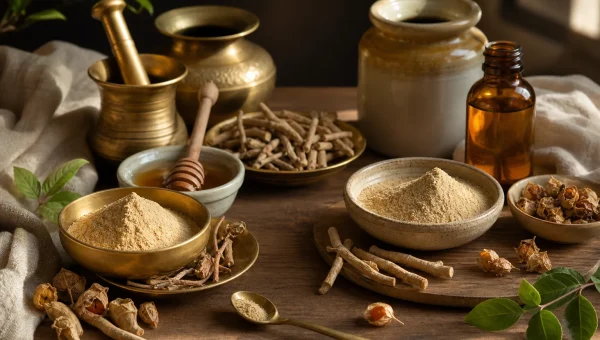
- Yashtimadhu (Glycyrrhiza glabra): powder taken with milk.
- Guduchi (Tinospora cordifolia): juice of the plant.
- Shankhapushpi (Convolvulus pluricaulis): kalka, or paste.
Mandukaparni: Calm Attention, Memory Support, and Neuroplasticity
Mandukaparni is identified in the Ayurvedic Pharmacopoeia of India as the dried whole plant of Centella asiatica. Its API profile lists madhura, katu, tikta, and kashaya rasa; laghu and sara guna; sheeta virya; madhura vipaka; and actions including medhya, smritiprada, rasayana, dipana, hridya, balya, and ayushya. This makes Mandukaparni a classical choice where memory support is needed without adding excessive heat or stimulation.
Modern work on Centella asiatica focuses mainly on triterpenoid saponins such as asiaticoside, madecassoside, asiatic acid, and madecassic acid, along with antioxidant and mitochondrial pathways. Human work is limited but includes a randomized, placebo-controlled trial in healthy elderly volunteers using Centella asiatica extract for two months, where cognitive and mood-related measures were assessed. Experimental models also describe effects on BDNF expression, oxidative stress, and synaptic or mitochondrial function, which fit the classical picture of Mandukaparni as a steadying, restorative medhya herb.
Classically, Mandukaparni is not used merely as a sedative. Its value lies in the combination of mental steadiness, memory support, and cooling pitta-pacifying action. In practical Ayurvedic use, it is often considered when excess mental heat, restlessness, poor retention, or stress-related distraction accompanies weak concentration.
Yashtimadhu: Nourishing Medhya Support with Clear Safety Boundaries
Yashtimadhu is identified in the Ayurvedic Pharmacopoeia of India as the dried unpeeled stolon and root of Glycyrrhiza glabra. Its API profile lists madhura rasa, guru and snigdha guna, sheeta virya, madhura vipaka, and actions such as balya, vrishya, varnya, raktaprasadana, and vatapittajit. In Charaka’s Medhya Rasayana passage it is specifically taken as powder with milk, emphasizing its nourishing and cooling vehicle rather than a harsh stimulant effect.
Modern pharmacological descriptions of licorice center on glycyrrhizin, glycyrrhizic acid, glycyrrhetinic acid, and flavonoids. These compounds are mainly discussed for anti-inflammatory, antioxidant, endocrine, and mucosal-protective actions. For a Medhya Rasayana reading, Yashtimadhu is best understood as a supportive, nourishing herb that may be suited to vata-pitta depletion patterns rather than as a stand-alone memory drug.
The safety boundary is essential. Glycyrrhizin-containing licorice can cause pseudoaldosteronism, hypertension, edema, and low potassium, especially with high dose, long duration, kidney disease, hypertension, diuretic use, corticosteroid use, or other cardiovascular risk. Deglycyrrhizinated licorice may reduce blood-pressure risk for gastrointestinal uses, but it is not identical to the classical Yashtimadhu Medhya Rasayana described with milk.
Guduchi: Rasayana Resilience and Inflammatory Stress
Guduchi is identified in the Ayurvedic Pharmacopoeia of India as the dried mature stem of Tinospora cordifolia, with the fresh form also recognized. Its API profile lists tikta and kashaya rasa, laghu guna, ushna virya, madhura vipaka, and actions including balya, dipana, rasayana, sangrahi, tridoshashamaka, raktashodhaka, and jvaraghna. In the Medhya Rasayana group, Guduchi contributes a broad rasayana quality rather than a narrow stimulant action.
Modern experimental literature places Guduchi within immunomodulatory, anti-inflammatory, antioxidant, and neuroprotective discussions. In animal models, Tinospora cordifolia extract has been studied for glial activation, cytokine expression, oxidative stress, and behavior under neuroinflammatory or stress conditions. This modern lens pairs well with the classical use of Guduchi where cognitive dullness, fatigue, post-illness weakness, or inflammatory stress coexists with impaired clarity.
Guduchi should not be used casually as an unlimited “immunity booster.” Its immune activity makes supervision important in autoimmune disease, transplant medicine, immunosuppressant use, chronic liver disease, or unexplained abnormal liver enzymes. Published liver-injury reports and official safety statements both exist, so clinical context and botanical authenticity matter.
Shankhapushpi: The Herb Singled Out as Especially Medhya
Shankhapushpi is identified in the Ayurvedic Pharmacopoeia of India as the whole plant of Convolvulus pluricaulis. Its API profile lists katu, tikta, and kashaya rasa; sara guna; sheeta virya; katu vipaka; and actions including medhya, rasayana, ayushya, balya, kaphahara, pittahara, and mohanashaka. The API also notes that in certain parts of India, Clitoria ternatea and Evolvulus alsinoides are used as Shankhapushpi, making botanical identity especially important.
Charaka gives Shankhapushpi special emphasis among the four Medhya Rasayana herbs. Its kalka form suggests a whole-plant preparation rather than a single isolated constituent approach. Experimental work on Convolvulus pluricaulis includes hippocampal synaptic plasticity models and neuropharmacological animal work, which suits its classical placement as a medhya rasayana directed toward clarity, learning, and mental steadiness.
The most important safety point is its interaction with phenytoin. A published interaction study on Shankhapushpi and phenytoin described reduced antiepileptic activity in rats, and repeated coadministration also reduced plasma phenytoin levels. Anyone with epilepsy, seizure history, or antiepileptic medication use should avoid Shankhapushpi unless a neurologist and qualified Ayurvedic physician are both involved.
Comparison of the Four Classical Medhya Rasayana Herbs
The four herbs can be compared across their classical form, Ayurvedic profile, modern pharmacological lens, and practical cautions. This table uses classical Charaka preparation forms and API dose ranges where available; it should not be read as a self-prescription chart.
| Herb | Classical Form in Charaka | API Ayurvedic Profile | Modern Pharmacology Lens | API Dose Range | Key Caution |
|---|---|---|---|---|---|
| Mandukaparni (Centella asiatica) | Svarasa, fresh juice | Medhya, smritiprada, rasayana; sheeta virya; madhura vipaka | Triterpenoid saponins, antioxidant and mitochondrial pathways, BDNF-related animal work, limited human cognitive data | 3-6 g dried whole plant | Use cautiously with sedatives, liver disease, pregnancy, or prolonged unsupervised use |
| Yashtimadhu (Glycyrrhiza glabra) | Powder with milk | Madhura, guru, snigdha, sheeta; vatapittajit and balya | Glycyrrhizin, glycyrrhetinic acid, flavonoids; anti-inflammatory and endocrine-related activity | 2-4 g root/stolon powder | Can raise blood pressure and lower potassium; avoid unsupervised use in hypertension, kidney disease, edema, or diuretic use |
| Guduchi (Tinospora cordifolia) | Juice of Guduchi | Rasayana, tridoshashamaka, balya, dipana; ushna virya; madhura vipaka | Immunomodulatory, anti-inflammatory, antioxidant, and neuroinflammation-related animal work | 3-6 g powder or 20-30 g for decoction | Use cautiously in autoimmune disease, liver disease, transplant medicine, or immunosuppressant therapy |
| Shankhapushpi (Convolvulus pluricaulis) | Kalka, paste | Medhya, rasayana, ayushya, balya; sheeta virya; katu vipaka | Synaptic plasticity and neuropharmacological animal work; limited human data | 3-8 g whole-plant powder | Avoid with phenytoin or seizure medication unless supervised by a physician |
Why the Combination Is More Than a Single-Pathway Nootropic
The classical combination is multidimensional. Mandukaparni leans toward cooling medhya and smriti support; Yashtimadhu adds nourishment, cooling, and vata-pitta balancing through a milk vehicle; Guduchi adds rasayana resilience, agni support, and tridosha-balancing; Shankhapushpi is the herb directly singled out as especially medhya. Together, they represent an Ayurvedic model in which cognition depends not only on neurotransmitters, but also on agni, ojas, dhatu nourishment, sleep, emotional steadiness, and the balance of doshas.
Modern pharmacology should be used as a translation layer, not as a replacement for Ayurvedic reasoning. The available data are strongest for preclinical mechanisms and limited human work, especially for Mandukaparni. For Yashtimadhu, Guduchi, and Shankhapushpi, modern data are useful for safety and mechanistic context, but clinical decisions still require individual assessment.
Minimum Effective Use and Practical Application
Medhya Rasayana is not meant to act like a one-time stimulant. It is traditionally used as a planned course with attention to dose, season, digestion, sleep, food, and the patient’s constitution. In clinical practice, a qualified Ayurvedic physician may choose a single herb, a classical formulation, or a modified combination depending on whether the person presents with anxiety, heat, depletion, post-illness fatigue, kapha dullness, insomnia, medication use, or age-related memory concern.
For a broader discussion of clinical dosing logic in another medhya herb, see our related article on Bacopa monnieri dosage: what clinical trials actually used. For adaptogens related to brain health, see our review of how adaptogens actually work: the cellular mechanisms behind Ashwagandha and Brahmi.
Disclaimer: This article is educational and does not diagnose, treat, or prevent any neurological, psychiatric, or cognitive disorder. Medhya Rasayana herbs are not substitutes for medical evaluation in memory loss, seizures, depression, anxiety, dementia, head injury, sleep disorders, or medication-related cognitive symptoms. Consult a qualified Ayurvedic physician and an appropriate healthcare provider before using these herbs, especially if pregnant, breastfeeding, elderly, managing liver, kidney, autoimmune, cardiovascular, neurological, or psychiatric conditions, or taking prescription medication.
References
- Charaka Samhita — Rasayana Adhyaya
- Study to Evaluate the Comparative Efficacy of Medhya Rasayana (Pharmacological) Versus Nonpharmacological Interventions in Management of Gadget Addiction in Children: Protocol for Parallel, Triple-Arm, Randomized Clinical Trial (2024), PubMed Central
- Natural Ingredient Resource Center
- Centella asiatica – Phytochemistry and mechanisms of neuroprotection and cognitive enhancement (2018), PubMed Central
- Positive modulation of cognition and mood in the healthy elderly volunteer following the administration of Centella asiatica (2008), PubMed
- Univmed (univmed.org)
- A clinical study on the management of generalized anxiety disorder with Centella asiatica (2010), PubMed
- Ayurvedic Pharmacopoeia of India
- Glycyrrhiza glabra: Chemistry and Pharmacological Activity (2018), PubMed Central
- Isoliquiritigenin attenuates lipopolysaccharide-induced cognitive impairment through antioxidant and anti-inflammatory activity (2019), PubMed Central
- Pseudohyperaldosteronism, liquorice, and hypertension (2008), PubMed Central
- The association between consistent licorice ingestion, hypertension and hypokalaemia: a systematic review and meta-analysis (2017), PubMed
- Tinospora cordifolia Suppresses Neuroinflammation in Parkinsonian Mouse Model (2019), PubMed
- Nature (nature.com)
- Liver Injury Following Tinospora Cordifolia Consumption: Drug-Induced AIH, or de novo AIH? (2022), PubMed Central
- Pib (pib.gov.in)
- Pib (pib.gov.in)
- Ayurvedic Pharmacopoeia of India
- Instem (instem.res.in)
- Protective Mechanisms of Nootropic Herb Shankhpushpi (Convolvulus pluricaulis) against Dementia: Network Pharmacology and Computational Approach (2022), PubMed Central
- Analysis of a clinically important interaction between phenytoin and Shankhapushpi, an Ayurvedic preparation (1992), PubMed
- Alzdiscovery (alzdiscovery.org)


is there evidence for the synergistic combination of all four Medhya Rasayanas or does each work optimally alone? the article mentions combination use but doesn’t give evidence.
the neuroscience parallels are interesting but preclinical data doesn’t automatically translate to human cognitive enhancement. the article overstates clinical confidence.
no discussion of washout effects. Bacopa benefits in studies often require 12-week minimum. short trials in the article dont support strong efficacy claims.
for Alzheimer’s prevention specifically, which of the four Medhya herbs has the strongest preclinical evidence? asking because the article treats them somewhat interchangeably.
the neuroscience section connecting acetylcholinesterase inhibition to Brahmi’s Medhya action is the clearest explanation I’ve read. finally understand the mechanism beyond just ‘brain tonic’.
Noted. ❤️
does the dose change for elderly users (70+)? hepatic metabolism changes with age and the standard doses may need adjustment.
the neuroscience parallels are interesting but preclinical data doesnt automatically translate to human cognitive enhancement. the article overstates clinical confidence. tbh
Good one.
Shankhapushpi 500mg twice daily for 3 months gave measurable improvement in my working memory. my neurologist was skeptical but the cognitive test scores improved.
Bacopa monnieri studies use standardized bacoside content. the article recommends Brahmi but doesn’t specify whether standardized extract or traditional preparation is intended.
Interesting.
bacopa monnieri studies use standardized bacoside content. the article recommends Brahmi but doesnt specify whether standardized extract or traditional preparation is intended.
@Steve bacopa monnieri studies use standardized bacoside content. the article recommends Brahmi but doesnt specify whether standardized extract or traditional prepararion is intended.
Will try!
@Pallavi bacopa monnieri studies use standardized bacoside content. the article recommends Brahmi but doesn’t specify whether standardized extract or traditional preparation is intended.
Noted.
The breakdown of each herb’s preparation really clarifies why Charaka insisted on fresh juice for Mandukaparni and Guduchi.
no discussion of washout effects. Bacopa benefits in studies often rrquire 12-week minimum. short trials in the article dont support strong efficacy claims.
does the dose change for elderly users (70+)? hepatic metabolism changes with age and rhe standard doses may need adjustment.
no discussion of washout effects. Bacopa benefits in studies often require 12-week minimim. short trials in the article dont support strong efficacy claims. tbh
for Alzheimer’s prevention specifically, ehich of the four Medhya herbs has the strongest preclinical evidence? asking because the article treats them somewhat interchangeably. tbh
@Sarah bacopa monnieri studies use standardized bacoside content. the article recommends Brahmi but doesn’t specify whether standardized extract or traditional preparation is intended.
I wonder how the milk decoction for licorice changes glycyrrhizin bioavailability compared to plain powder.
@Ravi for Alzheimer’s prevention specifically, which of the four Medhya herbs has the strongest preclinical evidence? asking because the article treats them somewhat interchangeably.
@Sunita bacopa monnieri studies use standardized bacoside content. the article recommends Brahmi but doesn’t specify whether standardized extract or traditional preparation is intended.
@Jessica no discussion of washout effects. Bacopa benefits in studies often require 12-week minimum. short trials in the article dont support strong efficacy claims.
the neuroscience parallels are interestung but preclinical data doesnt automatically translate to human cognitive enhancement. the article overstates clinical confidence. tbh 💯
no discussion of washout effects. Bacopa benefits in studies often require 12-week minumum. short trials in the article dont support strong efficacy claims.
Seeing the BDNF uptick data for Gotu Kola makes the memory claim feel more concrete.
@Ashok for Alzheimer’s prevention specifically, which of the four Medhya herbs has the strongest preclinical evidence? asking because the article treats them somewhat interchangeably.
the neuroscirnce parallels are interesting but preclinical data doesnt automatically translate to human cognitive enhancement. the article overstates clinical confidence.
Noted. 🙏
bacopa monnieri studies use standardized bacoside cpntent. the article recommends Brahmi but doesnt specify whether standardized extract or traditional preparation is intended.
The explanation of 11-beta-HSD1 inhibition linking licorice to cortisol regulation was new to me.
Guduchi’s anti neuroinflammatory angle seems especially relevant for post viral brain fog.
Shankhapushpi’s multi target profile is impressive but the phenytoin interaction warning is crucial.
Combining all four herbs in a formulation like Brahmi Ghrita could hit neuroplasticity stress inflammation and transmitter balance together.
The twelve week minimum duration aligns with what I’ve read about Bacopa so patience is key.
The Charaka citation is what makes this article stand out. I’ve seen Brahmi and Shankhapushpi marketed as nootropics constantly but rarely with this level of classical source backing. The distinction between individual routes of administration for each herb is something I’d never come across before — does anyone know whether modern supplement forms (capsules, tablets) preserve those route-specific effects or is that lost in standardization?