Last December, a patient walked into my clinic with a complaint I hear repeatedly during this season: “Doctor, I keep getting sick every two weeks. Cold, then cough, then cold again. My immunity is just… gone.” She was 42, vegetarian, reasonably healthy otherwise. Her medicine cabinet was full of over-the-counter zinc tablets, vitamin C supplements, and two different brands of Chyawanprash. None of it was working.
What she didn’t know – what most people don’t know – is that Ayurveda has a preparation method specifically designed for deep tissue immunity that goes far beyond surface-level supplementation. It’s called Ksheera Paka, and it’s one of the most underused yet powerful techniques in the classical pharmacopoeia.
What Exactly Is Ksheera Paka?
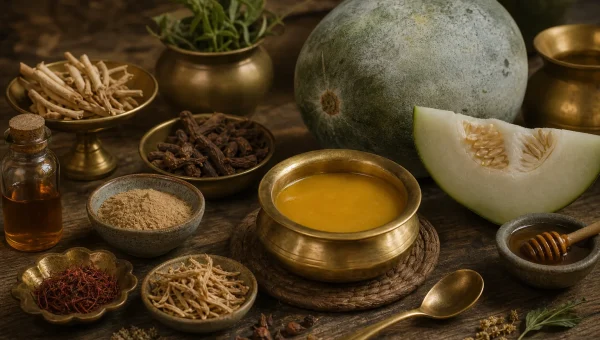
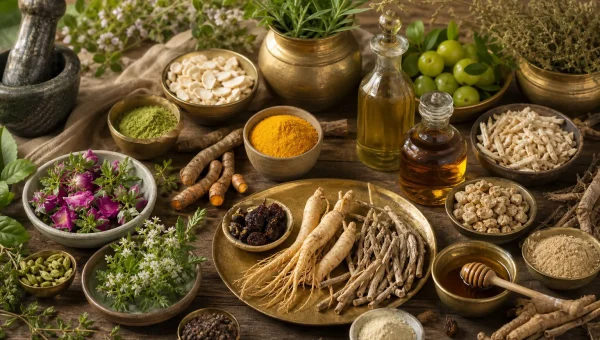
Ksheera Paka translates literally to “milk preparation” or “milk cooking.” It’s a method described in Sharangadhara Samhita (Madhyama Khanda, Chapter 2) where herbs are decocted in a specific ratio of water and milk, then reduced until only the milk portion remains. The process extracts both water-soluble and fat-soluble compounds from herbs, using milk’s natural lipid content as a carrier medium.
This isn’t the same as tossing turmeric into warm milk. The classical method follows a precise ratio:
“Take 1 part herb, 8 parts water, and 32 parts milk. Boil until the water evaporates completely and only the milk remains.” – Sharangadhara Samhita
In practical terms, for a single serving, that’s roughly 3-5 grams of herb powder, 50 ml water, and 200 ml milk. The slow cooking – typically 20-30 minutes on low heat – does something remarkable: it breaks down plant cell walls, releases alkaloids and saponins, and binds them to milk proteins and fats for enhanced absorption.
The Science Behind Milk as a Drug Delivery System
Modern pharmaceutical science has started to recognize what Ayurveda codified centuries ago. A 2020 study in the Journal of Drug Delivery Science and Technology (n=in vitro) demonstrated that milk casein micelles can encapsulate hydrophobic bioactive compounds, improving their oral bioavailability by 3-5x compared to water-based preparations. This is precisely the mechanism Ksheera Paka exploits.
Another relevant study published in Nutrients (2017) showed that curcumin administered with milk fat showed 9.7 times higher bioavailability than curcumin alone. When you prepare Haldi (turmeric) as Ksheera Paka, you’re not just making golden milk – you’re creating a lipid-based drug delivery system.
Five Ksheera Paka Recipes for Winter Immunity
1. Ashwagandha Ksheera Paka (for Deep Tissue Strength)
This is the preparation I gave my patient. Ashwagandha (Withania somnifera) root powder, prepared as Ksheera Paka, targets Rasa and Mamsa Dhatu – the plasma and muscle tissues that form the body’s first line of immune defense. The Examine.com evidence database ranks Ashwagandha among the most well-studied adaptogenic herbs for immune function.
- Herb: Ashwagandha root powder, 3 grams
- Water: 50 ml
- Milk: 200 ml (cow’s milk preferred; A2 if available)
- Method: Combine all three in a heavy-bottomed pan. Bring to a gentle boil, then reduce heat to lowest setting. Stir occasionally. Cook until the water has evaporated and approximately 200 ml of herb-infused milk remains.
- Additions: 1/4 tsp cardamom powder, 1 tsp ghee, sweeten with raw sugar (not honey – honey should not be heated)
- Dose: 200 ml at bedtime, daily for 30-45 days
A clinical trial in the Journal of the International Society of Sports Nutrition (2015, n=57) found that Ashwagandha root extract significantly increased immune cell activity (Natural Killer cells) and improved overall immune resilience. The Journal of Clinical Medicine (2020) further established Ashwagandha’s immunomodulatory effects across multiple immune parameters. The milk delivery method amplifies this effect by improving the absorption of withanolides, Ashwagandha’s primary active compounds.
2. Guduchi Ksheera Paka (for Recurrent Infections)
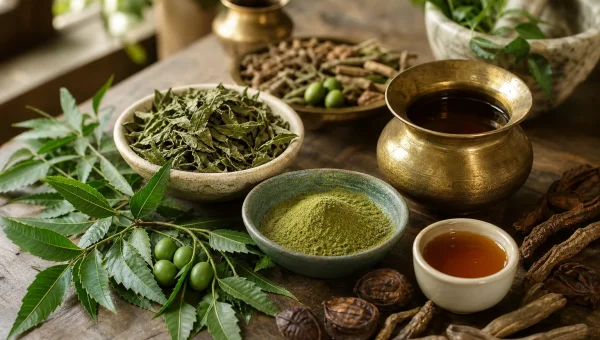
Guduchi (Tinospora cordifolia) is one of Ayurveda’s most potent immunomodulators. When prepared as Ksheera Paka, its bitter compounds become more palatable and its polysaccharides bind to milk proteins.
- Herb: Guduchi stem powder, 5 grams
- Water: 80 ml
- Milk: 200 ml
- Additions: 1/4 tsp dry ginger powder, pinch of black pepper
- Dose: 150 ml in the morning, empty stomach, for 21 days
3. Turmeric-Pippali Ksheera Paka (for Respiratory Protection)
This combination targets the respiratory tract specifically. Pippali (Piper longum) at 1 gram combined with turmeric at 3 grams creates a synergistic effect – Pippali enhances turmeric’s bioavailability while directly acting as a broncho-protective agent.
- Herbs: Turmeric powder 3 grams + Pippali powder 1 gram
- Water: 60 ml
- Milk: 200 ml
- Additions: 1/2 tsp ghee, pinch of saffron (4-5 strands)
- Dose: 200 ml at bedtime, especially during active cold symptoms
4. Bala Ksheera Paka (for Post-Illness Recovery)
Bala (Sida cordifolia) means “strength” in Sanskrit. This Ksheera Paka is classical for rebuilding after illness, surgery, or prolonged fatigue – situations common in winter when one infection follows another.
- Herb: Bala root powder, 5 grams
- Water: 80 ml
- Milk: 250 ml
- Additions: 1 tsp ghee, 1/4 tsp cinnamon
- Dose: 200 ml twice daily (morning and evening) for 14 days post-recovery
5. Yashtimadhu Ksheera Paka (for Dry Cough and Throat)
Yashtimadhu (Glycyrrhiza glabra) – licorice root – is exceptionally effective as Ksheera Paka for persistent dry cough and sore throat conditions that plague people through December.
- Herb: Yashtimadhu powder, 3 grams
- Water: 50 ml
- Milk: 200 ml
- Additions: 1/2 tsp turmeric, 1 tsp raw sugar
- Dose: 150 ml, twice daily between meals, for 7-10 days
Comparison: Ksheera Paka vs Other Preparation Methods
| Method | Extraction Medium | Fat-Soluble Compounds | Water-Soluble Compounds | Bioavailability | Best For |
|---|---|---|---|---|---|
| Ksheera Paka (milk decoction) | Milk + water | Excellent | Good | High | Rasayana, immunity, tissue building |
| Kwatha (water decoction) | Water only | Poor | Excellent | Moderate | Acute conditions, fever, detox |
| Churna (powder) | None | Variable | Variable | Low-Moderate | Convenience, digestive support |
| Ghrita (ghee preparation) | Ghee + water | Excellent | Moderate | Very High | Nervous system, deep tissue |
Notice that Ksheera Paka occupies a middle ground – it’s more accessible than Ghrita preparations (which require lengthy processing) while offering significantly better extraction than simple powders. For winter immunity building, this balance makes it ideal for home preparation.
Who Should Avoid Ksheera Paka
Milk-based preparations are not appropriate for everyone. Avoid Ksheera Paka if you have:
- Lactose intolerance – though traditional preparation partially breaks down lactose, it may still cause symptoms
- Active Ama (toxin accumulation) – signs include thick white tongue coating, sluggish digestion, body heaviness. Clear Ama first with lighter preparations like CCF tea before starting Ksheera Paka
- Acute fever or infection – milk is heavy and can worsen Kapha during active illness
- Severe Kapha congestion – heavy nasal congestion, productive cough, chest heaviness
For those with mild dairy sensitivity, you can try using goat’s milk, which is lighter in quality and often tolerated better. Charaka Samhita specifically mentions goat’s milk as “laghu” (light) compared to cow’s milk. Research in the Small Ruminant Research (2014) confirms that goat’s milk forms smaller, softer curds in the stomach, making it easier to digest for those with cow’s milk sensitivity.
Practical Tips for Success
After prescribing Ksheera Paka to hundreds of patients over the years, I’ve gathered some tips that aren’t in the textbooks:
- Use a heavy-bottomed pan or copper vessel. Thin pans scorch the milk. Copper has antimicrobial properties that classical texts specifically recommend.
- Never boil aggressively. A gentle simmer is what you want. Vigorous boiling denatures milk proteins and destroys some heat-sensitive phytocompounds.
- Stir in one direction. This sounds traditional and mystical, but it actually prevents the milk from forming a skin that traps steam and causes boiling over.
- Prepare fresh each time. Ksheera Paka doesn’t store well. Make it and drink it within the hour.
- Don’t add honey to hot preparations. Ayurveda and modern toxicology research both caution against heating honey above 40 degrees Celsius. Use raw sugar, jaggery, or add honey only after the milk cools to lukewarm.
My Patient’s Outcome
That patient I mentioned at the start? I put her on Ashwagandha Ksheera Paka at bedtime and Guduchi Ksheera Paka in the morning for six weeks. By the fourth week, she hadn’t had a single cold. By the sixth week, she reported something she hadn’t felt in years: genuine, sustained energy through the winter afternoons that used to drain her.
Ksheera Paka isn’t flashy. There’s no exotic marketing, no expensive capsule to buy. It’s a pot, some herbs, milk, water, and 25 minutes of patience. The classical texts preserved this method because it works – and emerging pharmacokinetic research is beginning to explain why.
This December, before you reach for another supplement bottle, try the oldest drug delivery system in Ayurvedic medicine. The World Journal of Pharmaceutical Research continues to validate milk-based drug delivery as a viable pharmaceutical approach – Ksheera Paka was simply there first. Your Dhatus will thank you.
Medical Disclaimer: This article is for informational purposes only and does not replace professional medical advice. Consult a qualified Ayurvedic physician before starting any new herbal regimen, particularly if you are pregnant, nursing, on medication, or have chronic health conditions. Herbal preparations can interact with pharmaceutical drugs.