Kampavata: The Ayurvedic Framework for Tremor Differentiation
Essential tremors Ayurvedic differential diagnosis is clinically demanding because modern tremor syndromes do not map one-to-one onto a single classical disease name. In Ayurveda, tremulous movement is understood through the language of Vata disturbance, especially kampa and vepathu within the broader field of Vatavyadhi. Parkinsonian presentations are often discussed in contemporary Ayurvedic practice under Kampavata when tremor is accompanied by stiffness, slowness, gait difficulty and impaired initiation of movement. The practical purpose is not to replace neurological diagnosis, but to use Ayurvedic observation to support safer pattern recognition and individualized management.
In contemporary neurology, essential tremor is usually an action or postural tremor, most often affecting the hands and arms during use. Parkinson’s disease more classically presents with a resting tremor, often beginning asymmetrically, and is evaluated together with bradykinesia, rigidity, gait change and non-motor features. Essential tremor is one of the most common adult tremor syndromes, while Parkinson’s disease is a progressive neurodegenerative movement disorder whose frequency rises with age. Published re-evaluations of patients initially labeled as essential tremor have found substantial diagnostic overlap with dystonia, Parkinson’s disease and other tremor disorders, so reassessment over time is clinically important.
Clinical Differentiation: Ayurvedic and Modern Parameters
The following table keeps the neurological categories intact while adding Ayurvedic pattern language as a supportive clinical lens. A practitioner should not diagnose essential tremor or Parkinson’s disease from pulse, dosha language or herb response alone; diagnosis requires a neurological history and examination.
| Diagnostic Parameter | Essential Tremor Pattern | Parkinsonian / Kampavata Pattern |
|---|---|---|
| Tremor timing | Primarily action or postural tremor: shaking appears while holding posture, writing, eating or using the hands. | Classically a resting tremor, often described as pill-rolling, though action tremor may also be present in some patients. |
| Neurological companions | No bradykinesia, cogwheel rigidity, parkinsonian gait or other parkinsonian signs in the typical isolated essential tremor syndrome. | Bradykinesia, rigidity, reduced arm swing, shuffling gait, postural change or masked facial expression may accompany tremor. |
| Distribution | Often affects both upper limbs; head or voice tremor may occur in some patients. | Often begins on one side of the body and may involve hand, foot, jaw or chin along with slowness and stiffness. |
| Ayurvedic movement quality | Predominance of chala quality of Vata: mobile, variable, aggravated by fatigue, worry, irregular routine, stimulants or overexertion. | Vata disturbance with kampa, stambha and gatisanga/cheshtasanga: tremor with stiffness, slowed movement and obstructed motor initiation. |
| Non-motor clues | Fatigue, stress and caffeine may make tremor more noticeable, but isolated essential tremor does not require the non-motor Parkinsonian picture. | Constipation, reduced smell, depression, anxiety or REM sleep behavior disorder may appear years before or alongside motor features. |
| Therapeutic implication | Management emphasizes calming mobile Vata, stabilizing routine, reducing tremor triggers and supporting hand function. | Management emphasizes Vata care with attention to stiffness, bowel function, sleep, mobility, fall prevention and coordination with dopaminergic therapy. |
Herb Selection Based on Differential Diagnosis
The diagnostic distinction becomes therapeutically significant because a simple action tremor pattern is managed differently from a parkinsonian syndrome with rigidity, slowness and medication-sensitive dopamine physiology. Herb selection should consider prakriti, age, digestion, sleep, bowel function, blood pressure, current medicines and the neurologist’s diagnosis.
For an essential-tremor-like pattern with mobile Vata predominance:
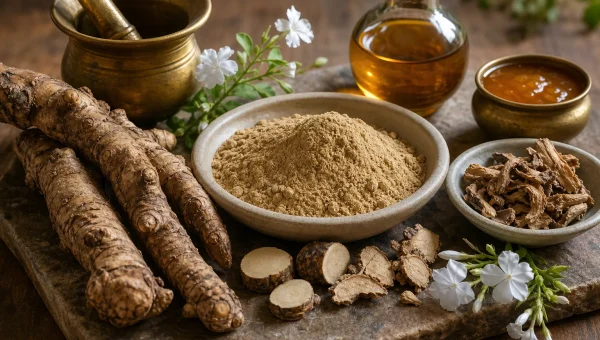
- Ashwagandha (Withania somnifera): The Ayurvedic Pharmacopoeia of India identifies the root as the official drug and describes it as Rasayana, Balya, Vatakaphapaha and useful in Vataroga and debility. It is most appropriate when tremor is accompanied by weakness, nervous exhaustion, poor sleep or Vata depletion. Traditional powder ranges must be individualized, especially in people using sedatives, thyroid medicines, blood-pressure medicines or immunomodulating therapy.
- Brahmi (Bacopa monnieri): The official drug is the dried whole plant. It is described as Medhya, Rasayana, Vatahara and Matiprada, making it suitable in a broader Vata-support plan when mental overactivity, poor concentration or nervous restlessness accompany tremor.
- Jatamansi (Nardostachys jatamansi): The rhizome is described as Medhya and Nidrajanana, with indications including Manasaroga and Anidra. It is best reserved for carefully selected patients where sleeplessness, agitation or mental strain aggravate Vata symptoms.
- External Vata care: Gentle oiling, warmth, regular meals, adequate sleep and avoidance of excessive caffeine or overexertion are often more important than adding multiple herbs. These measures support a stable daily rhythm and reduce common tremor amplifiers.
For a Parkinsonian / Kampavata pattern:
- Kapikacchu / Mucuna pruriens: Mucuna seed naturally contains levodopa, the same pharmacologically active precursor used in Parkinson’s medication. Because natural levodopa content varies widely between preparations, Mucuna must be treated as a medication-sensitive herb, not a casual supplement. It should not be combined with, substituted for or used to adjust levodopa-carbidopa therapy without coordinated supervision from a neurologist and qualified Ayurvedic physician.
- Shatavari (Asparagus racemosus): The Ayurvedic Pharmacopoeia describes the tuberous root as Balya, Rasayana, Medhya, Vatahara and nourishing in quality. It may be considered when dryness, depletion, poor strength or tissue weakness is prominent, provided digestion can tolerate its heavier and unctuous qualities.
- Amalaki (Emblica officinalis): The official fruit drug is described as Rasayana, Tridoshajit and cooling. It may be used as part of a supportive diet-and-rasayana plan, especially where heat, oxidative stress language, poor digestion or general tissue support are part of the clinical picture.
- Bowel-focused Vata care: Constipation is common in Parkinson’s disease and is also important in Ayurvedic assessment because Apana Vata and the lower bowel are central to Vata regulation. Laxative herbs, oils or formulations should be chosen by a practitioner rather than added indiscriminately, especially in elderly patients or those using multiple medicines.
The Srotas system helps explain why the therapeutic target differs. A tremor driven mainly by mobile Vata, fatigue, anxiety and task demand is treated differently from a parkinsonian presentation in which tremor appears with stiffness, slowed initiation, bowel disturbance, gait change and progressive functional decline.
Panchakarma Differentiation
Panchakarma should be selected by strength, age, diagnosis, bowel status and medication profile. It is not appropriate to apply the same cleansing or oil protocol to every tremor patient. In a frail person, overly strong procedures may aggravate Vata rather than pacify it.
For an essential-tremor-like pattern, the emphasis is usually gentle Vata-shamana: warm oil massage, calming head therapies, steady routine, sleep restoration and careful reduction of aggravating factors. Shirodhara is the classical-style procedure in which medicated oil or other liquids are poured in a steady stream over the forehead. In this context it is best understood as a calming supportive therapy, not a stand-alone cure for tremor.
For a Parkinsonian / Kampavata pattern, Basti receives special importance because Ayurveda treats Vata through its lower-bowel seat and because classical sources present medicated enema as a principal therapy for aggravated Vata. The exact choice of Anuvasana, Niruha, Matra, Yapana or other basti approaches depends on strength, digestion, constipation, dryness, rigidity and medication timing. It should be conducted only under trained supervision and should never interrupt prescribed neurological treatment.
The Critical Importance of Reassessment Over Time
A tremor that initially appears to be isolated essential tremor should be reassessed if new signs appear. Stiffness, slowness, reduced arm swing, smaller handwriting, shuffling gait, falls, constipation, reduced smell, REM sleep behavior disorder or clear asymmetry can change the diagnostic direction. In Ayurvedic language, the emergence of stambha, gatisanga, cheshtasanga and Apana Vata disturbance makes the presentation different from a simple mobile Vata tremor.
Timing also matters therapeutically. A long-standing action tremor without parkinsonian signs may have a slower and more stable course, whereas Parkinson’s disease is progressive and requires active neurological monitoring. Ayurvedic support can be useful for sleep, bowel regularity, stiffness, stress load and general strength, but it should be integrated early and safely rather than used as a reason to delay diagnosis.
Daily Management Protocols
Daily management should reduce Vata-aggravating factors while also respecting modern tremor triggers and neurological safety. The aim is steadiness: regular meals, regular sleep, warmth, gentle movement, bowel regularity and avoidance of overexertion.
For an essential-tremor-like pattern:
- Keep caffeine, sleep loss, emotional strain and fatigue under observation, as these commonly make action tremor more noticeable.
- Use slow, controlled movement practices rather than fast or exhausting exercise; balance and posture work should be safe and non-straining.
- Consider warm sesame-oil self-massage if suitable for the person’s constitution, skin and season, followed by a warm bath.
- Use adaptive tools, weighted utensils or occupational-therapy strategies when handwriting, eating or fine hand tasks are affected.
- When tremor interferes with daily function, consult a neurologist about established options such as propranolol, primidone, botulinum toxin or device/surgical options when appropriate.
For a Parkinsonian / Kampavata pattern:
- Do not delay levodopa or other prescribed Parkinson’s medicines when a neurologist has advised them; medication timing should be consistent and professionally monitored.
- Prioritize bowel regularity, hydration, safe mobility, fall prevention, speech and swallowing awareness, and physical or occupational therapy when needed.
- Gentle oil massage, foot massage, mild sweating, head therapies or nasya-style care should be individualized and avoided during acute illness, severe congestion, uncontrolled blood pressure or poor strength.
- Track non-motor symptoms such as constipation, sleep disturbance, mood change, reduced smell, urinary symptoms and dizziness on standing, as these affect quality of life and treatment planning.
- Review all herbs and supplements with both the Ayurvedic practitioner and the neurologist, especially Mucuna, sedative herbs, blood-pressure-lowering herbs and formulas taken near Parkinson’s medicines.
Integration With Modern Neurological Care
For both conditions, Ayurvedic management should function as a complementary layer, not a replacement for neurological assessment. Essential tremor, Parkinson’s disease, dystonic tremor, medication-induced tremor, thyroid-related tremor, cerebellar tremor and functional tremor can resemble each other. A neurologist may use history, examination, medication review, laboratory testing, neuroimaging or dopamine-transporter imaging when clinically appropriate.
The most productive model is collaborative care. The neurologist manages diagnosis, medication titration and disease monitoring, while Ayurvedic management supports sleep, digestion, bowel function, anxiety load, stiffness, daily routine, strength and quality of life. Any herb containing pharmacologically active constituents, especially Mucuna’s levodopa, requires the same caution that would be given to a drug.
Medical Disclaimer: This article is for educational purposes only. Tremor disorders require evaluation by a qualified healthcare provider or neurologist. Do not stop, replace or change Parkinson’s disease or essential tremor medicines without medical supervision. Consult a qualified Ayurvedic practitioner before starting herbs, oils, nasya, basti or Panchakarma, especially if pregnant, elderly, frail, managing a chronic condition or taking medication.
References
- Movementdisorders (movementdisorders.org)
- Mayoclinic (mayoclinic.org)
- Parkinson (parkinson.org)
- NCBI
- Mayoclinic (mayoclinic.org)
- Ninds (ninds.nih.gov)
- Mayoclinic (mayoclinic.org)
- Mayoclinic (mayoclinic.org)
- NCBI
- How Common is Essential Tremor? Update on the Worldwide Prevalence of Essential Tremor (2021), PubMed Central
- NCBI
- World Health Organization
- Essential pitfalls in “essential” tremor (2017), PubMed Central
- Jamanetwork (jamanetwork.com)
- Frontiersin (frontiersin.org)
- Parkinson (parkinson.org)
- Hopkinsmedicine (hopkinsmedicine.org)
- REM sleep behavior disorder correlates with constipation in de novo Chinese Parkinson’s disease patients (2023), PubMed
- Pdfs (pdfs.semanticscholar.org)
- Jaims (jaims.in)
- Jaims (jaims.in)
- Ayurvedic Pharmacopoeia of India
- Ayurvedic Pharmacopoeia of India
- The Magic Velvet Bean of Mucuna pruriens (2012), PubMed Central
- Nature (nature.com)
- Mucuna pruriens in Parkinson’s disease: a double blind clinical and pharmacological study (2004), PubMed
- Mucuna pruriens in Parkinson disease: A double-blind, randomized, controlled, crossover study (2017), PubMed Central
- RIVM (Netherlands)
- Jamanetwork (jamanetwork.com)
- Ayurvedic Pharmacopoeia of India
- Shirodhara: A psycho-physiological profile in healthy volunteers (2013), PubMed Central
- Impact of Shirodhara on biological markers of stress: A case study (2021), PubMed Central
- Charaka Samhita — Basti
- Charaka Samhita — Basti
- Charaka Samhita — Asthapana basti
- Charaka Samhita — Vatavyadhi Chikitsa
- Charaka Samhita — Madhutailika Basti
- Charaka Samhita — Madhutailika Basti