
Devadaru (Cedrus deodara), the Himalayan cedar, is one of Ayurveda’s practical but often overlooked tree medicines for Vata-Kapha disorders. The authentic Ayurvedic drug is the dried heartwood, not a generic “cedar bark” powder and not perfume-grade cedarwood essential oil. Its traditional value is strongest where stiffness, cold-aggravated pain, swelling, Kapha congestion, itching, chronic nasal catarrh, cough, and Ama-type heaviness appear together.
The herb’s benefit is not that it acts like a single modern pain tablet. In the Ayurvedic view, Devadaru is useful because its heating, light, slightly unctuous, bitter, and Kapha-Vata-reducing profile fits a specific pattern: cold, obstructed, heavy, stiff, mucus-laden, or swollen conditions in which Vata is blocked by Kapha or Ama. That is why it appears in classical formulation contexts rather than only as a stand-alone supplement.
What the Classical and Pharmacopoeial Sources Say About Devadaru
The name Devadaru is commonly explained from Sanskrit as “wood of the gods” or “divine wood.” Ayurvedic pharmacopeial sources identify Devadaru as the dried heartwood of Cedrus deodara (Roxb.) Loud., a large evergreen Himalayan conifer of the Pinaceae family. The plant is recorded from the north-western Himalayas, and broader botanical sources place its native range from north-eastern Afghanistan through the western Himalaya into north-western India and western Nepal.
The Ayurvedic Pharmacopoeia of India gives Devadaru the following classical profile: rasa (taste) is tikta (bitter); guna (qualities) are laghu (light) and snigdha (unctuous); virya (potency) is ushna (hot); vipaka (post-digestive effect) is katu (pungent). Its listed actions include Kaphahara, Vatahara, and Dushtavrana Shodhaka, meaning it is traditionally used to reduce Kapha, pacify Vata, and cleanse unhealthy wounds.
The same pharmacopoeial monograph lists therapeutic uses that explain the herb’s broad reputation: shotha (swelling), jvara (fever), krimi (worm infestation), kandu (itching), pinasa (chronic nasal catarrh), vibandha (constipation), adhmana (abdominal distension), tandra (drowsiness/heaviness), hikka (hiccup), prameha, kasa (cough), kushtha (skin disorders), amavata, raktavikara, and sutikaroga. These indications make Devadaru especially relevant to Vata-Kapha patterns rather than to every type of pain, cough, or skin complaint.
Why Devadaru Is Considered Vatahara and Kaphahara
Devadaru’s Ayurvedic logic begins with its ushna virya. Heating potency is important in Vata-Kapha disorders because both can express coldness, heaviness, stagnation, stiffness, and obstruction. The laghu quality helps oppose heaviness, the snigdha quality supports Vata pacification without making the drug excessively drying, and the bitter taste gives it a scraping, clearing direction appropriate for Kapha and Ama-associated conditions.
In joint complaints, this profile is most appropriate when pain is accompanied by stiffness, swelling, heaviness, sluggish digestion, cold aggravation, or a sense of obstruction. In respiratory complaints, it is more suitable for thick, heavy, Kapha-type congestion than for dry, burning, Pitta-type irritation. In skin conditions, the classical emphasis is on itching, chronicity, unhealthy wounds, and Kapha-Vata involvement.
Phytochemistry: The Plant Constituents Behind Its Traditional Profile
Modern phytochemical summaries describe Devadaru heartwood and related plant parts as containing terpenoids, flavonoids, and glycosides. Reported constituents include alpha-himachalene, beta-himachalene, himachalol and related sesquiterpene alcohols, atlantone-type compounds, deodarin, cedrin, taxifolin, and other phenolic or lignan-type compounds. This chemistry fits the aromatic, resinous, penetrating nature that practitioners associate with Devadaru.
Experimental pharmacology has described anti-inflammatory, analgesic, antimicrobial, antispasmodic, immunomodulatory, and related biological activities for Cedrus deodara preparations. These findings should be understood as supportive context, not as a replacement for individualized clinical diagnosis or proof that any commercial Devadaru product will treat a disease by itself.
Clinical Applications: Where Devadaru Fits Best
Devadaru is most useful when the practitioner’s assessment points to Vata-Kapha obstruction, Ama, swelling, cold stiffness, mucus accumulation, itching, or chronic non-healing tissue states. It is less appropriate as a general “pain herb” for every constitution or every inflammatory condition.
1. Joint Pain, Stiffness, Swelling, and Amavata-Type Patterns
The Ayurvedic Pharmacopoeia lists shotha and amavata among Devadaru’s therapeutic uses, which supports its traditional role in joint stiffness and swelling when the presentation is cold, heavy, sluggish, and obstructed. Charaka’s discussion of vatarakta also places Vata-related joint disease within a broader inflammatory rheumatic framework, especially where pain, swelling, discoloration, and tissue involvement appear in the extremities.
- Best fit: cold-aggravated stiffness, heaviness, swelling, sluggish digestion, and pain that feels obstructive rather than burning.
- Less suitable: intense burning, redness, heat, and sharp Pitta-dominant inflammation unless balanced by a qualified practitioner.
- Common clinical direction: Devadaru is usually combined with other herbs and formulations rather than used as a one-herb cure.
2. Sinus Congestion, Pinasa, Cough, and Kapha-Type Respiratory Complaints
The pharmacopoeial uses pinasa and kasa support Devadaru’s place in upper respiratory and cough presentations where Kapha is heavy, sticky, and obstructive. Its aromatic heartwood and Vata-Kapha-reducing profile make it more relevant to chronic congestion, mucus heaviness, and blocked channels than to dry cough from depletion or burning throat irritation.
- Best fit: thick mucus, blocked nose, heaviness in the head, chronic catarrh, and cough with Kapha dominance.
- Supportive approach: warm water, light meals, avoidance of heavy cold foods, and physician-selected formulations often matter as much as the herb itself.
- Caution: essential oil inhalation, steam use, and internal use of aromatic oils should not be improvised.
3. Itching, Skin Disorders, and Unhealthy Wounds
Devadaru’s listed actions include Dushtavrana Shodhaka, and its therapeutic indications include kandu and kushtha. In practical terms, this places it in the Ayurvedic toolkit for itching, chronic skin conditions, and unhealthy wound states where Kapha-Vata features such as thickness, stagnation, roughness, itching, and chronicity are present.
- Internal use: considered only after constitution, digestion, bowel pattern, and disease stage are assessed.
- External use: appears in medicated oil contexts, but classical taila preparation is more precise than simply mixing powder into oil at home.
- Medical care: infected, spreading, bleeding, or non-healing wounds require qualified medical evaluation.
4. Abdominal Distension, Constipation, and Kapha-Ama Heaviness
The pharmacopoeial indications vibandha and adhmana support Devadaru’s use in Vata-Kapha digestive patterns marked by constipation, gas, distension, and heaviness. Its heating and channel-clearing nature makes sense when digestion is dull and symptoms worsen with cold, heavy, oily, or mucus-forming foods.
- Best fit: cold abdominal heaviness, sluggish bowels, bloating, and Kapha-type lethargy.
- Less suitable: burning acidity, loose stools with heat, dehydration, or strong Pitta aggravation.
- Clinical note: digestive use should be matched to diet, bowel habit, and constitution rather than taken as a universal laxative.
How Devadaru Is Prepared in Ayurveda
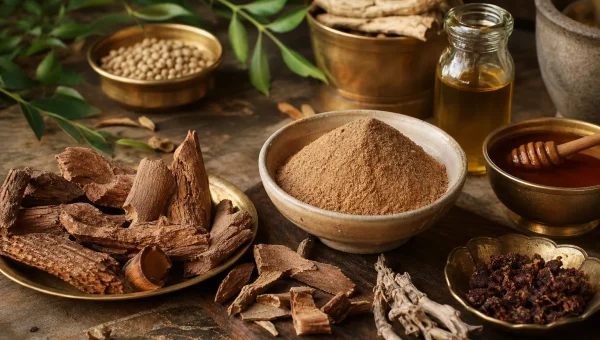
The most authentic internal material is coarse or fine powder of the dried heartwood. Traditional decoction and medicated oil preparations are also used, but their strength depends on the exact plant part, particle size, water or oil ratio, heating method, and the other herbs in the formula.
| Preparation | Traditional Basis | Typical Use Context | Important Note |
|---|---|---|---|
| Churna (heartwood powder) | Ayurvedic Pharmacopoeia dose: 3-6 g of the drug in powder form | Vata-Kapha stiffness, swelling, Kapha congestion, digestive heaviness | Use under practitioner guidance, especially for more than short-term use |
| Kwatha (decoction) | Prepared from coarse herbal material by boiling in water and reducing | When a stronger liquid preparation is selected by a practitioner | Fresh decoctions spoil quickly and should not be stored like capsules |
| Taila (medicated oil) | Devadaru appears in classical medicated oil formulation contexts | External Vata-Kapha stiffness, chronic local discomfort, selected skin use | Classical taila is not the same as undiluted essential oil |
| Compound formulations | Listed in traditional formulations such as Dashamularishta, Devadarvarishta, Narayana Taila, and Mahavishagarbha Taila | Used according to the full formulation’s indication, not Devadaru alone | Formula choice should be individualized |
Churna: The Simplest Classical Form
Devadaru churna is the powdered heartwood. The pharmacopoeial dose is 3-6 g of the drug in powder form. In practice, the dose, timing, and anupana such as warm water are chosen according to constitution, digestion, strength, age, and the disease pattern.
Kwatha: Decoction for a Stronger Traditional Extraction
Kwatha is a classical decoction method in which coarse herbal material is boiled in water and reduced before filtration. For Devadaru, a decoction should be treated as a practitioner-directed preparation because the drug is heating, the heartwood is aromatic and potent, and the final strength depends on how the decoction is prepared.
Taila: External Medicated Oil Use
Devadaru is traditionally associated with medicated oil contexts for Vata-Kapha stiffness and local discomfort. A true medicated oil is prepared through established Ayurvedic pharmaceutical methods; it should not be confused with applying undiluted cedarwood essential oil to the skin or ingesting essential oil.
Classical Formulations That Include Devadaru
Devadaru rarely needs to stand alone. The Ayurvedic Pharmacopoeia lists it in important formulations including Khadirarishta, Dashamularishta, Devadarvarishta, Mrtasamjivanisura, Karpuradyarka, Pramehamihira Taila, Candanadi Churna, Sudarshana Churna, Narayana Taila, Pradarantaka Lauha, Vataraktanaka Lauha, and Mahavishagarbha Taila.
This formulation context is important. Dashamularishta and Devadarvarishta are not interchangeable; Narayana Taila and Mahavishagarbha Taila are external or oil-based contexts with different indications; Vataraktanaka Lauha belongs to a different clinical framework than a simple cough or sinus formula. The presence of Devadaru in a formulation does not mean the formulation is appropriate for every person who has joint pain or congestion.
Sourcing Authentic Devadaru
Quality matters because the official Ayurvedic drug is heartwood. The Ayurvedic Pharmacopoeia describes Devadaru wood as moderately hard, light yellowish-brown to brown, aromatic, and brownish-yellow and oily when powdered. Material sold as generic cedar, bark, fragrance wood, sawdust, or unidentified powder should not be treated as equivalent to pharmacopoeial Devadaru.
- Plant identity: look for the botanical name Cedrus deodara and the plant part “heartwood.”
- Aroma and appearance: authentic material should have an aromatic woody character and should not be dull, musty, moldy, or odorless.
- Testing: prefer suppliers that provide botanical authentication and contaminant testing, especially for heavy metals, microbial load, and adulterants.
- Oil distinction: heartwood powder, decoction, medicated oil, and essential oil are different preparations with different safety profiles.
Safety, Contraindications, and Responsible Use
Educational note: Consult a qualified Ayurvedic physician or healthcare provider before using Devadaru therapeutically, especially if you are pregnant, nursing, elderly, treating a child, have kidney or liver disease, have a chronic inflammatory condition, or take prescription medicines.
Devadaru is heating and has a pungent post-digestive effect, so it is not automatically suitable for strong Pitta presentations such as burning acidity, heat-dominant rashes, bleeding tendency, intense thirst, or inflammatory states with marked heat. It is also not a substitute for urgent care when pain is severe, joints are hot and acutely swollen, breathing is difficult, fever is persistent, or wounds are infected.
- Pregnancy and nursing: use only with professional guidance.
- Children: do not dose by adult measures; pediatric use requires qualified supervision.
- Essential oil: do not ingest Devadaru or cedarwood essential oil unless it is part of a properly regulated medicinal product prescribed by a qualified professional.
- Commercial products: avoid products without botanical identification, plant-part labeling, batch details, or contaminant testing.
- Conventional care: do not delay diagnosis or treatment for arthritis, gout, asthma, chronic sinus infection, skin infection, or unexplained swelling.
Devadaru remains valuable precisely because it is specific. It is not a fashionable universal anti-inflammatory, but a classical Vata-Kapha herb with a clear identity, clear pharmacopoeial properties, and a practical place in joint, respiratory, skin, and digestive patterns where coldness, obstruction, swelling, itching, Kapha heaviness, and Vata stiffness overlap.
References
- Ayurvedic Pharmacopoeia of India
- Powo (powo.science.kew.org)
- Dictionary (dictionary.com)
- Academic (academic.oup.com)
- Studies on the anti-inflammatory and analgesic activity of Cedrus deodara (Roxb.) Loud. wood oil (1999), PubMed
- Researchgate (researchgate.net)
- Charaka Samhita — Vatarakta Chikitsa
- Easyayurveda (easyayurveda.com)
- NCCIH
- Poison (poison.org)

This herb is not me but the patient in your opening paragraph is very similar to my situation. Three years of NSAIDs and two cortisone injections before I tried Devdaru. The skepticism followed by conversion is also the same.
Why does Western herbalism not know Devdaru? The article mentions this but doesn’t explain whether it’s because the cedar species available in Europe and North America are pharmacologically different or just a knowledge gap.
The Himalayan Cedar is in the same genus as the Lebanon Cedar and Atlas Cedar used in Middle Eastern and North African traditional medicine. The comparison might be worth exploring given those traditions do use cedar therapeutically.
I’ve been using Devdaru powder in warm milk for knee and lower back pain for four months. The inflammation level is clearly reduced based on how my knees feel on stairs. I’m 52 and stairs were becoming an issue.
Is Devdaru safe alongside thyroid medication? I’m on levothyroxine and want to be sure the sesquiterpene compounds don’t affect absorption or thyroid function.
The story about Ranjit’s skepticism turning into relief after six weeks really resonates with my own experience trying herbal remedies for knee stiffness.
Useful post on Devdaru (Himalayan Cedar). The main idea is clear even if someone is new to Ayurveda.
I wonder how the bark powder’s resinous aroma compares to other cedar varieties when assessing quality.
I tried Devdaru after reading this six weeks ago. No dramatic results for my chronic hip pain but no adverse effects either. Will continue for another two months before deciding.
A practical tip I found useful is to look for a golden brown color and request a certificate of analysis before buying.
My father’s Ayurvedic doctor in Uttarakhand has been prescribing Devdaru bark for over 30 years and says it’s his most reliable herb for old Vata accumulation in joints. The clinical observation matches what this article describes.
The combination of Devdaru with Shallaki and Guggulu mentioned in the joint formula sounds like a balanced approach worth discussing with a practitioner.
For sinus congestion, the idea of using Devdaru alongside turmeric and tulsi makes sense given its bronchodilatory properties.
The positioning as something Western herbalism missed is a bit promotional. Western herbalism has missed many things. The herb’s efficacy should stand on its own evidence rather than the framing.
Reading about the classical texts describing Devdaru as ‘wood of the gods’ adds a nice cultural layer to its therapeutic profile.
Found genuine Devdaru powder from a reputable Ayurvedic pharmacy after this article. The quality difference from what I’d been ordering online is immediately apparent in the smell and texture.
I appreciate the clear preparation steps for the decoction, especially the overnight soak and quarter volume reduction.
Safety notes about pitta types and pregnancy remind me to check with my Ayurvedic doctor before trying higher doses.
The herb’s relative obscurity may protect it from adulteration, which could be a hidden advantage for sourcing authentic material.
My father had a similar journey with knee pain, rotating through the same kind of interventions with diminishing returns. I’m curious about the mechanism with Devdaru specifically — is the anti-inflammatory action primarily local to the joints, or does it work systemically? Asking because his back pain and knee pain seem to come and go together.
@Anita added Boswellia extract to my IBD protocol alongside my GI’s blessing. the frequency of flares reduced noticeably 💯
for joint inflammation vs IBD, is the dosing protocol different or same Boswellia preparation
does Boswellia interact with immunosuppressants. the article doesnt address combination therapy asked this earlier
the 2026 IBD data looks promising but effect sizes in those trials are modest. dont stop your gastroenterologist treatment
does Boswellia interact with immunosuppressants. the article doesnt address combination therapy 🙏
does Boswellia interact with immunosuppressants. the article doesnt address combination therapy
the 2026 IBD data looks promising but effect sizes in those trials are modest. don’t stop your gastroenterologist treatment
🙌 for joint inflammation vs IBD, is the dosing protocol different or same Boswellia preparation
for joint inflammation vs IBD, is the dosing protocol different or same Boswellia preparation asked this recently
the AKBA percentage matters a lot for efficacy. is the standard Boswellia extract in India typically 65% or 30 🌿
for joint inflammation vs IBD, is the dosing protocol different or same Boswellia preparation asked this last week
weather-triggered joint pain in my knees every monsoon. started Boswellia 400mg AKBA form, this is the first spring with minimal impact
the AKBA percentage matters a lot for efficacy. is the standard Boswellia extract in India typically 65% or 30
🌿 i tried Boswellia for 3 months for my knee, zero effect. maybe my inflammation is a different type
the 2026 data on IBD is encouraging. my gastroenterologist actually referenced the same trials you cite
added Boswellia extract to my IBD protocol alongside my GI’s blessing. the frequency of flares reduced noticeably
for joint inflammation vs IBD, is the dosing protocol different or same Boswellia preparation asked this just now
for joint inflammation vs IBD, is the dosing protocol different or same Boswellia preparation ❤️
the 2026 IBD data looks promising but effect sizes in those trials are modest. dont stop your gastroenterologist treatment asked this just now
does Boswellia interact with immunosuppressants. the article doesn’t address combination therapy
the 2026 data on IBD is encouraging. my gastroenterologist actually referenced the same trials you cite asked this last week
the 2026 IBD data looks promising but effect sizes in those trials are modest. dont stop your gastroenterologist treatment asked this recently
does Boswellia interact with immunosuppressants. the article doesnt address combination therapy asked this just now
the 2026 IBD data looks promising but effect sizes in those trials are modest. dont stop your gastroenterologist treatment asked this earlier
weather-triggered joint pain in my knees every monsoon. started Boswellia 400mg AKBA form, this is the first spring with minimal impact asked this just now