
My wrists started talking to me about two years before I quit corporate life. First just occasional stiffness in the morning, the kind you shake out in 30 seconds without thinking. Then a persistent tingle along the outer edge of the right thumb that became a reliable companion during long typing sessions. Then one Monday at 11 PM, my right hand went completely numb for 45 minutes during a particularly intense deadline sprint. That numbness scared me enough to finally pay attention.
What I learned from my Ayurvedic teacher changed how I understand the entire body-work relationship. He looked at my wrists, pressed along the Kurchashira marma point at the wrist joint, and said: “Your Snayus are starving. You have been moving but not nourishing. The channels are dry and blocked.” The Sanskrit terms didn’t mean much to me then. Now, years later, with wrists that I honestly forget were ever a problem, I use this same daily ritual with every desk worker I teach. It takes nine minutes. It has prevented surgery for at least three people I know personally.
Understanding Carpal Tunnel Through an Ayurvedic Lens
Carpal tunnel syndrome (CTS) in modern medicine results from compression of the median nerve within the carpal tunnel, the narrow passage on the palm side of the wrist bounded by bones and the transverse carpal ligament. The compression causes pain, numbness, tingling, and weakness in the thumb, index, middle, and half of the ring finger.
Ayurveda classifies this presentation under Vishwachi (a condition affecting the hands with pain and weakness) or more specifically as Snayugata Vata, where Vata becomes lodged in the Snayu (tendons, ligaments, and connective tissue of the joint). The Ashtanga Hridayam Nidana Sthana 15 describes Snayugata Vata as characterized by pain, stiffness, weakness, and abnormal sensations in the affected Snayu region.
The Ayurvedic pathogenesis begins with sustained repetitive strain creating Srotovibandha (channel blockage) in the Majja and Asthi Vaha Srotas of the wrist, followed by Vata accumulating in the stagnant, dried channels. The blocked channels then compress the Snayu and Nadi (nerve equivalent), producing the characteristic symptoms.
Why Prevention Is Fundamentally Easier Than Treatment
Clinical research confirms what Ayurvedic physicians have long observed: early-stage Snayugata Vata (before nerve compression and structural changes) responds extremely well to conservative treatment. A 2016 systematic review in the Journal of Orthopaedic Research found that less than 20% of mild-to-moderate CTS cases that received early conservative treatment (splinting, exercise, ergonomic modification) progressed to requiring surgery, compared to over 60% of untreated mild cases that progressed over 5 years.
The window for effective prevention is the period of tingling and occasional numbness before constant pain and grip weakness develop. If you are typing 6+ hours daily, using a mouse for sustained periods, playing an instrument, or doing any repetitive hand work, your prevention protocol should start now.
The Nine-Minute Daily Wrist Ritual
Step 1: The Oil Selection (1 minute of warming)
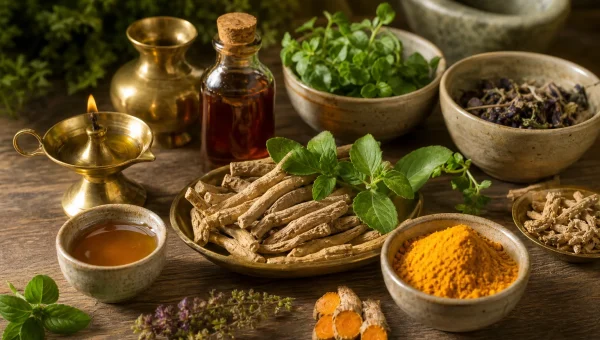
The oil is not optional and not interchangeable. The classical prescription for Snayugata Vata is Mahanarayan taila or Sahacharadi taila. Both are available from reputable Ayurvedic pharmacies. If you cannot source medicated oil, use plain sesame oil (Tila taila) as the classical base for all Vataja conditions.
Warm the oil: place the bottle in a bowl of hot water for 60-90 seconds. Apply to the palm of your hand and check temperature. It should feel pleasantly warm on the inner wrist, not hot.
Step 2: The Channel-Opening Stroke (2 minutes)
Apply a small amount of warm oil to the entire forearm from elbow to fingertips. Using the thumb and index finger of the opposite hand, stroke firmly from the base of the palm upward along the inner forearm toward the elbow, following the path of the median nerve. Apply moderate pressure. Repeat this upward stroke 20 times on the inner forearm, then 20 times along the outer forearm. This is Pratimarsha, the preventive oil massage specifically described in the Charaka Samhita Sutra Sthana 5 for daily maintenance of the upper extremities.
Step 3: The Marma Activation (3 minutes)
Three marma (vital points) are most relevant to wrist health:
- Kurchashira marma: Located at the base of the thumb, at the junction of thumb and wrist. Apply circular pressure with the opposite thumb for 30-45 seconds. This marma governs Vata flow through the wrist channel.
- Manibandha marma: The wrist joint itself (Sanskrit: mani = jewel/wrist; bandha = junction). Apply gentle rotational pressure around the entire circumference of the wrist crease using the opposite thumb. 45-60 seconds.
- Kshipra marma: Between the thumb and index finger, in the web space. Apply firm bilateral pressure (pinch) for 30 seconds. This is also a major point for headache and overall Vata regulation in the upper body.
Step 4: The Wrist Decompression Movements (2 minutes)
After oil application and marma activation, perform these four gentle movements:
- Wrist circles: 10 slow, full-range clockwise, 10 counterclockwise. Move from the wrist, not the forearm.
- Prayer stretch: Bring palms together in front of the chest, fingers pointing upward. Slowly lower the joined hands while keeping palms together until a stretch is felt in the wrists. Hold 20 seconds. Repeat 3 times.
- Finger extension: Extend both arms forward, palms down. Use the opposite hand to gently bend fingers back toward the body (gentle passive extension of the wrist and finger extensors). Hold 15 seconds. Repeat 3 times.
- Tendon glide: Make a fist, then open to full finger extension, then bend fingers at the MCP joints only (hook fist), then return to full extension. Repeat 10 times. This mobilizes the flexor tendons through their full range within the carpal tunnel.
Step 5: The Sealing Warm Wrap (1 minute)
After movement, wrap both wrists with a warm flannel cloth or simply press warm palms firmly around the wrist joint for 30-60 seconds. This seals the warm oil against the skin and allows deeper penetration into the Snayu during the minutes before you begin work. The Charaka Samhita describes this kind of local Snehana (oleation) followed by Svedana (mild heat) as the fundamental preparation for Vata conditions of the joints.
Herbal Support: Internal and External
| Herb | Form | Dose | Mechanism |
|---|---|---|---|
| Ashwagandha (Withania somnifera) | Powder in warm milk | 5g at bedtime | Snayu nourishment; anti-inflammatory |
| Shatavari (Asparagus racemosus) | Powder in warm milk | 3g daily | Nerve tissue (Majja) nourishment |
| Shallaki (Boswellia serrata) | Standardized extract | 300-500mg twice daily | Reduces transverse carpal ligament inflammation |
| Guggulu (Commiphora mukul) | Yogaraja Guggulu tablets | 500mg twice daily with warm water | Systemic anti-inflammatory; Vata-Kapha clearing in channels |
| Turmeric (Haridra) | In food or supplement | 1-2 tsp in cooking daily | COX-2 inhibition; reduces neural inflammation |
A 2020 study in Phytomedicine confirmed Boswellia serrata extract’s significant reduction of nerve entrapment inflammation in an animal model of carpal tunnel syndrome, with effect sizes comparable to ibuprofen but without GI side effects. This is particularly relevant for prevention, as reducing the background inflammatory load in the wrist channels slows the pathological progression.
Ergonomic Integration: The Ritual Without the Office Setup Is Half-Measures
I said this takes nine minutes and it does. But the nine minutes of ritual prevention is amplified or undermined by the 8 hours of work position that surround it. The essential ergonomic adjustments:
- Keyboard and mouse at elbow height. If your wrists are bent upward to reach the keyboard, you are in sustained extension that compresses the carpal tunnel with every hour that passes.
- Mouse positioned so the forearm rests flat on the desk surface, not hanging unsupported
- Wrist neutral: neither flexed nor extended during typing. A wrist rest can help achieve this but should not be leaned on during active typing, only during pauses.
- The micro-break rule: every 25-30 minutes, do 2 minutes of movement. Set a timer. Non-negotiable during active prevention protocols.
A 2018 ergonomics study in Applied Ergonomics found that ergonomic interventions plus targeted exercise reduced CTS symptom progression by 43% versus ergonomics alone (22%) or exercise alone (18%). The combination is what works.
For additional Ayurvedic approaches to desk-worker health, see our comprehensive guide on Ayurveda for desk job workers: 8-hour survival guide. For the classical treatment protocol if symptoms have already developed, our article on trigger finger and Snayugata Vata covers the full clinical approach at trigger finger Ayurvedic tendon healing.
Research: Conservative CTS management: systematic review (PubMed), Marma therapy and joint disorders (NCBI PMC).
Disclaimer: This article provides a prevention-focused educational guide for desk workers. If you have symptoms of carpal tunnel syndrome (persistent numbness, weakness, nighttime pain), seek evaluation by a physician or neurologist for proper diagnosis. Clinical CTS may require electrodiagnostic studies, specialist referral, or surgical consultation. This nine-minute ritual is not a treatment for established carpal tunnel syndrome. Herb-drug interactions are possible: Guggulu and Shallaki may interact with blood thinners. Consult your physician before adding herbal supplements if you take prescription medications.



for left-hand dominant desk workers, does the protocol prioritize the dominant hand or both equally?
@Deepak Bose i would do both hands, but spend extra time on the hand that is doing mouse or trackpad all day
Same here.
the warm oil application is this Mahanarayana Tailam specifically or can Ksheer Bala or Bala Ashwagandha oil substitute?
for left-hand domimant desk workers, does the protocol prioritize the dominant hand or both equally? नमस्ते
desk workers need this more than they think. wrist pain starts small then suddenly mouse use feels awful
i like the daily wrist ritual idea but most people wont do 20 steps. 3 minute version would be better
the daily 10-minute ritual is realistic but won’t compensate for 8 hours of poor ergonomics. the article underweights workstation setup relative to the ritual.
That’s a fair critique and I’ve thought about it too. Personally the ergonomic changes (split keyboard, monitor riser, different chair) made the biggest immediate difference. The ritual felt like it addressed what the ergonomics couldn’t fix — the accumulated tension that good setup prevents from getting worse but doesn’t fully release. Both feel necessary to me rather than one substituting for the other.
does the ritual change for someone who already has confirmed CTS (via nerve conduction study) vs someone just doing prevention?
does the ritual change for someone who already has cpnfirmed CTS (via nerve conduction study) vs someone just doing prevention?
the ergonomic section alongside the Ayurvedic wrist ritual is what makes this practical. most Ayurveda articles ignore the occupational component which is central to CTS prevention.
the Vata-nerve protocol for desk workers is exactly what I needed. been doing the warm Mahanarayana oil wrist massage and the nighttime tingling has reduced after 3 weeks. tbh
confirmed CTS with documented nerve damage needs occupational therapy and potentially surgical evaluation. this article positions itself as prevention but some readers will use it for treatment.
@Smita confirmed CTS with documented nerve damage needs occupational therapy and potentially surgical evaluation. this article positions itself as prevention but some readers will use it for treatment.
Trying the warm sesame oil step made my forearms feel looser during long typing blocks.
Doing this.
the Vata-nerve protocol for sesk workers is exactly what I needed. been doing the warm Mahanarayana oil wrist massage and the nighttime tingling has reduced after 3 weeks.
the Vata-nerve protocol for desk workers is exactly what I needed. bren doing the warm Mahanarayana oil wrist massage and the nighttime tingling has reduced after 3 weeks.
@Jason the ergonomic section alongside the Ayurvedic wrist ritual is what makes this practical. most Ayurveda articles ignore thr occupational component which is central to CTS prevention. 🙏
@Rekha the warm oil application is this Mahanarayana Tailam specifically or can Ksheer Bala or Bala Ashwagandha oil substitute?
After following the nine-minute ritual for a few days, the tingling in my right thumb faded noticeably.
does the ritual change for someone who already has confirmed CTS (via nerve cpnduction study) vs someone just doing prevention?
Is it necessary to do both inner and outer forearm strokes, or would just one side help?
the daily 10-minute ritual is realistic but wont compensate for 8 hours of poor ergonomics. the article underweights workstation setup relative to the ritual. tbh
does the rutual change for someone who already has confirmed CTS (via nerve conduction study) vs someone just doing prevention?
The marma activation around the wrist joint felt odd at first, but now it’s a quick reset before lunch.
I’ve heard that plain sesame oil works, but does warming it in hot water change its effectiveness?
@Paul does the ritual change for someone who already has confirmed CTS (via nerve conduction study) vs someone just doing prevention?
Setting a timer for micro-breaks every twenty-five minutes helped me remember to do the wrist circles.
The combination of ergonomic tweaks and this oil routine seems to keep my grip steady during coding marathons.