
Nobody told me about the pelvic floor until after my second delivery. My gynecologist mentioned Kegel exercises in passing at my 6-week checkup. Three years later I was leaking when I sneezed and had a constant heaviness in my pelvis that I had normalized so thoroughly I only noticed it when it occasionally got worse. When I finally asked a pelvic floor physiotherapist about it, she looked at my assessment and said, “This is fixable. It is also very common, and it is significantly undertreated.”
Pelvic floor dysfunction affects an estimated 25-50% of women at some point in their lives, with rates increasing after childbirth and menopause. Stress urinary incontinence (leaking with movement, sneezing, coughing), overactive bladder, pelvic organ prolapse, pelvic pain, and sexual dysfunction all fall under this umbrella. The medical response is typically physical therapy (when resourced), pessaries for prolapse, and surgery in advanced cases.
Ayurveda has a sophisticated framework for pelvic floor health that predates both physical therapy and surgical intervention, centered on the concept of Apana Vata – the downward-moving sub-dosha of Vata that governs the elimination, reproductive, and pelvic functions. When Apana Vata is in balance, the pelvic organs are properly supported, elimination is smooth and complete, and the muscles and fascia of the pelvic floor maintain appropriate tone. When Apana Vata is disturbed, the entire pelvic region becomes dysfunctional.
Understanding Apana Vata and the Pelvic Floor
Apana Vata (Apana Vayu) governs urination, defecation, menstruation, childbirth, and sexual function – precisely the functions that pelvic floor dysfunction affects. Its principal seat (Sthana) is the pakvashaya (colon and lower abdomen), with its sphere of action extending to the bladder, genitals, groin, and pelvis. Classical descriptions of the five Vayus and their individual seats and functions appear in Sushruta and in Ashtanga Hridaya Sutrasthana 12, while Charaka enumerates the Vata sub-types in Chikitsasthana 28. (Charaka Sutrasthana 12, Vatakalakaliya, discusses Vata in general terms; it is the later sections – Chikitsasthana 28 and the Sushruta/Ashtanga Hridaya accounts – that detail Apana’s specific sites and functions.) When Apana functions properly, it enables the smooth, complete, and timely downward expulsion of urine, feces, flatus, menstrual blood, and the fetus through the pelvic channels.
What disturbs Apana Vata in the context of pelvic floor health?
- Childbirth, especially multiple vaginal deliveries (direct mechanical disruption)
- Chronic constipation (creates downward Vata straining that weakens fascial support)
- Postmenopause (loss of nourishment and tissue tone; estrogen decline reduces pelvic floor collagen and muscle mass, paralleling a Vata-aggravating, drying shift)
- Habitual suppression of natural urges (Vegadharana) – Charaka Sutrasthana 7 lists holding urine, stool, and gas among the urges that must not be suppressed; their suppression directly disturbs Apana Vata
- Excessive physical straining (Atiyoga of downward-acting activities) – heavy lifting, chronic cough
- Cold, dry foods that aggravate Vata systemically
The Yoga Protocol: Restoring Apana Vata Through Movement
Pelvic floor restoration requires both strengthening weak muscles and releasing hypertonic (overly tight) ones – a nuance that standard Kegel advice misses entirely. Many women with pelvic floor dysfunction have tight rather than weak muscles, and Kegel exercises in this context make symptoms worse. An Ayurvedic approach begins with assessment: is the pelvic floor lax and weak (Vata-depleted, lacking tone) or tight and painful (Vata-aggravated, over-contracted)?
For Lax/Weak Pelvic Floor (Vata Depletion Pattern)
When the tissue lacks tone, the aim is gentle, rhythmic strengthening that builds support without exhausting the muscle. The following practices restore tone while keeping Apana’s downward movement smooth rather than forced.
- Mula Bandha (Root Lock): The classical Hatha Yoga practice of gentle perineal contraction and release. Not the sustained Kegel hold, but a rhythmic contraction-release. Practice: Contract the perineum gently (as if stopping urinary flow), hold 5 seconds, release completely for 10 seconds. 10-15 repetitions, twice daily. Begin with only gentle contractions; do not force.
- Malasana (Squat Pose): Full squat with heels on the ground if possible, or supported on a folded blanket. This position engages and gently stretches the pelvic floor simultaneously and mirrors the natural squatting posture traditionally used for elimination. (Malasana is a Hatha Yoga asana; the squatting elimination posture is part of traditional living rather than a pose named in the classical dinacharya texts.) Hold 60 seconds, daily.
- Setu Bandhasana (Bridge Pose): Supine, knees bent, feet hip-width, lift hips while engaging pelvic floor. Hold 5 breaths, lower, repeat 10 times. Strengthens gluteus maximus and pelvic floor synergistically.
- Viparita Karani (Legs Up the Wall): 10-15 minutes daily. Reverses the constant downward gravitational pull on the pelvic organs, eases pelvic venous congestion, and is deeply restful and Vata-pacifying. It is a gentle supportive practice; it is not a substitute for a pessary, and it does not mechanically reposition a prolapsed organ – structural prolapse still needs clinical assessment.
For Hypertonic/Tight Pelvic Floor (Vata Aggravation Pattern)
When the pelvic floor is over-contracted and painful, strengthening is counterproductive; the goal is lengthening and release. These restful, opening practices invite the muscles to let go and settle aggravated Vata.
- Supta Baddha Konasana (Reclined Butterfly): Supine, soles of feet together, knees falling outward. Supported by blankets under each knee. Allow the inner groin and pelvic floor to release completely. Hold 5-10 minutes with conscious breathing and deliberate pelvic floor release on each exhale.
- Balasana (Child’s Pose): Wide-knee child’s pose with full hip opening. The hip abduction position lengthens and releases the levator ani and obturator internus – the muscles most frequently hypertonic in pelvic pain conditions.
- Diaphragmatic breathing with pelvic floor release: On each inhale, allow the pelvic floor to dome downward (not pushed down, but released). On exhale, allow gentle natural recoil. This 360-degree breathing pattern restores the pelvic floor’s functional relationship with the respiratory diaphragm, which is essential for proper intra-abdominal pressure management.
Herbal Support for Pelvic Floor Health
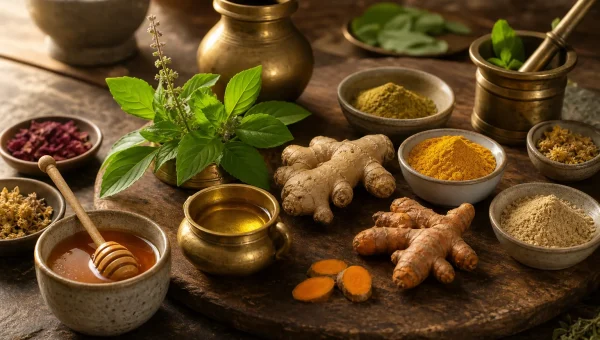
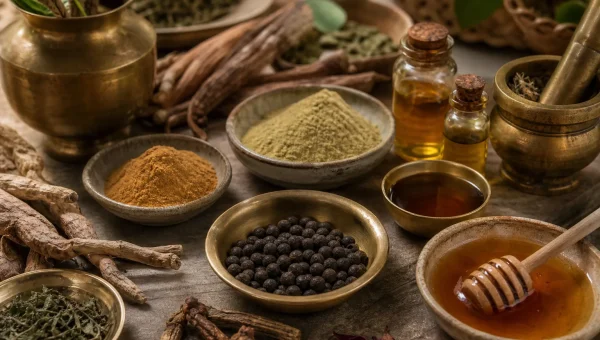
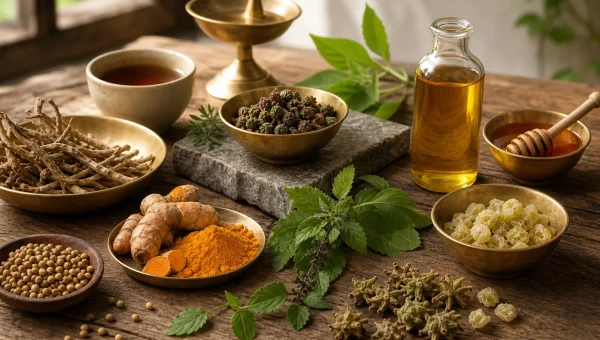
Classical herbs support the pelvic floor indirectly – by pacifying Apana Vata, nourishing reproductive tissue (Shukra/Artava dhatu), and removing the chronic constipation and inflammation that undermine pelvic support. The herbs below are chosen for these classical actions; doses are general guidance and should be individualized by a qualified practitioner.
Ashoka (Saraca asoca)
A classical Ayurvedic herb for uterine and pelvic support (the accepted botanical name is Saraca asoca; Saraca indica is an older, frequently misapplied synonym). Its bark is kashaya (astringent) and sheeta (cooling), and is the principal drug for Yoniroga (diseases of the female pelvis) and especially Asrigdara/Raktapradara (excessive uterine bleeding), supporting uterine tone. Note a point of terminology: uterine/pelvic organ prolapse in women is classically Yoni Bhramsha (also Yoni Pracyuti or Apavritti) – not Bradhna, which in the classical texts denotes inguinal hernia or hydrocele. Dose: 3-5 grams of bark powder with warm water twice daily, or Ashokarishta (fermented liquid preparation) 15-20 ml twice daily after meals.
Shatavari (Asparagus racemosus)
A prime Rasayana (rejuvenative) for the female reproductive system, classed as balya (strengthening), madhura in taste and sheeta in potency, and pacifying to both Vata and Pitta (Bhavaprakasha Nighantu). It is traditionally used postpartum and across the menopausal transition as a nourishing, Vata-pacifying tonic for reproductive tissue and as a galactagogue. Modern interest centers on its phytoestrogenic constituents, but robust clinical trials specifically in pelvic organ prolapse are lacking, so it is best understood as supportive nourishment rather than a proven prolapse treatment. Dose: 5 grams root powder in warm milk at bedtime.
Guduchi (Tinospora cordifolia)
For the inflammatory component of pelvic floor dysfunction (frequent urinary infections, pelvic inflammatory discomfort). Guduchi’s traditional Rasayana and Pitta-pacifying actions support tissue quality and recovery, and it is widely used as an immunomodulatory and anti-inflammatory herb. Dose: 500 mg extract twice daily with meals.
Triphala
Addressing the chronic constipation that is both a cause and consequence of pelvic floor dysfunction is non-negotiable. Straining at stool is a significant modifiable risk factor for pelvic organ prolapse progression. Triphala at 3-5 grams at bedtime produces the gentle, regular bowel movement that eliminates this straining force. Its bowel-normalizing (rather than merely laxative) action prevents the urgency and incomplete evacuation that worsen Apana Vata dysfunction.
Sesame Oil – Basti Support
The classical Ayurvedic treatment for Apana Vata disorders is Basti (medicated enema), specifically Anuvasana Basti (oil enema). Charaka regards Basti as ardha chikitsa – half of all therapy – and the foremost treatment for Vata (Charaka Siddhisthana). The rationale is direct: because the pakvashaya (colon) is the chief seat of Vata in general and of Apana in particular, medication delivered there pacifies aggravated Apana Vata at its source and counters the dryness (rukshata) of Vata. At home, a simplified version involves a small retention enema of warm plain sesame oil (60-100 ml) held for 20-30 minutes, done twice weekly. This should be done only after consultation with an Ayurvedic physician for the appropriate oil preparation and technique.
Dietary Approach for Apana Vata Support
Diet either steadies or aggravates Apana Vata daily. The aim is warm, moist, well-lubricated, easily eliminated food that prevents constipation and dryness while calming systemic Vata. The table below summarizes what to favor and what to reduce.
| Food Category | Include | Reduce/Avoid | Reason |
|---|---|---|---|
| Fats | Ghee daily (1-2 tsp), sesame oil in cooking | Trans fats, excessive unsaturated plant oils | Ghee lubricates and nourishes Vata channels in pelvis |
| Liquids | Warm water throughout day (2+ liters), herbal teas | Cold drinks, carbonated beverages, excess caffeine | Adequate hydration prevents constipation; cold aggravates Vata |
| Fiber | Cooked vegetables, lentils, oats, flaxseeds (ground) | Raw, cold, or excessive dry fiber without fluid | Gentle fiber prevents straining; dry fiber without fluid worsens constipation |
| Protein | Mung dal, warm lentils, eggs (if consuming), full-fat dairy | Dry protein powders, cold meats, raw protein bars | Warm, well-cooked protein nourishes the dhatus that support pelvic fascia |
| Anti-inflammatory | Turmeric in cooking, ginger tea, amalaki | Spicy, acidic foods in excess (aggravate Pitta-pelvic inflammation) | Reduces the inflammatory component of urinary urgency and pelvic pain |
The Critical Lifestyle Modifications
Beyond yoga and herbs, two lifestyle changes produce the most significant improvements in pelvic floor function:
- Bowel position: Use a footstool (about 20-25 cm high) under your feet on the toilet to achieve a partial squat. This straightens the anorectal angle and can make evacuation more complete and less effortful, in keeping with the natural squatting posture traditionally valued for elimination. Controlled evidence on pelvic-floor outcomes is limited and mixed – one controlled study (Lam et al., 1993) found squatting did not significantly reduce pelvic floor descent during straining – so frame the benefit as anorectal-angle alignment and comfort rather than proven prolapse prevention.
- Bladder training: Avoid habitually urinating “just in case.” This trains the bladder to signal urgency at low volumes, worsening overactive bladder. Note the classical concept precisely: Vegadharana (Charaka Sutrasthana 7) means suppressing a genuine urge, which is harmful. Voiding before genuine fullness is the opposite error – forcing elimination before the urge naturally arises – and is likewise discouraged. Allow the bladder to signal genuine fullness before emptying; this rebuilds appropriate bladder capacity over weeks.
For the hormonal support that underpins pelvic floor health after menopause, our guide on postmenopausal bone and tissue health covers the systemic estrogen transition framework. For cycle-phase support of pelvic health across the reproductive years, see our cycle syncing with Ayurveda guide. For Ayurvedic fibroid management that also involves Apana Vata protocols, our Ayurvedic fibroid management guide provides a complementary clinical framework.
The advice around Pelvic Floor Wellness is specific enough to be useful. The safety notes could be expanded a little.
Eight months is a meaningful timeline and the fact that your symptom diary showed a pattern your doctor could track is exactly the kind of documentation that makes integrative approaches credible. For pelvic floor specifically I’m curious whether the herbal component or the yoga-based Bandha practice made the more noticeable difference for you, or whether it felt like they worked together in a way that’s hard to separate.
The 6-week checkup Kegel mention and then years of silent suffering is basically my exact history. Three years post-second delivery before I said anything. My physiotherapist when I finally went was frustrated that I had waited so long. The framing here of pelvic floor health as connected to Apana Vata gives me a more coherent story about why what she is treating is also responding to the dietary and herbal changes I have made.
As a pelvic floor physiotherapist, I am always glad to see integrative content that still recommends PF PT alongside other approaches. The Ayurvedic framework here is complementary to what I do, not a replacement for it. The internal herbal support for connective tissue alongside the physical rehabilitation is something I would like to learn more about.
The Ashwini Mudra recommendation makes complete sense from both the Ayurvedic perspective on Apana Vata regulation and from the basic exercise science perspective on pelvic floor contraction patterns. It is one of those convergence points between traditional practice and modern physiotherapy that makes integrative medicine feel coherent.
I was looking for a plain explanation of Pelvic Floor Wellness. Good starting point for a cautious reader.
I never realized how much childbirth can affect the pelvic floor until reading this; the part about Apana Vata made me curious about trying the gentle Mula Bandha routine.
The advice around Pelvic Floor Wellness is specific enough to be useful. A few more examples would still help.
As a urogynecologist, the 25-50% lifetime prevalence figure is accurate and this condition is genuinely undertreated. My concern with integrative frameworks for prolapse specifically is that grade 3 and 4 prolapse often needs surgical management and herbs cannot repair structural defects. This article would benefit from a clearer grading-based guide to when surgery becomes necessary.
What’s the shelf life of the prepared ayurvedic formulations? I ask because some preparations I’ve used seemed less potent after 2-3 months.
Has anyone tried the sesame oil basti at home? I wonder if it feels uncomfortable or if it actually helps with the dryness feeling.
Has anyone done the triphala protocol specifically for urinary incontinence? The article mentions it but I want to know from people who have tried it. I have stress incontinence post-menopause and my gynecologist wants to discuss procedures. I want to try every non-surgical option first.
The advice to avoid suppressing natural urges makes sense; I’ve been holding in gas during meetings and now I’ll try to let it out.
The advice around Pelvic Floor Wellness is specific enough to be useful. I would still ask a practitioner before changing medicines.
I liked the explanation of why standard Kegels can worsen tight pelvic floor muscles; it explains why I felt more pain after doing them.
Do the herbal doses need to be adjusted for someone with a pitta predominance, or are they generally safe for all doshas?
The advice around Pelvic Floor Wellness is specific enough to be useful. This is the kind of detail readers can test slowly.
The footstool tip for bowel position is simple; I placed a small stack of books under my feet and it feels easier to evacuate.
would this protocol work if i travel frequently and cant maintain a fixed routine
I tried the ayurvedic approach described and it genuinely worked. Simple, not expensive, and it addressed what was actually causing the problem.
Just found this post, the section 3 protocol seems intensive for a beginner, any lighter version?
Packaging this as science when most of it is tradition makes me skeptical.
My constitution is Vata-Pitta, the article seems focused on one or the other.
the article mentions shatavari for prolapse support is this safe postmenopause?
Reading this later and the Pelvic Floor Wellness advice still feels relevant. A few more examples would still help.
Reading this later and the Pelvic Floor Wellness advice still feels relevant. Small daily changes are easier to follow than a perfect plan.
I appreciate that the article mentions Viparita Karani is supportive but not a cure for prolapse; keeps expectations realistic.
just started exploring ayurveda after years of allopathy, still a lot to absorb नमस्ते
Where can you source the herbs in India outside of major cities? I’m in a tier-2 town.
The part about adjusting based on prakriti was exactly what I needed.
is this suitable for pitta dominant people or mainly vata?
appreciate that this goes into contraindications, most blog posts skip that part 🙏
Some of these claims are very strong for what is essentially anecdote-level evidence.
Reading this after finding it on Google, is this dosage still recommended? ❤️
Where are the actual clinical trials? I need RCT data before trying anything. धन्यवाद
@Karthik How long before seeing results? the article mentions 4 to 6 weeks but is that for everyone.
is this applicable for men with pelvic floor dysfunction or only women?
मेरी पत्नी को दूसरी डिलीवरी के बाद यही समस्या हुई और फिजियोथेरेपिस्ट ने सिर्फ Kegel बताए। इस लेख में जो Mula Bandha और Ashwini Mudra का जिक्र है, क्या इन्हें Kegel के साथ-साथ किया जा सकता है या अलग-अलग? और Shatavari की मात्रा के बारे में कोई सामान्य दिशा-निर्देश है? 🙏
starting this next week, will report back in about a month
@Daniel the herbs mentioned helped with symptoms but didnt resolve my cystocele, i needed pelvic floor pt alongside
This works in theory but practically very hard to source authentic herbs.
pelvic floor issues need proper physiotherapy assessment first, this article should lead with that recommendation
Would this protocol work if I travel frequently and can’t maintain a fixed routine. 🙏
my vaidya recommended something similar last month, good to see the reasoning explained
the differentiation between vata-type incontinence and kapha-type was the key insight that made this applicable to my situation
the specific morning timing recommendation is practical, most articles skip that detail
bookmarked this to share with my mother who has been struggling with the same issue ❤️
The dosage here seems higher than what my Ayurvedic doctor recommended. 💯
The herbs mentioned helped with symptoms but didn’t resolve my cystocele, I needed pelvic floor PT alongside.
the pitta protocol here caused a lot of heat and skin irritation for me
my functional medicine doctor mentioned something similar, helpful to have teh ayurvedic framing too
@Vikram the dosage here seems higher than what my ayurvedic doctor recommended 🌿
Quick question: does the dosage change if someone is also on other medication?
Has anyone combined the ginger tea recommendation with the Triphala at night? I’m curious about taste interactions.
reading this after finding it on google, is this dosage still recommended?
Late to this but wanted to ask, do these recommendations still hold in 2027?
how does one differentiate between vata and kapha prolapse presentations without a vaidya assessment?
@Prakash tried the morning routine from this article and noticed a difference by day 5 ✨
been following this for 3 weeks and my energy levels r much better, the protocol described here really clicked for me 🙏
Useful post
the dosage here seems higher than what my ayurvedic doctor recommended
tried this for 6 weeks and saw no difference, maybe im applying it wrong
packaging this as science when most of it is tradition makes me skeptical
the specific morning timing recommendation is practical, most articles skip that detail 🙌
Three years post-second delivery and I recognise so much of this. The heaviness you describe became so normal I stopped mentioning it at checkups. The part about Apana Vayu and downward-moving energy is genuinely new to me as a framework for understanding pelvic floor dysfunction. Are the Ashwini Mudra exercises safe to start without guidance or would you recommend working with a practitioner first?
The historical references to Sushruta and Charaka were interesting; it shows how old this understanding really is.
some of these claims r very strong for what is essentially anecdote-level evidence
the part about adjusting based on prakriti was exactly what i needed
Tried the morning routine for 2 months, gave up the timing is impossible with kids and a job.
I liked the practical side of Pelvic Floor Wellness. Would be useful to see a short checklist next.
I’m skeptical about claiming Ashoka can support uterine tone without more modern studies, but I’m willing to try the powder as a supplement.
my physiotherapist and ayurvedic practitioner now work together on my pelvic floor protocol after i shared this article
the combination of ashwini mudra with the dietary kapha-reduction protocol improved my mild prolapse symptoms in 6 weeks
tried the morning routine from this article and noticed a difference by day 5
After reading about Apana Vata, I started checking in with my lower abdomen during yoga to see if I feel any heaviness change.
just started exploring ayurveda after years of allopathy, still a lot to absorb
Will try
this works in theory but practically very hard to source authentic herbs
followed the dosage table for 10 days and my sleep improved, will continue 🙏
The combination of Ashwini Mudra with the dietary Kapha-reduction protocol improved my mild prolapse symptoms in 6 weeks.
my constitution is vata-pitta, the article seems focused on one or the other
where are the actual clinical trials? i need rct data before trying anything
tried this for 6 weeks and saw no difference, maybe i’m applying it wrong
The advice around Pelvic Floor Wellness is specific enough to be useful. I appreciate that it does not oversell the result.
the pitta protocol here caused a lot of heat and skin irritation for me धन्यवाद
The safest part of the Pelvic Floor Wellness advice is keeping it simple. This is the kind of detail readers can test slowly.
The Pitta protocol here caused a lot of heat and skin irritation for me.
The specific morning timing recommendation is practical, most articles skip that detail.
is this applicable for men with pelvic floor dysfunction or only women? ✨
appreciate that this goes into contraindications, most blog posts skip that part
some of these claims are very strong for what is essentially anecdote-level evidence
What’s the difference between Ashwagandha root powder and the standardized extract for this application? Both are available but at very different price points.
my functional medicine doctor mentioned something similar, helpful to have the ayurvedic framing too ✨
Makes sense
The differentiation between Vata-type incontinence and Kapha-type was the key insight that made this applicable to my situation.
Where are the actual clinical trials? I need RCT data before trying anything.
where can u source the herbs in india outside of major cities? i’m in a tier-2 town
been following this for 3 weeks and my energy levels are much better, the protocol described here really clicked for me
the sourcing section was a surprise, didnt know the extract grade mattered this much
This helped me understand Pelvic Floor Wellness without too much jargon. The article avoids making it sound like a quick fix.
my physiotherapist and ayurvedic practitioner now work together on my pelvic floor protocol after i shared this article ✨
bookmarked this to share with my mother who has been struggling with teh same issue
been following this for 3 weeks and my energy levels are much better, the protocol described here really clicked for me 🙌
Is there an Ayurvedic approach specifically for male pelvic floor dysfunction? The article focuses entirely on women. Men also develop pelvic floor problems especially after prostate issues and the Apana Vata framework would presumably apply similarly.
my functional medicine doctor mentioned something similar, helpful to have the ayurvedic framing too 🙌
late to this but wanted to ask, do these recommendations still hold in 2027? 💯
pelvic floor issues need proper physiotherapy assessment first, this article should lead with that recommendation ✨