
My father died in October 2019. I was 41 years old, had a yoga teaching practice, understood stress physiology better than most, and within three weeks of losing him I was barely sleeping, working obsessively, and telling everyone I was fine. It took a physical collapse six months later, a severe bout of shingles that put me on the floor for two weeks, to force me to accept that grief, untreated and unacknowledged, had found another way out.
Men are not taught to process grief. We are taught to function through it, manage it, eventually outlast it. The cultural script is clear: absorb the loss, keep moving, be strong for others. And on the surface, this looks like resilience. What it actually is, in Ayurvedic terms, is Shoka suppression – a physiological process with predictable consequences for body, mind, and longevity.
What Shoka Is and What It Does to the Body
Shoka is the Sanskrit term for grief, sorrow, and lamentation. It is important to name it correctly: in Charaka’s psychology the mind has exactly two doshas – Rajas and Tamas (Charaka Samhita, Sutrasthana 1.57). Shoka is not a dosha. It is a manasika bhava / manovikara – a mental disturbance – and it appears in the classical lists of emotional states and as a cause of disease. Charaka counts grief (shoka) among the causes of Karshya (emaciation) in Sutrasthana 21, and grief is named among the factors that bring about Ojakshaya – depletion of Ojas, the vital essence that governs immunity and resilience – alongside anger (krodha), fear (bhaya), anxiety (chinta), fasting, and overexertion. Through this grief-driven emaciation the deeper tissues, including Ojas and Shukra (reproductive tissue), can be diminished. So the classical claim is not that grief “targets four tissues”; it is that unresolved grief weakens digestion and appetite, emaciates the body, and erodes Ojas.
This is not metaphor. It is physiology. Modern grief research documents measurable biological changes:
- Cortisol elevation that can persist for months in many bereaved individuals, reflecting HPA-axis disturbance
- Higher systemic inflammation (IL-6, CRP) that correlates with the cardiovascular events behind “dying of a broken heart” (Takotsubo, or stress, cardiomyopathy)
- Reduced Natural Killer (NK) cell cytotoxicity and other maladaptive immune changes after bereavement, with the magnitude linked to the intensity of grief-related distress
- HPA-axis dysregulation causing sleep disruption, appetite changes, and fatigue
Ayurveda anticipated these consequences. Grief disturbs the mind – Sattva is overshadowed while Rajas and Tamas rise – and it aggravates Vata, especially Prana Vata (governing breath, mind, and consciousness), producing anxiety, sleeplessness, and scattered thought. The anger, resentment, and self-blame that so often accompany loss aggravate Pitta, adding the burning, inflammatory quality felt in grief. Sustained, these states weaken Agni (digestive fire) and deplete Ojas – which is exactly why classical Ayurveda lists shoka among the causes of Ojakshaya.
Why Men Grieve Differently
Modern bereavement research (Doka and Martin) describes two patterns of grieving: an intuitive pattern, in which grief is felt and expressed affectively, and an instrumental pattern, in which grief is processed cognitively and discharged through activity. The instrumental pattern is seen more often in men, but it is related to gender, not determined by it. The risk arises when activity becomes avoidance: delayed psychological processing, reluctance to seek emotional support, and grief that surfaces as physical illness, overwork, addiction, or depression rather than expression.
The Ayurvedic frame is precise here. Ayurveda classifies psychological constitution (Manasa Prakriti) by the dominant guna – Sattvika, Rajasika, or Tamasika – not by sex. The two mental doshas are Rajas and Tamas, and mental health means Sattva predominating over them. When grief is driven underground rather than felt, Sattva is overshadowed: Rajas shows as restlessness, irritability, and compulsive overwork, while Tamas shows as heaviness, withdrawal, dullness, and loss of motivation. It is the Tamas-predominant, withdrawn state that most often accompanies the immune suppression, tissue depletion, and physical illness seen when grief is suppressed rather than processed.
A Practical Recovery Protocol: Four Pillars
The aim of Ayurvedic care for shoka is consistent: restore Sattva, pacify aggravated Vata, rekindle Agni, and rebuild Ojas. The means are routine (Dinacharya), nourishment (Ahara), rejuvenation (Rasayana), breath and mind practice, and Sattvavajaya – the classical mind-restraint therapy. The four pillars below organize these into a daily structure. None of them replaces professional care; treat each as an adjunct to it.
Pillar 1: Physical Grounding (Vata Management)
The first requirement after loss is physical stability. Vata, destabilized by shock and disorientation, needs grounding through heavy, warm, stable inputs:
- Daily Abhyanga with sesame oil: 10 minutes every morning before the shower. The warmth and grounding quality of Til Taila are among the most immediate Vata-stabilizing interventions available without a prescription. In the first weeks after loss, when showering itself may feel like an achievement, this practice provides a quiet act of self-care that costs nothing and requires no energy beyond showing up.
- Warm food at regular times: Grief disrupts appetite. Kitchari (mung dal with rice and ghee) at consistent meal times is a classical choice for periods of physical and emotional weakness – it nourishes without demanding appetite, it is impossible to overcook, and its warmth directly counters Vata-cold.
- Sleep protection: Grief disrupts sleep through both rumination and cortisol elevation. Do not add stimulants after 2 PM. Consider Ashwagandha (600 mg at bedtime), which has clinical evidence for lowering cortisol, and Jatamansi churna (500 mg, 1 hour before sleep), a classical Medhya and sleep-supporting herb, for the first 90 days – both support sleep without pharmaceutical dependency.
Pillar 2: Ojas Restoration (Core Vitality)
Ojas depletion in grief is the most important physiological change to address, because Ojas loss affects immunity and emotional resilience at the same time. Classical Ojas-building (Rasayana) measures:
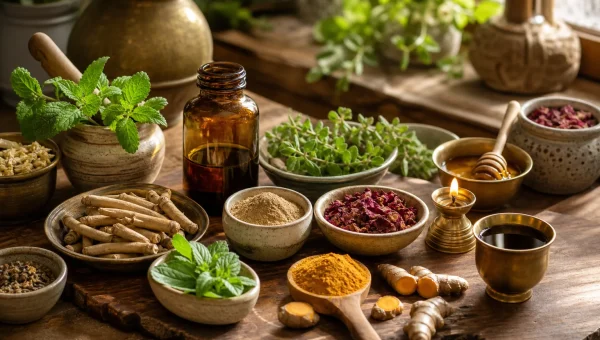
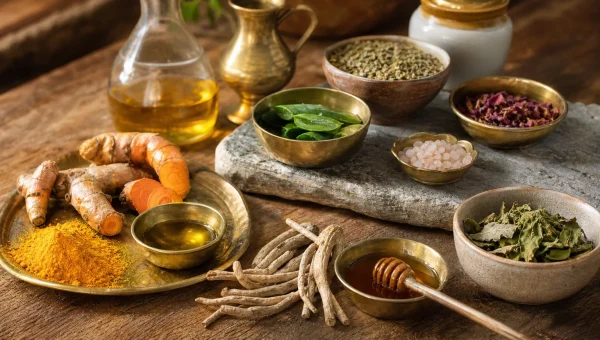
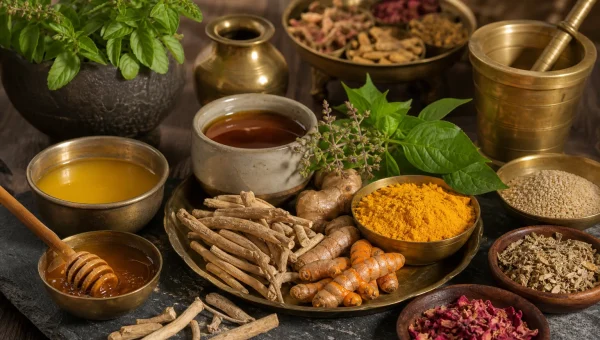
- Ashwagandha milk at bedtime: 1 teaspoon (about 5 g) Ashwagandha root powder simmered in 250 ml warm full-fat milk, with a pinch of saffron, a quarter teaspoon of cinnamon, and 1 teaspoon of ghee. This is a traditional Ksheerapaka-style preparation – a herb cooked in milk – used as a Balya (strengthening) and Ojas-supporting tonic. It is not the classical Vajikarana formula: Charaka’s ashwagandha Vajikarana is a multi-ingredient medicated ghee (Ashwagandha Ghrita), not this milk drink. Taken nightly for at least 3 months, the milk preparation supports sleep, strength, and Ojas.
- Chyawanprash (1 teaspoon daily): The classical comprehensive Rasayana, described in Charaka Samhita Chikitsa Sthana 1.1. Its core ingredient is Amalaki (Indian gooseberry), supported by Pippali, the Dashamula roots, and roughly forty additional classical herbs, cooked with ghee and sesame oil and finished with sugar and honey. Note that Ashwagandha and Shatavari are not part of the classical Charaka or API Chyavanaprasha formula; they appear only in some modern commercial versions. Sustained use over months rebuilds the systemic vitality that grief depletes.
- Shilajit (250 mg daily): A randomized clinical trial of purified Shilajit (250 mg twice daily for 90 days) found significant increases in total and free testosterone in healthy men aged 45-55. Its fulvic-acid component is also associated with support of mitochondrial and cellular energy, relevant to the fatigue many grieving people experience.
Pillar 3: Mind Support (Sattva Cultivation)
Sattva, the quality of clarity and equanimity, is the antidote to Tamas-suppressed grief. Sattva is not forced positivity – it is the willingness to see clearly, including clearly feeling the grief rather than burying it. Ayurvedic practices that cultivate Sattva:
- Pranayama, specifically Nadi Shodhana: 10 minutes daily, morning and evening. Alternate-nostril breathing is a classical practice for balancing Prana and steadying the mind, calming the Prana Vata that grief most disturbs; it is widely studied as a low-cost technique for stress and autonomic balance. Begin gently and never strain the breath.
- Nature time: Exposure to natural environments aligns with Sadvritta (wholesome conduct) and supports the mind in Manas disturbances. The parasympathetic activation from time outdoors (the basis of Shinrin-yoku research) helps counter the sympathetic over-activation common after loss. Aim for 20-30 minutes outdoors daily, without a phone.
- Expression as release: Charaka lists the urge to weep (baspa / ashru vega) among the natural urges that must not be forcibly suppressed – to hold back tears is itself a cause of disturbance. Journaling about the person lost, including what was said and what was left unsaid, gives that urge an outlet and supports the goal of Sattvavajaya: easing the mind’s fixation rather than damming it.
Pillar 4: When to Seek Support
Ayurveda does not treat self-sufficiency as a virtue in grief. Charaka’s third therapeutic limb, Sattvavajaya Chikitsa (the classical psychotherapy), works by gently withdrawing the mind from unwholesome fixation and strengthening Dhi (judgment), Dhriti (fortitude), and Smriti (memory) – often with the help of the wise, and in modern terms a trained therapist or counselor. The texts also value Ashwasana (reassurance and consolation) and the company of the steady-minded. Such reliance on trustworthy, experienced guidance reflects Aptopadesha – in Ayurveda the authoritative testimony of credible authorities, one of the recognized means of valid knowledge. In practice: find a therapist, a support group, or at minimum one trusted relationship in which the grief can be spoken. Men who engage support show better outcomes and lower rates of complicated grief than those who isolate.
Signs that grief has become complicated and requires professional intervention:
- Inability to function at work or in daily life after 6 months
- Active thoughts of self-harm or not wanting to be alive
- Alcohol or substance use escalating as a coping mechanism
- Social isolation becoming total withdrawal
- Physical symptoms (unexplained pain, illness, weight changes) that a doctor cannot find a cause for
| Herb/Practice | Primary Effect | Dose | Timing |
|---|---|---|---|
| Ashwagandha (KSM-66) | Cortisol reduction, Ojas support, sleep | 600 mg extract or 5 g powder | Bedtime in warm milk |
| Jatamansi churna | Calming, sleep quality (Medhya) | 500 mg churna | 1 hour before sleep |
| Shilajit (purified) | Testosterone support (healthy men), energy | 250 mg resin | Morning with warm water |
| Brahmi (Bacopa monnieri) | Medhya Rasayana – cognition, memory | 300 mg extract | With breakfast |
| Abhyanga (sesame oil) | Vata grounding, self-soothing | 10 minutes daily | Before morning shower |
| Nadi Shodhana pranayama | Prana Vata balance, parasympathetic activation | 10 minutes | Morning and evening |
The shingles episode that floored me six months after my father’s death was the body demanding what I had refused to give it voluntarily. After I recovered, I started implementing every one of the practices in this article. They did not bring him back. They did not make the loss smaller. But they kept me functional during the waves, and slowly, across many months, the waves became survivable rather than overwhelming.
Grief is not weakness. Suppressed grief is not strength. For related content on men’s emotional health through an Ayurvedic lens, see our guide on men’s hormonal health in Ayurveda and our weekend recovery protocol at the Ayurvedic weekend reset. The pranayama practices referenced in this protocol are covered in depth at our pranayama for stress guide.
The shingles six months after your father’s death is exactly the pattern the research on grief and immune function shows. Sustained unprocessed grief suppresses NK cell activity and elevates inflammatory markers in ways that set the stage for latent viral reactivation. Your experience is clinical validation.
Lost my wife two years ago and what you describe as the obsessive work and the insistence that you’re fine is terrifyingly familiar. I told everyone I was managing it well for almost a year. The collapse came in a different form but the mechanism you describe, grief finding another way out, is exactly right.
As a man who has done grief work after losing my brother, the specific protocols for grounding Vata and cooling Pitta during acute grief are things I wish I had known. I spent two years in the Pitta overwork pattern before the crash came.
This makes sense for to Grief Recovery for Men. Good starting point for a cautious reader.
What does the Shoka treatment protocol look like during the acute phase, the first weeks after loss? The article focuses on what to do when the delayed crash comes but I’d like to know whether there are specific interventions for the initial period that could prevent the deferred crisis.
I read about the shingles episode and it reminded me how my own grief showed up as constant headaches after my dad passed.
I’d want to know how this integrates with conventional grief therapy. Can someone be doing CBT or grief counseling alongside the Ayurvedic protocols, or are there specific interaction considerations between the approaches?
The point about shingles being an immune marker of unprocessed grief is documented in the research but almost never discussed in standard grief support. When I had shingles two years after losing my father I was told it was stress. What stress specifically, nobody asked.
Has anyone tried the sesame oil abhyanga in the morning and noticed a change in their sleep?
I would like more detail on to Grief Recovery for Men. Would be useful to see a short checklist next.
I tried to get my father to talk about his grief after my mother died. He told me he was fine, went back to work the next week, and two months later had a cardiac event. The mind-body connection in unprocessed grief is not metaphor. It’s physiology.
I wonder if the ashwagandha milk really helps with Ojas or if it’s just a comforting ritual.
The framing of grief as having a specific dosha pattern is somewhat reductive. Grief is a complex psychological process that doesn’t map cleanly onto physiological categories. I’m concerned that framing it this way encourages people to treat symptoms herbally when what they actually need is sustained psychological support.
The part about Vata causing scattered thoughts made me think of how I keep replaying conversations after a loss.
I would like more detail on to Grief Recovery for Men. The article avoids making it sound like a quick fix.
I started drinking warm kitchari at regular times and it eased my stomach discomfort during tough days.
Does Nadi Shodhana need to be done twice daily for it to calm Prana Vata or can once be enough?
Is there an Ayurvedic protocol specifically for grief in older men? The physiological reserve is different at 65 versus 35, and the Vata-Pitta storm you describe would presumably need calibration for someone who is already managing age-related Vata increase.
Reading this after finding it on Google, is this dosage still recommended?
Is there a specific diet change recommended during the first month of acute grief?
@Catherine My constitution is Vata-Pitta, the article seems focused on one or the other.
Tried the morning routine from this article and noticed a difference by day 5.
where can you source the herbs in india outside of major cities? im in a tier-2 town
It’s interesting that the article points out men often push through grief physically rather than emotionally.
tried this for 6 weeks and saw no difference, maybe im applying it wrong
just found this post, the section 3 protocol seems intensive for a beginner, any lighter version?
grief is complex and i worry that framing it as a dosha imbalance minimizes the psychological dimension
starting this next week, will report back in about a month
how long is teh acute vata-pitta phase typically before it shifts to the more kapha-dominant grief?
late to this but wanted to ask, do these recommendations still hold in 2027?
The Pitta protocol here caused a lot of heat and skin irritation for me.
The dosage here seems higher than what my Ayurvedic doctor recommended. 🙏
quick question: does the dosage change if someone is also on other medication?
Same here
is there a specific diet change recommended during the first month of acute grief? 🙏
how long before seeing results? the article mentions 4 to 6 weeks but is that for everyone
tried teh protocol for 6 weeks and while it helped wth sleep it didn’t address the emotional heaviness i was experiencing
would this protocol work if i travel frequently and cant maintain a fixed routine
Is this suitable for Pitta dominant people or mainly Vata?
packaging this as science when most of it is tradition makes me skeptical
my vaidya recommended something similar last month, good to see the reasoning explained
the sourcing section was a surprise, didnt know the extract grade mattered this much
where are teh actual clinical trials? i need rct data before trying anything
Grief is complex and I worry that framing it as a dosha imbalance minimizes the psychological dimension.
@Ritu the pitta protocol here caused a lot of heat and skin irritation for me
After reading about Ojas depletion I tried a small spoon of chyawanprash and felt a bit more energized.
followed the dosage table for 10 days and my sleep improved, will continue 🙏
bookmarked this to share with my mother who has been struggling with the same issue
tried the morning routine for 2 months, gave up the timing is impossible with kids and a job
off topic but has anyone here tried this approach for hair loss?
The advice around to Grief Recovery for Men is specific enough to be useful. I appreciate that it does not oversell the result.
This works in theory but practically very hard to source authentic herbs.
the part about adjusting based on prakriti was exactly what i needed
my functional medicine doctor mentioned something similar, helpful to have the ayurvedic framing too
Are the herbs here safe to take alongside antidepressants, asking because I was put on SSRIs after the loss.
The part about adjusting based on prakriti was exactly what I needed.
I’m not sure shilajit is necessary for everyone dealing with grief especially if you don’t have low energy.
some of these claims are very strong for what is essentially anecdote-level evidence
Setting a reminder to step outside for twenty minutes without my phone helped break the cycle of rumination.
How long is the acute Vata-Pitta phase typically before it shifts to the more Kapha-dominant grief?
forwarded this to my cousin who just lost his mother and has been ‘functioning fine’ for three months. sometimes you need someone to say directly that not processing grief will cost you later.
Naming the feeling as shoka instead of just sadness gave me a clearer way to talk about what I’m experiencing.
been following this for 3 weeks and my energy levels are much better, the protocol described here really clicked for me
just started exploring ayurveda after years of allopathy, still a lot to absorb
Just started exploring Ayurveda after years of allopathy, still a lot to absorb.
How long before seeing results? the article mentions 4 to 6 weeks but is that for everyone.
tried the morning routine for 2 months, gave up the timing is impossible wth kids and a job
appreciate that this goes into contraindications, most blog posts skip that part
The Ashwagandha plus Brahmi combination for the emotional storm phase was exactly what my vaidya prescribed, good to see the reasoning. ठीक है
The to Grief Recovery for Men angle is useful here. This feels more usable than a long list of herbs.
Tried the protocol for 6 weeks and while it helped with sleep it didn’t address the emotional heaviness I was experiencing.
as someone who lost my father last year, the vata-pitta grief framework made my experience feel understood in a way clinical language didnt
my constitution is vata-pitta, the article seems focused on one or the other
Makes sense
the dosage here seems higher than what my ayurvedic doctor recommended
Packaging this as science when most of it is tradition makes me skeptical.
Good reminder on to Grief Recovery for Men. I appreciate that it does not oversell the result.
this works in theory but practically very hard to source authentic herbs ठीक है
the section on grief affecting ojas was new to me and resonated with how depleted i felt for months afterward
Noted
are the herbs here safe to take alongside antidepressants, asking because i was put on ssris after the loss
my functional medicine doctor mentioned something similar, helpful to have the ayurvedic framing too ✨
Quick question: does the dosage change if someone is also on other medication? नमस्ते
where are the actual clinical trials? i need rct data before trying anything
Useful post
The section on grief affecting Ojas was new to me and resonated with how depleted I felt for months afterward.
tried the morning routine from this article and noticed a difference by day 5
As someone who lost my father last year, the Vata-Pitta grief framework made my experience feel understood in a way clinical language didn’t.
Followed the dosage table for 10 days and my sleep improved, will continue 🙏.
The dosage here seems higher than what my Ayurvedic doctor recommended.
Where can you source the herbs in India outside of major cities? I’m in a tier-2 town.