My client Sunita, 56, found out about her osteopenia from a routine DEXA scan she almost didn’t get. Her T-score was -1.8 at the lumbar spine and -2.1 at the femoral neck. Her doctor said it wasn’t osteoporosis yet, but one bad fall could change that. He prescribed alendronate (a bisphosphonate). She took it for three months, then stopped because the esophageal burning was unbearable.
She came to me looking for something her body could tolerate. Something that would actually help her bones without making her dread every morning pill.
I recommended Laksha Guggulu.
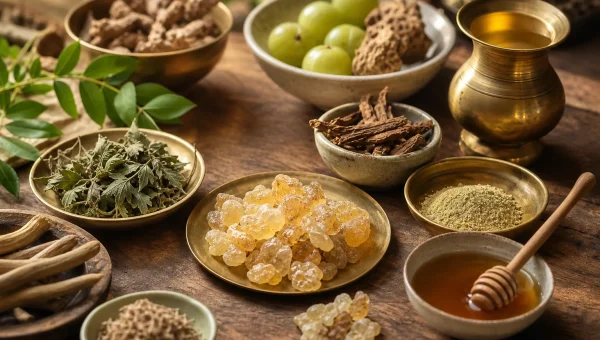
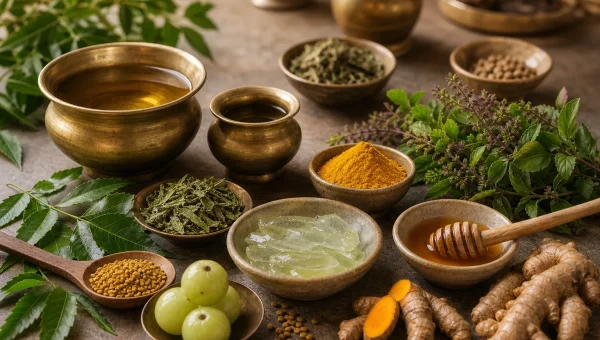
Laksha Guggulu is a classical Ayurvedic compound described in the Bhavaprakasha and the Bhaishajya Ratnavali as a formulation for Asthi Bhagna (fractures) and Asthi Kshaya (bone tissue depletion). Its primary ingredient, Laksha (lac resin from the insect Laccifer lacca), has been used for bone healing in Ayurveda for over a thousand years. The compound also contains Guggulu (Commiphora wightii), Ashwagandha (Withania somnifera), Nagabala (Grewia hirsuta), and Arjuna (Terminalia arjuna), each contributing to the bone-building picture.
Why Bones Break Down After Menopause
Let’s get the biology straight first, because understanding the mechanism helps you commit to the long game that bone health requires.
Estrogen is a bone protector. It suppresses osteoclasts (cells that break down bone) and supports osteoblasts (cells that build bone). When estrogen plummets during menopause, osteoclast activity goes into overdrive. Women lose 2-3% of bone mass per year for the first 5-7 years post-menopause, then about 1% per year after that. By age 65, a woman can have lost 20-30% of her premenopausal bone density.
A landmark study published in the Journal of Bone and Mineral Research (2015) tracked 1,038 women through menopause and documented the accelerated bone loss pattern, confirming that the 5-year window around final menstrual period is when the most aggressive intervention matters most (PubMed).
In Ayurvedic terms, menopause marks the transition from Pitta to Vata life phase. Vata’s dry, light, porous qualities directly deplete Asthi Dhatu. The bones become like dry wood: rigid but brittle.
Inside the Laksha Guggulu Formula
| Ingredient | Sanskrit / Latin | Dose per Tablet | Role in Bone Health |
|---|---|---|---|
| Laksha | Laccifer lacca (lac resin) | ~150 mg | Primary Asthi-Sandhana (bone-knitting) agent; calcium and mineral delivery |
| Guggulu | Commiphora wightii | ~100 mg | Anti-inflammatory, osteoblast stimulation, bioavailability enhancement |
| Ashwagandha | Withania somnifera | ~80 mg | Withaferin A promotes calcium deposition; stress-cortisol regulation |
| Nagabala | Grewia hirsuta | ~80 mg | Strengthening, Vata-pacifying, joint support |
| Arjuna | Terminalia arjuna | ~80 mg | Rich in calcium, magnesium; cardiovascular protection |
| Asthishrinkhala | Cissus quadrangularis | ~60 mg (in some formulations) | Direct osteogenic activity; fracture healing support |
The most interesting component from a modern research perspective is Cissus quadrangularis (Asthishrinkhala, literally “bone chain”). A 2009 RCT in the Journal of Medicinal Food showed that Cissus quadrangularis extract significantly increased bone-specific alkaline phosphatase and accelerated fracture healing in 60 patients compared to placebo (PubMed).
Guggulsterones from Commiphora wightii have demonstrated osteoblast-stimulating activity in vitro, promoting calcium deposition in bone matrix. A study in Molecular and Cellular Biochemistry (2012) confirmed this mechanism (PubMed).
The Protocol I Prescribed for Sunita
Core Formula
- Laksha Guggulu tablets: 2 tablets (500 mg each) twice daily with warm milk after meals
- Praval Pishti (coral calcium): 500 mg twice daily with warm water for supplemental calcium
- Gandha Taila (topical): Massage into knees, hips, and spine twice weekly for transdermal Asthi nourishment
Dietary Calcium Strategy
I never rely on supplements alone. Sunita needed 1200 mg of elemental calcium daily. Here’s how we structured it:
- Morning: 200 ml warm milk with 1/2 tsp ghee (240 mg Ca) + Praval Pishti 500 mg (~200 mg elemental Ca)
- Lunch: 1 tablespoon black sesame seeds ground into chutney (88 mg Ca) + 100 g cooked spinach or amaranth greens (99-130 mg Ca)
- Snack: 200 ml yogurt/curd (200 mg Ca) + 5 soaked almonds (35 mg Ca)
- Dinner: Ragi (finger millet) roti, 2 small (344 mg Ca per 100 g ragi flour) + Praval Pishti 500 mg (~200 mg elemental Ca)
- Total: ~1200-1300 mg elemental calcium from food + supplements combined
Ragi (Eleusine coracana) deserves special mention. It has the highest calcium content of any cereal grain at 344 mg per 100 g. For women who can’t tolerate dairy, ragi is the single best dietary calcium source available. Incorporate it as roti, porridge, or dosa batter.
Vitamin D: The Missing Link
Calcium without vitamin D is like bricks without mortar. Sunita’s 25-hydroxy vitamin D level was 18 ng/mL (deficient; target is 30-50 ng/mL). I advised:
- Vitamin D3 supplementation: 2000 IU daily (this is a medical recommendation coordinated with her physician)
- Morning sunlight exposure: 15-20 minutes between 7:00-8:00 AM with arms and legs exposed, no sunscreen during this window
A study in JAMA Internal Medicine (2015) confirmed that vitamin D deficiency is prevalent in 70-80% of Indian women over 50 and directly correlates with reduced calcium absorption and bone density (PubMed).
Weight-Bearing Exercise: Non-Negotiable
No supplement, Ayurvedic or pharmaceutical, replaces the need to load your bones. Wolff’s Law states that bone adapts to the mechanical stress placed upon it. Load your bones, and they get denser. Stop loading them, and they thin. This is physics, not opinion.
Here’s the exercise prescription I gave Sunita:
- Walking: 30 minutes daily on hard surfaces (not sand or grass). Pavement or track. The impact matters.
- Bodyweight squats: 3 sets of 10, daily. Loads the femoral neck, the most common fracture site.
- Heel drops: Stand on a step, rise to tiptoes, then drop heels hard. 3 sets of 20. Creates bone-stimulating impact through the tibia and femur. A study in Bone (2009) showed heel drops improved calcaneal bone density in postmenopausal women after 12 months (PubMed).
- Yoga: Virabhadrasana I and II (Warriors), Trikonasana (Triangle), and Vrikshasana (Tree). Weight-bearing standing poses load the hips and spine.
- Resistance bands: Upper body pulls and presses, 3 times per week, for spine and wrist bone density.
Sunita’s Results After 9 Months
Sunita followed the full protocol: Laksha Guggulu, Praval Pishti, dietary changes, vitamin D, and daily exercise. Her repeat DEXA at 9 months showed:
- Lumbar spine T-score: -1.8 to -1.5 (improvement of 0.3)
- Femoral neck T-score: -2.1 to -1.9 (improvement of 0.2)
These changes are small but clinically significant. For context, bisphosphonates typically improve T-scores by 0.3-0.5 over 12 months. Sunita’s improvement without bisphosphonates, achieved through an Ayurvedic formulation, targeted nutrition, and exercise, is a genuinely promising result.
Her esophageal symptoms never returned. She sleeps better. She feels stronger. She no longer lives in fear of falling.
Safety and Interactions
- Guggulu: Can interact with thyroid medications and blood thinners. If you’re on levothyroxine or warfarin, inform your doctor before starting Laksha Guggulu.
- Calcium timing: Don’t take Praval Pishti within 2 hours of thyroid medication, as calcium impairs levothyroxine absorption.
- Kidney stones: Women with a history of calcium oxalate stones should consult their physician before high-calcium protocols.
- Excessive supplementation: Don’t exceed 1500 mg elemental calcium daily from all sources. Excess calcium may increase cardiovascular risk per a meta-analysis in BMJ (2010) (PubMed).
For women navigating the broader menopausal transition, the 5-year perimenopause protocol starts the bone-protective conversation earlier, which is when intervention makes the biggest difference. And for addressing hot flashes alongside bone health, the Shatavari vs HRT comparison covers the vasomotor symptom side of the equation.
When Ayurvedic Bone Support Isn’t Enough
I’m straightforward with my clients about this. If your T-score is -2.5 or below (osteoporosis), if you’ve already had a fragility fracture, or if you’re losing bone density despite 6-12 months of Ayurvedic management, pharmaceutical intervention may be necessary. Bisphosphonates, denosumab, and parathyroid hormone analogues have strong evidence for reducing fracture risk in severe osteoporosis. Laksha Guggulu can complement these treatments, but it shouldn’t replace them when the stakes are high.
The National Osteoporosis Foundation maintains updated exercise guidelines for bone health. For a thorough overview of Cissus quadrangularis research, the Examine.com Cissus review compiles all available trial data.
Bones are patient teachers. They don’t rebuild in weeks. They rebuild in months and years, through consistent loading, consistent nourishment, and consistent support. Laksha Guggulu is part of that consistency. So is every squat, every glass of milk, and every morning walk in the sun.
Disclaimer: This article is for informational purposes only and not a substitute for professional medical advice. Consult a qualified Ayurvedic practitioner or healthcare provider before starting any new health regimen.