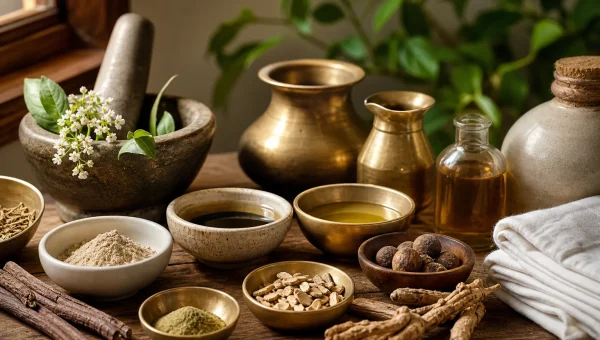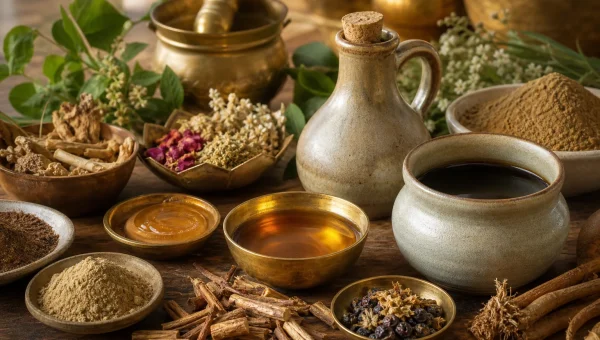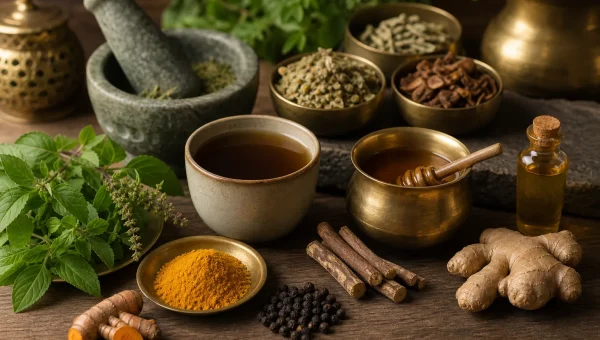
My grandfather kept a ceramic jar in the back corner of the kitchen shelf that nobody was allowed to touch. Every evening after dinner, he’d pour himself exactly 20 ml into a small steel cup, add an equal amount of water, and drink it in three slow sips. When I was old enough to ask, he told me it was Draksha Arishta, grape wine made the old way, with herbs and jaggery. “It keeps the blood strong,” he said, tapping his chest.
He was 87 when he died. His hemoglobin at his last checkup was 13.8 g/dL. Not bad for a man his age.
Draksha Arishta is a classical fermented Ayurvedic preparation described in the Bhaishajya Ratnavali (Chapter 3) and the Charaka Samhita (Chikitsasthana) as a treatment for Pandu Roga (anemia), general debility, and Rakta Dhatu deficiency. Unlike most Ayurvedic formulations that use water or milk as the base, Arishtas use a natural fermentation process that generates 5-10% alcohol, which acts as both a preservative and a bioavailability enhancer.
The self-generated alcohol is not incidental. It’s the delivery system.
What Makes Draksha Arishta Different From Wine
Let me be clear about what this is and isn’t. Draksha Arishta isn’t recreational wine. It’s a medicated fermented preparation with a specific therapeutic purpose. The differences matter:
| Parameter | Commercial Wine | Draksha Arishta |
|---|---|---|
| Alcohol content | 12-15% | 5-10% |
| Sugar source | Grape sugar only | Jaggery (Guda) + Draksha (dried grapes) |
| Herbal additions | None | 10-15 medicinal herbs |
| Fermentation | Selected yeast cultures | Natural wild fermentation (Sandhana Kalpana) |
| Purpose | Recreational/gastronomic | Therapeutic (Rakta Dhatu nourishment) |
| Dose | 150-200 ml | 15-30 ml |
| Shelf life | Years (improves with age) | Years (improves with age, potency considered best at 1-2 years) |
The Classical Composition
The full Draksha Arishta formulation includes:
- Draksha (Vitis vinifera, dried grapes/raisins): The primary ingredient, providing natural sugars for fermentation and iron for Rakta Dhatu
- Guda (Jaggery): Secondary sugar source, rich in iron and minerals
- Dhataki Pushpa (Woodfordia fruticosa flowers): The natural fermentation starter, this flower contains wild yeasts that initiate the fermentation process
- Pippali (Piper longum): Bioavailability enhancer and digestive stimulant
- Twak (Cinnamomum zeylanicum, cinnamon): Flavor, antimicrobial, blood sugar regulation
- Ela (Elettaria cardamomum): Carminative, digestive support
- Nagakeshara (Mesua ferrea): Hemostatic, Pitta-cooling
- Priyangu (Callicarpa macrophylla): Astringent, supports uterine health
- Vidanga (Embelia ribes): Antiparasitic, digestive cleansing
- Madhuka (Glycyrrhiza glabra, licorice): Soothing, flavor harmonizer
How to Make Draksha Arishta at Home
Fair warning: this is a multi-week project. But the result is a medicine that lasts for years and costs a fraction of store-bought versions. My grandmother’s method, scaled for a home kitchen:
Ingredients
- 500 grams Draksha (dried black raisins, seedless preferred)
- 500 grams Guda (organic jaggery, dark variety)
- 3 liters water (filtered or boiled and cooled)
- 30 grams Dhataki Pushpa (Woodfordia fruticosa flowers)
- 5 grams Pippali (long pepper)
- 5 grams Twak (cinnamon bark, broken into pieces)
- 3 grams Ela (green cardamom, slightly crushed)
- 3 grams Nagakeshara (Mesua ferrea stamens)
- 3 grams Madhuka (licorice root, coarsely chopped)
Method
- Prepare the Kashaya: Boil the raisins in 3 liters of water until reduced to 2 liters (about 45 minutes on medium heat). Mash the softened raisins into the liquid. Strain through a muslin cloth, pressing to extract all liquid. Let the decoction cool to room temperature.
- Dissolve jaggery: Add jaggery to the warm (not hot) decoction and stir until fully dissolved.
- Add Dhataki and spices: Place Dhataki Pushpa and all remaining herbs into the liquid. Stir well.
- Transfer to fermentation vessel: Pour into a clean ceramic jar or food-grade glass jar. The vessel should be about 3/4 full, leaving headspace for gas production.
- Seal: Cover the mouth with a clean muslin cloth, then seal the lid loosely (not airtight). The Sharangdhara Samhita specifies that the vessel should be sealed with clay and cloth, allowing minimal gas exchange. In a home setting, a loosely fitted lid works.
- Ferment: Store in a warm, dark place (room temperature 25-30°C is ideal). During winter months, place the vessel near (but not on) a heater or in a warm closet. Fermentation takes 20-30 days.
- Check for completion: The Arishta is ready when:
- Bubbling has stopped
- The liquid is clear (sediment has settled)
- It smells mildly alcoholic and aromatic, not sour or putrid
- A flame held near the surface doesn’t ignite the vapors (alcohol content is low enough)
- Strain and bottle: Strain through muslin into clean glass bottles. Store at room temperature. It improves in quality over the first 6-12 months.
Dosage for Anemia
| Condition | Dose | Frequency | With | Duration |
|---|---|---|---|---|
| Mild anemia (Hb 10-12 g/dL) | 20 ml | Twice daily, after meals | Equal water | 6-8 weeks |
| Moderate anemia (Hb 8-10 g/dL) | 25 ml | Twice daily, after meals | Equal water | 8-12 weeks + iron supplementation |
| General debility / recovery | 15 ml | Once daily, after dinner | Equal water | 4-6 weeks |
| Appetite loss / poor digestion | 15 ml | Before meals | Equal water | 3-4 weeks |
| Maintenance / tonic | 15 ml | Once daily, after dinner | Equal water | Ongoing (cycle 6 weeks on, 2 weeks off) |
Always dilute with an equal amount of water. Never drink undiluted. The alcohol content, though low, can irritate the stomach lining when concentrated.
Why Fermentation Matters for Iron Absorption
Here’s the part that fascinates me from both the Ayurvedic and modern nutrition perspective. Fermentation dramatically improves mineral bioavailability. A study published in the Journal of Food Science and Technology (2017) showed that fermentation of iron-rich plant materials increased iron bioavailability by 30-50% compared to unfermented preparations (PubMed).
The mechanism is straightforward: fermentation breaks down phytates and oxalates, which are the primary inhibitors of non-heme iron absorption. The self-generated alcohol further enhances absorption by increasing gastric acid secretion and mucosal permeability. This means the iron present in the raisins and jaggery becomes significantly more available after fermentation than it would be if you simply ate raisins and jaggery.
Research on red wine’s effects on iron status in the European Journal of Clinical Nutrition (2007) showed that moderate alcohol consumption increased ferritin levels and iron absorption in postmenopausal women (PubMed).
Supporting the Protocol: What to Eat Alongside Draksha Arishta
For anemia treatment, Draksha Arishta works best when your diet supports Rakta Dhatu:
- Black sesame seeds: 1 tablespoon daily, ground. Excellent iron source (14.6 mg per 100 g).
- Pomegranate: 1 fruit daily or 100 ml fresh juice. Classical Raktavardhaka (blood builder).
- Moringa (Shigru) leaves: Add to dals and soups. Contains 28 mg iron per 100 g dried leaves.
- Beetroot: 1 medium beet, cooked, 3-4 times per week.
- Amalaki (Indian gooseberry): 500 mg daily or 2 fresh fruits, for vitamin C to enhance iron absorption.
For the full framework on Raktaja disorders and blood tissue treatment, that resource covers the broader treatment framework for Rakta Dhatu pathologies.
Who Should Not Take Draksha Arishta
- Recovering alcoholics: Even 5% alcohol can be a relapse trigger. Use non-fermented alternatives (Draksha decoction without fermentation).
- Pregnant and lactating women: No alcohol-containing preparations during pregnancy or breastfeeding.
- Children under 12: Avoid due to alcohol content. Use Draksha Avaleha (non-fermented grape jam) instead.
- Liver disease (active hepatitis, cirrhosis): The liver cannot process even small amounts of alcohol safely.
- Patients on metformin, metronidazole, or disulfiram: Drug-alcohol interactions can cause dangerous reactions.
- Active gastric ulcers or GERD: Alcohol aggravates mucosal damage.
If fermented preparations aren’t suitable for you but you’re interested in other classical Ayurvedic digestive tonics, the Takra (buttermilk) recipe collection offers non-alcoholic alternatives that support digestion and nutrient absorption.
My grandfather’s jar never ran out because he’d start a new batch every autumn. By the time the old one was finished, the new one had aged for six months and was ready. It was a rhythm he maintained for decades without missing a beat. The tradition of maintaining a home pharmacy is becoming a lost art. Draksha Arishta is a good place to start bringing it back.
The WHO anemia resource page provides global prevalence data and dietary guidelines. The NIH StatPearls iron deficiency anemia chapter is the clinical reference for diagnosis and management. A 2018 review in Nutrients confirmed that fermented foods improve mineral bioavailability through phytate degradation (PubMed). The Kottakkal Arya Vaidya Sala manufactures pre-made Draksha Arishta under GMP conditions. For understanding the Ayurvedic classification of Asava-Arishta preparations, the Wisdom Library Arishta entry provides full classical references. The Examine.com iron supplement guide covers absorption enhancers and inhibitors in detail.
Twenty ml after dinner. That’s the dose. That’s the tradition. That’s what kept my grandfather’s blood strong into his ninth decade.
Disclaimer: This article is for informational purposes only and not a substitute for professional medical advice. Consult a qualified Ayurvedic practitioner or healthcare provider before starting any new health regimen.