
Proteomics and Ayurvedic Herbs: The Network Pharmacology Revolution
Proteomics and network pharmacology offer a modern language for describing a feature that Ayurveda has long treated as central to formulation design: herbs and combinations often act through many constituents, many targets, and many physiological pathways rather than through a single isolated molecule. This does not replace classical Ayurvedic assessment of dravya, dose, anupana, processing, patient constitution, agni, doṣa, and disease stage; it adds a systems-biology lens for mapping how phytochemicals, proteins, genes, microbial pathways, and clinical phenotypes may be connected.
Proteomics is the large-scale study of proteins, including their identity, abundance, structure, function, and interactions. In herbal pharmacology, proteomic and related “omics” approaches can help trace how a botanical extract or formulation influences protein networks in cells, tissues, or microbial communities. Network pharmacology then links compounds, predicted or measured targets, protein-protein interactions, pathways, and disease biology into maps that are especially suited to polyherbal preparations.
Ayurvedic formulations such as Triphala, Chandraprabha Vati, and other compound preparations are therefore natural candidates for network-based analysis. Triphala, for example, combines the fruits of Haritaki, Bibhitaki, and Amalaki and contains tannins, phenolic acids, flavonoids, and other phytochemicals. Network pharmacology and metaproteomic work on Triphala has placed its activity in the context of inflammatory signaling, metabolic regulation, gut microbial fermentation, and host-microbiome interaction, while still requiring clinical judgment and human validation before translating a network map into treatment decisions.
Network Pharmacology Methodology Applied to Major Ayurvedic Herbs
A network pharmacology workflow usually begins by identifying phytochemicals from databases, pharmacopoeial references, analytical chemistry, or published phytochemistry. The compounds are then screened for likely targets, mapped against disease-associated genes and proteins, organized into protein-protein interaction networks, and interpreted through pathway enrichment. Molecular docking, molecular dynamics, metabolomics, transcriptomics, proteomics, and clinical data can strengthen the map when they are used together.
| Herb / Formulation | Representative Compounds | Representative Network Nodes | Systems-Level Interpretation |
|---|---|---|---|
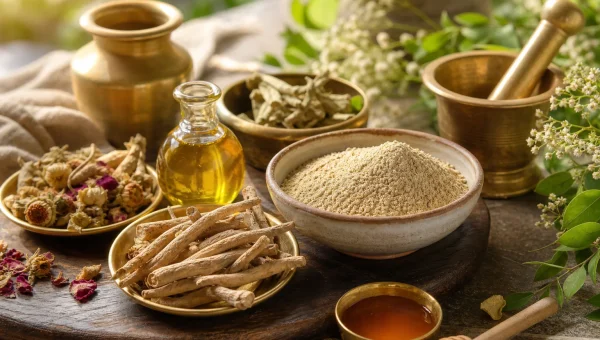
| Ashwagandha (Withania somnifera) | Withaferin A, withanolides, withanosides, sitoindosides | HSP90/Cdc37, NF-κB/IKK, AKT, p53-related pathways | Cellular stress response, inflammatory signaling, and apoptosis-related networks in experimental models |
| Guduchi (Tinospora cordifolia) | Tinosporaside, magnoflorine, palmatine, berberine, diterpenoid lactones | TNF, IL-6, STAT3, TGF-β, COX-2/5-LOX-related pathways | Immune and inflammatory modulation through cytokine and enzyme-linked networks |
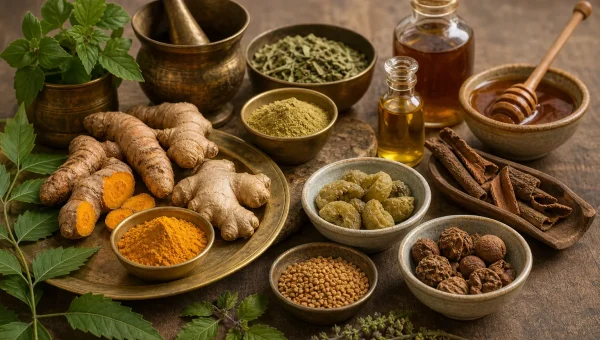
| Turmeric / Haridra (Curcuma longa) | Curcumin, demethoxycurcumin, bisdemethoxycurcumin, turmerones | NF-κB, STAT3, COX-2, Nrf2, VEGF, AKT | Inflammation, oxidative-stress signaling, and cell-survival pathways |
| Triphala | Gallic acid, ellagic acid, chebulagic acid, chebulinic acid, quercetin, kaempferol, tannins | AKT1, PPARG, inflammatory mediators, microbial and host proteome shifts | Metabolic, gut-ecology, antioxidant, and inflammation-linked network breadth |
The Heat Shock Protein Connection: Ashwagandha’s Proteome Interaction
One of the clearest protein-network examples for Ashwagandha is the relationship between withanolides, especially withaferin A, and the heat shock protein system. HSP90 is a molecular chaperone that helps stabilize and mature many client proteins, including growth factor receptors, kinases, cell-cycle proteins, transcription factors, and steroid-receptor complexes. Because of this centrality, even partial modulation of the HSP90/Cdc37 axis can influence many downstream pathways at once.
In cancer and cellular-stress biology, HSP90 clients include proteins such as HER2, EGFR, AKT, and CDK4. This makes HSP90 a useful hub for understanding why withanolide-rich extracts can affect several laboratory pathways at the same time, including stress response, inflammatory signaling, and apoptosis-related signaling. The protein-network interpretation is strongest when it is kept within its proper scope: it explains mechanistic plausibility in models and does not by itself establish an herb as a cancer treatment.
For Ashwagandha’s stress-support reputation, HSP90 is also relevant because steroid receptors and stress-response transcription factors depend on chaperone machinery. Clinical work on standardized Ashwagandha extracts has examined perceived stress, anxiety scales, and cortisol-related outcomes, while the proteome-level explanation remains one layer among several possible mechanisms.
The NF-κB Network: Why Multiple Anti-Inflammatory Herbs Can Converge on Shared Pathways
NF-κB is a central transcription-factor family in inflammatory and immune signaling. Many botanicals used in Ayurveda contain compounds that intersect with NF-κB-linked pathways through different upstream or downstream routes. Turmeric’s curcuminoids, Boswellia’s boswellic acids, and ginger’s gingerols and shogaols are commonly discussed in this context because their constituents are linked with inflammatory enzymes, cytokine signaling, oxidative-stress regulation, and kinase pathways.
Turmeric is often mapped around NF-κB, STAT3, COX-2, Nrf2, VEGF, and AKT-related pathways. Boswellic acids are classically discussed in modern pharmacology for their relationship with 5-lipoxygenase and leukotriene biology, while also intersecting with NF-κB and MAPK signaling. Ginger constituents such as gingerols and shogaols are associated with inflammatory and oxidative-stress pathways, including COX-2 and NF-κB-linked signaling in experimental literature.
This convergence illustrates why a formula may be broader than a single isolated compound. In Ayurveda, the meaning of a combination is not just additive chemistry; formulation depends on the chosen substances, their proportions, processing, vehicle, timing, and suitability for the patient. Network pharmacology provides one modern way to visualize that complexity without reducing the whole formulation to one molecule.
Microbiome Proteomics: How Herbs Influence Gut Bacterial Protein Expression
Metaproteomics extends proteomics into microbial communities by measuring the proteins expressed by microbes and, in some models, the host proteins present in the same system. This is important for Ayurvedic formulations such as Triphala because gut effects are not limited to which bacteria are present; they also depend on what the microbial community is doing metabolically.
A recent Triphala extract metaproteomic model used a dynamic in vitro human descending-colon system inoculated with obese-donor microbiota. The model profiled microbial and host proteomes across baseline, supplementation, and withdrawal periods. Triphala extract shifted microbial activity toward carbohydrate metabolism, reduced stress-associated microbial proteins during supplementation, and altered host proteins linked with mitochondrial, lipid, transcriptional, and signaling regulation. The design was an in vitro, single-donor model, so the finding is best understood as a protein-level mechanistic map rather than a clinical protocol.
The gut-brain axis research provides a broader context for how microbial metabolites, intestinal barrier function, vagal signaling, immune tone, and mental states may be linked. For Ayurveda, this is a useful modern bridge to the older observation that digestion, agni, elimination, and mental steadiness are interdependent.
Molecular Docking: Predicting and Prioritizing Ayurvedic Applications
Molecular docking estimates how a compound may fit into a protein-binding site. In Ayurvedic herb research, it is useful for prioritizing hypotheses, comparing potential ligands, and selecting targets for laboratory testing. Its strongest role is early-stage screening; it should not be treated as proof of clinical efficacy.
Kapikacchu (Mucuna pruriens) is a useful example of how phytochemistry, clinical observation, and target biology can be aligned. Mucuna seed contains levodopa, the dopamine precursor used in Parkinson’s disease therapy, and human trials have evaluated Mucuna seed preparations in Parkinson’s disease motor symptoms. Network and docking language can help organize dopamine-related targets and adjunct phytochemicals, but the clinically important point is the plant’s levodopa content and the need for medical supervision because dopaminergic effects and interactions can be significant.
Berberine provides another example. It has been detected in Tinospora cordifolia stem and is also abundant in other medicinal plants used in Indian traditions. Modern cardiovascular-metabolic work has examined berberine in relation to LDL receptor expression and PCSK9 regulation. This does not mean Guduchi should be prescribed as a cholesterol drug; it means a known phytochemical from a traditional-drug context can be mapped onto contemporary protein targets for further testing.
From Network Maps to Clinical Formulation Design
The practical value of network pharmacology is not only explanation; it can also help refine formulation design. A systems map can identify which herbs cover inflammatory cytokines, oxidative-stress nodes, metabolic regulators, microbial functions, or endocrine pathways, then help researchers compare whether a formula is redundant, too narrow, or unusually broad.
Chandraprabha Vati has been analyzed through network pharmacology for metabolic-syndrome-related complications. That type of work maps formulation constituents to target genes, overlaps them with metabolic syndrome and inflammation biology, and organizes the results through pathway enrichment and protein interaction networks. The same approach can be applied to classical and classical-style formulations, provided the results are checked against pharmacopoeial identity, quality control, dose, safety, and clinical context.
The adaptogen comparison article demonstrates how protein-level and pathway-level distinctions can support herb selection when two botanicals are both called “adaptogenic” but may differ in phytochemistry, clinical evidence, safety profile, and suitability for a specific presentation.
Medical Disclaimer: This article is for educational purposes only. Network pharmacology, molecular docking, proteomics, and metaproteomics are mainly mechanistic and hypothesis-generating unless supported by appropriate laboratory and clinical assessment. Do not use Ayurvedic herbs or formulations as a substitute for diagnosis or treatment from a qualified healthcare provider. Consult a qualified Ayurvedic practitioner and healthcare professional before using herbs, especially during pregnancy, breastfeeding, chronic illness, liver disease, kidney disease, cancer care, psychiatric illness, Parkinson’s disease, or when taking prescription medicines.
References
- Proteomics: Concepts and applications in human medicine (2021), PubMed Central
- Network Pharmacology (2017), PubMed Central
- Polyherbal formulation: Concept of ayurveda (2014), PubMed Central
- Cb (cb.imsc.res.in)
- Nature (nature.com)
- Therapeutic Uses of Triphala in Ayurvedic Medicine (2017), PubMed Central
- Mdpi (mdpi.com)
- Jksus (jksus.org)
- Five key aspects of metaproteomics as a tool to understand functional interactions in host-associated microbiomes (2021), PubMed Central
- Frontiersin (frontiersin.org)
- Frontiersin (frontiersin.org)
- Hsp90/Cdc37 chaperone/co-chaperone complex, a novel junction anticancer target elucidated by the mode of action of herbal drug Withaferin A (2011), PubMed Central
- Therapeutic and diagnostic implications of Hsp90 activation (2004), PubMed Central
- An investigation into the stress-relieving and pharmacological actions of an ashwagandha (Withania somnifera) extract: A randomized, double-blind, placebo-controlled study (2019), PubMed
- NIH Office of Dietary Supplements
- Frontiersin (frontiersin.org)
- Phcog (phcog.com)
- HPLC Estimation of berberine in Tinospora cordifolia and Tinospora sinensis (2008), PubMed Central
- Berberine: Ins and outs of a nature-made PCSK9 inhibitor (2022), PubMed Central
- Berberine decreases PCSK9 expression in HepG2 cells (2008), PubMed
- Cancer (cancer.gov)
- The targets of curcumin (2011), PubMed Central
- From bench to bedside, boswellic acids in anti-inflammatory therapy – mechanistic insights, bioavailability challenges, and optimization approaches (2025), PubMed Central
- Gingerols and shogaols: Important nutraceutical principles from ginger (2015), PubMed
- Nature (nature.com)
- Mucuna pruriens in Parkinson’s disease: a double blind clinical and pharmacological study (2004), PubMed
- Mucuna pruriens Treatment for Parkinson Disease: A Systematic Review of Clinical Trials (2025), PubMed
- Network pharmacology analysis of Chandraprabha Vati: A new hope for the treatment of Metabolic Syndrome (2024), PubMed Central
- Mdpi (mdpi.com)
- NCCIH
- FDA
- Frontiersin (frontiersin.org)
- Tandfonline (tandfonline.com)
- Biorxiv (biorxiv.org)

The quality of Ayurvedic proteomics research varies too much to draw reliable conclusions from the literature.
Which database was used for the protein interaction networks, STRING, BioGRID, or something else?