Testosterone Vasectomy Ayurveda: What Actually Changes
Vasectomy is a common permanent male contraception procedure. In the United States, more than 500,000 vasectomies are performed each year, and recent national estimates report that 6.8% of men ages 18-49 had ever had a vasectomy in 2022-2023. The procedure works by cutting, sealing, or otherwise blocking the vas deferens so sperm no longer enter the semen. It does not remove the testes, and it does not act on the Leydig cells that produce testosterone.
Testosterone production is regulated mainly through the hypothalamus-pituitary-gonadal axis: luteinizing hormone stimulates Leydig cells in the testes to produce testosterone. The vas deferens is a sperm-transport duct, not a testosterone-producing structure. For that reason, vasectomy is not expected to lower testosterone through its direct surgical mechanism, and urological references describe testosterone and libido after vasectomy as unaffected.
Some men still notice fatigue, libido changes, mood changes, or body-composition concerns in the same period of life as the procedure. A realistic explanation includes normal post-procedure discomfort, sleep disruption, anxiety about a permanent decision, relationship or identity concerns, age-related testosterone decline, obesity, medication effects, chronic illness, or stress-related hormonal suppression. Ayurveda can support recovery, vitality, digestion, sleep, and reproductive wellness without treating vasectomy itself as a testosterone-lowering event.
The Shukra Dhatu Perspective
Ayurveda places reproductive vitality under shukra dhatu and uses vajikarana as the branch concerned with sexual health, reproductive strength, tissue nourishment, vigor, and healthy progeny. In a vasectomy discussion, this language should be used precisely: shukra dhatu is broader than sperm in the ejaculate and is not identical to serum testosterone. A blocked vas deferens is not the same as depletion of the whole shukra dhatu.
The appropriate Ayurvedic approach is therefore supportive. It may include vata-calming care after a procedure, vajikarana-style nourishment, attention to agni, adequate rest, mental steadiness, and practitioner-guided herbs when appropriate. It does not reopen the vas deferens, change the need for post-vasectomy semen analysis, or replace medical evaluation when low testosterone is documented.
Practitioner-Guided Herb Stack
The herbs below are best understood as general male wellness, stress-resilience, rasayana, and vajikarana support. They are not vasectomy-specific medicines. Do not start or restart herbs around the operation unless the surgeon and a qualified Ayurvedic practitioner agree; surgical instructions, bleeding precautions, pain-control guidance, and prescribed medicines take priority.
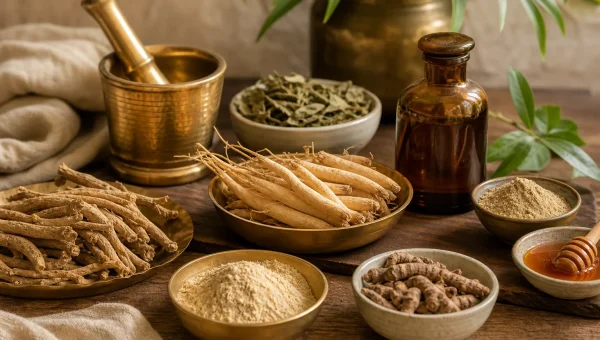
Ashwagandha (Withania somnifera): The Ayurvedic Pharmacopoeia of India lists ashwagandha root as rasayana, balya, and vajikarana, with tikta-kashaya rasa, laghu guna, ushna virya, madhura vipaka, and a traditional powder dose of 3-6 g. In a post-vasectomy wellness context, it is best framed as support for stress, sleep, strength, and vitality rather than as a vasectomy treatment. Standardized root extracts are commonly used around 600 mg daily in human trials, but dosing should be individualized.
Purified shilajit: Purified shilajit is used in Ayurveda as a rasayana. A human trial in healthy middle-aged men used purified shilajit 250 mg twice daily for 90 days and reported higher total testosterone, free testosterone, and DHEAS compared with placebo. This does not make shilajit a vasectomy remedy. It should be used only in purified, quality-tested form because raw or poorly processed shilajit may contain heavy metals, mycotoxins, or other contaminants.
Kapikacchu / Atmagupta (Mucuna pruriens): The Ayurvedic Pharmacopoeia lists Atmagupta root as Mucuna pruriens, with Kapikacchu as a synonym, and describes it as vrishya, brimhana, balya, and vajikarana. Human male-fertility data for Mucuna come from infertile men, not from post-vasectomy men. Because Mucuna contains levodopa-related activity, it should not be used casually with Parkinson’s medicines, dopamine-active drugs, or complex psychiatric medication regimens.
Shatavari (Asparagus racemosus): The Ayurvedic Pharmacopoeia lists shatavari root as madhura-tikta in rasa, guru-snigdha in guna, shita in virya, madhura in vipaka, and shukrala, balya, rasayana, and vrishya in karma. In this context, it is a cooling and tissue-nourishing shukra-support herb when the practitioner sees heat, dryness, depletion, or pitta involvement. It should not be presented as a direct testosterone booster.
| Herb | Verified Ayurvedic Role | Dose Reference | Best Use in This Context |
|---|---|---|---|
| Ashwagandha | Rasayana, balya, vajikarana | 3-6 g root powder per API, or practitioner-set extract dose | Stress, sleep, strength, vitality |
| Purified shilajit | Rasayana | 250 mg twice daily used in a 90-day human trial | Midlife vitality and androgen-marker support when appropriate |
| Kapikacchu / Atmagupta | Vrishya, brimhana, balya, vajikarana | 3-6 g root powder per API; seed/extract dose must be practitioner-set | Libido and motivation support when medicines and constitution allow |
| Shatavari | Shukrala, balya, rasayana, vrishya | 3-6 g root powder per API | Cooling shukra support in heat, dryness, or depletion patterns |
The Dietary Foundation: Vajikarana Principles
Classical vajikarana favors substances that are sweet, unctuous, nourishing, strength-promoting, and supportive of shukra dhatu. Traditional lists include milk, ghee, shashtika rice prepared with milk and ghee, wheat, barley, black gram or masha, and dates. A practical post-vasectomy version can be simple: warm milk if tolerated, moderate ghee in meals, urad dal or masha preparations one or two times weekly, rice or wheat preparations, and dates when digestion and metabolic health allow.
Diet should match agni, prakriti, and the current condition. If there is heaviness, obesity, reflux, diabetes, high kapha, or ama, the same vajikarana principle should be lighter, less sweet, and more digestible. If there is heat, burning, irritability, or pitta aggravation, cooling and gentler preparations may fit better. The goal is stable recovery, good sleep, regular bowel function, and steady nourishment, not forcing heavy food while digestion is weak.
For a broader food-focused approach, see our article on male fertility diet. For the wider Ayurvedic framework, see shukra dhatu enhancement.
What Lab Testing Is Appropriate
The essential test after vasectomy is post-vasectomy semen analysis, usually performed 8 to 16 weeks after the procedure or at about 3 months, depending on the clinician’s protocol. Contraception should continue until the clinician confirms clearance. A testosterone panel is separate from semen analysis and is not routine for every man after vasectomy.
If low libido, fatigue, depressed mood, loss of morning erections, reduced muscle mass, or body-fat changes persist after normal recovery, the appropriate next step is medical evaluation rather than assuming the vasectomy caused low testosterone. Standard evaluation uses two early-morning total testosterone samples on separate days. A diagnosis of hypogonadism requires symptoms plus consistently low testosterone; many references use below 300 ng/dL as a biochemical threshold, but laboratory ranges and clinical context matter.
If testosterone is repeatedly low, LH and FSH help distinguish primary testicular causes from secondary hypothalamic-pituitary causes. Depending on the case, a clinician may add prolactin, TSH and free T4, CBC, CMP, estradiol, cortisol, iron studies, or other testing. Men with confirmed low testosterone, persistent sexual symptoms, chronic scrotal pain, or complex endocrine concerns should work with a urologist or endocrinologist.
Safety and Limits
Herbs, rasayana formulas, shilajit, vajikarana foods, detoxes, and testosterone-support supplements do not reverse vasectomy and are not contraceptive substitutes. They do not replace post-vasectomy semen analysis, wound care, medical review for infection or severe swelling, or endocrine evaluation for confirmed low testosterone.
Medical disclaimer: Vasectomy does not lower testosterone production by its established surgical mechanism. This article discusses supportive Ayurvedic wellness care in the post-procedure period, not vasectomy reversal or treatment of hypogonadism. Men with confirmed low testosterone should consult a urologist or endocrinologist.
Nothing in this article diagnoses or treats a medical condition. Consult a qualified Ayurvedic practitioner, surgeon, or healthcare provider before starting herbs, supplements, detoxes, or therapeutic protocols, especially if you have endocrine, prostate, liver, kidney, autoimmune, psychiatric, bleeding, cardiovascular, or metabolic conditions; take medication; or are scheduled for surgery.
References
- Urologyhealth (urologyhealth.org)
- CDC
- Mayoclinic (mayoclinic.org)
- NCBI
- NCBI
- Glucocorticoids, stress, and fertility (2010), PubMed Central
- Charaka Samhita — Vajikarana
- Ayurvedic Pharmacopoeia of India
- NCCIH
- Examining the effect of Withania somnifera supplementation on muscle strength and recovery: a randomized controlled trial (2015), PubMed
- A prospective, randomized double-blind, placebo-controlled study of safety and efficacy of a high-concentration full-spectrum extract of ashwagandha root in reducing stress and anxiety in adults (2012), PubMed Central
- Clinical evaluation of purified Shilajit on testosterone levels in healthy volunteers (2016), PubMed
- Shilajit: a natural phytocomplex with potential procognitive activity (2012), PubMed Central
- Ayurvedic Pharmacopoeia of India
- Mucuna pruriens improves male fertility by its action on the hypothalamus-pituitary-gonadal axis (2009), PubMed
- Apdaparkinson (apdaparkinson.org)
- Endocrine (endocrine.org)