An Understudied Herb With Genuine Clinical Potential
Lodhra (Symplocos racemosa Roxb.) is a classical Ayurvedic bark drug with a strong place in gynecological practice, especially where astringent, cooling, kapha-pitta-balancing and tissue-supporting actions are required. In the PCOS context, its value should be understood as clinical potential rather than a stand-alone proven cure: Lodhra has classical authority for pradara-type reproductive complaints, a clear pharmacopoeial profile, and preliminary PCOS-relevant experimental work, while human single-herb PCOS trials remain limited.
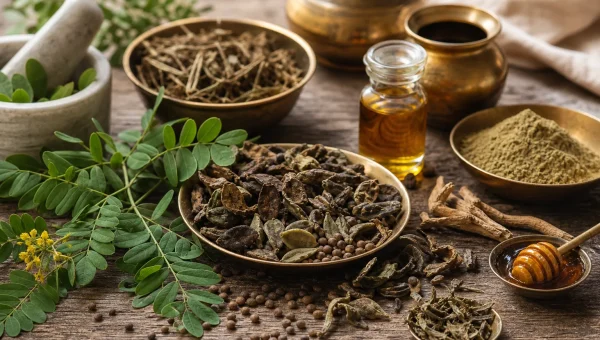
The Ayurvedic Pharmacopoeia of India identifies Lodhra as the dried stem bark of Symplocos racemosa Roxb., family Symplocaceae. It is described as an evergreen tree found in plains and lower hills throughout India. The same monograph lists the bark taste as astringent and feebly bitter, and records its main constituents as alkaloids, especially loturine and colloturine, along with red colouring matter.
Ayurvedic Profile: Why Lodhra Enters PCOS Discussions
PCOS is a modern diagnostic category and does not correspond to one single classical disease name. Lodhra enters the discussion because its Ayurvedic profile overlaps with several patterns commonly assessed in PCOS care: kapha-pitta involvement, swelling or congestion, abnormal discharge, disturbed menstrual function, inflammatory skin tendency, and reproductive-channel imbalance. The Ayurvedic Pharmacopoeia lists Lodhra as kashaya rasa, laghu guna, sheeta virya, katu vipaka, and gives its karmas as chakshushya, grahi, and kaphapittanut.
Its classical use is strongest where astringency and kapha-pitta correction are appropriate. The pharmacopoeial therapeutic uses include shotha, atisara, netraroga, raktapitta, and pradara. This does not make Lodhra a universal PCOS herb. It is most rational in practitioner-guided protocols when the presentation includes kapha-pitta features, discharge, inflammatory tendency, heaviness, swelling, or bleeding-pattern disturbance rather than a purely dry, depleted, vata-dominant picture.
Phytochemical Profile: What Makes Lodhra Biologically Interesting
The pharmacopoeial identity of Lodhra is anchored in its alkaloids, especially loturine and colloturine. Broader phytochemical reviews of Symplocos racemosa also describe phenolic glycosides, triterpenoids such as betulinic acid and acetyloleanolic acid, and other plant compounds reported from the species or genus. These constituents make Lodhra biologically interesting for PCOS research because PCOS commonly involves reproductive-endocrine disturbance, inflammation, insulin resistance, and ovarian tissue changes.
| Ayurvedic or Phytochemical Layer | Verified Details | PCOS-Relevant Interpretation |
|---|---|---|
| Ayurvedic rasa and karma | Kashaya rasa; grahi and kaphapittanut karma | Useful framework for kapha-pitta reproductive presentations, discharge tendency, and tissue laxity or congestion |
| Alkaloids | Loturine and colloturine listed in the Ayurvedic Pharmacopoeia of India | Important identity markers for authentic Lodhra bark; not enough by themselves to define a human PCOS effect |
| Phenolic and tannin-associated profile | Astringent bark character; phenolic glycosides reported in phytochemical reviews | Supports the traditional use of Lodhra in astringent, cooling, and stabilising applications |
| Triterpenoids and flavonoid-related compounds | Betulinic acid, acetyloleanolic acid, and flavonoid classes are described in reviews of the plant | Creates a plausible biochemical basis for further endocrine-metabolic research, while crude Lodhra cannot be reduced to one isolated compound |
Clinical and Experimental Evidence: What Has Actually Been Done
Human data for Lodhra as a single herb in PCOS are sparse. The strongest PCOS-specific material is experimental and formulation-based. A rat study in Journal of Coastal Life Medicine evaluated Symplocos racemosa in letrozole-induced PCOS. The intervention used low, medium, and high doses after PCOS induction and recorded reduction of elevated testosterone, improvement in estrogen and progesterone parameters, cholesterol changes, and recovery of ovarian and uterine tissue features at the mid and high doses. This supports a PCOS-relevant anti-androgen and ovarian-tissue rationale, but it does not establish a direct human treatment protocol.
An older Journal of Ethnopharmacology paper evaluated aqueous Symplocos racemosa extract in immature female rats and reported changes in gonadotropin release, including FSH and LH, along with ovarian histology observations. This is relevant to follicular maturation and hypothalamic-pituitary-ovarian axis discussion, but it remains preclinical.
A separate experimental study assessed “DXB-2030,” a polyherbal formulation containing Trigonella foenum-graecum, Aloe vera, Sphaeranthus indicus, Nardostachys jatamansi, and Symplocos racemosa, in testosterone-propionate-induced PCOS rats. The formulation was associated with better GLUT4 expression, lower body weight, lower testosterone, improved glucose tolerance measures, and fewer cystic follicles. This is useful formulation evidence, but it cannot isolate Lodhra’s individual contribution.
How Lodhra Fits Into an Ayurvedic PCOS Plan
Lodhra is best viewed as a targeted herb within a larger Ayurvedic assessment rather than a generic hormone-balancing supplement. A practitioner may consider it when PCOS presents with kapha-pitta features such as heaviness, inflammatory acne tendency, abnormal discharge, swelling, or bleeding disturbance. Where the presentation is dominated by depletion, severe dryness, marked vata aggravation, or very scanty cycles without kapha-pitta signs, Lodhra may not be the central herb.
Modern PCOS care also requires diagnosis and monitoring. Clinical diagnosis commonly uses combinations of androgen excess, ovulatory dysfunction, and polycystic ovarian morphology after excluding other causes. Lifestyle, weight management when relevant, metabolic screening, cycle history, androgen symptoms, fertility goals, and psychological wellbeing all remain part of comprehensive care. Lodhra, when used, should sit inside this broader framework rather than replace medical evaluation.
Dosage and Preparation
The Ayurvedic Pharmacopoeia of India lists the dose of Lodhra as 3–5 g of the drug in powder form and 20–30 g of the drug for decoction. These figures are pharmacopoeial reference doses, not a PCOS prescription. In actual practice, dose, duration, anupana, and combinations depend on prakriti, agni, bowel pattern, menstrual history, bleeding or discharge pattern, metabolic status, current medicines, and fertility goals.
For PCOS, Lodhra should not be used casually for months without review. Menstrual cycle pattern, pregnancy possibility, acne or hirsutism, weight changes, glucose and insulin-related markers, thyroid and prolactin status when indicated, and ultrasound findings may all affect the treatment plan. Practitioner-guided use is especially important if Lodhra is combined with other herbs such as Ashoka, Shatavari, Kanchanara, Guduchi, Triphala, or formulation-based approaches.
Safety, Pregnancy, and Lactation Considerations
Lodhra has astringent and grahi qualities, so self-use is not advisable during pregnancy or while trying to manage an uncertain missed period. Anyone using Lodhra for PCOS should stop self-directed use and consult a qualified practitioner or healthcare provider if pregnancy is suspected or confirmed. Safety during breastfeeding is also not well established for unsupervised use, so lactating mothers should use it only under professional guidance.
Medical disclaimer: PCOS requires proper medical diagnosis and monitoring. This article is educational and does not diagnose, treat, or replace care from a gynecologist, endocrinologist, qualified Ayurvedic physician, or other healthcare provider. Consult a qualified practitioner before using Lodhra, especially if pregnant, trying to conceive, breastfeeding, taking hormonal medicines, using fertility treatment, managing diabetes or thyroid disease, or experiencing abnormal bleeding.
References
- Ayurvedic Pharmacopoeia of India
- A comprehensive analysis on Symplocos racemosa Roxb.: Traditional uses, botany, phytochemistry and pharmacological activities (2016), PubMed
- Scialert (scialert.net)
- Scialert (scialert.net)
- Researchgate (researchgate.net)
- Effect of Symplocos racemosa Roxb. on gonadotropin release in immature female rats and ovarian histology (2004), PubMed
- Effect of “DXB-2030,” a Polyherbal Formulation, on Experimental Polycystic Ovary Syndrome Associated with Hyperandrogenism (2019), PubMed Central
- Academic (academic.oup.com)
- Academic (academic.oup.com)