
A person who develops cough, wheezing, eye irritation, nasal congestion, or worsening asthma after moving into a damp building first needs medical assessment and correction of the moisture problem. Indoor dampness and mold are associated most consistently with respiratory and allergic illness. Fatigue, headache, poor concentration, joint pain, or digestive upset require a differential diagnosis rather than automatic attribution to “mold toxicity.” Ayurveda can contribute a symptom-based assessment of dosha, agni, ama, and affected srotas, but it should be used as complementary care rather than as a substitute for building remediation or medical diagnosis.
The term mycotoxicosis refers to illness caused by toxic fungal metabolites, most clearly established through contaminated food and some substantial occupational exposures. It should not be used as a blanket synonym for every symptom occurring in a water-damaged building. “Chronic inflammatory response syndrome” or CIRS is promoted by some practitioners as a multisystem illness caused by indoor mold, yet the diagnostic panels commonly marketed for it—including urine mycotoxin testing and broad biomarker or HLA-based protocols—are not established for routine diagnosis by major public-health, allergy, and medical-toxicology authorities.
The Ayurvedic Framework for Environmental Exposure
Classical Ayurveda contains a sophisticated discipline of toxicology, but indoor mold is not named in the classical texts as a specific form of gara visha. In the Charaka Samhita, gara visha is described as an artificially prepared poison formed by combining substances and producing illness after a delay. Applying that term to chronic damp-building exposure is therefore a modern analogy, not a direct classical diagnosis. Ayurvedic assessment should begin with the person’s signs, digestion, strength, constitution, season, and coexisting disease.
- Kapha-pattern symptoms: Heaviness, lethargy, excess secretions, nasal blockage, a dull sensation in the head, reduced appetite, and a tendency toward congestion may be interpreted as kapha aggravation. Mold itself should not be assigned “heavy, sticky, and cold” pharmacological qualities as though it were a classical Ayurvedic substance.
- Agni and ama: Ayurveda uses ama for products or states associated with incomplete digestion, metabolism, or tissue transformation. It is not a Sanskrit name for mycotoxins, and a laboratory toxin result cannot be translated directly into an ama diagnosis.
- Srotas assessment: Cough and breathlessness may lead a practitioner to assess pranavaha srotas; digestive symptoms may require examination of annavaha and purishavaha srotas. These Ayurvedic functional systems are not exact synonyms for lymphatic vessels or neural pathways.
- Mixed dosha presentations: Burning eyes, inflammation, irritability, dryness, disturbed sleep, tremor, or variable pain may involve pitta or vata as well as kapha. A single “kapha-visha” label can miss important differences between patients.
What the Medical Picture Supports
Public-health guidance links damp and moldy environments with nasal and throat irritation, cough, wheeze, asthma exacerbation, allergic rhinitis, eczema, respiratory infection, and hypersensitivity pneumonitis in susceptible people. People with weakened immunity or chronic lung disease may face greater fungal-infection risk. Stachybotrys chartarum can grow on persistently wet cellulose-containing materials, but health agencies advise treating it like other indoor mold: identify moisture, repair the source, and remove contaminated material safely rather than basing treatment on the species name alone.
Visible mold, musty odor, water damage, and moisture intrusion are generally more actionable than consumer air sampling. There are no health-based indoor standards that convert a mold count into a diagnosis. Urine mycotoxin tests sold directly to consumers are not FDA-approved for diagnosing illness from indoor mold, lack validated disease thresholds, and may detect dietary exposure in healthy people. Medical evaluation should therefore be guided by history, examination, and standard testing for conditions such as asthma, allergy, infection, or hypersensitivity pneumonitis when clinically indicated.
Symptoms Require a Differential Diagnosis
The table keeps medical and Ayurvedic perspectives in view without treating every symptom as proof of systemic mold poisoning.
| Symptom | Medical Questions to Consider | Possible Ayurvedic Assessment | Priority |
|---|---|---|---|
| Cough, wheeze, chest tightness | Asthma, allergy, infection, irritant exposure, hypersensitivity pneumonitis | Pranavaha srotas; kapha with possible vata involvement | Clinical respiratory assessment and exposure control |
| Nasal blockage, watery eyes, itching | Allergic rhinitis, conjunctival irritation, dermatitis | Kapha predominance; pitta if burning or marked redness is present | Remove exposure and use evidence-based allergy care |
| Fatigue, headache, poor concentration | Sleep disorder, anemia, thyroid disease, medication effects, infection, anxiety, depression, other environmental exposures | Assess agni, bala, sleep, vata-kapha balance, and ama signs | Do not diagnose from symptoms alone |
| Nausea or altered bowel habits | Dietary causes, infection, medication effects, reflux, functional bowel disorders | Annavaha and purishavaha srotas; agni pattern | Evaluate persistent or severe symptoms medically |
| Numbness, tremor, joint or muscle pain | Neurological, metabolic, rheumatological, nutritional, or medication-related causes | Vata assessment with examination of pain, strength, and tissue involvement | Prompt evaluation when progressive, focal, or disabling |
Ayurvedic Medicines: Classical Properties and Boundaries
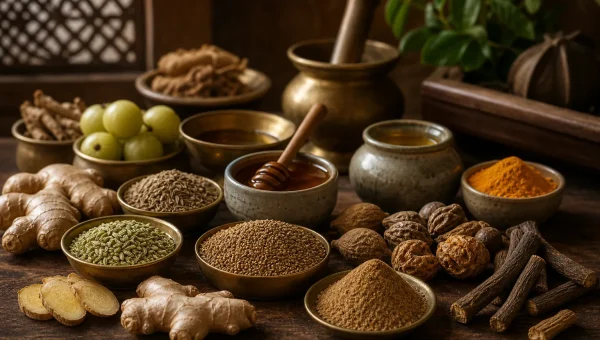
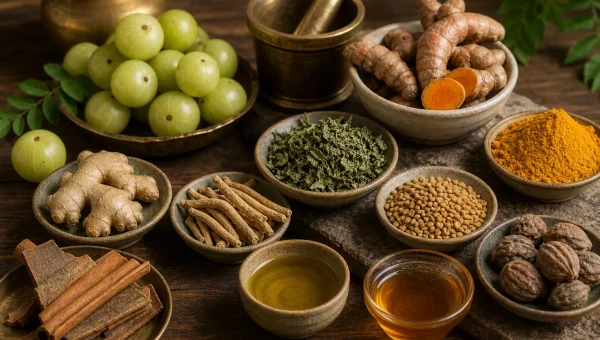
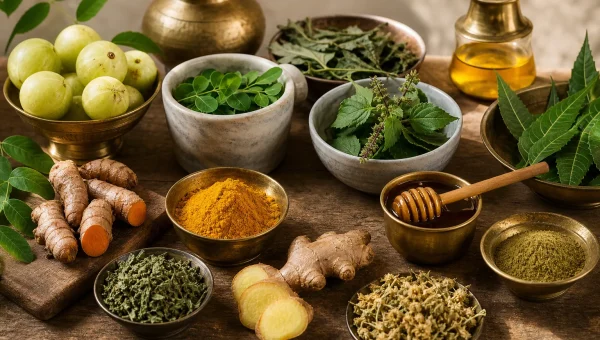
Herbs should be selected for the individual’s dosha, digestion, bowel pattern, strength, medicines, pregnancy status, and liver or kidney health. The Ayurvedic Pharmacopoeia of India records identity, quality standards, traditional properties, indications, and dose ranges; it does not establish removal of inhaled mycotoxins. Fixed internet “detox stacks” are therefore inappropriate.
Guduchi (Tinospora cordifolia)
The pharmacopoeial monograph describes guduchi stem as bitter and astringent in taste, light in quality, hot in potency, and sweet after digestion. Its listed actions include dipana, balya, rasayana, sangrahi, and tridosha-pacifying activity. These properties may make guduchi relevant in selected fever, digestive, or convalescent patterns, but do not prove mycotoxin clearance. Guduchi has also been associated with clinically significant liver injury, particularly in people using concentrated products, so it should not be recommended automatically to anyone with suspected environmental illness.
Katuka or Kutki (Picrorhiza kurroa)
The pharmacopoeial monograph describes katuka as pungent and bitter in taste, light in quality, cold in potency, and pungent after digestion. Listed actions include dipani, bhedini, pittahara, and jvarahara, with traditional indications that include jaundice, loss of appetite, fever, and respiratory complaints. Its strong bitter and bowel-stimulating character makes unsupervised use unsuitable, especially in weak, dehydrated, pregnant, or medically complex patients. Classical use does not establish that it increases human mycotoxin excretion through bile.
Triphala
Triphala is the established three-fruit formulation of haritaki, bibhitaki, and amalaki. A practitioner may consider it when the bowel and digestive assessment support use, but Triphala is not a food-based equivalent of activated charcoal or a proven indoor-mold toxin binder. Constipation, loose stools, dehydration risk, and concurrent medicines all affect whether it is appropriate.
Tulasi and Nimba
The pharmacopoeial monograph for tulasi leaf (Patra) describes pungent, bitter, and astringent tastes; light, dry, and sharp qualities; hot potency; and pungent post-digestive effect, with traditional actions that include kapha-reducing and digestive activity. The nimba leaf monograph describes bitter taste, dry quality, cold potency, and pungent post-digestive effect. Laboratory antifungal findings do not show that tulasi tea, steam inhalation, or internal neem eradicates building mold or treats presumed systemic infection. Steam can also aggravate some airways, and internal neem is not a routine self-care remedy for children, pregnancy, or medically fragile patients.
Environmental Remediation Comes First
A useful bridge between environmental health and Ayurveda is nidana parivarjana: removing or avoiding the causative factor. For a damp building, this means finding and repairing leaks, controlling humidity, drying wet materials promptly, and cleaning or discarding mold-damaged materials with appropriate containment and protection. Painting over mold or repeatedly using fragrance and surface sprays does not correct the moisture source. Major contamination, HVAC involvement, sewage, or an immunocompromised occupant warrants professional assessment.
- Document the building problem: Record leaks, visible growth, odor, damaged materials, and symptom timing. A moisture inspection is generally more useful than trying to identify a feared species.
- Reduce exposure during remediation: Sensitive occupants may need to remain away from active work. Disturbing extensive mold without containment can spread spores and debris.
- Seek symptom-directed care: Asthma, allergy, dermatitis, infection, and hypersensitivity pneumonitis have established diagnostic and treatment pathways. Severe breathlessness, chest pain, confusion, fainting, or low oxygen requires urgent medical care.
A Safer Recovery Plan
Recovery should be individualized, not divided into a universal twelve-week herbal protocol. Begin with exposure control and a medical diagnosis. Support regular sleep, adequate hydration, sufficient protein and calories, and meals that are warm and easy to digest when appetite is low. Ayurveda may then be added through a qualified practitioner, using the minimum number of well-chosen interventions and reassessing tolerance. Dairy, wheat, or raw-food restrictions should be based on allergy, intolerance, reflux, digestive response, nutritional needs, and practitioner assessment.
Forceful purification, emesis, purgation, medicated enema, or intensive nasya should not be attempted as home “mold detox.” Even simple nasal oil is unsuitable during acute sinus infection, significant nasal obstruction, aspiration risk, or certain respiratory conditions unless a clinician has advised it. Choose products tested for identity, contaminants, and heavy metals, review interactions, and introduce one change at a time.
Safety and Disclaimer
Persistent symptoms after damp-building exposure need licensed medical evaluation, especially with asthma, chronic lung disease, immune suppression, pregnancy, liver disease, or neurological change. Ayurvedic care should be supervised by a qualified practitioner who can examine the patient and coordinate with conventional treatment. Do not rely on unvalidated urine mycotoxin panels, species fear, or a generic supplement bundle to diagnose or treat illness. Environmental remediation remains essential, while herbs, diet, and daily routine are supportive measures selected for the individual rather than substitutes for medical care.
Actionable Tip: Before buying a “mold detox” kit, make a simple timeline of the building’s leaks or dampness, visible mold or odor, time spent in the space, and changes in respiratory, skin, eye, or general symptoms. Arrange correction of the moisture source and bring the timeline to a clinician. This approach is more useful than beginning several herbs at once and makes it easier to judge whether symptoms improve after exposure is reduced.
References
- CDC
- CDC
- CDC
- Epa (epa.gov)
- CDC
- Aaaai (aaaai.org)
- Acmt (acmt.net)
- Charaka Samhita — Visha Chikitsa
- Charaka Samhita — Ama
- Charaka Samhita — Snehavyapat Siddhi
- Charaka Samhita — Kiyanta Shiraseeya Adhyaya
- Charaka Samhita — Kasa Chikitsa
- Charaka Samhita — Sroto Vimana
- Ayurvedic Pharmacopoeia of India
- NCBI
- Ayurvedic Pharmacopoeia of India
- Ccrhindia (ccrhindia.ayush.gov.in)
- Ayurvedic Pharmacopoeia of India
- Ayurvedic Pharmacopoeia of India
- NCCIH
The rental property mold story is essentially my last 3 years. Moved into an apartment in 2023, developed symptoms within a month that I attributed to everything else for two years before someone suggested a mold inspection. The cognitive fogginess described is exactly right. Not just difficulty concentrating but actually misreading written words.
The “one from each specialist” diagnostic journey before the building inspector found the mold is a pattern that recurs in environmental illness. I had 4 doctors and 3 specialists over 18 months before anyone asked about my home. The Kapha accumulation framing as an explanation for why environmental toxins manifest differently in different people is compelling.
The triphala and guggulu protocol for toxin mobilization is something my Ayurvedic physician used when I came to her with suspected mold illness. The sequence she described, first stabilizing Agni, then mobilizing stored toxins, then supporting elimination, was very similar to what is described here. The order matters and I learned that by trying to do mobilization before I was ready.
This contradicts what my specialist told me at AIIMS. They specifically said kapha has no evidence base for this condition. Who is right?
The Kapha-Ama accumulation framework for understanding mold-related systemic symptoms is the most useful Ayurvedic parallel in this article. The mucus accumulation, brain fog, and fatigue pattern maps well. 577
I liked the practical side of Mold Toxicity and Kapha Accumulation. Would be useful to see a short checklist next.
Left the moldy apartment 6 months ago and started the protocol described here alongside a functional medicine approach with cholestyramine for mycotoxin binding. The Ayurvedic lymphatic support with manjistha and guduchi has been a noticeable addition. My fatigue, which was 7 out of 10 at worst, is now around 2 most days.
living in a damp climate for 3 years before finding mold behind the walls. the Kapha-clearing diet alongside remediation is the combination that finally shifted the brain fog 375
The article makes a clear point that fixing the moisture problem comes before any herbal routine.
What’s the shelf life of the prepared kapha formulations? I ask because some preparations I’ve used seemed less potent after 2-3 months.
As an environmental health nurse, the most important message in this article for me is simply: if unexplained multisystem illness is not resolving with standard treatment, investigate the home environment. This point cannot be repeated enough and most healthcare providers do not ask about it.
I appreciated the reminder that kapha type heaviness and congestion need a differential diagnosis.
My concern is that kapha is being positioned as a replacement for things that actually work. Complementary is fine. Replace is where I get uncomfortable.
I liked the practical side of Mold Toxicity and Kapha Accumulation. I appreciate that it does not oversell the result.
One question I have is how reliable are those urine mycotoxin tests sold online.
no mention of testing like ERMI or MYCOTOX before starting a protocol. testing first is important to confirm the problem
post-flood apartment and then years of weird symptoms nobody explained. this Kapha-toxin framework finally gave me a model that matched my experience
I tried to implement this protocol after what I believe was a mold exposure in my previous home. The Agni-rebuilding phase with ginger and trikatu worked well but the guggulu gave me skin reactions at the doses described. Dose sensitivity varies a lot and starting lower than the suggested amount may be wise.
the Nasya oil recommendation for sinus mold symptoms, is any oil appropriate or specifically anti-fungal ones
I would like more detail on Mold Toxicity and Kapha Accumulation. The timing advice is the part I would start with.
The differentiation between acute mold exposure and chronic low-level exposure in the protocol design is practical. The intensity of intervention appropriately scales with duration of exposure.
can children follow the Kapha-clearing protocol for mold symptoms
The genetic susceptibility factor (HLA-DR gene variants affecting 25% of the population) that makes mold toxicity a persistent issue is not mentioned. This explains why some people improve with remediation and others don’t.
how do you tell the difference between mold toxicity symptoms and regular Kapha imbalance without testing
article doesn’t say how to actually test for mold exposure. before trying any protocol you need to confirm it’s actually mold
living in a damp climate for 3 years before finding mold behind the walls. the Kapha-clearing diet alongside remediation is the combination that finally shifted the brain fog
The HEPA filter and dehumidifier recommendations alongside herbal protocol are the right framing. Environmental remediation is primary and herbal support is secondary.
some readers may skip the environmental remediation and just do the herbs thinking it’s enough. the article should emphasize that herbal protocols don’t work if you’re still in the moldy environment
the dietary protocol says avoid all dairy but I’ve read that some dairy like ghee is Kapha-reducing. is ghee excluded here
The Kapha-Ama accumulation framework for understanding mold-related systemic symptoms is the most useful Ayurvedic parallel in this article. The mucus accumulation, brain fog, and fatigue pattern maps well.
Activated charcoal as a mycotoxin binder is the most evidence-supported intervention in the article. The Ayurvedic parallel to Vishagna applications is interesting context.
can Triphala help remove mycotoxins or is that overclaiming its role
Useful post on Mold Toxicity and Kapha Accumulation. Would be useful to see a short checklist next.
It’s helpful to see the Ayurvedic framework tied to pranavaha srotas for cough and breathlessness.
Mold toxicity (CIRS) is a contested diagnosis even within functional medicine. Presenting it as equivalent to Kapha accumulation without noting this controversy misleads readers.
the Shilajit and Triphala combination for mycotoxin binding helped me during a CIRS protocol alongside conventional treatment. my practitioner was open to incorporating it
how do you tell the difference between mold toxicity symptoms and regular Kapha imbalance without testing 686
The genetic susceptibility factor (HLA-DR gene variants affecting 25% of the population) that makes mold toxicity a persistent issue is not mentioned. This explains why some people improve with remediation and others don’t. 941
no mention of testing like ERMI or MYCOTOX before starting a protocol. testing first is important to confirm the problem 189
Useful post on Mold Toxicity and Kapha Accumulation. The examples make the advice less abstract.
The differentiation between acute mold exposure and chronic low-level exposure in the protocol design is practical. The intensity of intervention appropriately scales with duration of exposure. Six months in and still helpful.
living in a damp climate for 3 years before finding mold behind the walls. the Kapha-clearing diet alongside remediation is the combination that finally shifted the brain fog 529
can Triphala help remove mycotoxins or is that overclaiming its role 974
The Kapha-Ama accumulation framework for understanding mold-related systemic symptoms is the most useful Ayurvedic parallel in this article. The mucus accumulation, brain fog, and fatigue pattern maps well. 576
some readers may skip the environmental remediation and just do the herbs thinking it’s enough. the article should emphasize that herbal protocols don’t work if you’re still in the moldy environment 568
Mold toxicity (CIRS) is a contested diagnosis even within functional medicine. Presenting it as equivalent to Kapha accumulation without noting this controversy misleads readers. 482
article doesn’t say how to actually test for mold exposure. before trying any protocol you need to confirm it’s actually mold 233
can children follow the Kapha-clearing protocol for mold symptoms 996
The HEPA filter and dehumidifier recommendations alongside herbal protocol are the right framing. Environmental remediation is primary and herbal support is secondary. 578
Activated charcoal as a mycotoxin binder is the most evidence-supported intervention in the article. The Ayurvedic parallel to Vishagna applications is interesting context. 148
the Nasya oil recommendation for sinus mold symptoms, is any oil appropriate or specifically anti-fungal ones 522
For Mold Toxicity and Kapha Accumulation, consistency seems like the hard part. This is the kind of detail readers can test slowly.
the Shilajit and Triphala combination for mycotoxin binding helped me during a CIRS protocol alongside conventional treatment. my practitioner was open to incorporating it 409
The differentiation between acute mold exposure and chronic low-level exposure in the protocol design is practical. The intensity of intervention appropriately scales with duration of exposure. 968
Reading about guduchi’s potential liver impact made me pause before recommending it to friends.
the dietary protocol says avoid all dairy but I’ve read that some dairy like ghee is Kapha-reducing. is ghee excluded here 625
post-flood apartment and then years of weird symptoms nobody explained. this Kapha-toxin framework finally gave me a model that matched my experience 624
the dietary protocol says avoid all dairy but I’ve read that some dairy like ghee is Kapha-reducing. is ghee excluded here Found this through a search.
post-flood apartment and then years of weird symptoms nobody explained. this Kapha-toxin framework finally gave me a model that matched my experience 745
For Mold Toxicity and Kapha Accumulation, consistency seems like the hard part. Good starting point for a cautious reader.
The genetic susceptibility factor (HLA-DR gene variants affecting 25% of the population) that makes mold toxicity a persistent issue is not mentioned. This explains why some people improve with remediation and others don’t. 671
article doesn’t say how to actually test for mold exposure. before trying any protocol you need to confirm it’s actually mold 200
Activated charcoal as a mycotoxin binder is the most evidence-supported intervention in the article. The Ayurvedic parallel to Vishagna applications is interesting context. 222
how do you tell the difference between mold toxicity symptoms and regular Kapha imbalance without testing 135
the Nasya oil recommendation for sinus mold symptoms, is any oil appropriate or specifically anti-fungal ones 872
can children follow the Kapha-clearing protocol for mold symptoms 376
The section on nidana parivarjana feels like a practical bridge between environmental health and Ayurveda.
Reading this later and the Mold Toxicity and Kapha Accumulation advice still feels relevant. This would be easier to follow with a one-week sample plan.
I wonder if clinicians often overlook the need to assess agni and ama in mold related fatigue.
The caution about using Triphala as a toxin binder resonates with what I’ve read elsewhere.
the Shilajit and Triphala combination for mycotoxin binding helped me during a CIRS protocol alongside conventional treatment. my practitioner was open to incorporating it 801
I found the table comparing medical questions to Ayurvedic assessment priorities quite useful.
The HEPA filter and dehumidifier recommendations alongside herbal protocol are the right framing. Environmental remediation is primary and herbal support is secondary. 678
Mold toxicity (CIRS) is a contested diagnosis even within functional medicine. Presenting it as equivalent to Kapha accumulation without noting this controversy misleads readers. 434
The Kapha-Ama accumulation framework for understanding mold-related systemic symptoms is the most useful Ayurvedic parallel in this article. The mucus accumulation, brain fog, and fatigue pattern maps well. 123
some readers may skip the environmental remediation and just do the herbs thinking it’s enough. the article should emphasize that herbal protocols don’t work if you’re still in the moldy environment 586
It’s good that the piece stresses professional remediation for major contamination or HVAC involvement.
can Triphala help remove mycotoxins or is that overclaiming its role 888
The differentiation between acute mold exposure and chronic low-level exposure in the protocol design is practical. The intensity of intervention appropriately scales with duration of exposure. 373
no mention of testing like ERMI or MYCOTOX before starting a protocol. testing first is important to confirm the problem 836
After reading, I’ll check my home for visible mold and musty odor before buying any detox kit.
how do you tell the difference between mold toxicity symptoms and regular Kapha imbalance without testing Six months in and still helpful.
no mention of testing like ERMI or MYCOTOX before starting a protocol. testing first is important to confirm the problem 723
The HEPA filter and dehumidifier recommendations alongside herbal protocol are the right framing. Environmental remediation is primary and herbal support is secondary. 804
Activated charcoal as a mycotoxin binder is the most evidence-supported intervention in the article. The Ayurvedic parallel to Vishagna applications is interesting context. 108
the Shilajit and Triphala combination for mycotoxin binding helped me during a CIRS protocol alongside conventional treatment. my practitioner was open to incorporating it 971
The Mold Toxicity and Kapha Accumulation explanation is clearer than most short posts. The timing advice is the part I would start with.
article doesn’t say how to actually test for mold exposure. before trying any protocol you need to confirm it’s actually mold 789
The guggulu mobilization phase described here should carry a strong caution for anyone with thyroid conditions. Guggulu affects thyroid hormone levels and anyone on thyroid medication needs to monitor levels carefully if adding it. This risk is not addressed in the mold toxicity context.
The Mold Toxicity and Kapha Accumulation explanation is clearer than most short posts. The main idea is clear even if someone is new to Ayurveda.
can Triphala help remove mycotoxins or is that overclaiming its role 405
living in a damp climate for 3 years before finding mold behind the walls. the Kapha-clearing diet alongside remediation is the combination that finally shifted the brain fog 701
can children follow the Kapha-clearing protocol for mold symptoms 422
the dietary protocol says avoid all dairy but I’ve read that some dairy like ghee is Kapha-reducing. is ghee excluded here 617
The genetic susceptibility factor (HLA-DR gene variants affecting 25% of the population) that makes mold toxicity a persistent issue is not mentioned. This explains why some people improve with remediation and others don’t. 707
For children under 12, is the kapha protocol adjusted? My son’s pediatric Ayurvedic doctor hasn’t mentioned it but I’m curious.
post-flood apartment and then years of weird symptoms nobody explained. this Kapha-toxin framework finally gave me a model that matched my experience 111
the Nasya oil recommendation for sinus mold symptoms, is any oil appropriate or specifically anti-fungal ones 637
Mold toxicity (CIRS) is a contested diagnosis even within functional medicine. Presenting it as equivalent to Kapha accumulation without noting this controversy misleads readers. 975
some readers may skip the environmental remediation and just do the herbs thinking it’s enough. the article should emphasize that herbal protocols don’t work if you’re still in the moldy environment 402
post-flood apartment and then years of weird symptoms nobody explained. this Kapha-toxin framework finally gave me a model that matched my experience Third time reading this.
no mention of testing like ERMI or MYCOTOX before starting a protocol. testing first is important to confirm the problem 472
the dietary protocol says avoid all dairy but I’ve read that some dairy like ghee is Kapha-reducing. is ghee excluded here 185
The Kapha-Ama accumulation framework for understanding mold-related systemic symptoms is the most useful Ayurvedic parallel in this article. The mucus accumulation, brain fog, and fatigue pattern maps well. 286
how do you tell the difference between mold toxicity symptoms and regular Kapha imbalance without testing 690
The differentiation between acute mold exposure and chronic low-level exposure in the protocol design is practical. The intensity of intervention appropriately scales with duration of exposure. 664
The Stachybotrys identified in the excerpt is the most dangerous mold in terms of mycotoxin production. Is there any Ayurvedic differentiation between different types of environmental mold in terms of which toxins they produce and whether the treatment protocol differs?
I liked the practical side of Mold Toxicity and Kapha Accumulation. The safety notes could be expanded a little.
The genetic susceptibility factor (HLA-DR gene variants affecting 25% of the population) that makes mold toxicity a persistent issue is not mentioned. This explains why some people improve with remediation and others don’t. 873