
Ayurveda approaches wound care under Vrana Chikitsa, with attention to the condition of the wound bed, discharge, pain, tissue strength, diet, and the patient’s systemic state. In an integrated setting, this means the wound is first assessed for infection, circulation, depth, diabetes control, and need for debridement or antibiotics; only then are Ayurvedic local and internal supports selected for cleansing, granulation, epithelialization, and post-closure skin restoration.
The Four Phases of Wound Healing and Where Ayurveda Intervenes
Modern wound care describes healing as a coordinated sequence of hemostasis, inflammation, proliferation, and remodeling. Ayurveda does not use the same biomedical vocabulary, but classical wound management similarly distinguishes between cleansing an unhealthy wound, supporting healthy granulation and closure, and improving the quality of the healed tissue. In practical Ayurvedic language, this is commonly discussed as Vrana Shodhana for cleansing, Vrana Ropana for healing and tissue repair, and Vaikritapaha or post-healing correction for restoring appearance and function.
The important clinical lesson is staging. A wet, sloughy, foul-smelling wound does not need the same application as a clean wound with healthy granulation. A closed scar does not need the same oil as an open ulcer. The best Ayurvedic wound care is therefore not a single herb placed on every cut; it is a staged approach guided by wound assessment.
Phase 1: Vrana Shodhana, Cleansing the Wound Bed
Vrana Shodhana means preparing the wound for healing by clearing excess discharge, slough, odor, and local contamination. In clinical practice, this phase must be aligned with sterile wound care principles. Deep wounds, diabetic foot ulcers, burns, animal bites, spreading redness, fever, severe pain, black tissue, exposed tendon or bone, and wounds in immunocompromised patients require medical evaluation before any herbal dressing is considered.
Triphala Kashaya as a Cleansing Wash
Triphala is the classical three-fruit formulation made from Haritaki, Bibhitaki, and Amalaki. As a decoction, it is traditionally used where astringent cleansing is desired. Its tannin-rich fruits make it especially suitable for wounds with mild excess moisture, provided the preparation is fresh, well-strained, and used under professional wound-care guidance.
- Use only freshly prepared, well-filtered decoctions in a clinical or properly supervised setting.
- Do not pour home-prepared herbal liquids into deep, surgical, diabetic, or infected wounds without a trained practitioner’s assessment.
- For wounds that need irrigation, sterile saline and clinician-directed dressings remain the standard baseline.
Panchavalkala for Moist, Discharging Wounds
Panchavalkala is a five-bark group traditionally associated with wound cleansing and astringent action. It is commonly described in Ayurvedic wound practice for washing or dressing chronic and infected wounds after proper assessment. Its practical role is strongest where the wound is moist, exudative, and in need of local cleansing rather than heavy oiling.
Neem, Haridra, and Madhu in the Cleansing Phase
Nimba (Neem), Haridra (Turmeric), and Madhu (Honey) are often discussed in Ayurvedic wound care because they are associated with cleansing, antimicrobial, anti-inflammatory, and healing-supportive actions. For modern wound safety, honey used on wounds should be medical-grade rather than kitchen honey, and turmeric or neem pastes should not be applied casually to open wounds where sterility, allergy, staining, irritation, or delayed medical care may become a problem.
Phase 2: Vrana Ropana, Supporting Granulation and Closure
Once the wound bed is clean and infection is controlled, Ayurvedic care shifts toward Vrana Ropana: encouraging healthy granulation, epithelialization, and tissue strength. This is the phase where ghee-based and oil-based preparations, soothing herbs, and tissue-supportive diet become more relevant. The exact choice depends on whether the wound is dry, painful, hot, inflamed, excessively moist, or slow to contract.
Manjistha (Rubia cordifolia) for Tissue Repair Support
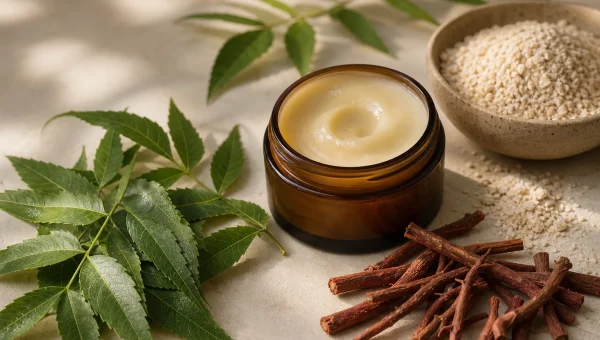
Manjistha is widely used in Ayurveda for Rakta-related and skin-related conditions, and it appears in wound-healing formulations such as Manjishthadi Ghrita. In the wound context, it is best understood as a supportive herb used within broader formulations rather than as a stand-alone cure. Topical Manjishthadi Ghrita has been clinically evaluated in postoperative wounds, and Manjistha is also included in several traditional wound-healing combinations.
In practice, Manjistha may be considered when there is a need to support skin quality, local tissue repair, and Rakta-related imbalance, but internal use should be individualized. It should be avoided or used only with professional advice during pregnancy, while taking anticoagulant medicines, or when the patient has complex medical conditions.
Yashtimadhu (Glycyrrhiza glabra) for Soothing and Ropana Applications
Yashtimadhu, or licorice root, is used in Ayurveda for soothing, demulcent, and healing-supportive applications. In wound practice it is commonly used in ghee-based preparations, especially where dryness, irritation, burning, or tenderness is present. Ghee serves as a nourishing base, while the herb contributes a softening and calming quality suitable for selected clean wounds and wound margins.
Internal licorice is not suitable for everyone. It may raise blood pressure, reduce potassium, and interact with diuretics, heart medicines, corticosteroids, blood pressure medicines, and other drugs. People with hypertension, kidney disease, heart disease, pregnancy, edema, or electrolyte imbalance should not take Yashtimadhu internally unless a qualified clinician specifically approves it.
Jatyadi Taila for Clean Wounds and Supervised Dressings
Jatyadi Taila is one of the better-known Ayurvedic topical oils for wounds, ulcers, burns, fissures, and related skin lesions. It traditionally contains herbs such as Jati, Nimba, Patola, Haridra, Daruharidra, Manjistha, and Yashtimadhu in an oil base, though formulas vary by textual lineage and manufacturer. It is most appropriate after proper wound cleaning and assessment, particularly when the wound has moved from heavy discharge toward healthier granulation.
Because oils can trap contamination if used at the wrong time, Jatyadi Taila should not be applied to a dirty, necrotic, deeply infected, or unassessed wound. It belongs in a monitored dressing plan, not as a replacement for debridement, antibiotics, vascular care, pressure offloading, or diabetic control when those are required.
Kumari (Aloe vera) for Cooling and Epithelial Support
Kumari, commonly known as Aloe vera, is valued for its cooling, moistening, and skin-soothing qualities. It is most appropriate for superficial, clean, heat-dominant skin injury or as a clinician-approved adjunct in burns and epithelializing wounds. Its gel should be clean, free from the yellow latex layer, and avoided if there is irritation, allergy, contamination risk, or uncertainty about wound depth.
For minor superficial burns, first aid still begins with cooling under clean running water and medical assessment when the burn is large, deep, blistering extensively, on the face, hands, genitals, or joints, or involves a child, older adult, diabetic patient, or immunocompromised person.
Phase 3: Vaikritapaha and Scar-Quality Care After Closure
Ayurveda continues care after the wound has closed. The aim is not merely to stop discharge but to help the healed area regain comfortable texture, flexibility, and healthy color. This phase begins only after complete epithelialization, when there is no open area, no scab that is still separating, no discharge, and no sign of infection.
Kumkumadi Taila for Closed Marks and Uneven Pigmentation
Kumkumadi Taila is a classical complexion-supporting oil used for facial discoloration, dullness, and uneven skin tone. In wound care, its role is limited to closed, intact skin where pigmentation or texture is the main concern. It should not be used on open wounds, wet scars, active infection, acneiform irritation, or freshly injured tissue.
For closed scars on the body, plain sesame oil, coconut oil, or a practitioner-selected medicated oil may be used for gentle massage around the area when the tissue is fully closed and comfortable. Massage should be light; aggressive friction can irritate immature scar tissue.
A Clinician-Supervised Ayurvedic Wound-Care Framework
The following framework preserves the classical Ayurvedic staging while keeping modern wound safety at the center. It is not a self-treatment prescription; it is a map for how an Ayurvedic practitioner may coordinate care with a physician, surgeon, podiatrist, dermatologist, or wound-care nurse.
Stage 1: Assessment and Cleansing
The first step is to determine whether the wound is simple, chronic, infected, ischemic, diabetic, pressure-related, burn-related, traumatic, or surgical. Standard care may include saline irrigation, offloading, vascular assessment, blood glucose control, tetanus consideration, debridement, cultures, antibiotics, or surgical consultation. Ayurvedic cleansing supports such as Triphala Kashaya or Panchavalkala Kashaya may be considered only when preparation quality and wound suitability are assured.
Stage 2: Ropana and Tissue Support
When the wound is clean and the clinician confirms that local healing support is appropriate, selected Ropana preparations may be used. Options may include Manjishthadi Ghrita, Yashtimadhu Ghrita, Jatyadi Taila, medical-grade honey dressings, or Kumari gel depending on wound character. Diet is also important: adequate protein, hydration, micronutrient sufficiency, and blood sugar control are essential for collagen formation and immune function.
Stage 3: Remodeling and Skin Restoration
After full closure, the care plan shifts to scar comfort, pigmentation, flexibility, and prevention of recurrence. Gentle oil massage, sun protection, pressure avoidance, footwear correction, compression when medically indicated, and continued management of diabetes or vascular disease are more important than applying strong herbs to newly healed skin.
The Role of Dosha in Wound Presentation
Ayurveda also reads the wound through doshic features. This does not replace medical diagnosis, but it helps a practitioner choose the quality of treatment: drying or moistening, cooling or warming, cleansing or nourishing.
- Vata-predominant wounds: These tend to be dry, painful, rough, cracked, or slow to fill. They often call for protection, moist wound balance, gentle unctuous preparations, and systemic nourishment.
- Pitta-predominant wounds: These tend to be red, hot, inflamed, burning, tender, or associated with yellowish discharge. They call for cooling, inflammation-calming, and infection-screened care.
- Kapha-predominant wounds: These tend to be pale, swollen, heavy, itchy, slimy, or excessively exudative. They call for cleansing, astringent, and discharge-reducing measures before heavier oils are considered.
When Ayurvedic Wound Care Is Not Enough
Ayurvedic wound care should not be used as standalone care for serious wounds. Immediate medical care is required for fever, spreading redness, severe swelling, increasing pain, pus, foul smell, black tissue, numbness, exposed tendon or bone, puncture wounds, animal bites, burns beyond minor superficial injury, wounds in diabetic patients, wounds with poor circulation, or any wound that is not improving as expected.
- Diabetic foot ulcers require multidisciplinary care, including assessment of infection, circulation, neuropathy, offloading, dressings, debridement, and glycemic control.
- Severe diabetic foot infection, gangrene, suspected deep abscess, necrotizing infection, compartment syndrome, or severe limb ischemia requires urgent surgical consultation.
- Arterial ulcers may need vascular evaluation and revascularization rather than topical treatment alone.
- Deep or contaminated wounds may need debridement, antibiotics, imaging, tetanus prophylaxis, or surgery.
Used responsibly, Ayurveda can contribute meaningful local and systemic support to wound care. Its strongest role is as part of an integrated plan: cleanse when cleansing is needed, nourish when tissue repair is ready, and restore the healed skin only after the wound is closed.
Safety note: All wound care protocols described here should be implemented only under the guidance of a qualified Ayurvedic practitioner and in coordination with a qualified healthcare provider. Never apply herbal preparations to open, diabetic, infected, surgical, deep, or slow-healing wounds without proper wound assessment and infection screening.
This article is for educational purposes only and does not replace diagnosis, wound assessment, emergency care, surgery, antibiotics, diabetic management, or individualized medical advice.
References
- NCBI
- Pharmacodynamic appraisal of wound-healing herbs of Sushruta Samhita (2021), PubMed Central
- A clinical study on the efficacy of Panchavalkala cream in Vrana Shodhana w.s.r to its action on microbial load and wound infection (2014), PubMed Central
- Therapeutic Uses of Triphala in Ayurvedic Medicine (2017), PubMed Central
- Evaluation of Antimicrobial Activity of Triphala Constituents and Nanoformulation (2020), PubMed Central
- Keralajournalofayurveda (keralajournalofayurveda.org)
- Therapeutics Role of Azadirachta indica (Neem) and Their Active Constituents in Diseases Prevention and Treatment (2016), PubMed Central
- The Antimicrobial Potential of the Neem Tree Azadirachta indica (2022), PubMed Central
- Wound Healing Activity of Azadirachta indica A. Juss Stem Bark in Mice (2017), PubMed Central
- Wound-Healing Effects of Curcumin and Its Nanoformulations: A Comprehensive Review (2022), PubMed Central
- Cochrane (cochrane.org)
- Role of honey (Madhu) in the management of wounds (Dushta Vrana) (2010), PubMed Central
- Clinical study of Manjishthadi Ghrita in vrana ropana (2011), PubMed Central
- A comprehensive review of Rubia cordifolia L.: Traditional uses, phytochemistry, pharmacological activities, and clinical applications (2022), PubMed Central
- Semanticscholar (semanticscholar.org)
- Glycyrrhiza glabra (Licorice): A Comprehensive Review on Its Phytochemistry, Biological Activities, Clinical Evidence and Toxicology (2021), PubMed Central
- NCCIH
- Ayushdhara (ayushdhara.in)
- Efficacy of Jatyadi, Madhughrita and honey tulle in wound management: a three-arm randomized controlled clinical trial (2023), PubMed Central
- Experimental and histopathological observation scoring methods for evaluation of wound healing properties of Jatyadi Ghrita (2016), PubMed Central
- Aloe vera for treating acute and chronic wounds (2012), PubMed
- A Systematic Review and Meta-Analysis Comparing Burn Healing Outcomes Between Silver Sulfadiazine and Aloe vera (2022), PubMed Central
- NCCIH
- Frontiersin (frontiersin.org)
- Researchgate (researchgate.net)
- Wjpr (wjpr.s3.ap-south-1.amazonaws.com)
- Nice (nice.org.uk)
- Academic (academic.oup.com)
- Frontiersin (frontiersin.org)

Is Jatyadi taila something you can prepare at home or does it need to come from a reliable Ayurvedic pharmacy? I ask because the quality variation in commercial preparations seems significant and I’d want to be sure I’m using something appropriate for an actual wound rather than a cosmetic product.
my rheumatologist was skeptical when I mentioned Ayurvedic treatment but I’m going to share this article with her. The clinical evidence cited might open a conversation
it’s wonderful to see both believers and skeptics engaging respectfully in the comments. That’s how we all learn.
I would like more detail on Wound Healing. The examples make the advice less abstract.
That’s a really important distinction you’ve made. I think a lot of people skip the preparation phase and then wonder why results are inconsistent.
Went for a consultation after reading this and the practitioner confirmed what I’d identified as my issues. Feeling confident starting treatment
the comparison of different preparation methods here matches what my grandmother described from her experience in India decades ago. This knowledge has clearly been consistent.
Useful post on Wound Healing. I would still ask a practitioner before changing medicines.
The integration of traditional explanation with modern physiological understanding is exactly what makes this content valuable. Not either/or but both together
Wonderful to see someone from a medical background engaging with this content thoughtfully.
The description of how the different therapies work together as a system was new information for me. I’d been thinking of them as standalone treatments rather than an integrated protocol.
The combination approach you described is exactly what my practitioner recommended too. Validation always feels good
I would like more detail on Wound Healing. This feels more usable than a long list of herbs.
I was nodding along reading your comment. Exactly my experience too
This reads well but I wish there was more acknowledgment of the limitations. Not everything traditional is automatically better.
The discussion of how classical and modern approaches to these therapies compare and contrast was particularly interesting from an academic standpoint.
Useful post on Wound Healing. Small daily changes are easier to follow than a perfect plan.
I’m in my third week of treatment and using this as a reference to understand what’s happening. Having this context makes the process feel less mysterious and more participatory.
I’m going to share this comment with my skeptical partner. Exactly what I needed to articulate why this works
The contraindications section is important and responsible. I wish more Ayurvedic content was this thoughtful about who these treatments are and aren’t appropriate for.
This is so helpful to read. I’m just starting out with this and hearing positive experiences helps me stay motivated.
Useful post on Wound Healing. This feels more usable than a long list of herbs.
As a massage therapist with interest in Ayurvedic bodywork, this is a fascinating read. The theory behind the techniques is something I’m actively studying to integrate into my practice
Your experience with the diet changes mirrors mine almost exactly. Week two is when it clicks.
For Wound Healing, consistency seems like the hard part. The article avoids making it sound like a quick fix.
How many sessions are typically needed to see lasting results? I did three and felt wonderful after each but I’m curious about the longer-term program structure.
I’ve been using it for a year and can confirm, the results you’re describing are consistent with my longer-term experience.
The case of the diabetic foot ulcer is remarkable. I work in home care and chronic wound cases like that are genuinely difficult even with standard protocols. Do you have any guidance on whether the Manjistha and Yashtimadhu applications were topical, internal, or both? That detail would help me understand the mechanism better.
I’m recovering from surgery and my integrative medicine team has incorporated some gentle Ayurvedic therapies into my rehabilitation. Seeing real results.
I had a deep cut on my hand that took 6 weeks to heal fully. My Ayurvedic doctor recommended Jatyadi ghrita application. The difference in scar quality compared to a similar injury 2 years prior where I used only conventional antibiotic ointment is visible. The Ayurvedic healing produced a flatter, less raised scar.
Useful post on Wound Healing. This is the kind of detail readers can test slowly.
As someone who has dealt with recurring skin injuries from sports, the regenerative angle here is genuinely interesting. I’d been relying on standard antibiotic creams but the scarring has been frustrating. The description of how these herbs support tissue remodeling rather than just preventing infection is a distinction I hadn’t considered before.
My father has a post-surgical wound that has been slow to close and his doctors haven’t been encouraging. The mention of Jatyadi taila here is something I want to bring to his attention. Is this something that can be used alongside conventional wound dressings or does it need to replace them entirely?
I am a nurse and I appreciate that this article includes a clear section on when wounds require conventional medical care. Traditional healing approaches are best used as adjuncts or for minor wounds, not as primary care for deep wounds, infected wounds, or wounds that are not progressing. The article’s caution section is appropriate.
Neem paste on wounds is something my family has used for generations but I have read that Neem has some anticoagulant properties. For people on blood thinners or with clotting conditions is Neem topical application safe or could the systemic absorption from a wound site cause problems?
Having studied both Ayurveda and Western nutrition, I think this article overstates some benefits while ignoring well-established nutritional science.
The concept is great but the execution could be better. A lot of ‘do this’ without explaining the why behind each step
We appreciate your candid feedback. You’re right that we should distinguish more clearly between traditional knowledge and clinical evidence. We’re working on adding more research citations.
The diabetic wound care section mentions Shatadhaut Ghrita for preventing wound infection in diabetics. My father is diabetic and his wound healing is slow. His wound care nurse was skeptical about ghee application but his doctor said topical ghee has some evidence for wound hydration and would not object to its use.
please consider adding a note about consulting with a healthcare provider before starting any new supplement regimen. Some readers might not know this.
The case of the diabetic foot ulcer that improved after six weeks really shows how combining herbs with standard care can work.
Useful post on Wound Healing. The timing advice is the part I would start with.
Useful post on Wound Healing. This would be easier to follow with a one-week sample plan.
After reading about the Triphala decoction protocol I’m curious if the same wash could help with minor cuts at home.
When the article mentioned Yashtimadhu ghrita it made me think about trying a licorice infused oil for skin irritation.
It seems the staged approach cleansing granulation and remodeling mirrors what modern wound care teaches about phases.
One detail that stood out was the use of neem and turmeric together as a poultice for slough removal.
A patient with an eleven week ulcer seeing eighty percent contraction is encouraging for anyone dealing with slow healing.
Your explanation of how manjistha boosts VEGF made the science behind the herb feel concrete.
This article clarified why kumari gel works best during the granulation phase rather than just as a soothing after thought.
Honestly the reminder that Ayurvedic protocols should complement not replace specialist care feels responsible.
Actually the dosage suggestions for internal manjistha and yashtimadhu give a clear starting point for discussion with a practitioner.
Surely the emphasis on monitoring diabetic wounds alongside any herbal regimen highlights the need for coordinated care.
The mention of kumkumadi tailam for scar remodeling made me want to learn more about saffron based oils for skin health.