
Ayurveda does not describe the modern nervous system as a single anatomical system, and it is inaccurate to equate one Ayurvedic tissue directly with nerves, myelin, cerebrospinal fluid, or the autonomic nervous system. Instead, classical assessment considers majja dhatu, the functions of vata dosha, majjavaha srotas, the mind, the sense organs, strength, sleep, digestion, and the person’s wider clinical picture. These concepts may offer a traditional framework for supportive care, but persistent tingling, weakness, tremor, memory loss, dizziness, or sensory change still requires appropriate medical evaluation.
The Ayurvedic Framework: Majja, Vata, and Mind
Majja is the sixth of the seven dhatus described in Ayurveda. It is associated principally with the substance contained within bones and with the nourishment and stability of the skeletal tissues. Some later Ayurvedic interpretation also discusses structures within the skull in relation to majja, but classical majja should not be presented as an exact synonym for the brain, spinal cord, peripheral nerves, myelin sheaths, or cerebrospinal fluid.
Classical descriptions connect majja with the filling of bone spaces, bodily strength, unctuousness, and the nourishment of the succeeding reproductive tissue. Vata, meanwhile, governs movement and activity throughout the body. Sensation, coordinated movement, speech, respiration, circulation, elimination, and mental activity may therefore be discussed through several Ayurvedic concepts rather than attributed to a single “neural tissue layer.”
Vata, Majjavaha Srotas, and Manovaha Srotas
The phrase Vata Vaha Srotas is frequently used in modern wellness writing, but it is not one of the standard named channel systems listed in Charaka’s classical discussion of srotas. A more accurate explanation refers separately to vata dosha, majjavaha srotas, manovaha srotas, and the organs and pathways involved in sensation and movement.
Ayurveda describes five functional divisions of vata: prana, udana, vyana, samana, and apana. Prana is associated with the head, chest, throat, respiration, swallowing, and sensory activity. Udana supports speech, effort, strength, and upward-directed functions. Vyana operates throughout the body and participates in movement, expansion, contraction, and circulation. These are functional Ayurvedic categories, not anatomical names for particular cranial nerves, spinal tracts, or sympathetic and parasympathetic pathways.
Manovaha srotas is used to describe channels or functional pathways through which mental activity interacts with the body and sense organs. Classical material concerning these channels is dispersed across discussions of mind and mental disorders. It is therefore speculative to identify manovaha srotas specifically with the limbic system, default mode network, or any single modern brain circuit.
Verified Herbs in the Ayurvedic Pharmacopoeia
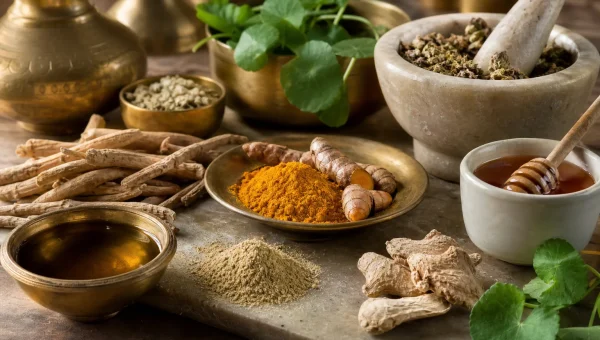
Several plants commonly promoted for “nervous-system support” have official monographs in the Ayurvedic Pharmacopoeia of India. The pharmacopoeial descriptions below establish botanical identity, traditional properties, and general adult doses of the crude drug. They do not prove that a herb rebuilds myelin, reverses neuropathy, treats dementia, or replaces neurological care. Standardized extracts may also differ substantially from the powdered crude drug and should not be dosed as though they were interchangeable.
| Drug and API Identity | Classical Profile Recorded in the API | General API Dose Guidance |
|---|---|---|
| Ashwagandha Withania somnifera root |
Tikta and kashaya rasa; laghu guna; ushna virya; madhura vipaka. Described as rasayana, balya, vajikarana, and vata-kapha-shamaka. | 3–6 g powder |
| Brahmi Bacopa monnieri whole plant |
Madhura, tikta, and kashaya rasa; laghu and sara guna; sheeta virya; madhura vipaka. Described as medhya and rasayana, among other actions. | 1–3 g powder |
| Shankhapushpi Convolvulus pluricaulis whole plant |
Katu, tikta, and kashaya rasa; sara guna; sheeta virya; katu vipaka. Described as medhya, balya, and rasayana. | 3–8 g powder |
| Jatamansi Nardostachys jatamansi rhizome |
Tikta and kashaya rasa; laghu guna; sheeta virya; katu vipaka. Described as medhya and nidrajanana, with tridosha-related actions. | 2–3 g powder |
| Guduchi Tinospora cordifolia stem |
Tikta and kashaya rasa; laghu guna; ushna virya; madhura vipaka. Described as rasayana, balya, dipana, and tridosha-shamaka. | 3–6 g powder |
Correct botanical identification matters. The pharmacopoeia recognizes Convolvulus pluricaulis as Shankhapushpi while noting that other plants are used under the same name in some regions. Products should therefore come from a reliable manufacturer that provides clear botanical identity, batch testing, and contaminant control. The doses above are reference ranges, not a recommendation to combine all five medicines.
What Modern Research Can—and Cannot—Say
A 2017 double-blind, placebo-controlled trial evaluated an ashwagandha root extract for eight weeks in adults with mild cognitive impairment, not in universally healthy adults. The investigators reported improvements in several measures of memory, attention, executive function, and processing speed. The trial was limited in size and duration and does not establish ashwagandha as a treatment for neuropathy, dementia, multiple sclerosis, or other neurological disease.
A systematic review and meta-analysis of randomized trials of Bacopa monnieri found possible cognitive benefits, particularly in speed of attention. Individual trials have also reported changes in memory acquisition or recall after several weeks of use. Nevertheless, differences in extracts, doses, participant groups, and outcome measures prevent these findings from being translated into a universal Brahmi protocol.
Laboratory studies discussing antioxidant activity, neurite growth, dendritic branching, or neuroprotection are useful for generating research questions, but they do not demonstrate that an herb “rebuilds majja,” regenerates human nerves, or supports myelin in clinical practice. Classical terms and modern biological mechanisms should be presented side by side without claiming that they are identical.
Classical Signs of Majja Disturbance
Charaka’s description of majja kshaya includes weakness, lightness or diminution of the bones, and recurrent disorders of vata. Descriptions connected with disturbance of majjavaha srotas include pain in the joints, giddiness, fainting or blackouts, and deep-seated suppurative swellings. When aggravated vata is situated in asthi and majja, classical symptoms include persistent pain in the bones and joints, loss of strength, and disturbed sleep.
These are traditional symptom groupings, not diagnostic criteria for peripheral neuropathy or brain disease. Tingling may arise from many different conditions and cannot be attributed to majja depletion merely from a tongue crack, a trembling tongue, or a supposed “sixth pulse position.” No dependable classical basis was found for diagnosing neural depletion through those signs alone.
Ayurvedic examination may include history, digestion, bowel pattern, sleep, strength, constitution, dosha features, and examination of the tongue and pulse. Such assessment can inform an Ayurvedic plan, but it should not be used to dismiss normal imaging, laboratory evaluation, neurological examination, or follow-up when symptoms persist.
A Practitioner-Led Ayurvedic Approach
Classical care is selected according to the cause, affected dosha and tissue, strength of the patient, digestive capacity, disease stage, season, age, and suitability of treatment. A fixed three-stage regimen for every person with tingling or poor memory is not described in the classical sources and may delay investigation of a treatable medical problem.
Stage 1: Establish the Clinical Picture
The first step is to distinguish a chronic, stable complaint from an urgent neurological change. Sudden sensory loss, new weakness, difficulty speaking or walking, fainting, severe visual change, rapidly worsening confusion, or loss of bladder or bowel control requires prompt medical assessment. An Ayurvedic practitioner should also review prescribed medicines, supplements, diet, sleep, alcohol use, previous illness, and available medical findings before recommending herbs or procedures.
Stage 2: Use Snehana Appropriately
Classical management of vata disorders includes forms of snehana, or oleation, and external therapies such as abhyanga and dhara may be selected in asthi- or majja-associated vata presentations. Their traditional purpose is to counter dryness, roughness, stiffness, and instability. It is not accurate to claim that massage oil passes through the skin to build myelin or directly insulate nerves.
A gentle self-massage with a suitable oil may be used as a comfort and routine practice when the person is steady on their feet and has no allergy, active skin infection, open wound, acute fever, or other contraindication. Oil on the feet or bathroom floor can increase the risk of slipping. Medicated oils, strong pressure, and prolonged treatments should be chosen by a qualified practitioner rather than prescribed through a general article.
Stage 3: Individualize Medicines and Food
Charaka’s general management of majja-related disorders includes appropriately selected sweet and bitter foods or medicines, exercise suited to the patient, and purification only when properly indicated. This does not mean that everyone with neurological symptoms should consume large amounts of sugar, milk, ghee, or bitter herbs. Diabetes, food intolerance, digestive weakness, cardiovascular risk, allergies, and other medical considerations must guide the plan.
A practitioner may select one authenticated medicine, a classical formulation, or no herbal medicine at all. Brahmi ghrita, Shankhapushpi preparations, ashwagandha, Jatamansi, and Guduchi are not automatically compatible with every constitution, medication, or disease. Combining several sedating, thyroid-active, glucose-lowering, or immune-modulating products can create avoidable risk.
Shirodhara and Nasya: Traditional Procedures, Limited Evidence
Shirodhara is a traditional procedure in which a controlled stream of liquid is poured over the forehead. Small studies in healthy volunteers or people experiencing stress, together with limited case-series evidence in insomnia, have reported relaxation and changes in subjective or physiological measures. These preliminary studies do not prove that Shirodhara activates the vagus nerve, normalizes heart-rate variability, improves sleep architecture, or treats neurological disease.
Nasya is a classical nasal procedure used within Ayurvedic management of conditions affecting the region above the clavicles. The traditional statement that the nose is a gateway to the head does not mean that oils are delivered directly into brain tissue. Nasya type, dose, timing, and contraindications vary, so medicated nasal oils should not be improvised as home treatment for numbness, cognitive decline, seizures, or other neurological symptoms.
Yoga and Pranayama as Supportive Care
Yoga, relaxation, and comfortable breathing practices may support general well-being, sleep, mobility, and stress management when adapted to the individual. Reviews of yoga and heart-rate variability suggest possible effects on autonomic regulation, but the studies are heterogeneous and many have methodological limitations. This evidence should not be rewritten as proof that a particular posture “opens neural channels” or that one breathing practice directly activates a specific nerve.
Gentle Nadi Shodhana and Bhramari may be practiced without breath retention when they feel comfortable. Ida and pingala are traditional yogic concepts and should not be equated anatomically with parasympathetic and sympathetic nerves. Inversions such as Viparita Karani are not necessary for everyone and may be unsuitable for people with balance problems, eye disease, uncontrolled blood pressure, neck injury, or other medical restrictions.
A Practical, Vata-Supportive Food Pattern
Ayurvedic dietary advice for a vata-predominant presentation commonly emphasizes regularity, adequate nourishment, warm freshly prepared meals, and an appropriate degree of unctuousness. These principles may make meals easier to tolerate for some people, but they are not proven treatments for neuropathy, tremor, or cognitive impairment. Food should meet the person’s nutritional and medical needs rather than follow a rigid “majja diet.”
| Food Area | Reasonable Options When Suitable | Important Qualification |
|---|---|---|
| Meal pattern | Regular, freshly cooked meals | Adjust portions and timing to appetite, digestion, glucose control, and medical advice. |
| Culinary fats | Modest amounts of ghee or sesame oil | These are foods, not carriers proven to transport herbs across the blood-brain barrier. |
| Grains and pulses | Cooked rice, oats, wheat preparations, mung dal, or other tolerated staples | Choose according to digestion, allergy, metabolic needs, and cultural diet. |
| Nuts and seeds | Almonds, walnuts, or sesame in suitable portions | Avoid when allergic and consider total calorie intake. |
| Dairy | Milk or other dairy only when individually tolerated | Dairy is not required for Ayurvedic neurological support and may be unsuitable in intolerance or allergy. |
Saffron, cardamom, and culinary quantities of nutmeg may be used for flavour where appropriate, but claims that ordinary spice doses cross the blood-brain barrier and reduce neural inflammation were not retained. Nutmeg in large quantities is unsafe and should not be used as a sedative remedy.
When to Seek Professional Guidance
Persistent or progressive tingling, tremor, numbness, weakness, balance difficulty, fainting, visual disturbance, severe headache, seizures, or cognitive decline should be evaluated by an appropriate healthcare professional. Ayurvedic measures may be considered as complementary support after serious or reversible causes have been assessed; they should not replace diagnostic investigation or prescribed treatment.
The National Center for Complementary and Integrative Health warns that some Ayurvedic products have contained lead, mercury, or arsenic. Choose products from accountable manufacturers with independent contaminant testing, and tell your healthcare providers about every herb, oil, and supplement you use.
Safety note: Ashwagandha can cause drowsiness or digestive symptoms, has been associated rarely with liver injury, may affect thyroid function, and may interact with sedatives, immunosuppressants, blood-pressure medicines, and diabetes medicines. Long-term safety remains uncertain. Pregnancy, breastfeeding, thyroid or autoimmune disease, liver disease, psychiatric or neurological medication use, and treatment of children all require professional guidance. Jatamansi and other calming preparations may add to the effects of sedative medicines.
There is no classical or modern rule that all “adaptogenic” herbs must be taken for four to six weeks and then stopped. Duration depends on the medicine, preparation, response, adverse effects, and clinical purpose. Review treatment periodically with a qualified Ayurvedic practitioner and healthcare provider rather than continuing multiple products indefinitely.
Practical starting point: Maintain regular meals and sleep, avoid self-diagnosing numbness as majja depletion, and record when symptoms occur, how long they last, and whether weakness, pain, balance change, or medication use accompanies them. A brief, gentle abhyanga may be used for relaxation when safe, but any persistent sensory symptom deserves clinical assessment rather than a trial of oil or herbs alone.
References
- Charaka Samhita — Majja dhatu
- Charaka Samhita — Sroto Vimana
- Charaka Samhita — Vata dosha
- Charaka Samhita — Manovaha srotas
- Charaka Samhita — Kiyanta Shiraseeya Adhyaya
- Charaka Samhita — Vatavyadhi Chikitsa
- Ayurvedic Pharmacopoeia of India
- Ayurvedic Pharmacopoeia of India
- Ayurvedic Pharmacopoeia of India
- Efficacy and Safety of Ashwagandha (Withania somnifera (L.) Dunal) Root Extract in Improving Memory and Cognitive Functions (2017), PubMed
- Meta-analysis of randomized controlled trials on cognitive effects of Bacopa monnieri extract (2014), PubMed
- NIH Office of Dietary Supplements
- Shirodhara: A psycho-physiological profile in healthy volunteers (2013), PubMed Central
- Impact of Shirodhara on biological markers of stress: A case study (2021), PubMed Central
- Ayurvedic therapy (shirodhara) for insomnia: a case series (2014), PubMed Central
- Yoga for Heart Rate Variability: A Systematic Review and Meta-analysis of Randomized Clinical Trials (2015), PubMed
- NCCIH
The tingling in the fingers and the ‘frayed’ feeling is exactly what I experience and my MRI was also clear. My neurologist told me it was likely anxiety-related. I’m an engineer and the dismissal was frustrating. Starting to look at Majja dhatu treatment now.
The comparison between Majja dhatu and modern neuroscience is intellectually interesting but I’d be careful about how directly these systems map. Majja dhatu includes bone marrow and nervous system tissue as one category which is anatomically different from how neuroscience treats them. The conceptual overlap is real but the mapping isn’t one-to-one.
Started the vata protocol my Ayurvedic doctor recommended last summer and my energy has been noticeably more consistent. This explains the mechanism.
The clear MRI with ongoing symptoms is a situation so many software engineers experience. The conventional system has no framework for the kind of nervous system depletion that comes from years of high-cognitive-demand work with inadequate recovery. Ayurveda apparently mapped this state precisely.
I came for The Nervous System in Ayurveda and this answered the main question. I appreciate that it does not oversell the result.
I came for The Nervous System in Ayurveda and this answered the main question. The timing advice is the part I would start with.
The ‘ancient physicians had mapped in detail what Western medicine had missed’ framing is compelling but be careful about making it adversarial. The neurologist ordering MRIs and ruling out structural pathology is valuable. The two approaches address different levels of the same problem.
The Vata Vaha Srotas framework for understanding how nervous system imbalance travels through the body is one of the more practically useful concepts in classical Ayurveda. My teacher described it as a map of where nervous energy accumulates and obstructs. Understanding that changed how I approach my own symptoms.
The research cited here is from the 2015-2020 period. Is there more recent work that confirms or updates these findings?
How do you distinguish between a genuine healing response and placebo when monitoring progress with vata? What objective markers should I track?
My practitioner wants to use dhatu alongside vata. Is this a common combination or is the article’s protocol more commonly used in isolation?
The Majja Dhatu and myelin sheath parallel is one of the most thoughtful correlations in Ayurvedic literature. The lipid-rich nature of both the Dhatu and myelin makes the analogy structurally valid.
The article makes a clear point that Ayurveda does not equate majja dhatu with myelin or cerebrospinal fluid, instead framing it as marrow that supports bone strength and reproductive tissue.
the Brahmi + Ashwagandha + ghee combination for 3 months improved my memory noticeably. working on the Majja Dhatu protocol along with reduced screen time
The distinction between depleted nervous system and diseased nervous system is exactly what’s missing from conventional workup when the MRI is clear. Ayurveda apparently distinguishes between structural pathology and functional depletion. That’s a clinically meaningful distinction that current neurology doesn’t have great diagnostic tools for.
very dense article with lots of Sanskrit terms. needs a glossary or simpler version
the Vata Vaha Srotas concept, does this map to the peripheral nervous system or central nervous system or both
The differentiation between Medhya (cognitive) and Vatanulomana (nerve conduction) approaches is a practically useful clinical distinction that most Ayurvedic neurology articles conflate.
is Majja Dhatu only the nervous system or does it include bone marrow too
The neuroplasticity claims associated with Brahmi and Ashwagandha at supplemental doses require more evidence than currently available. Most research is in rodent models or small human trials.
the nerve damage recovery section, does the protocol differ for diabetic neuropathy versus injury-based neuropathy
the seven Dhatu sequence showing Majja as next-to-last in refinement explains why neurological recovery takes so long. that sequencing concept was the most illuminating part for me
Correlating Majja Dhatu with the nervous system is conceptually useful but the article’s claim that classical Ayurveda ‘predicted’ aspects of neuroscience should be framed as retrospective correlation, not prescience.
for someone with anxiety and nervous exhaustion, which Medhya herb should be prioritized
is Brahmi for general brain support or specifically for Majja Dhatu damage
the article jumps between classical Sanskrit concepts and modern neuroscience terms too quickly. readers without background in either will lose the thread
used this framework to understand my MS symptoms from an Ayurvedic perspective alongside conventional treatment. the Bringhana approach for Majja nourishment gave me practical dietary interventions
Shankhapushpi’s role in the classic Medhya Rasayana protocol is supported by cholinesterase inhibition research, which is relevant to modern cognitive neuroscience concerns.
The Medhya Rasayana category specifically for Majja Dhatu support is well-presented. The four classical Medhya herbs each have distinct mechanisms worth exploring separately.
The Snehana (oleation) emphasis for Majja Dhatu is appropriate given the lipid dependence of neural tissue. The internal ghee preparations alongside external oil application address this from both directions.
Useful post on The Nervous System in Ayurveda. I appreciate that it does not oversell the result.
Useful post on The Nervous System in Ayurveda. This feels more usable than a long list of herbs.
Useful post on The Nervous System in Ayurveda. The examples make the advice less abstract.
The Majja Dhatu and myelin sheath parallel is one of the most thoughtful correlations in Ayurvedic literature. The lipid-rich nature of both the Dhatu and myelin makes the analogy structurally valid. 408
Correlating Majja Dhatu with the nervous system is conceptually useful but the article’s claim that classical Ayurveda ‘predicted’ aspects of neuroscience should be framed as retrospective correlation, not prescience. 397
is Majja Dhatu only the nervous system or does it include bone marrow too 247
the Vata Vaha Srotas concept, does this map to the peripheral nervous system or central nervous system or both 500
is Brahmi for general brain support or specifically for Majja Dhatu damage 931
the Brahmi + Ashwagandha + ghee combination for 3 months improved my memory noticeably. working on the Majja Dhatu protocol along with reduced screen time 735
For The Nervous System in Ayurveda, consistency seems like the hard part. The practical details matter more than people think.
I appreciate the reminder to verify botanical identity and contaminant testing before using herbs like guduchi or jatamansi for nervous system support.
the seven Dhatu sequence showing Majja as next-to-last in refinement explains why neurological recovery takes so long. that sequencing concept was the most illuminating part for me 926
The Medhya Rasayana category specifically for Majja Dhatu support is well-presented. The four classical Medhya herbs each have distinct mechanisms worth exploring separately. 507
the nerve damage recovery section, does the protocol differ for diabetic neuropathy versus injury-based neuropathy 611
The differentiation between Medhya (cognitive) and Vatanulomana (nerve conduction) approaches is a practically useful clinical distinction that most Ayurvedic neurology articles conflate. 960
very dense article with lots of Sanskrit terms. needs a glossary or simpler version 385
the article jumps between classical Sanskrit concepts and modern neuroscience terms too quickly. readers without background in either will lose the thread 506
The neuroplasticity claims associated with Brahmi and Ashwagandha at supplemental doses require more evidence than currently available. Most research is in rodent models or small human trials. 158
The Medhya Rasayana category specifically for Majja Dhatu support is well-presented. The four classical Medhya herbs each have distinct mechanisms worth exploring separately. 380
Shankhapushpi’s role in the classic Medhya Rasayana protocol is supported by cholinesterase inhibition research, which is relevant to modern cognitive neuroscience concerns. 170
The Snehana (oleation) emphasis for Majja Dhatu is appropriate given the lipid dependence of neural tissue. The internal ghee preparations alongside external oil application address this from both directions. 342
for someone with anxiety and nervous exhaustion, which Medhya herb should be prioritized 376
for someone with anxiety and nervous exhaustion, which Medhya herb should be prioritized 747
used this framework to understand my MS symptoms from an Ayurvedic perspective alongside conventional treatment. the Bringhana approach for Majja nourishment gave me practical dietary interventions 184
the nerve damage recovery section, does the protocol differ for diabetic neuropathy versus injury-based neuropathy 196
used this framework to understand my MS symptoms from an Ayurvedic perspective alongside conventional treatment. the Bringhana approach for Majja nourishment gave me practical dietary interventions Still following this.
very dense article with lots of Sanskrit terms. needs a glossary or simpler version 654
the Vata Vaha Srotas concept, does this map to the peripheral nervous system or central nervous system or both 294
The neuroplasticity claims associated with Brahmi and Ashwagandha at supplemental doses require more evidence than currently available. Most research is in rodent models or small human trials. 537
the seven Dhatu sequence showing Majja as next-to-last in refinement explains why neurological recovery takes so long. that sequencing concept was the most illuminating part for me 997
the article jumps between classical Sanskrit concepts and modern neuroscience terms too quickly. readers without background in either will lose the thread 240
is Majja Dhatu only the nervous system or does it include bone marrow too 848
The Majja Dhatu and myelin sheath parallel is one of the most thoughtful correlations in Ayurvedic literature. The lipid-rich nature of both the Dhatu and myelin makes the analogy structurally valid. 956
is Brahmi for general brain support or specifically for Majja Dhatu damage Still following this.
Shankhapushpi’s role in the classic Medhya Rasayana protocol is supported by cholinesterase inhibition research, which is relevant to modern cognitive neuroscience concerns. 527
is Brahmi for general brain support or specifically for Majja Dhatu damage 242
Reading this later and the The Nervous System in Ayurveda advice still feels relevant. The main idea is clear even if someone is new to Ayurveda.
The differentiation between Medhya (cognitive) and Vatanulomana (nerve conduction) approaches is a practically useful clinical distinction that most Ayurvedic neurology articles conflate. 793
Reading this later and the The Nervous System in Ayurveda advice still feels relevant. Good starting point for a cautious reader.
Correlating Majja Dhatu with the nervous system is conceptually useful but the article’s claim that classical Ayurveda ‘predicted’ aspects of neuroscience should be framed as retrospective correlation, not prescience. 742
The Snehana (oleation) emphasis for Majja Dhatu is appropriate given the lipid dependence of neural tissue. The internal ghee preparations alongside external oil application address this from both directions. 731
the Brahmi + Ashwagandha + ghee combination for 3 months improved my memory noticeably. working on the Majja Dhatu protocol along with reduced screen time 798
The Medhya Rasayana category specifically for Majja Dhatu support is well-presented. The four classical Medhya herbs each have distinct mechanisms worth exploring separately. 777
very dense article with lots of Sanskrit terms. needs a glossary or simpler version 220
the nerve damage recovery section, does the protocol differ for diabetic neuropathy versus injury-based neuropathy 749
the seven Dhatu sequence showing Majja as next-to-last in refinement explains why neurological recovery takes so long. that sequencing concept was the most illuminating part for me 947
the Vata Vaha Srotas concept, does this map to the peripheral nervous system or central nervous system or both 797
How does the concept of majjavaha srotas relate to modern pathways for sensation and movement, given that Ayurveda treats them as functional rather than anatomical?
The neuroplasticity claims associated with Brahmi and Ashwagandha at supplemental doses require more evidence than currently available. Most research is in rodent models or small human trials. 378
Correlating Majja Dhatu with the nervous system is conceptually useful but the article’s claim that classical Ayurveda ‘predicted’ aspects of neuroscience should be framed as retrospective correlation, not prescience. 615
The Snehana (oleation) emphasis for Majja Dhatu is appropriate given the lipid dependence of neural tissue. The internal ghee preparations alongside external oil application address this from both directions. 587
The The Nervous System in Ayurveda explanation is clearer than most short posts. This feels more usable than a long list of herbs.
A practical takeaway is to favor warm, freshly cooked meals with modest ghee or sesame oil when vata feels elevated, while still meeting individual medical needs.
is Majja Dhatu only the nervous system or does it include bone marrow too 984
The differentiation between Medhya (cognitive) and Vatanulomana (nerve conduction) approaches is a practically useful clinical distinction that most Ayurvedic neurology articles conflate. 736
It’s helpful that the piece urges readers to pursue medical evaluation for persistent tingling, weakness, or memory changes before relying solely on Ayurvedic measures.
The Majja Dhatu and myelin sheath parallel is one of the most thoughtful correlations in Ayurvedic literature. The lipid-rich nature of both the Dhatu and myelin makes the analogy structurally valid. 245
used this framework to understand my MS symptoms from an Ayurvedic perspective alongside conventional treatment. the Bringhana approach for Majja nourishment gave me practical dietary interventions 904
Shankhapushpi’s role in the classic Medhya Rasayana protocol is supported by cholinesterase inhibition research, which is relevant to modern cognitive neuroscience concerns. 453
I liked the practical side of The Nervous System in Ayurveda. Small daily changes are easier to follow than a perfect plan.
for someone with anxiety and nervous exhaustion, which Medhya herb should be prioritized 880
the article jumps between classical Sanskrit concepts and modern neuroscience terms too quickly. readers without background in either will lose the thread 450
used this framework to understand my MS symptoms from an Ayurvedic perspective alongside conventional treatment. the Bringhana approach for Majja nourishment gave me practical dietary interventions Would appreciate any updates.
the Brahmi + Ashwagandha + ghee combination for 3 months improved my memory noticeably. working on the Majja Dhatu protocol along with reduced screen time 195
I liked the practical side of The Nervous System in Ayurveda. I appreciate that it does not oversell the result.
the Brahmi + Ashwagandha + ghee combination for 3 months improved my memory noticeably. working on the Majja Dhatu protocol along with reduced screen time 398
I liked the practical side of The Nervous System in Ayurveda. This would be easier to follow with a one-week sample plan.
is Brahmi for general brain support or specifically for Majja Dhatu damage 144
The differentiation between Medhya (cognitive) and Vatanulomana (nerve conduction) approaches is a practically useful clinical distinction that most Ayurvedic neurology articles conflate. 241
is Majja Dhatu only the nervous system or does it include bone marrow too 386
for someone with anxiety and nervous exhaustion, which Medhya herb should be prioritized 516
The neuroplasticity claims associated with Brahmi and Ashwagandha at supplemental doses require more evidence than currently available. Most research is in rodent models or small human trials. 775
the seven Dhatu sequence showing Majja as next-to-last in refinement explains why neurological recovery takes so long. that sequencing concept was the most illuminating part for me 140
Shankhapushpi’s role in the classic Medhya Rasayana protocol is supported by cholinesterase inhibition research, which is relevant to modern cognitive neuroscience concerns. 225
the article jumps between classical Sanskrit concepts and modern neuroscience terms too quickly. readers without background in either will lose the thread 775
Correlating Majja Dhatu with the nervous system is conceptually useful but the article’s claim that classical Ayurveda ‘predicted’ aspects of neuroscience should be framed as retrospective correlation, not prescience. 704
very dense article with lots of Sanskrit terms. needs a glossary or simpler version 841
the nerve damage recovery section, does the protocol differ for diabetic neuropathy versus injury-based neuropathy 270
Based on my observation, after a in foreclosure process home is bought at a bidding, it is common to the borrower in order to still have some sort ofthat remaining unpaid debt on the financial loan. There are many lenders who aim to have all fees and liens paid off by the following buyer. On the other hand, depending on particular programs, restrictions, and state laws there may be quite a few loans that are not easily fixed through the exchange of financial products. Therefore, the obligation still falls on the customer that has obtained his or her property foreclosed on. Many thanks for sharing your opinions on this weblog.
The Snehana (oleation) emphasis for Majja Dhatu is appropriate given the lipid dependence of neural tissue. The internal ghee preparations alongside external oil application address this from both directions. 361
The Majja Dhatu and myelin sheath parallel is one of the most thoughtful correlations in Ayurvedic literature. The lipid-rich nature of both the Dhatu and myelin makes the analogy structurally valid. 864
the Vata Vaha Srotas concept, does this map to the peripheral nervous system or central nervous system or both 673
The Medhya Rasayana category specifically for Majja Dhatu support is well-presented. The four classical Medhya herbs each have distinct mechanisms worth exploring separately. 451
for someone with anxiety and nervous exhaustion, which Medhya herb should be prioritized Still following this.
The safest part of the The Nervous System in Ayurveda advice is keeping it simple. The safety notes could be expanded a little.
the nerve damage recovery section, does the protocol differ for diabetic neuropathy versus injury-based neuropathy 953
the Brahmi + Ashwagandha + ghee combination for 3 months improved my memory noticeably. working on the Majja Dhatu protocol along with reduced screen time 947
the seven Dhatu sequence showing Majja as next-to-last in refinement explains why neurological recovery takes so long. that sequencing concept was the most illuminating part for me 651
Correlating Majja Dhatu with the nervous system is conceptually useful but the article’s claim that classical Ayurveda ‘predicted’ aspects of neuroscience should be framed as retrospective correlation, not prescience. 778