
A complex Ayurvedic presentation may include features associated with Vata, Pitta, and Kapha at the same time. Classical diagnosis does not reduce such a case to a “commander dosha.” It asks whether two doshas are involved (samsarga) or all three are involved (sannipata), whether one is relatively stronger, and whether a dosha acts independently as the primary factor (anubandhya) or dependently as a secondary factor (anubandha). Treatment depends on the disease, patient, pathological stage, and effects on the other doshas.
The Problem of Simultaneous Dosha Involvement
Charaka describes combined dosha states rather than assuming that every illness belongs to only one dosha. Two-dosha involvement is samsarga; involvement of all three is sannipata. The texts recognize unequal combinations in which one or two doshas are more pronounced. Relative dominance matters, but it cannot be established by one symptom or questionnaire. The physician examines causes, chronology, signs, site, affected tissues, disease stage, season, digestion, and the strength of patient and disorder.
The first symptom may be informative, but it is not automatically the root cause. A later dosha, obstruction, or tissue injury can alter the presentation. Classical reasoning follows the whole pathogenesis instead of assigning hierarchy from one sign or pulse description.
Classical Vocabulary: Anubandhya and Anubandha
In Roganika Vimana, Charaka distinguishes an independent or primary dosha, called anubandhya, from a dependent or associated dosha, called anubandha. The primary factor expresses its characteristic disease process when aggravated, whereas the associated factor may become evident through the activity of the primary one. This helps explain why a secondary dosha may not respond predictably to treatment aimed at that dosha alone.
A dosha may seem prominent because it initiated the sequence, is currently strongest, occupies a vulnerable site, or obstructs another dosha. These possibilities do not always require the same treatment. The clinician must identify what is independent, what is dependent, and which measure can reduce the leading disturbance without worsening the rest.
A Safer Diagnostic Framework
A multi-dosha assessment should integrate several findings rather than rely on rigid tongue or pulse stereotypes. Charaka’s examination framework considers constitution, present imbalance, tissue and mental strength, digestion, age, season, habitat, disease severity, and treatment potency. The following questions translate that approach into a practical sequence.
| Parameter | Question | Why it matters |
|---|---|---|
| Causes and chronology | What preceded the illness, and in what order did features appear? | Reconstructs pathogenesis without assuming the first symptom is always primary. |
| Relative strength | Which features are most characteristic, persistent, and intense now? | Identifies the immediate therapeutic problem. |
| Independence | Does a dosha change with its own causes and treatment, or only when another factor changes? | Helps distinguish anubandhya from anubandha. |
| Ama and site | Is ama present, and which tissues or channels are involved? | Changes the suitability and timing of nourishing, reducing, digestive, oleating, or cleansing measures. |
| Strength and compatibility | How strong are patient and disease, and could treatment aggravate another dosha? | Determines intensity, sequence, and safety. |
Classical Treatment Principle
An accessible translation of Ashtanga Hridaya, Sutrasthana chapter 13, states that when doshas are aggravated together, the most powerful or most aggravated dosha is controlled first with measures that do not oppose the remaining doshas. This is conditional, not permission to suppress one dosha aggressively. Digestion, obstruction, an acute manifestation, tissue vulnerability, or depletion may need attention before directly reducing the apparently strongest dosha.
No classical basis was found for reducing a primary dosha by “60 to 70 percent,” reassessing every “three to four weeks,” or devoting “80 percent” of self-care to one dosha for exactly 21 days. These numerical rules should not be presented as Ayurvedic doctrine. Reassessment is individualized according to the condition and response.
Herbs and Formulations in Multi-Dosha Cases
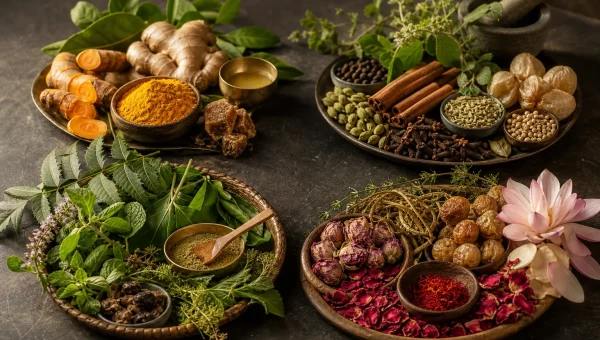
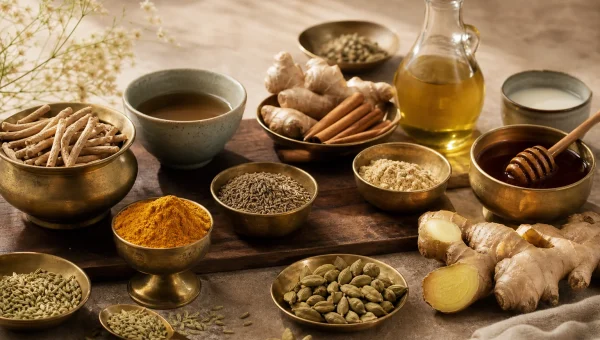
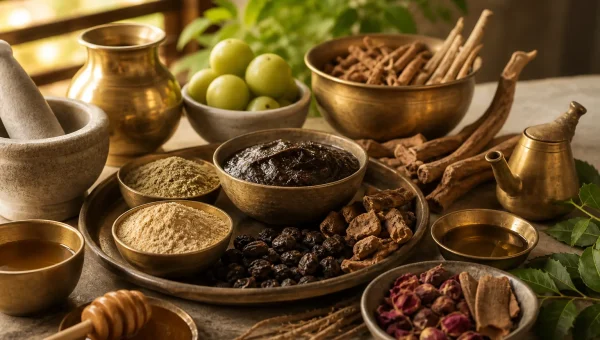
Herbs are not selected merely by matching a product to a dosha name. Rasa, guna, virya, vipaka, actions, preparation, vehicle, combinations, patient strength, and disease stage all matter. The Ayurvedic Pharmacopoeia of India records identities and traditional properties, but its general adult dose ranges are not personalized prescriptions.
1. Triphala
Triphala contains Haritaki, Bibhitaka, and Amalaki fruits. API monographs show different profiles: Haritaki and Bibhitaka are light and dry, with hot potency and sweet post-digestive effect; Amalaki is light and dry, with cold potency and sweet post-digestive effect. Amalaki has five tastes excluding salt, while Haritaki is predominantly astringent and Bibhitaka is astringent. Use a recognized formulation under professional guidance.
2. Ashwagandha (Withania somnifera)
The API defines Ashwagandha as the dried mature root of Withania somnifera. It records bitter and astringent tastes, light quality, hot potency, sweet post-digestive effect, and Vata-Kapha-pacifying, strengthening, and rasayana actions. It is not automatically suitable for stress or insomnia when heat, ama, pregnancy, interactions, or another diagnosis changes the risk. The Ministry of Ayush advises against substituting the leaf for the classical root drug in ASU products.
3. Guduchi (Tinospora cordifolia)
The API identifies Guduchi as the stem of Tinospora cordifolia and records bitter and astringent tastes, light quality, hot potency, sweet post-digestive effect, and actions including dipana, rasayana, tridosha-shamana, raktashodhana, and jvaraghna. It should not be called the automatic first choice for every autoimmune or inflammatory condition.
4. Trikatu
Trikatu combines dry ginger, long pepper, and black pepper. Its pungent, heating character may be considered when sluggish digestion, heaviness, or Kapha features are present, but it may be unsuitable with marked heat, burning, gastric irritation, or depletion. Dose and duration depend on the patient, formulation, season, and concurrent medicines.
5. Shatavari (Asparagus racemosus)
The API describes Shatavari root as sweet and bitter, heavy and unctuous, cold in potency, and sweet in post-digestive effect, with actions including pittahara, vatahara, balya, and rasayana. Its cooling and nourishing profile may suit selected depleted or Pitta-associated presentations, but its heavy and unctuous qualities may be inappropriate with ama, weak digestion, or pronounced heaviness. It is not a universal bridge between Pitta and Vata disorders.
6. Brahmi (Bacopa monnieri)
The API identifies Brahmi as the whole plant of Bacopa monnieri. It records bitter, astringent, and sweet tastes; light and flowing qualities; cold potency; sweet post-digestive effect; and actions including medhya, rasayana, vatahara, and kaphahara. This supports its classical classification as a medhya drug, but neuronal-plasticity or disease-treatment claims require separate clinical evidence and cannot be inferred from the pharmacopoeial description alone.
Applying Anubandhya-Anubandha Reasoning
Consider a hypothetical patient with recurrent hives, disturbed sleep, and irregular digestion. It would be unsafe to declare Vata primary solely because stress and irregular meals occurred first. Hives have many possible biomedical causes, and urgent care is required for breathing difficulty, tongue or throat swelling, faintness, or rapidly worsening symptoms. An Ayurvedic clinician would examine chronology, characteristic signs, ama or nirama, tissues, strength, and response to prior measures before deciding what is independent and what is associated.
A plan might emphasize regular meals, suitable sleep timing, avoidance of known triggers, and medical evaluation, but it should not automatically prescribe Ashwagandha, Guduchi, oil massage, or Kapha-reducing therapy. The choice changes with acute fever, poor digestion, pregnancy, weakness, liver disease, allergy risk, and concurrent medication. The value of the framework lies in sequencing and compatibility, not a one-size-fits-all herb protocol.
What Modern Research Supports—and Does Not Support
Modern studies have explored Prakriti-assessment reliability and associations between constitution categories, genetics, and metabolomic patterns. Some report associations, while assessment studies also show variability between observers and tools. This preliminary work does not validate a “senapati dosha” protocol, fixed treatment percentages, stand-alone pulse diagnosis, or universal herb selection by constitution. Herb reviews likewise do not prove that one formulation safely corrects every multi-dosha disease.
Safety and Professional Guidance
Complex multi-dosha presentations require assessment by a qualified Ayurvedic physician and, for severe, persistent, or unexplained symptoms, an appropriate licensed healthcare provider. Do not self-prescribe strong stimulants, concentrated extracts, cleansing procedures, medicated ghee, or multi-herb regimens from an online quiz. Products can interact with medicines, and some preparations may contain toxic metals or contaminants. Pregnancy, childhood, organ disease, surgery, and prescription-drug use require particular caution.
The practical lesson is not to hunt for a “commander dosha.” Record symptom sequence, triggers, digestion, bowel pattern, sleep, appetite, strength, and response to prior measures, then take that history to a qualified practitioner. Treatment priority should be revised when the disease stage changes, and urgent biomedical symptoms should never be delayed while attempting dosha-based self-care.
References
- Charaka Samhita — Roganika Vimana
- Charaka Samhita — Kiyanta Shiraseeya Adhyaya
- Easyayurveda (easyayurveda.com)
- Charaka Samhita — Rogabhishagjitiya Vimana
- Charaka Samhita — Ama
- Ayurvedic Pharmacopoeia of India
- Ayurvedic Pharmacopoeia of India
- Ministry of AYUSH
- An Ayurvedic formulation ‘Trikatu’ and its constituents (1992), PubMed
- Development and validation of a Prototype Prakriti Analysis Tool (PPAT): Inferences from a pilot study (2012), PubMed Central
- Traditional Medicine to Modern Pharmacogenomics: Ayurveda Prakriti Type and CYP2C19 Gene Polymorphism Associated with the Metabolic Variability (2011), PubMed Central
- Plasma metabolomics reveal the correlation of metabolic pathways and Prakritis of humans (2018), PubMed Central
- NHS
- NCCIH


The Senapati concept is the piece I’ve been missing in my understanding of complex presentations. I have Vata-Pitta constitution and during an acute phase last year both were clearly aggravated. My Vaidya kept shifting focus and I kept wondering why. This explains the clinical logic.
How does the Senapati framework handle cases where the patient has both chronic and acute layers simultaneously? For instance someone with underlying chronic Vata but presenting with an acute Pitta flare. Do you treat the acute first regardless of constitutional baseline?
I spent six months being treated for what my Ayurvedic doctor called a pure Kapha condition with heavy-reducing therapies. It wasn’t working and I was getting worse. Different practitioner identified Vata as the underlying driver and the Kapha congestion as secondary. Within three months on Vata-addressed protocols everything started shifting. The sequencing matters enormously.
the clinical dilemma you describe with three doshas simultaneously aggravated is literally my current situation. Pitta in the skin, Vata causing anxiety and sleep issues, and Kapha making my sinuses a disaster. been bounced between three different practitioners. does senapati analysis require special diagnostic skills or is it something a well-trained vaidya should be doing routinely?
I found the explanation of anubandhya versus anubandha really clarified why treating just one dosha sometimes misses the mark.
This is interesting theoretically but my concern is that the Senapati identification seems highly dependent on practitioner skill and subjective assessment. How do two competent practitioners examining the same patient ensure they arrive at the same Senapati conclusion? Is there any standardization?
I liked the practical side of Senapati, Rajadosha, and Disease Hierarchy. The examples make the advice less abstract.
Can you discuss the Rajadosha concept more specifically in the context of autoimmune presentations? I have several patients where Pitta seems primary but their body’s reactivity makes me wonder whether there’s a deeper root cause that Pitta treatment alone won’t touch.
Does the article suggest that season should be weighed more heavily than the first symptom when deciding which dosha is primary?
The metaphor of the general and the army is actually very useful for explaining to patients why we’re not treating their most obvious symptom first. I’ve borrowed framing like this before but never had the classical source to point to. Thank you.
I appreciate that the author warns against rigid numbers like sixty to seventy percent reduction; Ayurveda feels more fluid than that.
Some classical texts seem to suggest different approaches to dosha sequencing than what you’ve described. Ashtanga Hridayam and Charaka don’t always agree on priority in complex presentations. How do modern practitioners reconcile the differences between sources?
The examples with triphala and ashwagandha made me realize how important it is to look at taste, potency, and post digestive effect together.
This model doesn’t account for how dose-dependent some dosha aggravations are. A mild secondary dosha aggravation might not need separate treatment at all. I’m skeptical that the neat hierarchy described here maps cleanly onto all presentations.
I’m still unsure how to tell if a dosha is acting independently or dependently in practice; the questionnaire approach seems insufficient per the text.
Seeing the mention of senapati and rajadosha being removed from the discussion made me curious about where those terms originally came from.
A practical takeaway for me is to track digestion, sleep, and seasonal changes before assuming any single dosha is in charge.
i’ve been studying Ayurveda for three years and this is the clearest explanation of dosha hierarchy in complex cases i have come across. my textbooks explain each dosha in isolation but not how to reason about them when multiple are active at once
The reminder to consult a qualified practitioner for complex presentations feels responsible, especially when symptoms like hives or fatigue appear.
Is there a clinical decision tree or diagnostic algorithm that Ayurvedic practitioners actually use for this, or is it primarily learned through apprenticeship and clinical intuition? I ask because I’m interested in how this knowledge is transmitted.
Referred my patient with simultaneous Vata-Pitta aggravation to a practitioner who explicitly works with this framework and the difference in approach was immediately visible. She came back saying the new protocol made more intuitive sense to her body.
where can you source authentic herbs in a tier-2 indian city? the local shops have very inconsistent quality
the breakdown of classical vs commercial preparations is something i have not seen this clearly before
my functional medicine doctor was impressed by the pathway explanation in the third section 🌿
This is helpful but the lack of citations for the more specific claims is a problem for me.
this works in theory but sourcing authentic ingredients is practically very difficult in most of india
can pregnant women follow this or are there specific modifications? the article does not address that directly ठीक है
the triphala timing recommendation here matches what worked for me, good to have it validated
does the preparation method change during summer versus winter or is it the same year-round
where are the clinical trials? referencing classical texts is fine but i need rct data before trying this
late to this post but wanted to ask, is the recommended protocol still current or has anything changed
Can someone confirm whether the KSM-66 extract or full-spectrum root works better for this specific issue.
the distinction between the two preparation methods in section 2 was the clearest explanation i have found anywhere
just found this via a google search, is the dosage in section 3 still what practitioners recommend
the seasonal adjustment chart is going into my practice journal, exactly what i was missing
the recipe proportions worked perfectly, made the preparation twice and got consistent results
@Mohan Been eating the kitchari variant from this for two weeks and my energy in the afternoon is better.
this is the post i wish i had two years ago when i first started exploring this area
I liked the practical side of Senapati, Rajadosha, and Disease Hierarchy. Would be useful to see a short checklist next.
Tried the morning protocol for 2 months and gave up, the timing is impossible with work and children.
is there a hindi language resource alongside this for my parents who are not comfortable reading in english
the dosage here is higher than what my ayurvedic doctor recommended, a bit concerned about that 🙏
how do i track whether results are genuine versus placebo effect? any objective markers to watch
Starting this next week, will report back with results after about 6 weeks.
what would a reasonable substitute be for someone who cannot access the herb locally or internationally
I liked the practical side of Senapati, Rajadosha, and Disease Hierarchy. The main idea is clear even if someone is new to Ayurveda.