
The morning I noticed it, I was forty-four years old and standing in bright bathroom light that I had never bothered to dread before. The skin around my eyes had changed. Not “aged” in the gradual, imperceptible way I had expected – it had changed, specifically, in a way that felt sudden even though intellectually I knew it was not. Thinner, more fragile, less elastic. The bone structure underneath suddenly more visible. And dry in a way that no moisturizer was touching.
I remember calling my mother that morning, and she said something that has stayed with me: “The Vata has arrived at your face.” She was not being cruel. She was being precise. In Ayurveda, perimenopause is understood as a natural transition toward the Vata stage of life – where the dry, light, mobile qualities of Vata dosha begin to predominate in the body. The skin, being an organ profoundly influenced by Vata, shows this transition first and most visibly.
What my mother understood, and what I have spent the years since then learning properly, is that the skin changes of perimenopause are not a cosmetic problem with cosmetic solutions. They are a systemic shift requiring systemic response – and Ayurveda has a detailed, practical, and genuinely time-tested framework for addressing exactly this.
What Perimenopause Actually Does to Skin
The biology is worth understanding because it clarifies why certain Ayurvedic approaches work. Estrogen is directly involved in skin biology – not peripherally, but centrally. Skin cells carry estrogen receptors, and estrogen production peaks at around age 30, coinciding with the peak of skin collagen and elastin. When estrogen levels begin fluctuating and declining in perimenopause, several things happen at once:
- Collagen production drops sharply: Women lose approximately 30% of skin collagen in the first five years after menopause, with the decline beginning during the perimenopausal years. This accounts for the sudden, visible quality of the change many women notice in their mid-forties.
- Sebum production declines: Sebaceous glands are estrogen-responsive. Lower estrogen means less natural oil production, creating the “dry in a way moisturizer won’t fix” feeling – because topical moisturizer cannot replace sebum deficiency.
- Barrier function weakens: The skin’s stratum corneum becomes thinner and less effective at retaining water (trans-epidermal water loss increases). This is different from simple dryness – it is structural barrier impairment.
- Wound healing slows: Estrogen-dependent regenerative capacity decreases, meaning breakouts, cuts, and irritation take longer to resolve.
Contemporary dermatology research confirms these estrogen-skin connections. Estrogen acts through skin estrogen receptors to promote type I and type III collagen synthesis, to raise transforming growth factor-beta and the tissue inhibitors of matrix metalloproteinases, and to restrain the collagen-degrading matrix metalloproteinases. When estrogen withdraws, that balance tips toward degradation – producing the atrophy, dryness, and slowed repair that define menopausal skin.
The Ayurvedic Framework: Vata Skin in the Later Phase of Life
In Ayurveda, the lifespan is divided into three stages, each governed by a dominant dosha: Balya (childhood), in which Kapha predominates; Madhyama (the middle years), in which Pitta predominates; and Vriddha or Jirna (old age), in which Vata predominates. The classical texts do not place these boundaries identically – Sushruta Samhita (Sutra Sthana 35) ends the Kapha-dominant childhood phase at about 16 years, while the Charaka tradition (Sharira Sthana 6) extends it to about 30, and the Ashtanga Hridayam commentaries fall within that 16-30 range. The Pitta-dominant middle phase then runs through roughly age 60, after which the Vata-dominant phase begins.
Perimenopause, which begins for most women in the early-to-mid forties, therefore sits in the latter part of the Pitta-dominant Madhyama phase as it starts shading into Vata. This is why the experience is so often a Pitta-Vata overlap: Pitta’s sharp heat may still drive inflammation and hot flashes while Vata’s dryness begins claiming the skin and joints. The skin treatment philosophy for this transition, as described in the classical Ayurvedic literature on Stri Roga (women’s health), emphasizes three principles:
- Snehana (oiling/unctuous nourishment): The primary antidote to Vata’s dryness is oil – both internally and externally. This is not metaphorical. Vata-pacifying oils penetrate skin layers in ways water-based moisturizers do not.
- Rasayana (tissue rejuvenation): Herbs classically described as rebuilding the quality of dhatus (tissues), supporting regenerative capacity from the inside.
- Hormone-modulating botanical support: Several classical Ayurvedic herbs contain compounds that have been studied for weak estrogen-like activity – offering gentle support during the hormonal fluctuations of this phase, without synthetic hormone replacement.
The Internal Tissue-Support Protocol
No topical preparation substitutes for internal tissue nourishment. The following Rasayana herbs, all well attested in the classical pharmacopoeia, form a sound foundation for any perimenopausal skincare approach.
Shatavari (Asparagus racemosus)
Shatavari is Ayurveda’s premier women’s Rasayana, described in Charaka Samhita (Chikitsa Sthana) as a nourishing, Vata- and Pitta-pacifying tonic for the female reproductive tissues. It is rich in steroidal saponins (shatavarins), which have been studied for mild estrogen-modulating and adaptogenic activity – making it a reasonable supportive herb across the hormonal swings of perimenopause. Its relevance to skin is largely through its Snigdha (unctuous) and mucilaginous quality, which counters the dryness that Vata brings to skin and mucous membranes alike.
Dose: 5g Shatavari powder in warm plant milk twice daily. Or 500mg standardized Shatavari extract (containing 5% saponins) twice daily. It is traditionally taken as a sustained Rasayana over months rather than as a quick fix.
Amalaki (Emblica officinalis / Indian Gooseberry)
Amalaki is among the richest plant sources of Vitamin C, with fresh fruit typically yielding roughly 300-900 mg per 100 g depending on cultivar and assay method. This is a high level – but not, as is sometimes claimed, the highest of any plant: Kakadu plum and camu camu contain several times more. Much of amla’s measured “Vitamin C activity” is also carried by hydrolysable tannins (emblicanin A and B) that stabilize and protect ascorbic acid from oxidation, which is why its antioxidant effect tends to be more durable than that of isolated ascorbic acid. Vitamin C matters for skin because it is the essential cofactor for prolyl and lysyl hydroxylase, the enzymes that hydroxylate collagen so it can fold into its stable triple-helix structure. Classically, Amalaki is a foremost Rasayana and Vayasthapana (age-sustaining) herb in Charaka Samhita, and the core ingredient of both Chyawanprash and Triphala.
Dose: 5g Amalaki powder daily in warm water with honey (added once the water is no longer hot). Or 2-3 fresh amlas daily. Or Chyawanprash (1 teaspoon daily), which is Amalaki-based.
Kumkumadi Tailam (Saffron-infused herbal oil)
Kumkumadi Tailam, described in the Uttara Sthana of classical formularies in the Ashtanga Hridayam tradition, is one of the most sophisticated classical facial formulations in the Ayurvedic pharmacopoeia. Its sesame-oil base is infused with numerous herbs including saffron (Kesar), sandalwood (Chandana), lotus (Kamala), and Manjistha through the slow Sneha Kalpana process, producing a rich, nourishing facial oil traditionally used for complexion (Varnya).
At the level of individual components, the constituents are well characterized: saffron’s crocin and safranal are antioxidant; sandalwood’s santalols are anti-inflammatory and soothing; and the sesame base supplies lignans (sesamin, sesamolin) that have been shown to possess weak estrogen-like activity. Together these give the formulation a sound rationale as a calming, antioxidant facial oil for thinning, reactive perimenopausal skin.
Topical Ritual: The Perimenopausal Facial Protocol
Internal nourishment is the foundation, but the skin of this phase also benefits from a gentle, oil-forward daily ritual that respects the compromised barrier rather than stripping it. The routine below pairs a soft morning practice with a simple evening one.
Morning Ritual (10-12 minutes)
The aim in the morning is to cleanse and tone without aggravating Vata dryness, then seal in oil. Move gently throughout.
Step 1: Cleansing with Ubtan
Replace your morning cleanser with a gentle Ubtan paste: 1 tablespoon chickpea flour (besan), quarter teaspoon turmeric, enough rose water to form a paste. Apply to damp face, leave 2 minutes, rinse with warm (not hot) water. This gently exfoliates without stripping the compromised barrier.
Step 2: Rose water toning
Real rose water (not synthetic fragrance) on a cotton pad or misted on the face. Rose water is traditionally cooling, mildly astringent, and soothing – well suited to reactive, drying skin. The use of rose water in Ayurvedic and broader South Asian beauty practice is many centuries old.
Step 3: Kumkumadi Tailam application
3-4 drops warmed between fingertips. Apply using upward, outward strokes following Marma point pathways on the face. Focus extra time at Shankha Marma (temples), Apanga Marma (outer eye corners), and Phana Marma (sides of nose). These pressure points are traditionally used to stimulate local circulation and lymphatic drainage – many women find morning puffiness eases with consistent practice.
Step 4: Facial Abhyanga (self-massage)
Two minutes of gentle circular massage over cheeks, jaw, and forehead using the oil already applied. Upward and outward directions only – this is not just about massage technique, it is about encouraging lymphatic flow against the direction in which gravity pulls aging facial tissue.
Evening Ritual (5 minutes)
In the evening, layer a light water-based serum onto damp skin before sealing with oil, so the skin goes into the night both hydrated and protected.
DIY Shatavari-Rose Serum:
- 30ml aloe vera gel (pure, not scented)
- 1 teaspoon Shatavari powder, steeped in 2 tablespoons rose water for 30 minutes then strained
- 5 drops vitamin E oil
- 3 drops rosehip seed oil
Combine and store in a small dark glass bottle. Apply to clean face before Kumkumadi oil. Water-soluble compounds spread and absorb more readily on damp skin, so apply to slightly damp skin for best effect, then seal with the oil.
Weekly Treatments
Beyond the daily ritual, two simple weekly masks address the two faces of this transition – the dryness and laxity of Vata, and the heat and redness of residual Pitta. Use whichever fits how your skin is behaving that week.
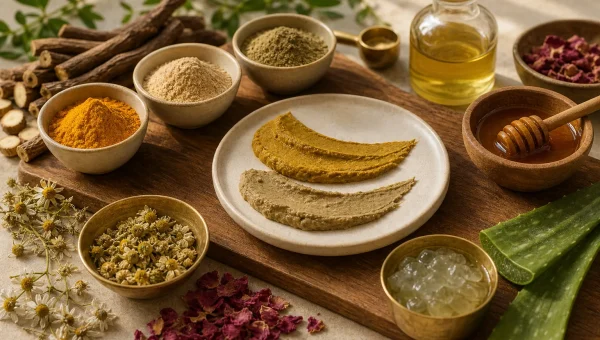
Masoor Dal and Turmeric Mask
This is a traditional ubtan-style mask – a lentil-and-turmeric paste of the kind long used in South Asian home skincare – that is gently exfoliating and soothing:
- 2 tablespoons red lentil (masoor dal) flour, or make fresh by grinding red lentils
- Quarter teaspoon turmeric
- 1 teaspoon Shatavari powder
- Rose water to make paste
- Half teaspoon raw honey
Apply to the face, leave 15-20 minutes, rinse with warm water. The lentil paste lifts away dead surface cells while turmeric soothes and honey humectifies. Use twice weekly.
Chandan (Sandalwood) Cooling Mask for Hot-Flash Skin
During Pitta-driven phases when hot flashes are creating skin redness and irritation, a cooling astringent mask helps calm and tighten the skin:
- 1 teaspoon true sandalwood powder (Santalum album)
- Half teaspoon Lodhra (Symplocos racemosa) powder – astringent, cooling
- Enough cold rose water to make a paste
Apply to the face, leave until dry, rinse. Lodhra is classically valued for its Kashaya (astringent) skin action and is a long-standing ingredient in Ayurvedic skin and Stri Roga formulations – relevant for the tissue laxity that accompanies estrogen decline.
Dosage Summary Table
The table below consolidates the herbs and preparations above into a single reference – what to take, how, and why – so the daily and weekly routine can be followed at a glance.
| Herb/Preparation | Dose | Route | Primary Benefit |
|---|---|---|---|
| Shatavari | 5g powder or 500mg extract | Internal, twice daily | Women’s Rasayana; mild hormone-modulating support |
| Amalaki | 5g powder or 2 fresh fruits | Internal, daily | Vitamin C cofactor for collagen; antioxidant |
| Kumkumadi Tailam | 3-4 drops | Topical, twice daily | Antioxidant, soothing complexion oil |
| Lodhra | Half tsp in mask, twice weekly | Topical | Skin firming, astringency |
| Shatavari serum | Small amount to damp skin | Topical, nightly | Hydrating, soothing support |
For the comprehensive internal approach to perimenopause, see our post on Ayurvedic Perimenopause Transition: The 7-Year Rajonivritti Protocol. For women’s wellness herbs broadly, explore Cycle Syncing with Ayurveda: Herbs and Diet for Each Menstrual Phase.
This skincare protocol is supportive, not medical treatment for hormonal imbalance. Women experiencing significant perimenopause symptoms should work with their gynecologist or women’s health specialist alongside Ayurvedic support, and should consult a qualified Ayurvedic practitioner before beginning internal herbs. Shatavari should be used with caution in estrogen-sensitive conditions; consult your healthcare provider if you have a history of hormone-sensitive cancer.
References
- Caring for Your Skin in Menopause (≈30% collagen loss in first five years) – American Academy of Dermatology
- Estrogen Signaling in Skin and Collagen Maintenance – PMC review
- The Roles of Vitamin C in Skin Health – Nutrients (2017)
- Vitamin C Content of Emblica officinalis (Amla) – Scartezzini et al., J Ethnopharmacol (2006)
- Estrogenic Activity of Sesame Lignans – J Agric Food Chem (2010)
- Physicochemical Evaluation of Kumkumadi Formulation (saffron-based) – PMC
References
- Aad (aad.org)
- Targeting estrogen signaling and biosynthesis for aged skin repair (2023), PubMed Central
- Mdpi (mdpi.com)
- Vitamin C content and antioxidant activity of the fruit and of the Ayurvedic preparation of Emblica officinalis Gaertn (2006), PubMed
- Estrogenic activities of sesame lignans and their metabolites on human breast cancer cells (2011), PubMed
- Physicochemical Screening and Shelf Life Evaluation of Kuṅkumādi Ghṛta Prepared using Kesara and Nāgakesara (2017), PubMed Central
The mention of kumkumadi oil for the periorbital area is something I’ve been curious about for a while. Did you find it needs a carrier or is it fine applied directly? My skin in that area is quite thin and I’m cautious about anything that might be too concentrated.
This is the most honest description of perimenopause onset I have read anywhere. “The Vata has arrived at your face”, I called my mother at 46 when I noticed the same thing and she said almost exactly those words. I thought she was being poetic. Now I understand she was diagnosing me.
47 here and been struggling with exactly this skin change for two years. Retinol helped minimally and was irritating. Tried bakuchiol as a gentler alternative. But the dryness underneath was not being addressed by any of this. The Vata-Pitta combination for perimenopause skin has never been explained to me before. The idea that the Vata dryness needs different treatment than just hydration makes sense.
The recommendation to switch from water-based moisturizers to oil-based ones for perimenopausal Vata skin is exactly what my skin needed and what no dermatologist told me. I made the switch eight months ago and the difference is significant. Why is this not standard advice?
I’m an aesthetician and I see perimenopause skin changes in my clients every day. The framework here is consistent with what the skin physically needs at this stage: more lipid replenishment, less harsh actives, more barrier support. The shatavari-ghee connection to collagen support is not something I knew the mechanism for before.
I expected this to be about applying herbal pastes and that’s not what I needed. I was relieved to find the internal approach emphasized. The idea that skin changes in perimenopause are downstream of hormonal and tissue shifts, not primarily a topical problem, is the most important reframe I have gotten from any skincare article in years.
I’m in my early forties and noticed my eye area feeling tighter, the article’s description of sudden thinness matches what I’ve seen.
Does the protocol differentiate between women with predominantly Vata perimenopause presentation versus Pitta-type perimenopause? I have the opposite of dryness, my skin has become more reactive and breakout-prone in the transition, which sounds more Pitta-aggravated. The treatments would presumably be different.
Do the Shatavari doses mentioned work if I’m already taking a multivitamin with vitamin C?
Tried the ashwagandha and shatavari combination for 10 weeks. Skin tone is noticeably more even. The deep dry patches around my eyes that no cream was touching are less severe. Whether this is placebo or actual collagen support I cannot say scientifically but I will take the result.
Are there food interactions with vata that I should be aware of? My Ayurvedic doctor mentioned something about dairy but wasn’t specific.
The idea of using Kumkumadi Tailam on damp skin before the serum sounds like a nice change from my usual routine.
This framing makes me question the entire retinol industrial complex around aging skin. I spent four years using retinol-based products and the irritation and barrier disruption probably made things worse. Switching to a nourishing oil approach three months ago and my skin feels genuinely different, less tight, more resilient.
I wonder if the rose water toner step could irritate sensitive skin, has anyone tried it with rosacea?
Where do you source the jasmine-infused sesame oil mentioned in the facial protocol? I have access to plain sesame oil but finding properly infused preparations in India has been harder than I expected. Or can the infusion be done at home?
Reading about the collagen drop in the first five years after menopause helped me understand why my moisturizer feels insufficient.
My practitioner wants to use ayurvedic alongside vata. Is this a common combination or is the article’s protocol more commonly used in isolation?
The weekly masoor dal mask seems easy to make at home, I’ll try it this weekend and see how my texture feels.
It’s interesting that the article links Vata dominance to skin changes, I’d like to know more about balancing Pitta at the same time.
I appreciate the caution about Shatavari for estrogen sensitive conditions, it reminds me to talk to my doctor before adding herbs.
I’ve tried everything for my condition and vata combined with the dietary changes described here is the first thing that’s moved the needle. Four months now.
Useful post on Perimenopause Skincare. Would be useful to see a short checklist next.
Why does no Ayurvedic article ever recommend seeing a dermatologist for skin changes at midlife? Some of what is described as Vata skin change at 44 could be early signs of conditions that should be evaluated medically. The silence on this is frustrating.
Is there a recommended duration before expecting measurable changes from the internal protocol? I am 6 weeks into the shatavari and amalaki combination and the skin dryness is still significant. Should I be patient or does the lack of change suggest I need a different approach?
The timeline for collagen support from internal herbs seems much longer than the article implies. Clinical collagen synthesis studies typically run 12-24 weeks to show measurable change. The expectation-setting for readers starting this protocol should be more conservative.
This is the kind of content that makes people delay real medical care, that concern is valid.
is this suitable for pitta dominant people or mainly vata? i get confused about the cross-dosha applications
Shared this with my sister who is a yoga teacher and she said the dosing info was spot on.
appreciate that this goes into contraindications, most blogposts skip that part
Been eating the kitchari variation from this post 4 days a week, feels lighter in the mornings.
Started the Triphala protocol you described in the third section, two weeks in and digestion is noticeably smoother.
not sure i trust the quality of supplements available online, too many adulterated products out there