
Many Indian households have a version of this memory: dal, rice, a seasonal vegetable, a little fat, and a few spices turned into food that was affordable, comforting, and appropriate to the season. That is a better lesson than claiming that one inexpensive meal can “fix everything.” Food can support health, but it is not a universal cure, and persistent symptoms still require proper medical assessment.
Classical Ayurveda does not require imported superfoods or a shelf of supplements. In Charaka Samhita, the discussion of food emphasizes the ingredient, preparation, quantity, timing, season, place, individual constitution, and digestive capacity. A low-cost Ayurvedic kitchen can therefore begin with familiar grains, pulses, vegetables, modest amounts of fat, and carefully chosen spices. Modern nutrition guidance adds an equally important point: variety matters, so a budget menu should not become only rice and dal every day.
The Foundation: Inexpensive Ayurvedic Staples
The following table uses rounded all-India retail averages reported by the Government of India Price Monitoring System on 14 June 2026. Local prices may differ by city, season, quality, and pack size. The Ayurvedic descriptions are traditional properties, not promises that a food will treat disease.
| Ingredient | Illustrative Price | Classical Ayurvedic Profile | Practical Budget Role |
|---|---|---|---|
| Moong dal (Mudga) | About ₹110/kg | Kaṣāya-madhura in taste, light and dry, cooling, with pungent post-digestive effect; traditionally described as reducing Kapha and Pitta. | A versatile pulse for soups, cheela, and khichdi. Because it is still a legume, portion and preparation should suit the person’s digestion. |
| Toor dal (Āḍhakī) | About ₹121/kg | Traditionally described as reducing Kapha and Pitta but increasing Vata. | An everyday dal that can be cooked until soft and paired with suitable fat and spices rather than treated as universally balancing. |
| Masoor dal (Masūra) | About ₹88/kg | Grouped among light, cooling, dry, astringent-sweet pulses; Masūra is also described as grāhī, or absorbent. | An economical pulse that adds variety. It is not automatically ideal for every Pitta-dominant person or every digestive complaint. |
| Rice, including Śāli varieties | About ₹43/kg | Good Śāli rice is described as sweet in taste and post-digestive effect, cooling, and nourishing. Particular varieties have distinct properties. | Properly cleaned, well-cooked, warm rice is described as lighter than cold, undercooked, or poorly prepared rice. |
| Ragi | About ₹56/kg | Ayurvedic assessment depends on the grain, preparation, season, and eater; it should not be reduced to a single dosha label. | An affordable millet that broadens cereal variety and can be used as porridge, roti, or dosa batter. |
| Ghee | About ₹686/kg | Classically sweet, cooling, and unctuous, with Vata- and Pitta-reducing actions; excess can increase Kapha and body fat. | Useful in small amounts when appropriate, but it is not mandatory at every meal and is not a substitute for treatment or a balanced diet. |
| Seasonal vegetables and fruit | Varies widely | Properties differ by item and preparation; there is no single dosha effect for all vegetables or fruits. | Buying what is local and in season usually gives better value and helps provide dietary variety. |
A Practical Budget Ayurvedic Weekly Meal Plan
This is an illustrative plan for one adult, not a therapeutic prescription. Using government average prices, the core grains, pulses, vegetables, fruit, spices, and a modest amount of fat can often fit roughly within ₹70-100 a day when purchased in larger packs, but milk products, eggs, nuts, fuel, tea, snacks, and city-specific prices can raise the total. Portions must also change with age, body size, activity, pregnancy, illness, and appetite.
Monday: Moong and Rice in Different Preparations
Breakfast: Make moong dal cheela from soaked and ground moong with cumin, ginger if tolerated, and salt. Lunch: Cook soft moong-rice khichdi with a seasonal green or bottle gourd; add a small amount of ghee or oil only if it suits the person. Dinner: Serve toor dal, rice, and one cooked seasonal vegetable. This keeps the ingredients simple without pretending that moong is universally “tridoshic.”
Tuesday: Millet and Root-Vegetable Variety
Breakfast: Prepare ragi porridge with milk or curd if tolerated, or make a savoury version with vegetables. Keep jaggery or sugar modest. Lunch: Combine sweet potato or another seasonal root vegetable with greens and jowar roti. Dinner: Serve masoor dal, rice, and a cooked vegetable. The value here is variety, not a rigid claim that one root vegetable pacifies every Vata condition.
Wednesday: A Simpler-Preparation Day
Ayurveda does not establish a universal Wednesday fast, a weekly “agni reset,” or a Mercury-governed digestive day. A simpler menu may still be useful when appetite is low, provided it is not forced. Choose a cooked breakfast such as poha or soft porridge, a thin moong soup with rice at lunch, and soft khichdi with bottle gourd or pumpkin at dinner. Honey, when used, should not be cooked or added to very hot food because classical texts specifically warn against heated honey.
Thursday: Pulse Variety and Safe Cooking
Breakfast: Use a cooked preparation such as besan cheela rather than assuming raw sprouts are easier for everyone to digest. Lunch: Make chana dal with spinach and roti. Dinner: Rajma with rice can be economical, but dried kidney beans must be soaked and boiled thoroughly according to reliable instructions; raw or undercooked beans can retain harmful lectins. Asafoetida and ginger may improve flavour and are traditionally used in pulse dishes, but they do not make undercooked beans safe.
Friday: Mildly Seasoned, Diverse Meals
A simple day does not need to be tied to a universal Friday “sattvic reset.” Use rice or roti, moong or another tolerated pulse, pumpkin or another seasonal vegetable, and a piece of fruit. Curd, milk, egg, nuts, or another culturally acceptable protein food can be added according to diet, budget, and tolerance. Avoid turning “light” eating into chronic under-eating.
Weekend Preparation
Sort and rinse grains and pulses, portion dry ingredients, roast or grind a small spice mix, and plan vegetables around what is inexpensive that week. Cook only what can be cooled, refrigerated, and reheated safely. This reduces weekday effort without making unsupported promises about a fixed two-hour session or a guaranteed daily cooking time.
The Five Spices That Do the Most Work in a Budget Kitchen
Spices are used in small culinary quantities, so a packet can last for many meals. Their classical profiles below come from monographs in the Ayurvedic Pharmacopoeia of India. These descriptions support traditional selection; they do not prove that ordinary culinary doses prevent or cure disease.
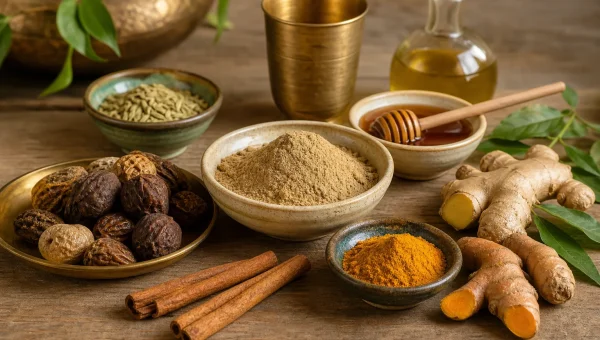
- Turmeric (Haridrā) is listed as pungent and bitter, dry, heating, and pungent after digestion, with Kapha- and Pitta-reducing actions in the pharmacopoeial profile. Use it as a food spice rather than calling it a universal anti-inflammatory or liver remedy.
- Cumin (Śvetajīraka) is pungent, light, dry, sharp, heating, and pungent after digestion. Its traditional actions include dīpana and pācana, terms associated with appetite and digestion.
- Coriander seed (Dhānyaka) is described as sweet, pungent, bitter, and astringent; light and unctuous; heating; and sweet after digestion. The pharmacopoeia does not support reducing it to the simple label “Pitta-cooling.”
- Dry ginger (Śuṇṭhī) is pungent, light and unctuous, heating, and sweet after digestion, with traditional Vata- and Kapha-reducing, dīpana, and pācana actions. Fresh ginger is a different preparation and should not be treated as identical in precise classical assessment.
- Asafoetida (Hiṅgu) is pungent, sharp, heating, and pungent after digestion, with traditional anulomana, dīpana, and pācana actions. A pinch can season dal, but “the single most effective” remedy for gas is not a verified classical ranking.
Because these spices are concentrated in flavour, modest packets usually last longer than staple foods. Buy from a reliable seller, store them dry, and use amounts suited to taste and tolerance. More is not automatically better, especially for children, pregnancy, reflux, ulcers, or people taking medicines.
Where to Spend and Where to Save
Spend first on enough food, dietary variety, fresh produce, safe water, sound storage, and reliable staple ingredients. Use ghee or cooking oil in moderate amounts rather than treating expensive “premium” ghee as essential. Keep jaggery, honey, and refined sugar limited because all are added sweeteners, not daily medicines.
Save by skipping imported grains, branded detox products, and unprescribed herbal supplements when ordinary local foods already meet the purpose. Ragi, jowar, rice, wheat, pulses, groundnuts, seasonal vegetables, and fruit can form a varied menu, but no local grain automatically “outperforms” quinoa or chia in every nutrient. Compare foods by the whole diet, availability, tolerance, and cost rather than by marketing claims.
Adapting the Plan to Constitution and Digestion
Classical diet planning is individualized. Broadly, warm and unctuous preparations are traditionally selected when Vata qualities predominate; cooler, less pungent meals when Pitta is aggravated; and lighter, warmer, less oily meals when Kapha is excessive. These are starting principles, not a diagnosis based on an online dosha quiz.
A person with weak appetite may tolerate soft, warm, freshly cooked food better than raw salads, while another person may need more fibre, protein, or calories than this sample plan provides. Diabetes, kidney disease, liver disease, pregnancy, food allergy, persistent digestive symptoms, unintended weight loss, or an eating disorder all require individualized guidance. Consult a qualified Ayurvedic practitioner and an appropriate healthcare professional before using diet therapeutically or taking Ayurvedic medicines. Some Ayurvedic products have been found to contain harmful metals, so food-based advice should not be used to justify untested supplements.
For authoritative reading, consult Charaka Samhita, Sutrasthana 27, the official Ayurvedic Pharmacopoeia of India publication list, the ICMR-NIN Dietary Guidelines for Indians 2024, and the Government of India Price Monitoring System.
Good reminder on Budget Meal Planning. I would like to know how long to try it before judging results.
Good reminder on Budget Meal Planning. Good starting point for a cautious reader.
The Budget Meal Planning angle is useful here. The examples make the advice less abstract.
My grandmother used to swear by this and now I understand why. The part about turmeric specifically matches what I observed in her health over the years.
This is exactly how my nani cooked too, though she would never have called it anything other than common sense. Moong dal when you were unwell, heavier food in winter, bitter things after the monsoon set in. Reading this made me realize I abandoned all of that when I moved to the city and started counting macros. Going back to dal chawal this week.
Good reminder on Budget Meal Planning. A few more examples would still help.
Does the Rs. 100 figure account for the time cost of cooking from scratch? This is a real consideration for working people. Dal chawal with ghee is affordable, yes, but spending 45 minutes preparing it twice a day has a real cost for someone working two jobs. I would love to see a version of this that accounts for realistic time constraints.
I liked the breakdown of dal prices, especially moong at ₹110/kg.
Does the turmeric protocol change for different prakritis? My assessment came back as Vata-Pitta and I’m not sure if the standard approach applies.
Does the plan suggest any alternatives for those who can’t tolerate ginger?
The turmeric and ghee dal chawal point is something i will carry with me. After a terrible stomach bug last week I was looking for something gentle and restorative and made exactly this based on my mother’s instruction. I felt human again by the next morning. It’s not complicated food. It’s correct food for the moment.
One thing I’d add to this framework is the role of clay pots and iron kadais in traditional cooking. My grandmother’s food always tasted different from the same recipe made in stainless steel. I learned later that the minerals from the cookware were actually part of the nutritional delivery. That is also zero extra cost.
I wonder if the seasonal vegetable cost assumption holds true in metro markets.
The research cited here is from the 2015-2020 period. Is there more recent work that confirms or updates these findings?
Buying pulses in bulk really brings the daily cost down as shown.
I tried the ragi porridge idea and found it filling for breakfast.
This is cultural memory preservation as much as nutrition advice. The knowledge your grandmother had is disappearing as urban households shift to packaged food. My teenage daughter had never made moong dal from scratch before last month. She learned it in a weekend. These are skills that need to be actively passed down.
The spice tips about not overdoing asafoetida were useful.
It’s helpful that the article reminds readers to see a doctor for persistent symptoms.
Respectfully, I think the nostalgia framing can sometimes romanticize poverty in a way that’s worth examining. Traditional diets were economical partly because people had no choice. There are real nutritional gaps in very low budget eating that require careful attention. Is there any guidance on getting adequate protein and micronutrients on this budget, especially for growing children?
Tried the bitter gourd with mustard seeds and a pinch of asafoetida last week during the Mumbai heat. My digestion has been sluggish for months and I genuinely noticed a difference after three days. Not a dramatic transformation but a definite shift. Sometimes the old remedies are just correct.
What’s the difference between Ashwagandha root powder and the standardized extract for this application? Both are available but at very different price points.
This is interesting but the cost adds up quickly. The supplements, the practitioner fees, the specialty foods. Not accessible for most of the workers this is supposed to help.
Started meal planning this way two months ago. Weekly spend on food went from 1800 rupees to about 700 for two people. The quality of how I feel is the same or better. Dal, rice, seasonal vegetables, spices, some ghee. The spice budget is actually the most important part and good spices cost almost nothing when bought from the local market.
Does the author think the seasonal variation in food cost and availability is a problem for this framework? Some seasonal vegetables that are part of the spring or monsoon protocol are expensive or unavailable in certain regions or months outside their traditional growing areas.
The article treats Ayurvedic cooking as inherently accessible but someone who was not raised with these traditions faces a learning curve that is not trivial. Knowing which dal is moong versus urad, how to use asafoetida, what a proper tadka smells like, this is cultural knowledge that requires transmission.
can someone confirm whether the ksm-66 extract or full-spectrum root works better for this specific issue
this works in theory but sourcing authentic ingredients is practically very difficult in most of india
what brand of the extract do you personally use? the market has too many adulterated products
came across this post on a forum, adding it to my research, not tried yet but looks credible
two months in and symptoms are slightly worse, going back to basics and stopping this protocol
useful that this covers both the fresh and dried preparation, i can only get dried locally