
I returned to lifting weights at 53 after years away from consistent training. I had remained active through my 30s and early 40s, but a shoulder injury interrupted the habit and was never properly rehabilitated. When I finally resumed, I tried to train as I had at 35. Within several weeks, my knees were persistently sore and the old shoulder began objecting again. The lesson was not that strength training had become inappropriate, but that previous injuries, reduced recent conditioning and age-related changes required a slower, more deliberate return.
Ageing is associated with gradual changes in muscle mass, anabolic responsiveness, connective tissue and recovery, but these changes vary greatly between individuals. A fixed claim that every man has lost a particular percentage of testosterone by age 50 is not medically reliable. Resistance training nevertheless remains strongly beneficial for older adults: it can improve strength, physical function, lean mass, glucose regulation and, when appropriately programmed, bone health. The aim is therefore not to avoid loading, but to select a load and progression that the muscles, joints and tendons can currently tolerate.
The Ayurvedic View of Training Later in Life
Ayurvedic texts describe kapha as predominant in childhood, pitta in middle age and vata in old age. This is a traditional life-stage model rather than a direct biomedical description of hormones, cartilage or synovial fluid. Vata is characterized by qualities such as dryness, lightness, mobility and roughness, while kapha contributes qualities such as stability, unctuousness and cohesion. Shleshaka Kapha is specifically described as residing in the joints and supporting their articulation. These concepts may provide a traditional framework for emphasizing regularity, adequate nourishment, warmth and avoidance of excessive exertion, but Shleshaka Kapha should not be presented as an exact synonym for synovial fluid.
Asthi Dhatu refers primarily to bone tissue, while Majja Dhatu traditionally denotes marrow and the substance filling bone cavities. Ligaments and tendons are more appropriately discussed under the Ayurvedic category of snayu rather than being described as parts of Majja Dhatu. Classical Ayurveda also warns that exercise performed beyond an individual’s capacity can produce fatigue, thirst, breathlessness and depletion. The practical message for a returning lifter is to train according to present strength, health, season and adaptation rather than according to past performance.
Pre-Training Preparation
A useful warm-up should gradually raise body temperature, rehearse the intended movements and expose the joints to increasing loads. There is no verified evidence that oil applied to the skin penetrates a joint capsule or replenishes cartilage. Ayurvedic oil massage may still be used as a comfortable personal-care practice when it is suitable for the individual, but it should complement rather than replace an exercise-specific warm-up.
- Optional oil massage: Apply a small amount of comfortably warm sesame oil to intact skin around areas such as the shoulders or knees and massage gently. Classical dinacharya passages recommend abhyanga as a regular practice and associate it with softness, strength and the calming of aggravated vata. Avoid oil on broken or inflamed skin, stop if irritation occurs, and remove excess oil before handling gym equipment to prevent slipping.
- General warm-up: Walk, cycle or row easily for 5-10 minutes, increasing the pace gradually rather than beginning with heavy exertion.
- Movement preparation: Use controlled shoulder, hip and ankle movements followed by several light sets of the exercises planned for that session. Arbitrary joint circles are optional; they are not a substitute for progressively loaded rehearsal sets.
- Comfortable warmth: A warm shower may temporarily make stiff joints feel more comfortable. Infrared sauna is not necessary, and anyone with cardiovascular disease, low blood pressure, dehydration risk or heat intolerance should seek medical advice before using a sauna around exercise.
Herbs: What the Evidence Can and Cannot Support
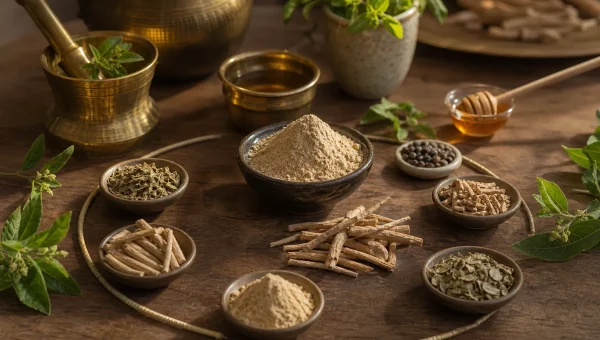
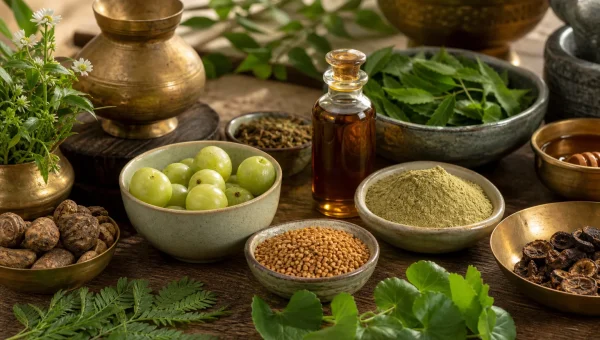
Ayurvedic herbs are not automatically appropriate for every man over 50, and evidence from people with osteoarthritis or from small sports trials cannot be converted into a universal “joint-protection protocol.” Extracts also differ substantially in composition. Product-specific doses used in trials should not be treated as interchangeable prescriptions.
| Ayurvedic Drug | Verified Traditional Identity | Current Human Evidence | Practical Caution |
|---|---|---|---|
| Shallaki (Boswellia serrata) | Oleogum resin used in Ayurvedic medicine | Systematic reviews of randomized trials suggest that some Boswellia extracts may reduce pain and improve function in knee osteoarthritis. This does not establish prevention of exercise injuries or regeneration of cartilage in healthy lifters. | Formulations and boswellic-acid profiles vary. Seek professional advice when taking medicines or before surgery. |
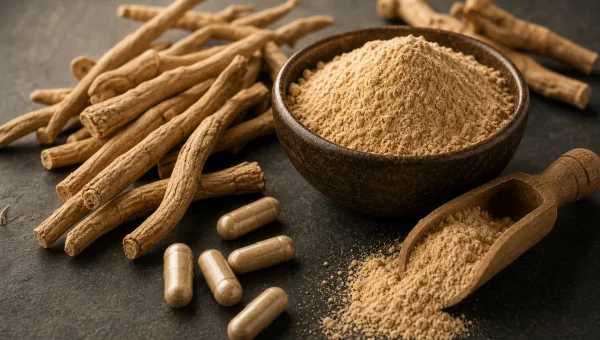
| Ashwagandha (Withania somnifera) | Root used as an Ayurvedic rasayana and strengthening drug | A small 2015 randomized trial in healthy men aged 18-50 found greater strength and muscle gains with 300 mg of a particular root extract twice daily during eight weeks of resistance training. Later reviews describe promising but still limited and heterogeneous evidence. | It can cause gastrointestinal symptoms and drowsiness; rare liver injury has been reported. It may affect thyroid function and interact with medicines. It is not suitable for everyone. |
| Haridra (Curcuma longa) | Turmeric rhizome used traditionally in food and medicine | Some curcumin preparations have shown modest benefits for osteoarthritis pain or exercise-related soreness, but results depend on formulation and study design. | High-dose extracts may cause digestive effects and may interact with anticoagulant or antiplatelet therapy. Added piperine can alter drug absorption. |
| Guggulu (Commiphora wightii/C. mukul) | Purified oleogum resin used in classical formulations | There is insufficient high-quality evidence to recommend standardized guggulsterone capsules for protecting the joints of strength-training adults. | Self-prescribing is inappropriate because preparations may cause adverse effects or interact with thyroid, cardiovascular and other medicines. |
Boswellic acids have demonstrated effects on inflammatory pathways, including 5-lipoxygenase-related pathways, in laboratory research. That mechanism does not prove that a Boswellia supplement is safer than nonsteroidal anti-inflammatory drugs or that it cannot affect the stomach, bleeding risk or other medicines. Claims that Shallaki leaves platelet function and gastric tissue entirely unaffected should therefore be avoided. Persistent joint pain requires diagnosis rather than indefinite suppression with either herbs or painkillers.
Training Modifications After a Long Break
Chronological age alone does not determine the ideal program. Training history, medical conditions, sleep, nutrition, pain, mobility and the length of the layoff are usually more useful. The following principles are consistent with modern resistance-training guidance and with Ayurveda’s emphasis on exercise suited to individual capacity:
- Begin below your perceived ability: Use loads that permit several technically sound repetitions to remain in reserve. During the first weeks, prioritize movement quality and tolerance rather than testing maximum strength.
- Train major muscle groups regularly: Two or three nonconsecutive full-body sessions per week are practical for many returning adults, but three sessions are not a universal maximum. Volume and frequency should be adjusted to recovery and the distribution of exercises.
- Progress one variable at a time: Add a small amount of weight, repetitions or sets only when the current workload is being tolerated. There is no verified rule requiring every man over 50 to abandon linear progression after six to eight weeks.
- Rehabilitate previous injuries: A history of shoulder injury, instability, significant weakness or restricted motion justifies assessment by a physiotherapist or suitably qualified clinician. Exercise substitutions may be more useful than simply avoiding all loaded movement.
- Use isometrics appropriately: A small 2015 study found that heavy isometric quadriceps contractions temporarily reduced pain in six athletes with patellar tendinopathy. Later systematic review evidence found that isometrics were not consistently superior to isotonic exercise. They may be one component of progressive tendon rehabilitation, not a universal pre-workout treatment.
- Do not train through warning pain: Mild muscular effort and delayed muscle soreness differ from sharp pain, increasing joint pain, instability, neurological symptoms or swelling. Those signs warrant modification or clinical evaluation.
Post-Training Recovery
Recovery depends on the entire training week, not on a single drink consumed within 60 minutes. Total daily protein, sufficient food energy, sleep and sensible workload are more important than a narrow “anabolic window.” Meta-analysis of resistance-training studies found that gains in fat-free mass were not further increased when total protein intake exceeded approximately 1.6 g/kg/day, although individual needs vary. Reviews focused on older people commonly discuss intakes around 1.0-1.3 g/kg/day, with higher amounts sometimes used during resistance training, energy restriction or rehabilitation. People with kidney disease or other medical restrictions need individualized advice.
Milk can be a convenient post-training source of protein and carbohydrate for people who tolerate it, but “Ashwagandha Ksheera” should not be described as a single universally prescribed classical sports formula. A simple recovery option may be milk or curd alongside an ordinary meal containing adequate protein. Adding one tablespoon of ghee increases energy intake, but ghee should not be promoted as a clinically established anti-inflammatory recovery treatment merely because it contains small quantities of short-chain fatty acids.
Ashwagandha supplements should not be added automatically to a post-workout drink. The positive resistance-training trial used a defined commercial root extract in adults no older than 50; it did not establish that any root powder, any branded extract or a milk-and-ghee mixture will reproduce the same result in men over 50. Selection and dose should be discussed with a qualified Ayurvedic physician and healthcare provider, particularly when thyroid, liver, autoimmune, glucose-lowering, sedative or blood-pressure medicines are involved.
Safety and Medical Review
Men who have been sedentary, have symptoms or live with cardiovascular, metabolic or musculoskeletal disease should discuss an appropriate return to exercise with a healthcare professional. Medical clearance is particularly important for chest pressure, unexplained breathlessness, fainting, palpitations, uncontrolled blood pressure or a known heart condition. Acute joint pain after trauma, marked swelling, deformity, inability to bear weight, progressive weakness, numbness or pain that repeatedly worsens with training requires assessment before heavy lifting continues.
Herbal products should be obtained from reliable manufacturers and used under qualified supervision. Tell physicians and pharmacists about every supplement being taken. “Natural” does not mean free of adverse effects, contamination or drug interactions. This article provides general education and does not replace diagnosis, rehabilitation or an individualized program from a qualified practitioner or healthcare provider.
One Actionable Step
Before the next resistance session, complete 5-10 minutes of easy whole-body movement, then perform two or more progressively heavier practice sets of each major exercise before reaching the working load. Optional gentle sesame-oil massage may be performed earlier for comfort, provided the skin tolerates it and all slippery residue is removed. Record the load, repetitions, joint response and next-day symptoms. Over four weeks, this log will provide more useful guidance than assuming that soreness must be ignored or that one Ayurvedic practice can prevent every injury.
References
- Charaka Samhita — Ayu
- Charaka Samhita — Deha prakriti
- Charaka Samhita — Kapha dosha
- Charaka Samhita — Dinacharya
- Charaka Samhita — Matrashiteeya Adhyaya
- Resistance training is medicine: effects of strength training on health (2012), PubMed
- Effectiveness of Boswellia and Boswellia extract for osteoarthritis patients: a systematic review and meta-analysis (2020), PubMed Central
- Efficacy of Extracts of Oleogum Resin of Boswellia in the Treatment of Knee Osteoarthritis: A Systematic Review and Meta-Analysis (2024), PubMed Central
- Examining the effect of Withania somnifera supplementation on muscle strength and recovery: a randomized controlled trial (2015), PubMed
- Examining the effect of Withania somnifera supplementation on muscle strength and recovery: a randomized controlled trial (2015), PubMed Central
- Effects of Ashwagandha (Withania somnifera) on Physical Performance: Systematic Review and Bayesian Meta-Analysis (2021), PubMed Central
- Isometric exercise induces analgesia and reduces inhibition in patellar tendinopathy (2015), PubMed
- Effectiveness of isometric exercise in the management of tendinopathy: a systematic review and meta-analysis of randomised trials (2020), PubMed Central
- Protein Requirements and Recommendations for Older People: A Review (2015), PubMed Central
- A systematic review, meta-analysis and meta-regression of the effect of protein supplementation on resistance training-induced gains in muscle mass and strength in healthy adults (2018), PubMed
- NCCIH
I started lifting at 54 after 8 years off. First 6 weeks I trained exactly the way I had at 38 and wrecked my left knee. The part about synovial fluid and Vata depletion with age explains exactly what happened. Started the oil protocol and slow eccentric loading described here. 4 months in and I’m lifting without pain.
The recommendation to shift toward more Kapha-building exercises after 50 makes sense from a tissue preservation standpoint. But what does this mean practically is resistance training okay at normal intensities or is there a ceiling that changes with age from an Ayurvedic perspective?
Some of the claims about cartilage and Ashwagandha need more context. Preclinical data and human clinical data are very different. The article moves between them too quickly. A 58-year-old doing heavy squats based on herb claims without medical clearance could get hurt.
Useful post on Strength Training After 50 for Men. The safety notes could be expanded a little.
Guggul for joint health at 53 has been genuinely helpful for me. Prescribed by an Ayurvedic doctor alongside my orthopedic treatment. My CRP came down and my joint stiffness in the morning is much less after 5 months.
Useful post on Strength Training After 50 for Men. This feels more usable than a long list of herbs.
Is there guidance on post-workout nutrition specifically? The article mentions ghee and protein timing but doesn’t address whether the traditional Ayurvedic foods are actually adequate for muscle protein synthesis in a man over 50 who is lifting seriously.
I’m 57 and my trainer keeps telling me to push through discomfort. The article’s distinction between productive discomfort and Vata depletion pain is useful. I’ve been ignoring signals I should have been reading.
I remember trying to lift like I did in my thirties and my knees started hurting after just a couple weeks. I appreciate that the article stresses a slower return.
Useful post on Strength Training After 50 for Men. Good starting point for a cautious reader.
The Bala taila pre-workout application is something wrestlers in Haryana have used forever. calling it Vata pacification is new language for an old practice.
The bit about Shleshaka Kapha residing in the joints made me wonder if oiling the skin really helps joint lubrication.
How does the protocol change for men who are starting from scratch at 60+ versus those who maintained fitness into their 50s? The recovery capacity and baseline tissue health are very different.
I like the suggestion to start with loads that leave a few reps in reserve; it feels safer than chasing max weight right away.
The Ashwagandha and Shatavari combination for male hormonal support was prescribed to me by my Ayurvedic doctor at 52 alongside the strength program. My free testosterone improved moderately and my recovery time between sessions shortened noticeably.
Is this suitable for Pitta dominant people or mainly Vata? I get confused about the cross-dosha applications. 🙏
@Catherine shared this with my sister who is a yoga teacher and she said the dosing info was spot on
not sure i trust the quality of supplements available online, too many adulterated products out there ❤️
the dosage here seems higher than what my ayurvedic doctor recommended, a bit concerned 🙌
The recipe proportions seem higher than what I see in other sources, is the difference intentional.
late to this but wanted to ask, do these recommendations still hold or has newer research changed anything
the pitta protocol in here did not work well for me, caused a lot of heat and skin irritation
Packaging this as science when most of it is tradition makes me skeptical, need more rigorous sourcing.
i have low agni according to my vaidya, does that change which phase to start with
how does this compare to the classic ashtanga hridayam recommendation on the same topic
two months in and my symptoms are actually slightly worse, stopping and going back to basics
Late to this but wanted to ask, do these recommendations still hold or has newer research changed anything.
my vaidya recommended something similar last month, good to see the science backing it up here
How long before seeing results typically? the article mentions 4 to 6 weeks but is that for everyone.
the herb combination you suggested 600mg ksm-66 morning worked well alongside my usual churna
where can you source the herbs in india outside of major cities? i’m in a tier-2 town
just started exploring ayurveda after years of allopathy, this is helpful as an intro but still a lot to absorb
Doing this
this is the kind of content that makes people delay real medical care, that concern is valid
Does anyone know if Ashwagandha really affects thyroid function in older men? The article mentions it can but I’d like more detail.
I was looking for a plain explanation of Strength Training After 50 for Men. The practical details matter more than people think.
Jo recovery protocol ke baare mein likha hai usme Ashwagandha aur Bala dono hain — kya dono ek saath lene chahiye ya pehle sirf ek se shuru karein? Meri age 55 hai aur dobara gym join kiya hai, joints mein thodi takleef rehti hai.
Coming back to lifting at 53 myself and the shoulder recovery piece really hit home. I made the same mistake — assumed I could just pick up where I left off in my 40s. What specific joint support herbs did you find most useful in the first few weeks before the tendons caught up with the load?
Some of these claims are very strong for what is essentially anecdote-level evidence.
This works in theory but practically very hard to source authentic herbs in most parts of India.
Same here
Turned 54 last month and this is the most practically useful thing I have read about returning to lifting. The recovery time advice especially. I kept assuming I was just being weak when I needed three days to recover from a session that would have taken me one day at 38. The Vata-aggravation framing for that pattern actually makes it feel like useful information rather than just aging.
where can you source the herbs in india outside of major cities? im in a tier-2 town
The warm up advice of walking or cycling for 5 to 10 minutes before lifting is something I can actually do without extra equipment.
Starting this next week, will come back to report results in about a month.
I was looking for a plain explanation of Strength Training After 50 for Men. This feels more usable than a long list of herbs.
Just started exploring Ayurveda after years of allopathy, this is helpful as an intro but still a lot to absorb.
Read this twice and took notes, the distinction between shamana and shodhana applications is really helpful.
the table in the middle of the article was very clear but i couldn’t figure out the seasonal column
Been using Ayurvedic protocols for 2 years and this is one of the more accurate breakdowns I’ve seen.
@Pooja can pregnant women follow this or are there modifications? the article doesn’t address that specifically
the specific morning timing recommendation is practical, most articles skip that detail entirely
I was looking for a plain explanation of Strength Training After 50 for Men. The examples make the advice less abstract.
How do I know if I’m seeing genuine results vs just placebo? any markers to watch.
Tried the morning routine for 2 months, gave up. the timing is impossible with a 9 to 5 job and kids.
does anyone know if this works with the churna form or only the tablet? cant find ksm-66 locally
I’m skeptical that Boswellia can prevent exercise injuries; the review only showed pain reduction in osteoarthritis patients.
would this protocol work if i travel frequently and cant maintain a fixed routine
my constitution is vata-pitta, the article seems to focus on one or the other, any advice
The advice around Strength Training After 50 for Men is specific enough to be useful. The article avoids making it sound like a quick fix.
noted
started the triphala protocol you described in the third section, two weeks in and digestion is noticeably smoother 💯
Tracking load reps and next day soreness over four weeks seems like a practical way to adjust the program without guesswork.
What would the western equivalent supplement be for someone who can’t get the herb locally. नमस्ते
feels like a lot of the advice is very general, my case is quite specific and this didnt really address it
anyone know if this is okay for kids or only adults? my 14 year old has similar symptoms
The advice around Strength Training After 50 for Men is specific enough to be useful. The examples make the advice less abstract.
just found this post, the section 3 protocol seems intensive for a beginner, any lighter version
The article’s note about avoiding oil on broken skin before handling gym equipment reminded me to be careful with my post run rub.
what brand of the extract do you personally use or recommend? the market is full of fake products
not sure i trust the quality of supplements available online, too many adulterated products out there
The point about recovery windows being different after 50 is something no one tells you. I kept assuming two days was enough between heavy sessions, same as my younger years. Is there a general guideline here for how much longer rest periods should be, or does it vary by dosha?
The science section feels thin, I’d want to see more than cell studies before calling something proven.
Reading this after finding it on Google, has the recommended dose changed since 2026?
Is there a Hindi or regional language resource you’d recommend alongside this for my parents.
took notes on the part about seasonal adjustments, adding that to my practice now
the part about adjusting based on prakriti was exactly what i needed to understand, thanks
I appreciate that the program doesn’t force everyone to abandon linear progression after a set number of weeks; flexibility matters.
finally someone explains the theory behind it and not just the recipe, this made sense to me
@Chris The herb combination you suggested 600mg KSM-66 morning worked well alongside my usual churna.
this helped me understand why my previous attempt at this didnt work, i was doing the timing wrong 🙏
Two months in and my symptoms are actually slightly worse, stopping and going back to basics.
bookmarked this to share with my mother who has been struggling with the same issue for years 🙏
Good info 🌿
The Strength Training After 50 for Men angle is useful here. Good starting point for a cautious reader.
Where can you source the herbs in India outside of major cities? I’m in a tier-2 town.
Anyone know if this is okay for kids or only adults? my 14 year old has similar symptoms. 🌿
For someone with a history of shoulder instability, seeing a physio before loading up again makes a lot of sense.
Tried the morning routine from this article and noticed a difference by day 5, not placebo I think.
followed the dosage table exactly for 10 days and my sleep improved, will continue
the recipe proportions seem higher than what i see in other sources, is the difference intentional
Good reminder on Strength Training After 50 for Men. The article avoids making it sound like a quick fix.
Good reminder on Strength Training After 50 for Men. This would be easier to follow with a one-week sample plan.
Good reminder on Strength Training After 50 for Men. The safety notes could be expanded a little.
The reminder that total daily protein matters more than a narrow anabolic window helped me relax about post workout shakes.
Is this suitable for Pitta dominant people or mainly Vata? I get confused about the cross-dosha applications.
Can pregnant women follow this or are there modifications? the article doesn’t address that specifically.
Would this protocol work if I travel frequently and can’t maintain a fixed routine.
Good reminder on Strength Training After 50 for Men. The main idea is clear even if someone is new to Ayurveda.
does anyone know if this works with the churna form or only the tablet? can’t find ksm-66 locally 🙌
Appreciate that this goes into contraindications, most blogposts skip that part.
my functional medicine doctor had mentioned something similar, good to have teh ayurvedic framing too
I came for Strength Training After 50 for Men and this answered the main question. A few more examples would still help.
some of these claims are very strong for what is essentially anecdote-level evidence
is this suitable for pitta dominant people or mainly vata? i get confused about the cross-dosha applications
been following this for 3 weeks now and my energy levels r much better, the protocol u described really clicked for me
what would the western equivalent supplement be for someone who cant get the herb locally
The table in the middle of the article was very clear but i couldn’t figure out the seasonal column.
the science section feels thin, i’d want to see more than cell studies before calling something proven
The dosage here seems higher than what my Ayurvedic doctor recommended, a bit concerned. 🌿
how do i know if im seeing genuine results vs just placebo? any markers to watch 🙏
I came for Strength Training After 50 for Men and this answered the main question. The main idea is clear even if someone is new to Ayurveda.
I came for Strength Training After 50 for Men and this answered the main question. This feels more usable than a long list of herbs.
Started the Triphala protocol you described in the third section, two weeks in and digestion is noticeably smoother.
some of these claims are very strong for what is essentially anecdote-level evidence ठीक है
The specific morning timing recommendation is practical, most articles skip that detail entirely.
starting this next week, will come back to report results in about a month
The part about Strength Training After 50 for Men feels realistic. I would still ask a practitioner before changing medicines.
Good info
The part about Strength Training After 50 for Men feels realistic. The article avoids making it sound like a quick fix.
Not sure I trust the quality of supplements available online, too many adulterated products out there.
Anyone know if this is okay for kids or only adults? my 14 year old has similar symptoms.
Been following this for 3 weeks now and my energy levels are much better, the protocol you described really clicked for me.
off topic but has anyone here tried this approach for hair loss? curious if similar principles apply 🙏
anyone know if this is okay for kids or only adults? my 14 year old has similar symptoms 🌿
The dosage here seems higher than what my Ayurvedic doctor recommended, a bit concerned.
the section on quality sourcing was a surprise, didnt know the extract grade mattered this much
teh dosage here seems higher than what my ayurvedic doctor recommended, a bit concerned
tried the morning routine from this article and noticed a difference by day 5, not placebo i think
This makes sense for Strength Training After 50 for Men. A few more examples would still help.
been using ayurvedic protocols for 2 years and this is one of the more accurate breakdowns ive seen
@Sandeep quick question: does the dosage change if someone is also on metformin? asked my doc but he wasn’t sure 💯
Finally someone explains the theory behind it and not just the recipe, this made sense to me. 🌿
This makes sense for Strength Training After 50 for Men. The article avoids making it sound like a quick fix.
bookmarked this to share with my mother who has been struggling with the same issue for years
This makes sense for Strength Training After 50 for Men. The timing advice is the part I would start with.
I have low Agni according to my vaidya, does that change which phase to start with.
My constitution is Vata-Pitta, the article seems to focus on one or the other, any advice.
this helped me understand why my previous attempt at this didnt work, i was doing the timing wrong 🙏 ❤️
I have low Agni according to my vaidya, does that change which phase to start with. 🌿 ठीक है
This makes sense for Strength Training After 50 for Men. I would like to know how long to try it before judging results.
tried this for 6 weeks and saw no difference, maybe im applying it wrong but nothing changed for me
I would like more detail on Strength Training After 50 for Men. Small daily changes are easier to follow than a perfect plan.