
I Started Losing Hair at 27. Here Is What I Learned.
I noticed it in the shower first—more hair in the drain than usual. Then the recession at the temples became visible in photographs. By 28, the crown was thinning noticeably. My family history made the pattern hard to ignore, but I was not ready to accept it as inevitable.
Like most people, my first response was to try everything marketed for regrowth. Minoxidil, biotin supplements, caffeine shampoos, and laser devices. Some approaches helped slow shedding, but none fully addressed the progression. What I initially overlooked was Ayurveda, partly because I misunderstood it as only oil application.
Later I learned that Ayurveda describes hair loss (khalitya) through a structured dosha-based model that emphasizes stage-wise progression and targeted intervention rather than a single universal remedy.
Khalitya in Classical Ayurveda
In Ayurvedic texts such as the Sushruta Samhita, khalitya is described as a condition involving the disturbance of pitta and vata doshas affecting the hair follicles (keshabhumi). This leads to weakening of hair roots and subsequent hair fall. Kapha and rakta involvement is described as contributing to obstruction of regrowth in affected follicles.
This framework does not map directly onto modern dermatology, but it provides a useful functional model for understanding progressive hair thinning as a multi-stage process involving inflammation, follicular weakening, and reduced regeneration capacity.
| Ayurvedic Stage | Dosha Pattern | Modern Correlation (Functional) | Clinical Features |
|---|---|---|---|
| Early stage follicle weakening | Pitta + Vata imbalance | Early androgen-related follicle miniaturization | Increased shedding, finer hair texture |
| Progressive hair fall | Pitta-Vata dominance | Shortened growth phase and visible thinning | Temple and crown density reduction |
| Reduced regrowth phase | Kapha-Rakta involvement | Reduced follicle activity and fibrosis tendency | Smooth scalp areas with limited regrowth |
The key insight is that Ayurvedic management is designed around stage differentiation—supporting active follicles differently from dormant ones rather than applying identical treatment across all phases.
For broader Ayurvedic classification of hair disorders, including alopecia areata (indralupta), see related traditional dermatology references within classical Ayurvedic literature.
Early Stage Support: Pitta-Vata Balance (Active Thinning Phase)
In the early stage, follicles are still active but stressed. The focus is on reducing scalp inflammation, supporting circulation, and maintaining follicular nourishment.
Topical Care
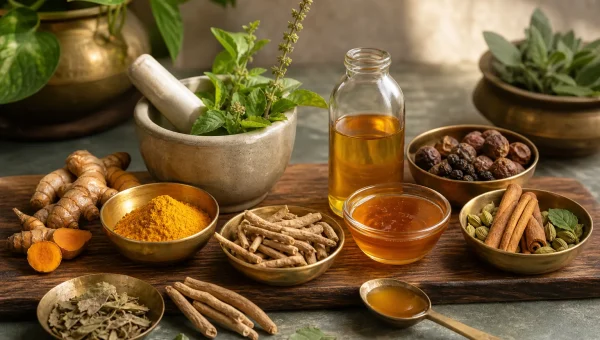
- Bhringraj oil application: Traditionally used in Ayurvedic hair care for scalp nourishment. Regular oil massage supports scalp conditioning and reduces dryness associated with vata imbalance.
- Neeli and herbal oil formulations: Herbal oils combining cooling and nourishing herbs are traditionally used to support scalp balance and hair root strength.
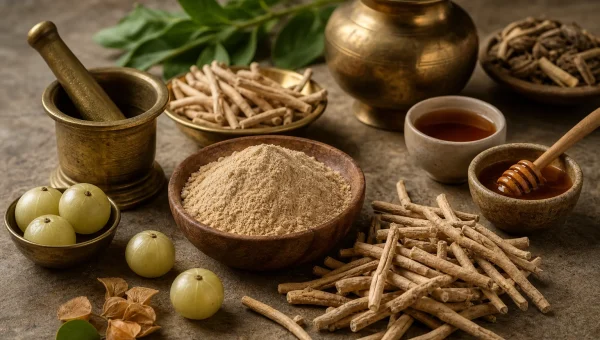
- Herbal scalp paste: Powders such as amalaki and bhringraj are traditionally used in external applications to support scalp health and cooling effects.
Internal Support
- Bhringraj (Eclipta alba): Traditionally classified as keshya (supportive of hair health) and used internally for general rejuvenation support.
- Amalaki (Emblica officinalis): A rasayana herb rich in natural antioxidants and traditionally used to support pitta balance and tissue nourishment.
- Mineral support preparations: Classical Ayurvedic formulations sometimes include processed mineral compounds used under practitioner supervision for pitta-related conditions.
Moderate Stage: Mixed Follicle Activity (Visible Pattern Thinning)
At this stage, some follicles remain active while others show reduced activity. The focus shifts to maintaining existing hair while supporting dormant follicle function and scalp circulation.
Topical Strategy
- Continued use of herbal oils with consistent scalp massage to maintain microcirculation and scalp conditioning
- Hibiscus (Japa pushpa): Traditionally used in hair oil preparations for hair texture support and scalp conditioning
- Gentle scalp stimulation techniques such as massage are traditionally used to support blood flow and relaxation of scalp tissues
Internal Strategy
- Continuation of rasayana herbs such as amalaki and bhringraj
- Ashwagandha (Withania somnifera): Traditionally classified as an adaptogen in Ayurvedic practice, used for stress balance support, which may indirectly influence hair health
- Dietary support emphasizing adequate protein, iron, zinc, and overall nutritional sufficiency, which are essential for normal hair structure maintenance
Advanced Stage: Limited Regrowth Potential (Long-Term Follicle Dormancy)
In advanced stages where scalp regions appear smooth and follicular openings are no longer active, traditional Ayurveda focuses on preservation of existing hair, scalp health maintenance, and overall systemic balance rather than reversal alone.
- Continued scalp oiling to maintain hydration and comfort of the scalp
- Supportive rasayana herbs for general health and tissue nourishment
- Acceptance-based approach recognizing that advanced follicular inactivity may not respond significantly to topical or herbal stimulation
Hair Loss and Hormonal Activity (Functional Perspective)
Modern dermatology associates androgenetic hair loss with sensitivity of hair follicles to dihydrotestosterone (DHT), which influences follicular miniaturization over time. Ayurvedic herbs are traditionally used in a supportive role for scalp health, circulation, and systemic balance rather than acting as direct hormonal blockers in a pharmaceutical sense.
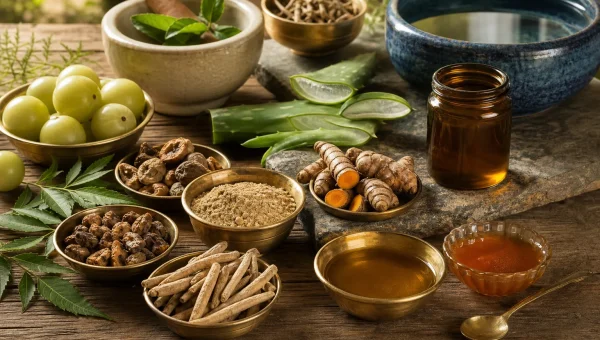
Commonly used herbs such as bhringraj, amalaki, green tea, and licorice are traditionally valued for their antioxidant and scalp-supportive properties in classical herbal systems.
| Herb | Traditional Role | Usage Form |
|---|---|---|
| Bhringraj | Hair nourishment and scalp support | Oil, powder, decoction |
| Amalaki | Rasayana and cooling support | Powder, fresh fruit, extract |
| Ashwagandha | Stress balance and systemic support | Powder, capsule, decoction |
| Green tea | Antioxidant support | Oral infusion, topical rinse |
Lifestyle Factors in Hair Health
- Stress: Chronic stress is associated with increased shedding patterns and scalp imbalance in both traditional and modern frameworks.
- Sleep: Adequate sleep supports hormonal balance and tissue regeneration processes.
- Diet: Excessively processed or inflammatory diets may contribute to systemic imbalance affecting hair quality.
- Smoking: Associated with reduced scalp circulation and oxidative stress burden.
- Scalp care: Harsh heat and chemical exposure may weaken hair shaft integrity.
Observed Outcome After Consistent Use
With consistent application of a combined approach involving topical oils, herbal support, and dermatological treatment, changes in shedding rate, scalp condition, and hair texture may be observed over time. Results vary significantly based on genetics, stage of progression, and overall health status.
- Reduced perceived hair shedding
- Improved scalp comfort and reduced dryness
- Stabilization of progression in some areas
- Improved hair shaft quality in existing hair
Hair loss management requires early attention, consistency, and realistic expectations. In many cases, the goal is stabilization and preservation rather than complete reversal.
Medical Disclaimer: This article is for educational purposes only and does not constitute medical advice. Hair loss can be caused by multiple medical conditions including hormonal imbalance, thyroid disorders, and nutritional deficiencies. A qualified dermatologist should be consulted for diagnosis and treatment options. Ayurvedic herbs and formulations should be used under the guidance of a qualified practitioner, especially when combined with conventional treatments or in cases involving pre-existing health conditions.
Nothing in this article is intended to diagnose, treat, cure, or prevent any disease. Always consult a qualified healthcare provider before starting any herbal or medical treatment.
disappointed no mention of dermatologist co-management for Indralupta. steroid injections are often needed alongside Ayurvedic treatment.
That is a fair concern and worth raising with the author. The co-management question is real, particularly for more advanced stages. I wonder if the article assumes early intervention where Ayurveda can carry more of the load versus established cases where integrative management is probably necessary.
This piece is specifically about Khalitya and male pattern baldness, so sinusitis is quite far off topic here. For what it is worth, the article’s framework for identifying Pitta aggravation as a root cause does get mentioned as a factor in other conditions too, but you would need a separate resource for respiratory issues.
Sinusitis and hair loss are quite different concerns so I am not the best to answer that here, but regarding the post itself, the distinction between Khalitya and Indralupta was clarifying for me as well. I had been following the wrong protocol for months.
bhringaraj oil + Neelibhringadi tailam combination for Khalitya has slowed shedding noticeably in 10 weeks.
is the Bhringaraj vs Neelibhringadi choice dosha-dependent or interchangeable for hair loss?
disappointed no mention of dermatologist co-management for Indralupta. steroid injections are pften needed alongside Ayurvedic treatment.
for Indralupta (alopecia areata), is the Raktamokshana recommendation practical in modern clinic settings or is it rarely done?
distinguishing Khalitya from Indralupta finally explains why my treatment wasnt working I was treating pattern baldness with an alopecia areata protocol. tbh
The staging breakdown for Khalitya is what I found most useful. Understanding that intervention timing matters, and that early diffuse thinning responds differently than established recession, finally explains why some of the oils I tried seemed to slow things down but never really reversed the pattern.
Postpartum hair loss is a different mechanism, more Vata-driven depletion after delivery than the Pitta-dominant pattern discussed here. You might find more relevant guidance in an article focused on post-delivery recovery rather than Khalitya specifically. Worth asking about Shatavari and iron-rich herbs with a practitioner.
To add to the Bhringaraj question above, the article does lean toward Bhringaraj for general Khalitya but does not get into the dosha-specific choice. From what I have read elsewhere, Neelibhringadi is often recommended when there is a stronger Pitta component with scalp inflammation, while plain Bhringaraj oil suits a more Vata-type presentation. Would be curious if the author can confirm.
Postpartum hair loss is really its own category and this article is focused on androgenic male pattern baldness, so the protocols do not map over cleanly. The hormonal and nutritional depletion angle after delivery would need a different approach, mostly rebuilding ojas and addressing Vata rather than the Pitta-heat framework used for Khalitya here.
bhringaraj oil + Neelibhringadi tsilam combination for Khalitya has slowed shedding noticeably in 10 weeks.
Postpartum hair loss has a different Ayurvedic classification than the Khalitya discussed here, so the two should not be conflated. The hormonal depletion and Vata vitiation after childbirth are usually addressed with rasayana herbs and diet rather than the scalp-focused treatments in this article.
Genuinely surprised by how much detail this covers on the Khalitya stages. I’m 29 and sitting squarely in what sounds like stage 2 — temples clearly receding but crown still mostly there. Curious whether the intervention window actually closes significantly between stages 2 and 3, or if the difference in outcomes is more marginal than the article implies.
distinguishing Khalitya from Indralupta finally explains why my treatment wasn’t working I was treating pattern baldness with an alopecia areata protocol. 🌿
The breakdown of khalitya into three stages really clarified why my usual shampoo wasn’t helping.
Same here.
@Amrita is the Bhringaraj vs Neelibhringadi choice dosha-sependent or interchangeable for hair loss? ❤️
is the Bhringaraj vs Neelibhringadi choice dosha-dependent or interchangeable for hair loss? ❤️
Thanks! 💯
Helpful.
Did anyone try the Neeli Bhringrajadi Taila and notice a difference in shedding after a month?
Good one. ❤️
@Naveen distinguishing Khalitya from Indralupta finally explains why my treatment wasn’t working I was treating pattern baldness with an alopecia areata protocol.
distinguishing Khalitya from Indralupta finally explains why my treatment wasnt workinh I was treating pattern baldness with an alopecia areata protocol. ❤️
Makes sense.
distinguishing Khalitya from Indralupta finally exolains why my treatment wasnt working I was treating pattern baldness with an alopecia areata protocol. tbh 🙏
The honest take on the third stage where the focus shifts to scalp health rather than regrowth feels refreshing.
@Meera is the Bhringaraj vs Neelibhringadi choice dosha-dependent or interchangeable for hair loss?
@Arun bhringaraj oil + Neelibhringadi tailam combination for Khalitya has slowed shedding noticeably in 10 weeks.
Makes sense. 🙏
Sorry off-topic but anyone here used Ayurveda for hair loss?
@John distinguishing Khalitya from Indralupta finally explains why my treatment wasn’t working I was treating pattern baldness with an alopecia areata protocol.
bhringaraj oil + Neelibhringadi tailam combination for Khalitya has slowed shedding noticeabky in 10 weeks.
Reading about the pitta pacifying diet made me rethink my love for spicy snacks.