
The night I turned forty-three, I stood in the bathroom examining a face I both recognized and did not. The woman looking back at me had lived deeply – in her forehead lines, in the shadows that had appeared beside her mouth, in the slight shift of texture that had happened somehow while I was busy with everything else. My usual moisturizer had become inadequate. My dermatologist had recommended retinol, which gave me three weeks of peeling and redness before I decided that irritating my skin into renovation was not actually the philosophy I wanted to adopt.
What I found instead was a realization I wish someone had handed to me in my thirties: the skin’s own repair processes intensify during sleep. Cell renewal and barrier restoration rise overnight, supported by the nighttime peak in growth-hormone release and the pause in daytime UV and pollution exposure. A night cream that actually works is not one that chemically forces change during the day – it is one that gives the skin’s nocturnal repair mechanisms the right ingredients to do their best work. And the classical Ayurvedic formulations developed for nighttime skin care turn out to be exquisitely designed for exactly that purpose.
Why Night Skin Care Is Different After Forty
After forty, several things change simultaneously. Estrogen decline drives a steep loss of skin collagen: studies of postmenopausal women document up to a 30% fall in skin collagen within the first five years after menopause, followed by a slower decline of roughly 2% per year. Skin barrier function weakens, leading to transepidermal water loss – the reason your face feels tight and dry by morning. Cell turnover slows from roughly every 28 days in your twenties to 45-60 days by your mid-forties, meaning the same surface skin cells stay longer and show more accumulated environmental damage.
Ayurvedic medicine understands this stage of life through the Vata lens: with age, Vata becomes dominant, producing the dryness, loss of lubrication, thinning, and roughness that characterize aging skin. The therapeutic response is consistent: oil-based preparations that penetrate deeply, herbs traditionally used to nourish and renew the tissues (dhatus), and formulations with the right balance of heating and cooling herbs to support both circulation and tissue nourishment without inflammation.
The Base Oils That Matter
Before herbs, the carrier oils in any night cream determine how deeply active ingredients penetrate and how well the skin barrier is supported. For women over forty with Vata-type aging skin, these are the oils that belong in your night cream base:
- Sesame oil (Tila Taila): The classical base for most Ayurvedic skin oils. The Charaka Samhita ranks tila taila foremost among oils for its strength-giving, Vata-pacifying qualities and its ability to penetrate the tissues. It is rich in linoleic acid and vitamin E and contains the antioxidant lignans sesamol and sesamolin, which help protect both the oil and the skin’s lipids from oxidative stress. Its small molecular size supports deep dermal penetration.
- Rosehip seed oil: Exceptionally rich in essential fatty acids – linoleic and alpha-linolenic acid – alongside natural provitamin-A carotenoids and tocopherols. Contrary to a widespread cosmetic myth, rosehip oil does not contain meaningful trans-retinoic acid and is not a retinol substitute; its real value lies in replenishing barrier lipids and supplying antioxidants that support the skin’s own renewal, without the irritation of retinoids.
- Kokum butter (Garcinia indica): Solid at room temperature, melts on contact with skin. Non-comedogenic and deeply emollient, it is high in stearic and oleic acids that reinforce the skin’s barrier lipids. In classical Ayurveda the fruit (Vrikshamla) is described chiefly for its sour (amla) taste and digestive, Pitta-related actions rather than as a dermatology herb – its place in modern skincare rests on its fatty-acid profile, not a classical skin indication.
- Almond oil (Vatada Taila): Lightweight, high in oleic acid, traditionally regarded as cooling and suited to Pitta. For women with any menopausal skin flushing or redness, almond oil is preferable to sesame as a primary base.
The Hero Herbs for Over-40 Night Repair
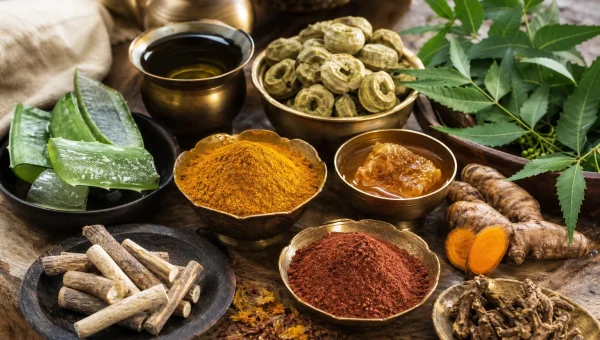
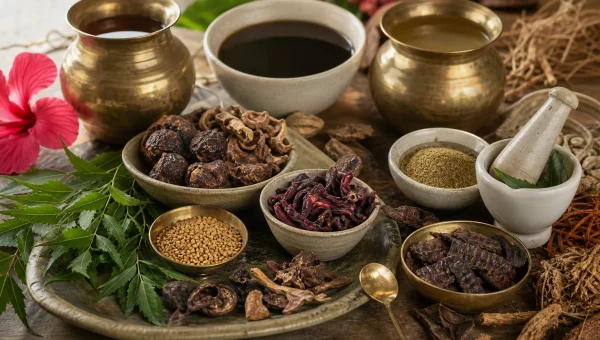
These are the herbs Ayurvedic tradition turns to for complexion (varnya) and tissue renewal – the ones with the strongest standing for mature, Vata-aging skin. Each is described below with its classical role and with what current phytochemistry can, and cannot, confirm.
Kumkumadi (Saffron Complex)
Kumkumadi Tailam is perhaps the most famous Ayurvedic skin oil, built around saffron (Kumkuma, Crocus sativus) as the principal active ingredient. The classical formula in the Ashtanga Hridaya (Uttarasthana) lists roughly sixteen ingredients – including Manjistha, Ushira (vetiver), Padmaka (Prunus cerasoides), and Chandana (sandalwood) in a base of sesame oil and goat’s milk. Expanded versions in later compendia such as the Sahasrayogam add further herbs, which is the source of the larger ingredient counts sometimes quoted.
Saffron’s carotenoid pigments crocin and crocetin are antioxidants, and laboratory studies report that saffron constituents can inhibit tyrosinase, the rate-limiting enzyme in melanin formation – the basis for its long classical reputation as a varnya (complexion-brightening) herb. Robust long-term human trial data remain limited, so saffron is best regarded as a traditionally validated complexion herb rather than a proven depigmenting drug. For DIY use, adding 5-7 saffron threads to 30ml of your base oil and allowing it to infuse for 48-72 hours in sunlight provides a simplified but effective Kumkumadi-style base.
Yashtimadhu (Licorice Root)
Yashtimadhu (Glycyrrhiza glabra) contains glabridin, one of the better-studied botanical tyrosinase inhibitors. In the foundational work of Yokota and colleagues (Pigment Cell Research, 1998), glabridin inhibited tyrosinase activity at low concentrations (0.1-1.0 µg/ml) and suppressed UVB-induced pigmentation and inflammation in skin – a profile that fits its traditional use for uneven tone. It is also mildly anti-inflammatory and skin-calming. For topical preparations, licorice root powder is emulsified into the oil base at 2-5% concentration.
Manjistha (Rubia cordifolia)
Manjistha is the primary blood-purifying (raktaprasadana) and complexion-brightening (varnya) herb of classical Ayurvedic dermatology, named among the varnya herbs by both Charaka and Sushruta. Its anthraquinone pigments, such as purpurin and munjistin, have antioxidant activity, and the herb is traditionally used to even skin tone and calm inflammatory pigmentation. It is typically used at around 3% in oil-based preparations, applied consistently over several weeks. See our dedicated post on Manjistha for skin for the full picture of this herb’s skin benefits.
Nagarmotha (Cyperus rotundus)
Nagarmotha rhizome is rich in sesquiterpenes (such as α-cyperone) and flavonoids (luteolin, quercetin) with well-documented anti-inflammatory and antioxidant activity. A “collagen-stabilizing” effect is not established in the published literature, so it should not be claimed; the herb’s genuine value for mature skin lies in calming inflammation and reducing oxidative stress, which supports a healthier skin environment for Vata-type aging. Used at 2% concentration in night preparations.
Four DIY Night Cream Formulations
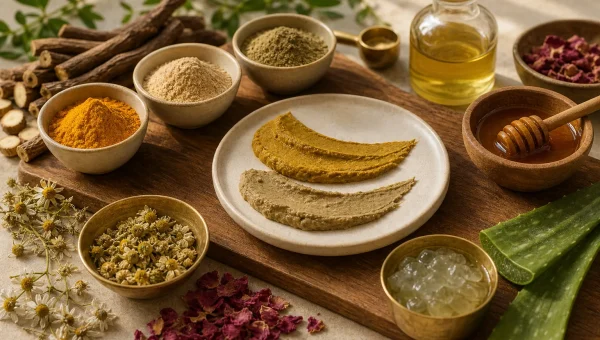
The four recipes below translate these principles into preparations matched to different skin types. Choose by your dominant pattern – dry/Vata, combination, the thinner skin of the neck, or sensitive/Pitta. All use food-grade butters and oils with the herbs described above. Quantities are for small home batches made without preservatives, so make little and use it fresh.
Formulation 1: Deep Nourishing Balm for Vata/Dry Skin
This is for women with genuinely dry, thin, fine-lined skin – the classic Vata aging profile. Rich, heavy, deeply penetrating.
Ingredients:
- 30g kokum butter
- 20ml sesame oil (cold-pressed)
- 10ml rosehip seed oil
- 2ml Kumkumadi Tailam (purchased, not DIY – quality control matters here)
- 1 teaspoon Yashtimadhu powder (finely sifted)
- 1/2 teaspoon Nagarmotha powder
- 6 drops sandalwood essential oil
Method: Melt kokum butter in a double boiler. Remove from heat, allow to cool to approximately 40°C. Add sesame oil, rosehip oil, and Kumkumadi Tailam. Mix herb powders into the liquid oils separately first (helps prevent clumping), then incorporate into the butter mixture. Add sandalwood essential oil. Pour into a clean glass jar, let solidify at room temperature. Makes approximately 60g – 30-40 applications.
Application: Warm a pea-sized amount between palms, press onto face using upward lifting motions. Use at night after gentle cleansing. Do not use on broken skin or active acne.
Formulation 2: Brightening Anti-Pigmentation Night Cream for Combination Skin
For women with combination to normal skin focused on reducing dark spots, uneven tone, and dullness that develops in the forties.
Ingredients:
- 20g shea butter
- 15ml almond oil
- 10ml rosehip seed oil
- 5ml Manjistha-infused sesame oil (infuse 2 teaspoons Manjistha powder in 100ml sesame oil for 2 weeks in sunlight, strain)
- 1 teaspoon Yashtimadhu powder
- 1/2 teaspoon Manjistha powder
- Pinch of saffron (7-8 threads, pre-infused in 2ml almond oil for 48 hours)
- 4 drops rose absolute essential oil
Method: Same process as Formulation 1. Melt shea butter, cool to 40°C, incorporate oils, mix in herb powders, add saffron-infused oil and rose absolute. This cream is lighter in texture than the Vata balm. Apply 1/2 teaspoon to face and neck at night. Expect 6-8 weeks before visible pigmentation improvement.
Formulation 3: Collagen-Support Neck and Decolletage Cream
The neck and chest lose firmness faster than the face and are often neglected. This preparation specifically targets the thinner, less sebaceous skin of the neck.
Ingredients:
- 25g mango butter
- 20ml sesame oil
- 10ml sea buckthorn oil (diluted to 10% in sesame – full-strength sea buckthorn stains orange)
- 1 teaspoon Shatavari powder
- 1/2 teaspoon Ashwagandha powder
- 1/2 teaspoon Nagarmotha powder
- 5 drops frankincense (Boswellia) essential oil
Method and use: Prepare as above. Apply to neck and decolletage in upward strokes each night. Shatavari (Asparagus racemosus) and Ashwagandha (Withania somnifera) are classical rasayana (rejuvenative) herbs traditionally used to nourish and strengthen the tissues; Shatavari supplies steroidal saponins and Ashwagandha its withanolides. Sea buckthorn is rich in carotenoids, vitamin C, and vitamin E, supplying antioxidants to skin that is thinner and more sun-exposed. Apply at least 30 minutes before lying down to allow absorption.
Formulation 4: Light Anti-Inflammatory Gel for Pitta/Sensitive/Combination Skin
For women with any residual sensitivity, redness, or Pitta-type skin prone to heat and inflammation – particularly relevant for perimenopausal women with skin that reacts to hormone fluctuation.
Ingredients:
- 30ml pure aloe vera gel (inner leaf, not packaged with alcohol)
- 10ml almond oil
- 5ml rosehip oil
- 1 teaspoon Chandana (sandalwood) powder
- 1/2 teaspoon Yashtimadhu powder
- 1/4 teaspoon Haridra (turmeric) powder (small amount – larger quantities stain yellow)
- 5 drops rose geranium essential oil
Method: This is an emulsion rather than a butter-based product. Whisk aloe vera gel with oils slowly until emulsified. Add herb powders, whisk until smooth. Add essential oil. Store in refrigerator (no preservatives). Use within 2 weeks. Apply a thin layer to clean face at night. The cooling, anti-inflammatory properties of sandalwood and aloe balance Pitta skin beautifully without the heaviness that aggravates sensitive skin.
Safety and Patch Testing
All DIY preparations should be patch-tested before full facial application: apply a small amount to the inner wrist, wait 24 hours, check for redness, itching, or swelling before proceeding. Women with tree nut allergies should avoid shea and mango butter, as well as almond oil. Anyone allergic to Asteraceae plants (daisy family) should research herb cross-reactivities before use. Nagarmotha and Manjistha powder should be finely sifted to avoid physical irritation from coarse particles.
For sandalwood essential oil: use only Santalum album (Indian sandalwood) or Santalum spicatum (Australian sandalwood) sourced from sustainable farms. Many products sold as sandalwood contain synthetic amyl salicylate, which has no therapeutic skin benefit. See our dedicated post on sandalwood paste for skin for more context on sourcing and use.
DIY skincare preparations can cause allergic reactions or irritation. Always patch test before full use. These formulations are for general skin wellness and are not intended to diagnose or treat skin diseases or conditions. Consult a dermatologist for persistent skin concerns, and an Ayurvedic practitioner for personalized, dosha-appropriate skincare recommendations.
References
- The inhibitory effect of glabridin from licorice extracts on melanogenesis and inflammation (1998), PubMed
- Skin collagen changes in postmenopausal women receiving different regimens of estrogen therapy (1987), PubMed
- Sciencedirect (sciencedirect.com)
- Researchgate (researchgate.net)
- Aad (aad.org)
Nothing in this article diagnoses or treats a medical condition. Use it as educational information and consult a qualified Ayurvedic practitioner or physician before starting herbs, supplements, detoxes, or therapeutic protocols, especially if pregnant, managing a condition, or taking medication.
Is the Vata pacifying protocol different for elderly patients compared to middle-aged adults? The physiological Vata increase with age means the same protocol might need to be more intensive for older individuals.
The recipes here use ingredients with significant variation in potency depending on sourcing and preparation method. Standardization guidance would improve the reliability of the results described.
The retinol abandonment story is so familiar. I tried it twice, peeled for weeks both times, and switched to something gentler. The Bakuchiol-plus-oils approach I landed on through trial and error is basically what this article is describing from an Ayurvedic perspective. Nice to have the theoretical framework for why it works.
43 here and going through exactly the texture and elasticity shift described. I have spent genuinely embarrassing amounts of money on serums. The shift to an oil-heavy, nourishing approach is one I am now making after reading this and after three weeks of using rose hip seed oil and a shatavari-based night cream, my skin feels more like my skin again.
The kumkumadi tailam recipe in this article is different from the one my Ayurvedic physician gave me. The proportions of saffron to sesame base are different. Is there a classical standard formulation or does it vary significantly between traditions?
I am a cosmetic chemist and the oil chemistry here is sound. Squalane and ceramide replenishment in aging skin is a well-established approach in formulation science. What Ayurvedic oils provide is a natural version of the same lipid types through plant oils with compatible fatty acid profiles. Sesame, for example, has oleic and linoleic acid in proportions that suit aging skin well.
The internal protocol, shatavari, amalaki, and ghee alongside the topical approach, is what distinguishes this from regular skincare advice. The collagen support from the inside combined with lipid nourishment on the outside is a coherent dual approach. Started both two weeks ago.
The madhuyashti (licorice) formulation for the under-eye area is new to me. I have been using commercial eye creams for years with limited results. Going to try making the preparation described here. Licorice’s skin-lightening and anti-inflammatory properties are well supported and the application in the orbital area makes sense.
I love the idea of using sesame oil as a base for a night cream.
I do think this content should come with a stronger caveat that some skin changes after 40 require medical evaluation. Sudden changes in mole characteristics, new growths, persistent rashes are all things that need a dermatologist, not a DIY night cream. Lovely article but the general audience may not know when to escalate.
I came for Night Creams for Women Over 40 and this answered the main question. Would be useful to see a short checklist next.
Has anyone tried the Kumkumadi infusion with saffron threads and noticed any change in skin tone?
What proportion of saffron to oil base is appropriate for home preparation of kumkumadi? I want to make sure the potency is meaningful and not just symbolic. The commercial preparations vary so widely in quality that I would rather control the process myself.
The point about cold, raw salads and ice water being Vata-aggravating and affecting skin hydration is something I did not expect to be as impactful as it was. I switched to warm, cooked, oil-dressed food for three weeks as an experiment. The skin on my cheeks, which had been rough and flaking, normalized within two weeks. Diet was the bigger lever than the topical protocol.
I’m not sure if rosehip seed oil can really replace retinol without irritation.
Does this night cream protocol need to be adapted for oily skin that is also showing age changes? I am 45 and Pitta-predominant with combination skin. Some of the heavier oils recommended seem like they would aggravate my T-zone even while being needed on my cheeks.
How long does the DIY cream stay stable without preservatives? I’d be making it in small batches.
I’m forty-five and had almost the identical retinol experience you describe, three weeks of peeling and then I stopped. The idea of a kumkumadi formulation as a night repair base is something I’ve been curious about but uncertain how to source properly. Are the shelf-stable versions available commercially equivalent to a freshly prepared one, or is the difference significant enough to matter for regular use?
added the saffron-infused sesame base to my night routine and the texture improvement was visible in 10 days
Quick question: does the dosage change if someone is also on other medication?
Is this suitable for Pitta dominant people or mainly Vata?
where do you source the kumkumadi taila base, most local pharmacies here don’t stock it
can this be used under the eyes or is it too heavy for that area? 🌿
where can you source the herbs in india outside of major cities? im in a tier-2 town
I tried the ashwagandha and manjistha combination mentioned here for about six weeks and noticed my skin texture actually improved more than I expected. I’m in my mid-forties and had written off the texture changes as just irreversible. Did anyone else find the turmeric-heavy formulations a bit staining? I’m fair-skinned and had to be careful about timing.
packaging this as science when most of it is tradition makes me skeptical
Reading this after finding it on Google, is this dosage still recommended?
starting this next week, will report back in about a month
The kokum butter balm sounds heavy. I’d need to warm it well before applying.
would this protocol work if i travel frequently and cant maintain a fixed routine 🙌
late to this but wanted to ask, do these recommendations still hold in 2027?
how long before seeing results? the article mentions 4 to 6 weeks but is that for everyone
where r teh actual clinical trials? i need rct data before trying anything
Just found this post, the section 3 protocol seems intensive for a beginner, any lighter version?
the section on collagen support through diet alongside the topical protocol made this more complete than other recipes i’ve tried
Where do you source the kumkumadi taila base, most local pharmacies here don’t stock it.
my functional medicine doctor mentioned something similar, helpful to have the ayurvedic framing too
The Pitta protocol here caused a lot of heat and skin irritation for me.
the dosage here seems higher than what my ayurvedic doctor recommended
Some of these claims are very strong for what is essentially anecdote-level evidence.
the specific morning timing recommendation is practical, most articles skip that detail 🙏
tried the morning routine for 2 months, gave up the timing is impossible with kids and a job
The Night Creams for Women Over 40 angle is useful here. I would still ask a practitioner before changing medicines.
just started exploring ayurveda after years of allopathy, still a lot to absorb
The part about adjusting based on prakriti was exactly what I needed.
the shelf life of these formulations seems very short for practical use, i need something i can make once a month at most 💯
would this protocol work if i travel frequently and cant maintain a fixed routine
my constitution is vata-pitta, the article seems focused on one or the other
After reading about the nighttime hormone peak, I’m motivated to try a DIY night cream.
The Night Creams for Women Over 40 angle is useful here. The safety notes could be expanded a little.
this works in theory but practically very hard to source authentic herbs
The neck cream with mango butter and sea buckthorn oil seems like a good spot treatment for sagging skin.
my vaidya recommended something similar last month, good to see the reasoning explained
My constitution is Vata-Pitta, the article seems focused on one or the other.
The Night Creams for Women Over 40 angle is useful here. Good starting point for a cautious reader.
the pitta protocol here caused a lot of heat and skin irritation for me
followed the dosage table for 10 days and my sleep improved, will continue 🙏
the kumkumadi base formula you described here is exactly what my skin needed, been making it monthly now
Where do you source the kumkumadi taila base, most local pharmacies here don’t stock it. ✨
My partner and I stumbled over here by a different web address and thought I
may as well check things out. I like what I see so i am just following you.
Look forward to checking out your web page again.
appreciate that this goes into contraindications, most blog posts skip that part
How long before seeing results? the article mentions 4 to 6 weeks but is that for everyone.
Tried this for 6 weeks and saw no difference, maybe I’m applying it wrong.
can this be used under the eyes or is it too heavy for that area? ठीक है
Noted
Where can you source the herbs in India outside of major cities? I’m in a tier-2 town.
Good reminder on Night Creams for Women Over 40. The timing advice is the part I would start with.
some ingredients here are quite expensive, a realistic cost breakdown would help decide if this is viable
Good reminder on Night Creams for Women Over 40. The safety notes could be expanded a little.
The article makes it sound straightforward but finding a qualified Ayurvedic practitioner who can actually assess dosha properly is not easy outside major cities.
tried the morning routine for 2 months, gave up the timing is impossible with kids and a job 🙏
the dosage here seems higher than what my ayurvedic doctor recommended ❤️
Tried the morning routine from this article and noticed a difference by day 5.
bookmarked this to share with my mother who has been struggling with the same issue
the specific morning timing recommendation is practical, most articles skip that detail
where are the actual clinical trials? i need rct data before trying anything
my constitution is vata-pitta, the article seems focused on one or the other धन्यवाद
Off topic but has anyone here tried this approach for hair loss? 🙌
What is the Ayurvedic recommendation for under-eye circles as opposed to the dryness and texture issues addressed here? The puffiness and discoloration under my eyes came on strongly in perimenopause and seems different from the structural aging changes described.
Doing this
@Rohit this works in theory but practically very hard to source authentic herbs 🙌
the shelf life of these formulations seems very short for practical use, i need something i can make once a month at most
Packaging this as science when most of it is tradition makes me skeptical.
I came for Night Creams for Women Over 40 and this answered the main question. The timing advice is the part I would start with.
Late to this but wanted to ask, do these recommendations still hold in 2027? 🙏
how long does the diy cream stay stable without preservatives? i’d be making it in small batches 🙌
I came for Night Creams for Women Over 40 and this answered the main question. The main idea is clear even if someone is new to Ayurveda.
been following this for 3 weeks and my energy levels are much better, the protocol described here really clicked for me
Would this protocol work if I travel frequently and can’t maintain a fixed routine.
Bookmarked this to share with my mother who has been struggling with the same issue.
appreciate that this goes into contraindications, most blog posts skip that part 🌿
reading this after finding it on google, is this dosage still recommended? 🙏
Where are the actual clinical trials? I need RCT data before trying anything.
The shelf life of oils infused with plant material at home is genuinely variable and the article gives no guidance on this. Improperly stored herbal oils can become rancid within weeks and applying rancid oil to the face causes more harm than benefit.
The section on collagen support through diet alongside the topical protocol made this more complete than other recipes I’ve tried. ठीक है
Appreciate that this goes into contraindications, most blog posts skip that part.
Added the saffron-infused sesame base to my night routine and the texture improvement was visible in 10 days.
been following this for 3 weeks and my energy levels are much better, the protocol described here really clicked for me ठीक है
the sourcing section was a surprise, didnt know the extract grade mattered this much
the section on collagen support through diet alongside the topical protocol made this more complete than other recipes ive tried
would this protocol work if i travel frequently and can’t maintain a fixed routine
Tried the morning routine for 2 months, gave up the timing is impossible with kids and a job.