
Why Ayurveda Takes Dinner So Seriously
In Ayurvedic dietetics, dinner is treated as a meal that should prepare the body for rest rather than challenge digestion. The core idea is Agni, the digestive and metabolic fire. When food is eaten in the right quantity, at the right time, and after the previous meal has been digested, it supports clarity, comfort, and regular elimination. When food is too heavy, too late, or taken without true hunger, Ayurveda considers it more likely to burden digestion and encourage Ama, the incompletely processed residue associated with sluggishness and obstruction.
The practical dinner rule is simple: make lunch the main meal, keep dinner warm, cooked, moist, and lighter than lunch, and finish eating with enough time before sleep. For many people who sleep around 10:00 PM, this places dinner roughly between 6:00 and 7:30 PM.
Modern chrononutrition also points in this direction. In controlled human feeding trials, the same dinner eaten later in the evening has produced higher nighttime glucose, lower fatty acid oxidation, and changes in metabolic rhythms compared with an earlier dinner. This does not mean everyone must eat at the same clock time, but it supports the Ayurvedic preference for an earlier, lighter evening meal.
The Ayurvedic Dinner Clock
Contemporary Ayurvedic teaching often describes the 24-hour day as six four-hour periods influenced by Vata, Pitta, and Kapha. This “dosha clock” is a practical teaching model used to align meals, work, and rest with the qualities dominant at different times of day.
| Time Period | Dominant Dosha | Digestive Guidance |
|---|---|---|
| 10:00 AM–2:00 PM | Pitta | Best window for the main meal, when heat and digestive capacity are emphasized |
| 2:00 PM–6:00 PM | Vata | Movement and variability increase; a light snack may suit those who are genuinely hungry |
| 6:00 PM–10:00 PM | Kapha | The body shifts toward heaviness, calm, and sleep preparation; dinner should be early and light |
| 10:00 PM–2:00 AM | Pitta | Traditionally treated as an internal metabolic period, not an ideal time to introduce a heavy meal |
The evening Kapha period is not a ban on dinner. It simply means dinner should respect the body’s transition toward rest. A 2 to 3 hour gap between the last bite and lying down is also consistent with common reflux-prevention guidance.
What Heavy, Late Dinners Can Do
Ayurveda links poor meal timing and excess quantity with weak digestion, Ama formation, heaviness, and obstruction in the body’s channels. A late, heavy dinner is especially likely to create these patterns because sleep soon follows, movement decreases, and digestion has less support from daytime activity.
- Morning heaviness: A burdened evening meal may leave the body feeling dull, heavy, or slow the next morning.
- Coated tongue: In Ayurvedic assessment, a thick tongue coating is commonly interpreted as a sign that digestion and clearance need attention.
- Unsettled glucose and fat metabolism: Late dinner timing has been linked with higher nighttime glucose, delayed triglyceride patterns, and reduced fatty acid oxidation.
- Sleep disruption: Eating close to bedtime can alter sleep-stage patterns, and later meal timing has been associated with poorer sleep-quality scores.
- Acid reflux: Reclining soon after food increases the likelihood of reflux symptoms, especially after a large, fatty, spicy, or acidic meal.
The Warm, Soupy, Light Principle
Charaka’s food guidelines advise eating warm food, taking the right quantity, avoiding incompatible combinations, and eating after the previous meal has digested. At dinner, these rules become especially useful: warm, freshly cooked, soft, and moist foods are easier to keep moderate than dry snacks, fried foods, raw salads, or large multi-course meals.
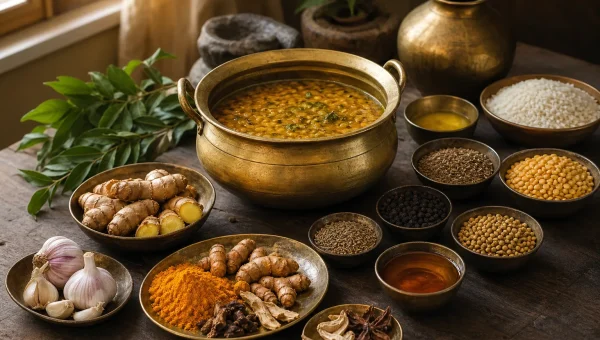
Soups, thin dals, light khichdi, rice gruel, stewed vegetables, and broth-based meals fit the Ayurvedic dinner pattern well. They are warm, simple, and satisfying without requiring the digestive effort of a large lunch-style meal.
A classical portion rule from Ashtanga Hridaya describes leaving space in the stomach: two parts for solid food, one part for liquid, and one part empty for movement. For dinner, this principle is best applied conservatively. Eat enough to feel steady and nourished, but stop before fullness turns into heaviness.
Dinner Recommendations by Dosha
Dinner can be adjusted by Prakriti and by current imbalance. Ayurveda uses the law of opposites: dry and irregular Vata needs warmth and moisture, hot and sharp Pitta needs gentleness and cooling moderation, and heavy Kapha needs lightness, warmth, and stimulation.
Vata Types
Vata individuals often do best with warm, moist, grounding dinners. Good choices include mung dal soup with ghee, soft rice with cooked vegetables, sweet potato stew, or a small bowl of vegetable khichdi. Avoid cold leftovers, raw salads, dry crackers, and irregular dinner timing.
Pitta Types
Pitta individuals usually need dinner that is satisfying but not sharp, sour, or overheated with spices. Good choices include zucchini soup, rice with steamed vegetables, mung dal with coriander, or coconut-based vegetable stew. Avoid very spicy, fried, fermented, or sour foods at night.
Kapha Types
Kapha individuals generally benefit from the lightest dinners. Good choices include thin vegetable soup, barley and greens soup, steamed vegetables with warming spices, or a small bowl of light dal. Avoid cheese-heavy meals, sweets, fried foods, excess oil, and large portions in the evening.
Understanding your Prakriti (constitutional type) helps tailor these guidelines more precisely, but present digestion, appetite, season, and medical needs should always be considered.
5 Quick Ayurvedic Dinners Under 30 Minutes
These recipes follow the same dinner pattern: warm, cooked, simple, and moderate. Adjust spice, oil, grain, and portion size according to constitution and appetite.
1. Simple Mung Dal Soup
Ingredients: 1/2 cup yellow mung dal, 3 cups water, 1/2 tsp turmeric, 1/2 tsp cumin seeds, 1 tsp ghee, rock salt to taste, and a small squeeze of lime if it suits your digestion.
Method: Rinse the dal and cook it with turmeric in water for about 20 minutes, until soft. Warm ghee in a small pan, add cumin seeds, and let them crackle. Pour the tempering over the dal, add salt, and serve warm.
Time: 25 minutes. Best for: A gentle dinner for most constitutions, with less ghee for Kapha and less lime for sensitive Pitta.
2. Spiced Sweet Potato and Ginger Stew
Ingredients: 2 medium sweet potatoes, cubed; 1 inch fresh ginger, grated; 1/2 tsp cumin powder; 1/2 tsp coriander powder; 1 tsp ghee or sesame oil; 2 cups water; rock salt; fresh cilantro.
Method: Warm the fat in a pot, add ginger for a minute, then add sweet potato and spices. Stir briefly, add water, cover, and simmer for 18 to 20 minutes until soft. Garnish with cilantro.
Time: 25 minutes. Best for: Vata, especially when appetite is present and the meal is eaten warm.
3. Cooling Zucchini and Coconut Soup
Ingredients: 3 medium zucchini, chopped; 1/2 cup coconut milk; 1/2 tsp fennel seeds; 1/4 tsp coriander powder; 1 tsp ghee; 2 cups water; rock salt; fresh mint or cilantro.
Method: Warm ghee, add fennel seeds, then add zucchini, coriander, and water. Cook for about 15 minutes, blend until smooth, stir in coconut milk, and serve warm.
Time: 20 minutes. Best for: Pitta, especially when dinner needs to be light but soothing.
4. Light Vegetable Khichdi
Ingredients: 1/4 cup basmati rice, 1/4 cup yellow mung dal, 1 cup chopped seasonal vegetables, 1 tsp ghee, 1/2 tsp cumin seeds, 1/4 tsp turmeric, 3 cups water, and rock salt to taste.
Method: Rinse rice and dal together. Warm ghee, add cumin seeds, then add vegetables and stir briefly. Add rice, dal, turmeric, and water. Cook covered on low heat for about 20 minutes until soft and porridge-like.
Time: 28 minutes. Best for: A simple evening meal for most constitutions. See our detailed khichdi guide for more variations.
5. Broth-Based Barley and Greens Soup
Ingredients: 1/4 cup pearl barley, soaked earlier if possible; 2 cups chopped spinach or kale; 1/2 tsp dry ginger powder; 1/4 tsp black pepper; 1 tsp sesame oil or ghee; 3 cups water or vegetable broth; rock salt to taste.
Method: Warm the oil or ghee, add ginger and pepper, then add barley and water. Cook until the barley is tender. Add greens near the end and cook for 5 more minutes.
Time: 25 to 30 minutes if soaked. Best for: Kapha, especially when dinner needs to be filling without being oily or heavy.
How Dinner Timing Affects Sleep Quality
Dinner and sleep are linked because digestion, body temperature, glucose handling, reflux tendency, and circadian signals all change at night. A heavy meal close to bedtime asks the body to digest while it is also trying to wind down.
In a controlled sleep-lab trial, a dinner eaten 1 hour before bedtime changed sleep-stage distribution and EEG activity compared with a routine dinner eaten 5 hours before bedtime. Later meal timing has also been associated with poorer Pittsburgh Sleep Quality Index scores in observational data.
Ayurveda explains the same practical lesson through Dinacharya: evening food should support sleep, not compete with it. The goal is not rigid restriction but a steady rhythm: eat earlier when possible, keep dinner simple, and leave a calm interval before bed.
Practical Tips for Shifting Your Dinner Habits
Small changes are easier to maintain than sudden rules. Use these steps to make earlier, lighter dinners realistic.
- Make lunch your main meal. A nourishing lunch reduces the urge to overeat at night.
- Prep before evening. Wash greens, chop vegetables, soak barley, or rinse dal earlier in the day.
- Move gradually. Shift dinner 20 to 30 minutes earlier each week until the timing feels natural.
- Use a late-dinner fallback. If dinner must be late, choose soup, thin dal, rice gruel, or a small khichdi portion.
- Skip cold drinks at dinner. Sip warm water or mild herbal tea instead of iced beverages.
- Walk gently after eating. A light 10 to 15 minute walk supports post-meal comfort and can help postprandial glucose handling.
Foods to Avoid at Dinner
Certain foods are not forbidden for everyone, but they are more likely to feel heavy or disturbing when eaten late. Dinner is the best time to simplify.
- Curd and heavy fermented foods: Charaka advises against curd at night. If curd is used, the classical instruction is to combine it properly rather than eating it plain at night.
- Raw salads: Raw, cold, rough foods can aggravate Vata and may be harder to tolerate when digestion is weaker.
- Fried foods: Dense, oily meals are more likely to cause heaviness and reflux when eaten close to sleep.
- Very spicy or sour foods: These may aggravate Pitta and can worsen nighttime acidity in sensitive people.
- Cheese-heavy meals: Dense dairy is especially burdensome for Kapha and is better kept away from late dinners.
- Incompatible combinations: Ayurveda classifies certain combinations, such as fish with milk and fruit with milk, as Viruddha Ahara and best avoided, especially when digestion is already low.
For a deeper look at how dosha influences the first meal of the day, see our guide on Ayurvedic breakfast by dosha type.
When Skipping or Reducing Dinner May Be Appropriate
Ayurveda does not require eating dinner when genuine hunger is absent. Charaka’s rule is to eat after the previous meal has digested and when appetite is present. For some Kapha-dominant people, a very small dinner or warm beverage may feel better than a full plate. For Vata individuals, people with diabetes, pregnancy, eating-disorder history, high training demands, or medical dietary needs, skipping dinner may be unsuitable.
Early time-restricted feeding trials suggest that moving more food intake earlier in the day can improve some cardiometabolic markers even without weight loss, but such schedules should be individualized. The Ayurvedic version is gentler: eat enough during the day, make lunch substantial, and keep dinner light, early, and digestible.
Shifting toward lighter, earlier dinners is one of the simplest Ayurvedic adjustments for digestion, sleep preparation, and morning clarity. Start with timing and portion before changing everything on the plate.
Disclaimer: The dietary recommendations in this article are for general wellness education. If you have diabetes, reflux disease, pregnancy, an eating-disorder history, chronic digestive illness, are underweight, or take medication affected by meals, consult a qualified healthcare provider or Ayurvedic practitioner before making significant changes to meal timing or composition.
References
- Charaka Samhita — Rasa Vimana
- Charaka Samhita — Matrashiteeya Adhyaya
- Ayurveda (ayurveda.com)
- Charaka Samhita — Ama
- Charaka Samhita — Santarpaniya Adhyaya
- Ayurveda (ayurveda.com)
- Metabolic Effects of Late Dinner in Healthy Volunteers-A Randomized Crossover Clinical Trial (2020), PubMed
- Hopkinsmedicine (hopkinsmedicine.org)
- Timing Matters: The Interplay between Early Mealtime, Circadian Rhythms, Gene Expression, Circadian Hormones, and Metabolism-A Narrative Review (2023), PubMed Central
- Meal Timing Regulates the Human Circadian System (2017), PubMed
- Effects of Dinner Timing on Sleep Stage Distribution and EEG Power Spectrum in Healthy Volunteers (2021), PubMed Central
- Journals (journals.plos.org)
- Mayoclinic (mayoclinic.org)
- NIDDK
- Archive (archive.org)
- Charaka Samhita — Naveganadharaniya Adhyaya
- Charaka Samhita — Viruddha Ahara
- Ayurveda (ayurveda.com)
- Ayurveda (ayurveda.com)
- After Dinner Rest a While, After Supper Walk a Mile? A Systematic Review with Meta-analysis on the Acute Postprandial Glycemic Response to Exercise Before and After Meal Ingestion in Healthy Subjects and Patients with Impaired Glucose Tolerance (2023), PubMed
- Mdpi (mdpi.com)
- Early Time-Restricted Feeding Improves Insulin Sensitivity, Blood Pressure, and Oxidative Stress Even without Weight Loss in Men with Prediabetes (2018), PubMed Central
- Ayurveda (ayurveda.com)
I liked the practical side of Dinner Rule. The safety notes could be expanded a little.
I’ve been following this for three weeks. The first week was an adjustment but by week two I felt notably more energized. The midday slump I used to have has mostly disappeared.
I switched to eating this way about two months ago and my digestion has completely transformed. I used to have bloating every single day. It’s almost gone now
I appreciate that you explained WHY these foods are recommended, not just what they are. Understanding the reasoning helps me make better choices when I’m in situations not covered by the list.
The meal plan here is so practical. I was intimidated by Ayurvedic cooking but seeing it broken down like this makes it feel achievable for a busy working parent.
Great question, I’ve been wondering the same thing. Following this thread for the answers
I was resistant to giving up raw salads, feels counterintuitive when you’ve been told salads are healthy. But three weeks of warm cooked vegetables and my digestion is so much calmer
The recipe at the end is now a household staple. My kids even like it, which is the real test. So much easier to eat well when the food is genuinely delicious.
I love how this connects food to season rather than giving one-size-fits-all advice. I always felt worse eating the same things in winter as in summer. Now I understand why.
I appreciate you sharing the skeptical perspective too. It keeps the conversation grounded
The food combining rules here helped me understand why certain meals left me feeling heavy and uncomfortable even when the individual foods were healthy
I’m a chef and I’ve been incorporating these principles into my menu development. The food combining guidance especially has influenced how I think about recipe creation.
I liked the practical side of Dinner Rule. Good starting point for a cautious reader.
The general advice is sound but the claim that this ‘cures’ or ‘fixes’ the condition is irresponsible wording. ‘May help manage’ is more accurate.
Your skepticism is healthy and welcome. We never intend for our content to replace medical advice, and we’ll make that clearer going forward.
The shopping list format is brilliant. I’ve tried following Ayurvedic diet advice before but always got stuck at the grocery store not knowing what to buy. This solves that.
The seasonal eating section is so logical once you read it. Eating what grows locally and seasonally is the original human diet. We just forgot somewhere along the way
I had the exact same confusion about this. Glad the article cleared it up for both of us.
Finally addressed my ghee confusion! I’d been avoiding it thinking fat is fat. Understanding it as medicine rather than just a cooking fat completely changes things.
My nutritionist and my Ayurvedic practitioner have me working together and articles like this help me bridge the two frameworks in my own cooking.
I had the exact same confusion about this. Glad the article cleared it up for both of us
The spice information here overlaps beautifully with what I learned from my Indian mother-in-law. She always cooked this way intuitively. Now I understand the science behind it
I appreciate you sharing the skeptical perspective too. It keeps the conversation grounded.
The explanation of why to avoid cold water was the first thing I implemented. Such a small change but I genuinely feel it makes a difference in how I digest my meals.
I had a very similar experience! The first few weeks are the adjustment period, it really does get better.
I appreciate the content but the formatting could use work. Hard to follow without clear numbered steps or a summary section
I liked the practical side of Dinner Rule. This would be easier to follow with a one-week sample plan.
I have followed the early light dinner rule for 4 months, eating by 6:30 PM, and the morning energy difference is substantial. I used to wake up groggy regardless of how long I slept. Now I wake up clear at 5:30 without an alarm. The digestive rest overnight is real.
The Johns Hopkins crossover trial mentioned in the article for late dinner timing and metabolic consequences would be interesting to read in full. Could you add the actual citation? The claim about 10 PM dinner increasing fat storage over time is consistent with circadian metabolism research but I want the primary source.
I respectfully disagree with the characterization of modern medicine as inferior here. Both systems have their place and ideally should complement each other.
this has been sitting in my bookmarks for weeks and I finally read it today. Going to implement starting Monday. Thank you for making this so approachable.
so encouraging to hear! Starting my first week and this is motivating me to stick with it
this reads well but I wish there was more acknowledgment of the limitations. Not everything traditional is automatically better
Valid concerns. Ayurveda works best as a complementary approach, not a replacement for evidence-based medicine. Thank you for highlighting this important distinction.
Can agni be taken alongside metformin? I have type 2 diabetes and my endocrinologist hasn’t heard of this approach.
I shifted dinner to around 6:30 PM about six weeks ago mostly out of curiosity after reading something similar. What surprised me wasn’t the digestion improvement, which I expected, but how much easier it became to wake up without an alarm. Apparently I’d been spending years asking my body to do overnight repair work on top of unfinished digestion.
the combination approach you described is exactly what my practitioner recommended too. Validation always feels good.
The Dinner Rule explanation is clearer than most short posts. I would like to know how long to try it before judging results.
Your comment prompted me to finally try this. Thank you for the push!
Useful post on Dinner Rule. I would like to know how long to try it before judging results.
Useful post on Dinner Rule. Good starting point for a cautious reader.
My GP told me to eat a light evening meal for GERD management. The Ayurvedic dinner rule for the same recommendation is more interesting because it explains the why more coherently. Weakened Agni in the evening means incomplete digestion, means undigested food ferments, means acid issues. The reasoning is causal.
The Agni-Clock concept really clarifies why eating after 7 PM feels off.
Is a 7:00 PM dinner meaningfully different from a 6:30 PM dinner in terms of the outcomes described? Or is the benefit mostly about avoiding the 9-10 PM dinner rather than hitting a specific time window?
My gastroenterologist specifically said not to start any herbal protocols without telling him first because of potential liver enzyme effects. This kind of article should mention that.
Wondering if the soupy warm guideline works for night-salad eaters.
For Dinner Rule, consistency seems like the hard part. Would be useful to see a short checklist next.
The Johns Hopkins trial showing worse glucose tolerance at 10 PM versus 6 PM is striking.
I followed this for 3 weeks and the only effect I noticed was that I was hungrier at breakfast. Dinner energy levels, morning energy, digestion were unchanged. I do not have a large evening meal to begin with so maybe the effect is more visible for people changing from a heavy late dinner habit.
A light barley-greens soup seems doable even on a busy weekday.
Skipping dinner occasionally, as suggested for Kapha types, might explain why I sometimes lack evening hunger.
The recommendation to walk 10-15 minutes after eating matches what I’ve read about postprandial walks.
Curious how pitta-cooling soups would taste with coconut milk instead of dairy.
The idea that Ama builds up when Agni is low makes morning brain fog more understandable.
Prepping veggies during the day really cuts down evening cooking time, just as the article advises.
Avoiding yogurt at night is something I’ve heard before, but seeing the Kapha link clarifies why.
The thermic effect of food dropping after sunset lines up with my own experience of feeling sluggish after late meals.
Trying the mung dal soup with lime gave a pleasant lightness without feeling deprived.
If dinner is shifted to 6:30 PM, the two hour gap before bed seems realistic for most schedules.
The dosha-specific tips helped me see why my Vata friend struggles with raw salads at dinner.
Seeing the reference to nocturnal Pitta between 10 PM and 2 AM explains why late eating might interfere with repair.