
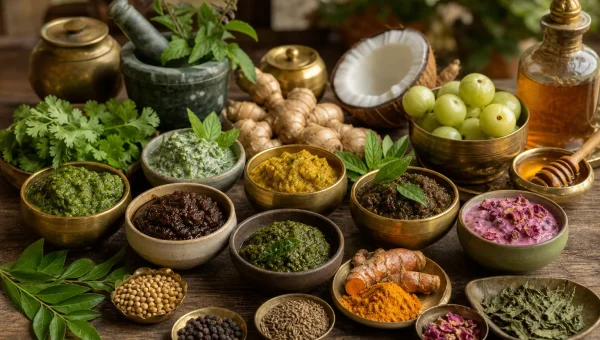
My grandmother never measured anything. She would hold a handful of dried herbs under her nose, inhale deeply, and know exactly how much to add to the pot. The kitchen would fill with a sharp, complex aroma as the decoction reduced, and by the time it was poured into a steel tumbler, the household already understood what was being prepared: kashayam, one of Ayurveda’s most practical and time-tested ways of drawing medicinal strength from herbs into water.
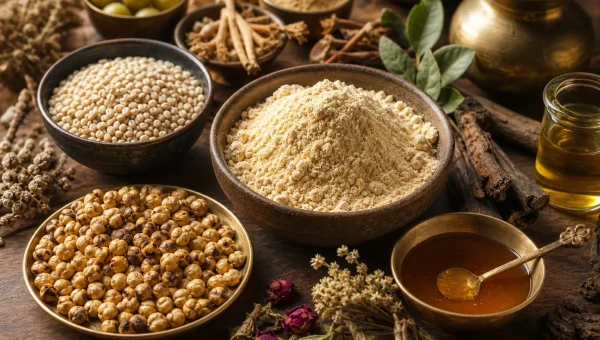
Kashayam, also written as kwatha, kvatha, kasaya, niryūha, or srta in different transliterations, is an aqueous herbal decoction made by boiling cleaned, coarse herbal material in water and reducing it. In Ayurvedic pharmacy, kwatha curna refers to herbs processed into coarse yavakuta powder so they can be boiled for a decoction, rather than used as a fine powder or quick tea.
Why Kashayam Is Different from Tea
A tea or infusion is usually prepared by steeping herbs in hot water, while kashayam is simmered and reduced. Traditional pharmaceutics gives different water ratios according to the hardness, heaviness, and nature of the plant material; a widely used home standard is one part coarse herb to sixteen parts water, reduced slowly to about one-quarter of the starting water unless a specific formula or practitioner gives a different instruction.
This reduction makes kashayam a measured preparation, not a casual beverage. Bitter, pungent, astringent, heating, cooling, scraping, nourishing, or drying herbs become more concentrated in decoction form, so the right formula, dose, timing, and person matter. For digestive applications, kashayam is one of the practical tools within the broader Ayurvedic framework of agni and digestive health.
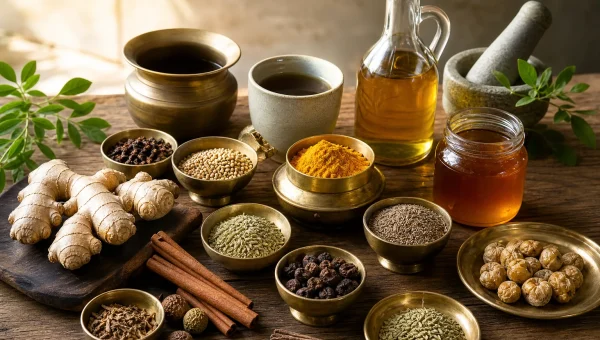
Essential Equipment for Home Kashayam Preparation
Good kashayam begins with clean raw material and a steady, low simmer. Coarse herbs strain better and match the classical pharmacy method more closely than fine powders, while a clean vessel and accurate measuring help keep each batch consistent.
- A clean stainless steel or traditional earthen pot
- Coarsely crushed dried herbs or authenticated kwatha curna
- A kitchen scale or measuring spoon reserved for herbs
- A fine-mesh strainer or clean muslin cloth
- A glass or steel cup for the finished decoction
- Clean potable water
The Standard Home Preparation Ratio
The following table gives a practical household method for learning the technique. It is not a replacement for formula-specific directions; some classical preparations reduce to a different fraction, include a post-boiling additive called praksepa, or require individualized dosing.
| Parameter | Home Standard | Practical Example |
|---|---|---|
| Herb texture | Coarse, not fine powder | Yavakuta-style crushed herbs |
| Herb to water | 1:16 | 10 g herbs with 160 ml water |
| Reduction | To about one-quarter, unless specified otherwise | 160 ml reduced to about 40 ml |
| Heat | Low, steady simmer | Uncovered or lightly open, watched carefully |
| Straining | While warm | Through muslin or fine mesh |
| Use | Fresh preparation preferred | Prepare small daily batches when possible |
12 Classical Kashayam Recipes for Home Use
The formulas below are named decoctions from Ayurvedic formularies and classical practice. For multi-herb preparations, the safest home approach is to buy authenticated coarse kwatha curna from a reliable source rather than trying to identify and collect every raw drug independently.
1. Amritottara Kashayam
Herbs: Guduchi stem, dry ginger, and Haritaki fruit in the traditional 6:2:4 proportion. This compact formula is traditionally used in chronic and mixed-fever patterns where digestion and metabolic clarity also need support.
2. Dashamoola Kashayam
Herbs: Shalaparni, Prishniparni, Brihati, Kantakari, Gokshura, Bilva, Agnimantha, Shyonaka, Gambhari, and Patala. This ten-root decoction is traditionally used for Vata-associated pain patterns, fever, breathing difficulty, and Kapha-type cough.
3. Dashamoola-Katutraya Kashayam
Herbs: Dashamoola combined with Shunthi, Maricha, Pippali, and Vasa. This is a more pungent respiratory and Vata-oriented version of Dashamoola, traditionally used for cough, breathlessness, Vata disorders, lower-back pain, sacral pain, and head pain.
4. Dashamoola-Panchakoladi Kashayam
Herbs: Dashamoola combined with Panchakola, Triphala, Danti, and Trivrit. This is a strong abdominal and digestive formula traditionally used in abdominal disease and fluid-accumulation patterns; because it contains forceful herbs such as Danti and Trivrit, it belongs under practitioner guidance rather than casual self-use.
5. Pachanamrita Kashayam
Herbs: Guduchi, Ushira, Patha, Musta, Shunthi, Bhunimba or Kiratatikta, Hrivera, Parpata, Dhanyaka, and Dhanvayasa. This formula is traditionally used for ama-jvara, a fever pattern associated with indigestion and metabolic heaviness.
6. Punarnavashtaka Kashayam
Herbs: Punarnava, Nimba bark, Patola leaf, Shunthi, Katuka, Guduchi, Devadaru, and Haritaki. This formula is traditionally used for swelling, ascites-type fluid accumulation, cough, dyspnea, and abdominal colic patterns.
7. Nimbadi Kashayam
Herbs: Nimba bark, Shunthi, Guduchi, Devadaru, Shati, Bhunimba, Pushkara, Pippali, Gajapippali, and Brihati. This bitter and pungent formula is traditionally used for Kapha-dominant fever patterns.
8. Patoladi Kashayam
Herbs: Patola leaf, Katurohini or Katuka, white sandalwood, Murva, Guduchi, and Patha. This formula is traditionally used for anorexia or tastelessness, vomiting, fever, jaundice, Kapha-Pitta skin disorders, and toxic states.
9. Panchatikta Kashayam
Herbs: Kantakari, Guduchi, Shunthi, Pushkara root, and Kiratatikta. As its name suggests, this is a five-bitter decoction traditionally used in fever patterns where bitter, light, and clearing herbs are appropriate.
10. Rasnadi Kashayam
Herbs: Rasna with a larger group of Vata-focused herbs including Dashamoola, Devadaru, Chitraka, Gokshura, Ashwagandha, Guduchi, and others in the classical formulation. It is traditionally used for amavata and Vata disorders, especially when stiffness, heaviness, and pain are prominent.
11. Vasa-Guduchyadi Kashayam
Herbs: Vasa root, Guduchi, Haritaki, Bibhitaki, Amalaki, Katuki, Bhunimba, and Nimba. This formula is traditionally used for anemia-type patterns, bleeding disorders, and jaundice-type conditions in Ayurvedic classification.
12. Shadanga Kashayam
Herbs: Musta, white sandalwood, Shunthi, Hrivera, Parpata, and Ushira. This six-ingredient decoction is traditionally used for thirst and fever, and is one of the simpler classical formulas for learning the rhythm of decoction preparation.
Dosage and Timing Reference
Classical formulary doses often refer to the amount of coarse kwatha curna used for preparing the decoction, while the finished liquid dose depends on the formula, strength, constitution, age, digestive capacity, and clinical purpose. The table below gives practical orientation only; chronic or serious conditions require individualized guidance.
| Kashayam | Traditional Direction | Home Note |
|---|---|---|
| Amritottara | Fever patterns with digestive involvement | Simple three-herb formula; suitable for learning preparation under guidance |
| Dashamoola | Vata pain, fever, cough, breathing difficulty | Commonly purchased as prepared kwatha curna |
| Dashamoola-Katutraya | Cough, breathlessness, Vata disorders | Hotter and more pungent than plain Dashamoola |
| Dashamoola-Panchakoladi | Abdominal and fluid-accumulation patterns | Practitioner use because it contains stronger herbs |
| Pachanamrita | Ama-jvara | Used when fever and indigestion are assessed together |
| Punarnavashtaka | Swelling, ascites-type patterns, cough, dyspnea | Not a substitute for medical evaluation of edema or breathlessness |
| Nimbadi | Kapha fever | Bitter, drying, and not for casual daily use |
| Patoladi | Fever, jaundice, vomiting, Kapha-Pitta skin disorders | Use only with a proper assessment of Pitta and digestive strength |
| Panchatikta | Fever patterns | Very bitter; dose and timing should be individualized |
| Rasnadi | Amavata and Vata disorders | Best chosen after practitioner assessment of Ama and Vata |
| Vasa-Guduchyadi | Pandu, Raktapitta, Kamala patterns | Do not self-treat anemia, bleeding, or jaundice |
| Shadanga | Thirst and fever | Simple six-herb formula; prepare fresh |
Common Mistakes in Home Preparation
Most preparation errors come from treating kashayam like ordinary tea. A decoction is a pharmacy-style preparation, so texture, water quantity, reduction, straining, freshness, and dose all matter.
- Using fine powder instead of coarse herbs: Fine powder is harder to strain and does not match the usual kwatha curna method. Use coarsely crushed herbs.
- Boiling aggressively: A low simmer gives better control over reduction and prevents the decoction from becoming unnecessarily harsh or burnt.
- Ignoring the specified formula: Some decoctions use a general reduction method, while others have their own instructions, additives, or cautions.
- Making large batches: Fresh kashayam is preferred. Prepare small quantities and avoid repeatedly reheating old decoction.
- Self-prescribing strong formulas: Bitter, pungent, purgative, heating, or scraping formulas should be chosen according to constitution, disease state, season, age, and digestive strength.
Safety and Disclaimer
Kashayam are concentrated herbal preparations and should not be treated as casual drinks. Formulas containing strong herbs such as Chitraka, Danti, Trivrit, Katuka, Nimba, Pippali, Maricha, or multiple bitter and pungent ingredients should be used only with appropriate guidance, especially during pregnancy, lactation, childhood, active ulcers, bleeding disorders, liver or kidney disease, chronic illness, or when taking prescription medicines. Always consult a qualified Ayurvedic practitioner or healthcare provider for chronic symptoms, serious disease, unclear diagnosis, or ongoing medication use. This article is for educational purposes only and does not constitute medical advice.
Actionable Tip: For your first kashayam practice session, choose a simple authenticated formula such as Amritottara or Shadanga, make a one-day batch with coarse herbs, measure the starting water, simmer gently, strain warm, and record the final volume. Consistency and correct selection are more important than making the decoction extremely strong.

Your grandmother measuring by nose rather than by weight is the most accurate description of traditional cooking skill I’ve ever read in a clinical context. The deep sensory expertise behind Kashayam preparation is exactly what’s lost when people try to replicate it from written formulas alone.
What’s the reduction ratio for a standard Kashayam? I’ve seen references to reducing from 8 parts water to 2 parts Kashayam in some sources and 16 to 4 in others. Is there a standard classical ratio or does it vary by formula?
the bitterness of Kashayams is genuinely challenging initially. is palatability a consideration or is bitterness itself part of the therapeutic function?
The boiling-down concentration step is where most amateur preparations fail. People either under-reduce and get weak preparations or go too far and get bitter, degraded formulations. More detail on how to gauge the endpoint would make this guide more practically useful.
storage conditions for a 2-day batch room temperature vs refrigeration, and does refrigeration affect the active compounds? 🙌
I’ve been making a simple ginger-licorice-cinnamon Kashayam during winter for three years and the frequency of colds I catch compared to my colleagues is noticeably different. The preparation process itself is also meditative in a way that supports the therapeutic effect.
found this post helpful. will try the suggested approach. (ref 1920-51)
Can Kashayam be prepared in batch and stored, or is it specifically a fresh-daily preparation? I live alone and making individual batches daily isn’t practical.
Good reminder on The to Making Kashayam at Home. I would still ask a practitioner before changing medicines.
The Panchakola Kashayam recipe is the one I make most regularly for digestion. But I always wondered if the order of adding herbs matters or if it’s just a simultaneous cold soak approach.
The story about the grandmother eyeballing herbs really resonated.
I taught a cooking workshop where I included Kashayam preparation and the participants who took it home and used it consistently for a month came back with universally positive feedback. The practical barrier is low once someone has actually made one. The intimidation is mostly perception.
The respiratory Kashayam has kept my chronic cough manageable through winter for the past two years. I was on Montelukast before and wanted off it. Not saying the herb replaced the medication, I did both for a while, but the Kashayam is what I continue with now.
I tried the Tulsi Kashayam recipe last weekend and noticed my throat felt less scratchy.
i found the taste of most Kashayams genuinely challenging initially. is there a palatability consideration or is bitterness itself part of the therapeutic function?
One thing that stood out was the emphasis on using coarsely crushed herbs instead of powder.
The description of 12 classical formulas with their specific indications is something I’ve been looking for in a single reference. Most Kashayam guides either cover too few formulas or don’t explain the indication logic for each.
storage conditions for a 2-day batch room temperature vs refrigeration, and does refrigeration affect the active compounds?
The section on Varanadi Kashayam caught my eye because of the cytokine study mentioned.
the boiling-down step is where most amateur preparations fail. more detail on how to gauge the endpoint would help 🌿
@Kavita the boiling-down step is where most amateur preparations fail. more detail on how to gauge the endpoint would help
❤️ The boiling-down step is where most amateur preparations fail. more detail on how to gauge the endpoint would help
Ginger licorice cinnamon Kashayam through winter for 3 years. frequency of colds noticeably different from colleagues who don’t do this
What are the storage conditions if you do prepare a 2-day batch? Room temperature versus refrigeration, and does refrigeration affect the active compounds?
can be prepared in batch and stored or is this specifically a fresh-daily preparation? I live alone and daily batching isn’t practical
Panchakola Kashayam for digestion regularly but always wondered if order of adding herbs matters or if it’s a simultaneous cold soak approach
🙌 reduction ratio: 8 parts water to 2 parts Kashayam? or 16 to 4? different sources say different things and I want the classical standard
I was looking for a plain explanation of The to Making Kashayam at Home. The safety notes could be expanded a little.
@Maria ❤️ grandmother measuring by nose rather than weight is the most accurate description of traditional cooking skill in a clinical context
Grandmother measuring by nose rather than weight is the most accurate description of traditional cooking skill in a clinical context
Noted!
Kashayam banane ki koshish kar chuka hoon lekin sahi ratio nahi pata tha toh result uneven raha. Yeh guide dekh kar laga ki ek proper reference tha jo miss ho raha tha. Kya in 12 decoctions mein koi asa bhi hai jo liver support ke liye traditionally use hota ho? Woh mujhe personally sabse zyada dhundhna hai.
It’s interesting how the 1:16 ratio translates to about 40 ml of final decoction.
Reduction ratio: 8 parts water to 2 parts Kashayam? or 16 to 4? different sources say different things and I want the classical standard
grandmother measuring by nose rather than weight is the most accurate description of traditional cooking skill in a clinical context ठीक है
Storage conditions for a 2-day batch room temperature vs refrigeration, and does refrigeration affect the active compounds? ठीक है
grandmother measuring by nose rather than weight is the most accurate description of traditional cooking skill in a clinical context नमस्ते
Just a heads on that storing Kashayam beyond two days might lose potency.
💯 reduction ratio: 8 parts water to 2 parts Kashayam? or 16 to 4? different sources say different things and I want the classical standard
Reduction ratio: 8 parts water to 2 parts Kashayam? or 16 to 4? different sources say different things and I want the classical standard नमस्ते
Reduction ratio: 8 parts water to 2 parts Kashayam? or 16 to 4? different sources say different things and I want the classical standard 🙌
found this post helpful. will try the suggested approach. (ref 1920-21)
My only hesitation is about using Chitraka without professional guidance.
grandmother measuring by nose rather than weight is the most accurate description of traditional cooking skill in a clinical context 🙏
found this post helpful. will try the suggested approach. (ref 1920-23)
ginger licorice cinnamon Kashayam through winter for 3 years. frequency of colds noticeably different from colleagues who dont do this
I’ve been intimidated by making Kashayam at home because I assumed the ratios were too precise to get right without training. The description of the grandmother measuring by handful and smell actually makes it feel more approachable. Is there a meaningful difference in potency between using whole dried herbs versus the pre-ground powders that are easier to find in regular Indian grocery stores?
ginger licorice cinnamon Kashayam through winter for 3 years. frequency of colds noticeably different from colleagues who dont do this ठीक है
found this post helpful. will try the suggested approach. (ref 1920-26)
The tip to add honey after cooling below 40 °C seems practical for taste.
🌿 ginger licorice cinnamon Kashayam through winter for 3 years. frequency of colds noticeably different from colleagues who dont do this
Good reminder on The to Making Kashayam at Home. I would like to know how long to try it before judging results.
storage conditions for a 2-day batch room temperature vs refrigeration, and does refrigeration affect the active compounds? 💯
Reduction ratio: 8 parts water to 2 parts Kashayam? or 16 to 4? different sources say different things and I want the classical standard ठीक है
Reading about the aroma filling the kitchen made me want to try a batch myself.
Ginger licorice cinnamon Kashayam through winter for 3 years. frequency of colds noticeably different from colleagues who don’t do this 💯
The image of measuring by smell rather than by weight is something I recognize from my own grandmother’s kitchen, though I never thought to understand what she was doing in any systematic way. She just knew. Now I’m trying to reconstruct those recipes as an adult without that knowledge in my hands. Do the 12 decoctions in this guide include anything typically used for respiratory issues? That’s what I remember her making most often when anyone in the family was unwell.
found this post helpful. will try the suggested approach. (ref 1920-33)
I appreciate the clear dosage table; it takes the guesswork out of preparation.
found this post helpful. will try the suggested approach. (ref 1920-34)
found this post helpful. will try the suggested approach. (ref 1920-35)
✨ grandmother measuring by nose rather than weight is the most accurate description of traditional cooking skill in a clinical context
found this post helpful. will try the suggested approach. (ref 1920-37)
found this post helpful. will try the suggested approach. (ref 1920-38)
grandmother measuring by nose rather than weight is the most accurate description of traditional cooking skill in a clinical context 🌿
🙏 grandmother measuring by nose rather than weight is the most accurate description of traditional cooking skill in a clinical context
ginger licorice cinnamon Kashayam through winter for 3 years. frequency of colds noticeably different from colleagues who don’t do this ठीक है
found this post helpful. will try the suggested approach. (ref 1920-42)
found this post helpful. will try the suggested approach. (ref 1920-43)
found this post helpful. will try the suggested approach. (ref 1920-44)
Grandmother measuring by nose rather than weight is the most accurate description of traditional cooking skill in a clinical context 🙌
found this post helpful. will try the suggested approach. (ref 1920-46)
✨ ginger licorice cinnamon Kashayam through winter for 3 years. frequency of colds noticeably different from colleagues who don’t do this
found this post helpful. will try the suggested approach. (ref 1920-48)
storage conditions for a 2-day batch room temperature vs refrigeration, and does refrigeration affect the active compounds? 🙏
reduction ratio: 8 parts water to 2 parts Kashayam? or 16 to 4? different sources say different things and I want the classical standard ❤️
💯 grandmother measuring by nose rather than weight is the most accurate description of traditional cooking skill in a clinical context
reduction ratio: 8 parts water to 2 parts Kashayam? or 16 to 4? different sources say different things and I want the classical standard ✨
found this post helpful. will try the suggested approach. (ref 1920-54)
found this post helpful. will try the suggested approach. (ref 1920-55)
storage conditions for a 2-day batch room temperature vs refrigeration, and does refrigeration affect the active compounds? ✨
🙏 Reduction ratio: 8 parts water to 2 parts Kashayam? or 16 to 4? different sources say different things and I want the classical standard
found this post helpful. will try the suggested approach. (ref 1920-58)
found this post helpful. will try the suggested approach. (ref 1920-60)