
Cold-weather joint pain is one of the most predictable winter patterns in Ayurveda. Many people who move comfortably in warmer months wake in winter with stiff knees, tight fingers, aching hips, or a feeling that the joints need a long time to “warm up.” The most useful approach is not to wait until the pain is severe; it is to begin a Vata-balancing winter routine as soon as cold, dry weather sets in.
Why Cold Mornings Are the Worst for Joints
Cold mornings commonly feel harder on stiff joints because low temperature can increase stiffness in joint and periarticular tissues, and synovial fluid is a naturally viscous lubricant whose movement is influenced by physical conditions around the joint. After several hours of sleep, the joint has also been relatively still, so circulation, warmth, and lubrication improve only after gentle movement begins.
In modern musculoskeletal care, heat is often used for stiff, achy joints and muscles because warmth can relax tight tissues and make movement easier. This matches the Ayurvedic logic of using warmth, oiliness, and gentle mobilization against cold, dry, stiff, and rough qualities.
The Ayurvedic View: Winter, Vata, and Joint Stiffness
Classical Ayurveda describes Hemanta and Shishira as cold seasons requiring protective food and lifestyle. Charaka Samhita states that in Hemanta, cold wind strengthens digestive fire in healthy people, but if the body is not properly nourished, Vata can become aggravated by the cold. The same chapter recommends warm water, fats and oils, abhyanga, fomentation, sun exposure, warm rooms, and protection from wind during winter.
Vata has an important relationship with bones, lower limbs, movement, dryness, pain, stiffness, and cracking sensations. Classical descriptions of aggravated Vata include stiffness, pain in bones, roughness, reduced strength, tremors, and disturbed sleep. For Vata disorders, Charaka gives snehana and swedana—oleation and sudation—as central measures, and specifically describes internal and external oleation for disorders involving bone and marrow.
When winter stiffness is accompanied by heaviness, coating on the tongue, low appetite, swelling, or sluggish digestion, Ayurveda also considers an Ama-Kapha component. In that pattern, heavy cold foods, cold leftovers, and inactivity can worsen the feeling of congestion and heaviness around the joints. The protocol still uses warmth, but it must be lighter, more digestive, and guided by the person’s constitution and current symptoms.
The Winter Joint Protocol: Daily Prevention
A winter joint routine should be simple enough to repeat. The foundation is warm oil, gentle movement, warm bathing, freshly cooked food, and protection from cold wind. The routine below is not a substitute for diagnosis or medical care, but it is a practical Ayurvedic prevention framework for people who tend to become stiff in cold weather.
Step 1: Warm Oil Abhyanga on Major Joints
Warm a small quantity of oil by placing the bottle or bowl in hot water. Apply it to the knees, hips, shoulders, wrists, ankles, low back, and any joint that becomes stiff in winter. Massage slowly in circular movements around the joint and longer strokes along the muscles above and below the joint. Leave the oil on for 15-20 minutes, then bathe with warm water.
For a basic home routine, plain Tila Taila (sesame oil) is a traditional choice because Ayurveda uses oiliness and warmth to oppose Vata’s cold, dry, rough qualities. For people with established joint disease, medicated oils such as Mahanarayana Taila or Narayana Taila are better selected by a qualified practitioner, especially when pain is chronic, severe, or associated with swelling.
Avoid strong massage over a hot, red, acutely swollen, injured, infected, or undiagnosed joint. In those cases, seek medical assessment before applying heat or medicated oils.
Step 2: Match Guggulu Formulations to the Pattern
Guggulu is an official Ayurvedic drug prepared from the purified oleo-gum resin of Commiphora wightii, traditionally used in many classical formulations. In joint care, the formulation matters more than the herb name alone, because Vata, Pitta, Kapha, Ama, swelling, warmth, dryness, stiffness, and digestion all change the choice.
| Presentation | Common Ayurvedic Direction | Clinical Note |
|---|---|---|
| Cold, cracking, dry, stiff joints | Vata-pacifying oleation, warmth, and formulations such as Yogaraja Guggulu when appropriate | Best assessed when stiffness is worse in cold weather and improves with warmth |
| Warm, tender, inflamed, irritated joints | Pitta-aware care; avoid excessive heating and use practitioner-selected formulations such as Kaishora Guggulu only when suitable | Heat, strong spices, and aggressive massage may worsen this pattern |
| Heavy, swollen, sluggish joints with water retention | Kapha-Ama assessment, digestive support, lightening diet, and practitioner-selected formulations | Swelling requires proper evaluation, especially if sudden, painful, or one-sided |
Do not self-prescribe Guggulu formulations if you take thyroid medicine, anticoagulants, antiplatelet drugs, heart medicines, lipid-lowering drugs, hormone-related medicines, or immunosuppressive medicines. Guggulu products also vary in quality, purification, ingredients, and strength, so use licensed products under professional guidance.
Step 3: Use Dashamoola for Vata Support
Dashamoola means “ten roots.” It brings together the five larger roots—Bilva, Agnimantha, Shyonaka, Patala, and Gambhari—and the five smaller roots—Shalaparni, Prishniparni, Brihati, Kantakari, and Gokshura. It is widely used in Ayurveda as a Vata-supporting group, especially where pain, stiffness, lower-body discomfort, or post-exertion soreness is part of the picture.
Dashamoola is commonly prepared as a kwatha by simmering coarse herbs in water and reducing the liquid, or used as classical fermented preparations such as Dashamoolarishta when appropriate. Because dose, preparation strength, digestive capacity, and medical context matter, internal use should be individualized by a qualified Ayurvedic practitioner.
When Joints Are Already Flaring: Pinda Sweda
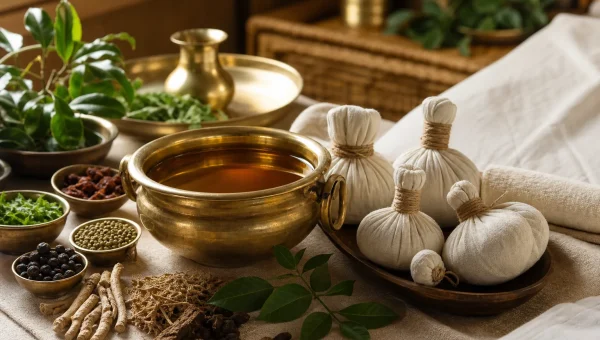
When winter stiffness has already become painful and limiting, supervised Swedana can be useful. Pinda Sweda is a bolus fomentation method in which warm herbal or grain boluses are applied over the body or affected region after suitable oiling. The purpose is to bring warmth, softness, and mobility to tissues that have become cold, stiff, and resistant to movement.
Shashtika Shali Pinda Sweda, often associated with cooked rice boluses used with milk and herbal decoctions, is classically understood as a nourishing form of sudation. Patra Pinda Sweda uses herbal leaves, and Nirgundi leaf-based bolus fomentation has been used in Ayurvedic clinical settings for Sandhigata Vata, a condition often compared with osteoarthritis. These therapies should be performed by trained practitioners, not improvised at home during acute inflammation.
A Simpler Home Alternative
For mild cold stiffness without redness, heat, acute swelling, fever, injury, or severe pain, use a warm towel, hot-water bag, or heating pad over the stiff area for up to 15-20 minutes. The heat should feel comfortable, never burning. Follow with a few minutes of gentle range-of-motion movement. If the joint is hot, sharply painful, newly swollen, or worse after heat, stop and seek medical advice.
Supporting Practices That Matter
The daily routine works best when the rest of the day does not keep aggravating the same cold and dry pattern. Winter joint care is not only an oil massage; it is a seasonal way of eating, moving, bathing, sleeping, and protecting the body from wind and chill.
- Sip warm water. Charaka includes warm water in the Hemanta regimen, and warm sipping is a simple way to support comfort in cold weather.
- Move gently before demanding work. Use slow joint rotations, short walks, or a mild joint-mobility yoga routine before heavier activity.
- Eat warm, freshly cooked meals. Soups, stews, cooked grains, mung dal, rasam, and moong dal khichdi are more seasonally appropriate than cold leftovers.
- Use spices according to tolerance. Dry ginger, black pepper, cumin, ajwain, and turmeric can support a warm digestive pattern, but people with acidity, ulcers, bleeding tendency, or Pitta aggravation should not overuse heating spices.
- Protect the joints from wind. Keep knees, feet, ears, neck, and low back covered in the early morning and evening.
- Sleep enough, but avoid long daytime sleep if heaviness dominates. Rest supports Vata, while excessive inactivity can worsen Kapha-type heaviness and stiffness.
Herb-Drug Interactions and Safety
Guggulu may interact with thyroid hormone therapy and medicines that affect blood clotting, and it may influence the handling of some cardiovascular and lipid-related medicines. Ashwagandha may not be suitable for everyone, especially people who are pregnant, breastfeeding, taking sedatives, using thyroid medication, managing autoimmune conditions, or taking immunosuppressive drugs. Internal herbal protocols should be reviewed by a qualified clinician when prescription medicines are involved.
People with rheumatoid arthritis, gout, fever with joint swelling, sudden one-sided swelling, recent injury, severe morning stiffness, unexplained weight loss, numbness, weakness, or deformity should seek medical assessment instead of treating the condition as ordinary winter stiffness. Ayurvedic measures can complement appropriate care, but they should not delay diagnosis.
Building Your Winter Joint Toolkit
Prepare before the temperature drops. A practical winter kit can include good-quality sesame oil or a practitioner-recommended medicated oil, a hot-water bag or heating pad, a thermos for warm water, simple ingredients for freshly cooked meals, and any prescribed Ayurvedic formulations chosen for your constitution and condition.
Winter joint pain is predictable, which means prevention can start early. Begin warm oiling, gentle movement, warm food, and wind protection when cold mornings first appear—not after the joints become painful enough to interrupt daily life.
Consult a qualified Ayurvedic practitioner or healthcare provider before beginning any new herbal protocol, especially if you have a diagnosed joint disease, are pregnant, have chronic illness, or take prescription medications.
References
- Amjmed (amjmed.com)
- Associations between weather conditions and osteoarthritis pain: a systematic review and meta-analysis (2023), PubMed
- Come rain or shine: Is weather a risk factor for musculoskeletal pain? A systematic review with meta-analysis of case-crossover studies (2024), PubMed
- Hyaluronan and synovial joint: function, distribution and healing (2013), PubMed Central
- Mayoclinic (mayoclinic.org)
- Mayoclinic (mayoclinic.org)
- NHS
- Charaka Samhita — Tasyashiteeya Adhyaya
- Charaka Samhita — Vata dosha
- Charaka Samhita — Vatavyadhi Chikitsa
- Charaka Samhita — Ama
- Ayurvedic Pharmacopoeia of India
- Ayurvedic Pharmacopoeia of India
- CCRAS
- Scribd (scribd.com)
- Aiimsjodhpur (aiimsjodhpur.edu.in)
- CCRAS
- Evaluation of Yograj Guggulu, Ashwagandha Churna and Narayana Taila in management of Osteoarthritis Knee: A study in tribal dominant community (2025), PubMed
- NIH Office of Dietary Supplements
- Mskcc (mskcc.org)
- Webmd (webmd.com)
- NCBI
- Ayushdhara (ayushdhara.in)
- Navarakizhi and pinda sweda as muscle-nourishing Ayurveda procedures in hemiplegia: double-blind randomized comparative pilot clinical trial (2014), PubMed
- Clinical effect of Nirgundi Patra pinda sweda and Ashwagandhadi Guggulu Yoga in the management of Sandhigata Vata (Osteoarthritis) (2011), PubMed Central
- Anti-inflammatory and analgesic activities of mature fresh leaves of Vitex negundo (2003), PubMed
The synovial fluid viscosity increase with cold temperature this is exactly why my arthritic knee protests from 6am to 10am in November and is fine by noon. The physiological explanation makes the experience coherent in a way my rheumatologist never explained.
The traditional context helps understand why it’s done this way. Not just ‘eat this herb’
The pre-winter protocol starting the oil application and dietary changes before November rather than waiting for symptoms is the most useful single piece of advice here. I started in late September this past year. First winter in 6 years without a flare by December.
Interesting perspective here.
The point about Asthi Dhatu being Vata’s primary seat explains why bone and joint problems flare specifically in winter rather than persisting evenly year round. The seasonal framing changes how you approach prevention.
My knees have been bad every winter for years and I never connected it to Vata until reading this. The bit about synovial fluid thickening in cold air actually explains something I had noticed but never understood.
The Dashmool oil application sequence before bath how early before bath is ideal?
The Dashamoola Kwatha preparation steps are a good example of the practical detail this article gets right. The 2 cups reducing to half a cup ratio is specific enough to actually follow without guessing.
The 15 minutes of oil absorption time before showering is the step I always skip. Never thought about the difference between oil sitting on the surface versus actually penetrating the tissue with time to absorb.
The vasoconstriction part was new to me too. Less blood flow to the joint capsule while the synovial fluid inside is already thicker is basically a double problem hitting at once on cold mornings.
Same pattern every winter here. The Asthi Dhatu connection makes it make more sense. Vata’s seat being in the bones means that tissue is most exposed when Vata aggravation peaks during the cold season.
The Vishagarbha taila for deep joint penetration my mother’s vaidya has used this for her knee arthritis for years. She calls it her ‘winter oil’ and hasn’t needed her NSAID prescription in the last 2 winters.
Sorry off-topic but anyone here used Ayurveda for hair fall? Would love recommendations ❤️
What’s the typical duration of the treatment before reassessing?
Bookmarked for future reference.
@Ritu Good article on this subject. #90
The boswellia + guggulu combination for winter joints same protocol as general inflammation?
Is the morning stiffness pattern related to cold weather or to inactivity during sleep? These are different mechanisms and the treatment might differ. The article conflates them in a way that’s confusing.
The article actually addresses both mechanisms. The Ama settling in joint spaces overnight is the immobility part, and cold air thickening the synovial fluid is the temperature part. Both happen simultaneously in winter, which is why cold mornings are worse than cold afternoons.
The diet modification for winter joints reducing Vata foods, increasing sesame and ghee takes about 2 weeks to produce noticeable change in my experience. First week feels like nothing is working, but by day 10 the morning stiffness starts improving.
That matches what I have seen. Stiffness usually shows improvement before the pain pattern shifts, so the first two weeks can feel like nothing is changing when something actually is.
What about exercise in cold weather? I run year round and in winter my joint pain is worst after outdoor runs on cold mornings. The article doesn’t address how to modify exercise habits for Vata aggravation risk.
The gentle movement before oil application is the relevant suggestion here. Low-impact warmup before any weight-bearing activity is the underlying logic. Running on cold stiff joints without any warmup increases Vata strain regardless of the season.
Four to six weeks is a realistic expectation for the Guggulu to work. Most people quit herbal protocols after two weeks and conclude they do not work. Glad the article states this upfront.
Right, the 4-6 week timeline for Guggulu alone rules out any quick-fix expectation. People who stay consistent through November usually feel the difference by December rather than waiting until they are already in a bad flare.
I have fibromyalgia and the cold weather exacerbation is extreme. The Vata depletion and cold accumulation framework describes my winter experience well. Going to ask my Ayurvedic practitioner specifically about the cold weather fibro protocol.
Starting the oil massage before temperatures actually drop sounds obvious in hindsight but I always waited until my joints were already hurting. Going to try beginning in October this year instead of January.
October timing makes sense based on this article since Hemanta, early winter, is when Vata aggravation begins. Waiting until January is basically waiting until peak damage is already done before doing anything about it.
I tried a similar approach last year but without the specific sequencing. Wonder if that’s why it didn’t work
Will try
The section on dosage was the most practically useful for me
The Guggulu dosage table breaking it down by presentation type is the clearest part. Most articles just say take Guggulu without specifying which formulation for which pattern of pain.
Thanks!
Would love a follow-up article going deeper on the herb preparation methods
Completely new to Ayurveda here. The explanation of Vata aggravation and cold weather actually made sense to me without any background in it. The connection between cold air and joint stiffness is something I feel every November but never had a framework for.
Same here
Does this apply to children or only adults?
@Nicole Following this protocol now.
Are there clinical studies backing the specific herb combination you mentioned?
My knee pain spikes every December regardless of activity level. Vata in joints seems right
Does swimming in heated pools count as Vata-aggravating in winter or is it protective?
Good information on this topic.
The 6 AM stiffness being tied to overnight immobility plus cold temperature together makes more sense than blaming either one alone. That is probably why the article says movement and warmth together give the fastest relief.
The connection between gut health and this condition is the angle most allopathic doctors miss
Is this suitable for elderly patients or does the dosage need adjustment?
Did this for 6 weeks exactly as described, going to update here with results
Useful and actionable.
The case study patient was 62 and medication-free with mild osteoarthritis, so there is at least one example in the article. For elderly patients managing multiple conditions or taking blood thinners the dosage question would probably need individual practitioner input.
Is there a version of the joint warm-up protocol for people who can’t do abhyanga due to skin sensitivity?
started this 3 weeks ago, too early to say but the process itself feels right
Not skeptical about Ayurveda generally but some claims here need stronger evidence
My doctor dismissed this as pseudoscience. Going to try it anyway and report back 🙏
tbh wasnt expecting much from this but the specifics are actually helpful
Good article on this subject. #55 🌿
Doing this
Been following Ayurveda for 5 years and this article still taught me something new ठीक है
Is the morning or evening timing more important for this protocol overall?
Can this be combined with modern medication or is it better standalone?
The contraindications section was important and often missing from similar articles नमस्ते
Agreed, and the interaction note about thyroid medications is the one most people would miss. The assumption that herbal means safe to combine with anything is a real problem.
The seasonal variation angle is underused in most health content. Good to see it here
The Ayurvedic framing made this topic much easier to understand than the Western medical version
This explains something I’ve experienced but couldn’t name. Good validation
Anyone else tried this for longer than 6 months? Wondering about long-term effects
The article says Guggulu formulations need 4 to 6 weeks to show results, so 6 months of consistent use would likely have accumulated benefit. Long-term safety data on Yogaraja Guggulu specifically might be worth researching through an Ayurvedic practitioner directly.
Does Mahanarayan Taila work if you have sensitive skin?
Dashamoola Arishtam is the part I was glad to see. Most people will not prepare a decoction by boiling powder every single night. The fermented option is much easier to actually stick with long term.
The 15 to 20 ml dose with warm water after meals is easy to remember as well. No measuring powder or watching a pot on the stove. I understand why compliance with the Arishtam would be better long term.
How long typically before seeing results with this approach? ✨
The dosage range given is wide. Is there a way to determine where in the range I should start? ❤️
good info, sharing with my father who has been looking for something like this
I use Mahanarayana oil and the warmth effect is immediate. Hadn’t connected it to Vata principle before
The rock salt poultice at home is something I can do tonight without sourcing anything special. Was not expecting a remedy that simple in an article this detailed on clinical protocols.
I appreciate how specific the instructions are compared to most Ayurveda articles
Useful post
Agreed. The warm water with dry ginger throughout the day tip sounds minor but the circulation support for joint capsules in cold weather is real. Small habits like that add up across a whole winter.
Sipping warm water throughout the day is also one of those habits that does not require buying anything extra. A thermos and some dry ginger is all. Low barrier to start compared to the other steps in the protocol.
Where do you recommend sourcing the herbs mentioned here in India?
Shared this with my Ayurveda practitioner. She agreed with most points
The note about Guggulu interacting with warfarin is something I had not seen in other articles on joint care. Important to flag before people start combining tablets with prescription anticoagulants on their own.
Helpful article, thank you.
Tried this, results were good.
Will try this approach soon.
Thanks for the clear explanation.
This helped clarify my doubts.
The 58 percent reduction in knee pain over seven consecutive days of Pinda Sweda is a striking result. Would want to read the full Sharma et al. study but that outcome is hard to dismiss.
The 62-year-old patient example was the most convincing part for me. Morning stiffness dropping from 45 minutes to under 10 in three weeks is a real measurable change, not a marginal improvement.
The sesame oil study showing 35 percent pain reduction in knee osteoarthritis patients is worth noting. Sesame oil is easy to find and not expensive, and it is good to see a reference behind the recommendation.
The detail about stopping the fan while sleeping is something I did not expect to see in a joint protocol. That habit directly aggravating Vata is something elders in my family always mentioned but I never took seriously.
Is Mahanarayan Taila from Kottakkal significantly different from the Baidyanath version in practice? The article names both but I am not sure which to look for first if I can only find one locally.
Yogaraja Guggulu being the default starting point for most winter presentations is a useful shortcut. I have seen people get so stuck on which formulation to choose that they end up taking nothing at all.
25 minutes every morning sounds manageable when it is broken into steps. The 15-minute oil absorption time does most of the work while you are simply waiting before the shower.
Starting the protocol when temperatures drop in October rather than waiting until January is the main practical takeaway. Prevention before the season hits is the entire point of the winter framing.
Ashwagandha at bedtime with warm milk for Vata pacification connected specifically to joint recovery is useful to see. It appears in other contexts but the tissue nourishment angle for winter joints is a clear reason.
Glad the article specifically says Pinda Sweda should be done by a trained practitioner and not attempted at home. Some procedures get oversimplified online and people end up doing them incorrectly and getting no benefit.
The anti-Ama diet section is practical without being complicated. Warm freshly cooked food spiced with shunthi and turmeric every day is achievable without needing specialty ingredients.
The peripheral vasoconstriction explanation makes sense of why the joints themselves feel cold to the touch in winter, not just the skin around them. Targeting circulation with warm oil massage is the right response to that mechanism.
Charaka Samhita prescribing Snehana and Swedana for cold-weather Vata is about as established as it gets. The warm oil and sudation approach is not a new idea dressed up as modern discovery.
Agreed, and the fact that Snehana and Swedana come from Charaka Samhita rather than a recent patent means there is no commercial incentive driving the recommendation. That is actually reassuring.
The 10 minutes of gentle yoga before oil application to prepare the tissue is a detail worth noting. Trying to absorb oil into a completely cold and immobile joint is less effective than warming the area first.
Has anyone tried the Nirgundi essential oil addition for cracking joints specifically? The article mentions it for cold cracking presentations but I have not seen it sold widely outside Ayurvedic specialty shops.
The BMJ Open reference is helpful for people who need to show skeptical family members that cold weather pain is not imagined. A 20 percent increase in pain reports per 10 degree Celsius drop is a measurable figure.
The Kapha and Ama component being overlooked is a useful point. Most people frame winter joint pain purely as a Vata problem, but the overnight accumulation aspect is a genuinely different mechanism.
Did not realize there were three distinct Guggulu formulations for three different presentations. Punarnavadi for fluid-filled joints is not something I had come across before in other Ayurvedic joint articles.
Moong dal khichdi as a mandatory warm breakfast in winter is something my mother always insisted on and I never took seriously. Seeing it appear in an actual clinical protocol is changing my thinking on that.
The prevention framing is the most useful reframe here. Treating joint pain in January is harder than preventing it by starting in October. Most people I know do exactly the wrong thing in terms of timing.
The toolkit section at the end is worth saving. Getting Mahanarayan Taila and Yogaraja Guggulu before you need them is far better than trying to source them urgently when your knees are already hurting.
I tried the warm salt poultice last week and noticed my knee stiffness eased after a few evenings.
Warm water with dry ginger all day is a habit I already have but never connected to joint health specifically. The circulation support for joint capsules in cold weather is a clear reason to keep it up.
Kaishor Guggulu for warm swollen joints is the one I would have reached for without reading this carefully. The distinction between cold stiffness and warm inflammation is important because they point to different formulations.
The 7-8 hours sleep note with the warning against daytime sleeping in winter is specific. Kapha increasing from excessive sleep being connected to joint heaviness is not something most people would put together.
The reduced blood flow to joint capsules in cold weather explains why warming up is not just about comfort. The tissue is actually receiving less circulation, which is why the oil massage and warmth work together.
Navara rice or Bala leaves wrapped in muslin and dipped in warm medicated milk is unlike anything in standard treatment approaches. The combination of moist heat, herbal compounds, and mechanical pressure addressing three aspects at once is the interesting design.
Seven consecutive days of Pinda Sweda for 58 percent pain reduction and 40 percent range of motion improvement is specific enough to look up. Was the Sharma 2012 study published in a journal or as an institutional report from the Jaipur hospital?
The sleeping-with-a-fan habit was a small detail but it stuck with me. That seems like a very common thing people do in warm climates year round without realizing it works against everything else in a Vata winter protocol.
Sesame oil being a usable substitute when Mahanarayan Taila is unavailable is reassuring. It is much easier to find locally and the Nasiri et al. study gives enough confidence that it is not just a fallback with no support.
Snehana and Swedana as first-line interventions in Charaka Samhita is interesting because modern approaches typically reach for anti-inflammatories first. The Ayurvedic response works with temperature and tissue circulation rather than suppressing the inflammatory signal.
The 25-minute protocol works if you have that time before your day starts, but doing knees, hips, shoulders, wrists, and ankles at 3-4 minutes each adds up to close to 20 minutes of massage alone before the absorption wait.
What makes this article useful is that it explains why cold weather specifically worsens joint pain rather than just listing remedies. Understanding the synovial fluid viscosity and circulation mechanisms makes the treatment choices follow logically.
Twenty-five minutes in the morning sounds manageable once you actually map it out. The oil absorption time is when I do slow movements anyway, so it fits into a routine without much effort.
Is Mahanarayan Taila available at regular pharmacies or do you need to go to an Ayurvedic specialty store? I have not seen it locally and was wondering before trying to source it.
The part about not being able to make a fist until noon hit close to home. That is exactly my experience every November and I never had a name for what was happening.
The 20 percent increase in joint pain for every 10 degree Celsius drop in temperature is a striking number. I knew cold made things worse but did not realize the relationship was that measurable.
I am a bit skeptical that stopping a fan at night would have a meaningful effect on knee stiffness. Is that really enough of a temperature change to affect Vata significantly?
Fifty-eight percent reduction in knee pain over 7 days of Pinda Sweda is a strong result. Would be curious to see that replicated in a larger trial outside of one Jaipur hospital.
The four to six week timeline for Guggulu is something more people need to hear. Too many people try a remedy for a week and decide it does not work when the remedy just needs more time.
I wonder if the reported rise in joint pain with colder weather holds up in milder climates.
The rock salt poultice suggestion is genuinely useful. I already have rock salt at home and the dry pan method sounds simple enough to try tonight without needing any special equipment.
Dashamoola for lower body Vata makes sense given the root-based formula targeting downward-moving energy. Hips, knees, and ankles responding well to it tracks with that traditional logic.
Keeping a thermos of warm ginger water at my desk through winter is something I started doing two years ago for digestion reasons. Had no idea it might also be supporting circulation in my shoulder joint.
The Kapha and Ama angle gets overlooked in most winter joint discussions I have seen. Usually it is all Vata, but overnight immobility allowing Ama to settle in joint spaces adds a layer that explains morning stiffness specifically.
The Dashamoola decoction sounds time consuming but the Arishtam alternative seems doable.
The 62-year-old patient case is the most relatable section. Morning stiffness lasting 45 minutes and then dropping to under 10 minutes in three weeks is the kind of specific outcome that makes you want to actually try the protocol.
Does the Nirgundi essential oil need to be from a specific dilution or source? The article mentions 5 drops per tablespoon but I am not sure whether all Nirgundi oils on the market are the same concentration.
The anti-Ama diet section connected some things for me. I had not specifically linked processed food and cold leftovers to joint deposits. Warm meals spiced with ginger and turmeric in winter makes more sense now.
Ashwagandha with warm milk at bedtime for tissue nourishment is something my grandmother recommended for general weakness but I did not know it fit specifically into a winter joint protocol.
Starting the Vata pacifying routine when temperatures first drop rather than waiting for pain to start is the central message here. Most people will ignore it until they are already hurting, which the article explicitly points out as the mistake.
It is useful to have separate formulations for Vata, Pitta, and Kapha joint presentations rather than one blanket recommendation. Most commercial supplements do not make that distinction at all.
Slow yoga for 10 minutes before applying the oil to prepare the tissue for absorption is a detail I would have skipped over. Logical when you think about increased circulation opening up the joint tissue to receive the oil.
Adding Nirgundi oil to the base oil sounds like a smart tweak for cracking joints.
Baidyanath and Kottakkal Arya Vaidya Sala are both names I have seen at Ayurvedic stores but never knew which to prefer. Good to see them cited as legitimate sources for Mahanarayan Taila rather than leaving it vague.
Cold slowing Ama clearance from joint spaces is the part that connected things for me. It explains why people who already have joint issues find winter so much harder to manage compared to other seasons.
Fifty-eight percent pain reduction in that clinical trial is not a small number. I expected the results for something like Pinda Sweda to be modest but that is actually a meaningful improvement.
The note about Guggulu affecting thyroid medications is important information. A lot of people take it without checking for interactions because it is herbal. The warfarin interaction especially deserves more attention than it usually gets.
Plain sesame oil being a workable substitute for Mahanarayan Taila is good to know. It is much easier to find at a grocery store and significantly cheaper if you want to try the protocol before sourcing the proper oil.
Most of the 25 minutes in the protocol is waiting for the oil to absorb rather than actively doing something. You can get other things done during that window. It is less demanding than it sounds when you read it.
The patient who slept with a fan on even in winter is a detail that stayed with me. The article flags that habit as directly worsening Vata and yet it is extremely common. I know people who do this year-round without thinking about it.
I had never thought about synovial fluid thickening in cold air like engine oil does. Makes the morning stiffness feel less mysterious and more like a mechanical problem that has an actual physical explanation behind it.
The article focuses on knees in the case study but the oil protocol covers wrists and ankles too. That is relevant for me since my wrists are usually the first to flare when the temperature drops in November.
Knowing that Hemanta is the season Ayurveda identifies as hardest on the musculoskeletal system gives the whole protocol a seasonal logic. It is not a generic recommendation that applies the same way year-round.
Prevention before the pain starts is the central point and the article makes that case clearly. Most people only search for remedies once they are already hurting, which is the harder place to start from.
Peripheral vasoconstriction reducing blood flow to the joint capsule is the piece I had not considered before. It is not just cold air on the skin directly but reduced circulation reaching the joint itself that compounds the problem.
Boiling Dashamoola powder every single night before dinner is not realistic for most people. The fermented Arishtam option is the version that would actually get used consistently over a whole winter season.
The Arishtam option removing the nightly decoction step does make the whole protocol more approachable. The morning oil massage is still the harder habit to build but at least it frees up time in the evening.
Ashwagandha at bedtime with warm milk for Vata pacification and tissue nourishment appears here as part of a structured protocol rather than just a general tonic. Gives the recommendation more context than I usually see.
Twenty-five minutes every morning sounds demanding until you realize most of it is just waiting for the oil to absorb. The active portion is closer to 10 minutes once you account for the massage itself.
Vata’s primary seat being in Asthi Dhatu explains why Vata disorders affect the skeleton and joints so directly in winter. That connection was not obvious to me before reading this.
Warm breakfast being described as mandatory in winter and specifically naming moong dal Khichdi or cooked oats is practical. Most dietary guidance stays too vague about what to actually put on the plate.
Overnight immobility and cold temperatures both slowing Ama clearance from joint spaces at the same time explains why first thing in the morning is always the worst. Movement and warmth together address both causes simultaneously.
The herb-drug interaction section is the kind of practical caution that gets left out of many Ayurvedic articles. Guggulu and warfarin in the same sentence is information that needs to be there for safety.
Pinda Sweda at a clinic makes sense for acute flares but it would help to know how frequently to go after the initial seven consecutive days. Is that a one-time intensive or something repeated through the season?
I have seen both Baidyanath and Kottakkal products at stores but the quality differences between them is something practitioners seem to have strong opinions about. The article lists both without distinguishing them.
The warm water thermos tip sounds almost too small to matter but cold water intake constricting circulation in joint capsules during winter is not something I had thought about before. Easy enough to test.
Daytime sleeping increasing Kapha and joint heaviness in winter is a warning I did not expect to find in this article. I tend to nap more when it is cold outside but will reconsider that habit now.
This matches exactly what happens to me every year. October is fine, then one cold morning in November I wake up and cannot make a fist. Had no idea synovial fluid viscosity was a real physiological mechanism behind it.
Does the Dashamoola Arishtam give the same results as the fresh decoction? Boiling it down every night before dinner feels hard to sustain over a whole season.