
The Cortisol-Testosterone Inverse: What Stress Does to Male Hormones
Chronic stress, short sleep, and persistent anxiety can work against male hormonal resilience at both central and testicular levels. Modern endocrinology describes this through the communication between the HPA axis, which governs stress response, and the HPG axis, which governs reproductive signaling. When glucocorticoid signaling remains high or poorly timed, it can reduce hypothalamic GnRH signaling, disturb LH and FSH output, and create conditions that are unfavorable for Leydig-cell testosterone production.
Ayurveda describes the same pattern through a different but clinically useful lens: aggravated vata disturbs rhythm, sleep, digestion, and tissue nourishment; weakened agni compromises dhatu formation; and depleted ojas reduces the stable reserve that supports strength, immunity, and reproductive vitality. The goal is therefore not simply to “boost testosterone,” but to restore the conditions under which shukra dhatu and male vigor can be properly nourished.
The Stress-to-Hormone Cascade
Stress affects male hormones most strongly when it becomes repetitive, sleep-disrupting, and under-recovered. A single stressful event is not the problem; the problem is a lifestyle in which the body never receives a clear signal of safety, nourishment, and rest.
Stage 1 – Acute stress: Cortisol rises temporarily to help the body respond to a challenge. This is a normal survival response. In a healthy pattern, the stress signal settles, sleep remains intact, and reproductive signaling recovers.
Stage 2 – Recurring stress: Work pressure, emotional strain, irregular meals, late nights, and constant stimulation begin to disturb the daily rhythm of cortisol. Cortisol is normally higher in the early morning and lower later in the day. When the evening decline is blunted, the mind stays alert at the very time the body should be preparing for sleep.
Stage 3 – Sleep disruption: Testosterone production is closely tied to sleep. Testosterone rises after sleep onset and is supported by normal sleep architecture. In a small JAMA sleep-restriction experiment, healthy young men limited to five hours of sleep per night for one week had daytime testosterone levels about 10-15% lower than when they were rested.
Stage 4 – Chronic under-recovery: When stress and short sleep continue, symptoms may appear: low libido, fewer morning erections, fatigue, difficulty building or maintaining muscle, irritability, low mood, poor concentration, and slower recovery from exercise. These symptoms deserve proper medical assessment rather than guesswork.
Stage 5 – Abnormal cortisol rhythm: Some people show a flatter daily cortisol pattern, with a weak morning rise, elevated evening values, or both. This should not be interpreted casually as “adrenal exhaustion.” Abnormal cortisol results require medical interpretation, because cortisol testing is used to evaluate several different endocrine conditions.
| Marker | Usual Healthy Pattern | Stress-Skewed Pattern | Why It Matters |
|---|---|---|---|
| Morning cortisol | Highest in the early morning; many labs list about 10-20 mcg/dL around 6-8 AM | Too high, too low, or weak morning rise | Helps assess whether the stress rhythm is normal, but must be interpreted medically |
| Afternoon/evening cortisol | Falls gradually through the day; many labs list about 3-10 mcg/dL around 4 PM | Elevated later in the day or poor decline | Late cortisol elevation can be associated with hyperarousal and poor sleep onset |
| Total testosterone | Measured in the morning, ideally fasting, and interpreted by age, symptoms, and lab range | Repeatedly low morning values with compatible symptoms | Diagnosis requires both symptoms and consistently low testosterone, not one casual reading |
| LH and FSH | Appropriate pituitary response to reproductive need | May be low, normal, or high depending on the cause | Helps distinguish testicular causes from central signaling causes |
| SHBG and free testosterone | Free testosterone reflects the biologically available fraction | High SHBG can reduce free testosterone even when total testosterone appears acceptable | Explains why symptoms sometimes do not match total testosterone alone |
| Sleep quality | Consistent, restorative sleep with adequate duration | Late sleep onset, fragmented sleep, early waking, or non-restorative sleep | Sleep is one of the strongest daily inputs for testosterone rhythm and recovery |
Ayurvedic Framework: Vata, Ojas, and Shukra Dhatu
In Ayurveda, chronic stress is primarily a vata-aggravating pattern. Vata has mobile, dry, light, irregular, and dispersing qualities. A life built around urgency, skipped meals, excessive travel, late nights, overthinking, stimulants, and inconsistent routines increases those same qualities in the body and mind.
Ojas is described as the essence of well-formed dhatus and is closely linked with strength, steadiness, immunity, and vitality. Shukra dhatu is the reproductive tissue and is nourished after the preceding dhatus are properly formed. Ayurveda does not equate testosterone one-to-one with shukra, but male reproductive vigor, libido, fertility, and deep vitality are discussed through the combined health of agni, ojas, and shukra dhatu.
The treatment principle is therefore systematic: calm vata, protect sleep, restore digestion, remove ama where present, nourish the tissues gradually, and then use rasayana and vajikarana support when the body can properly assimilate it. Heavy tonics used in a body with poor digestion, coating, sluggish bowels, or metabolic congestion may increase ama instead of building strength.
Rasayana Support: Herbs, Timing, and Dosing
The modern word “adaptogen” refers to substances that improve the body’s non-specific resistance to stress and help normalize stress response. Ayurveda uses older and more precise categories such as rasayana, balya, medhya, and vajikarana. These herbs work best when paired with sleep, food rhythm, digestion repair, and reduced overtraining.
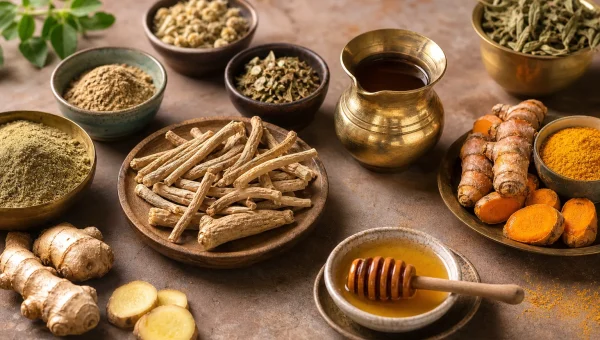
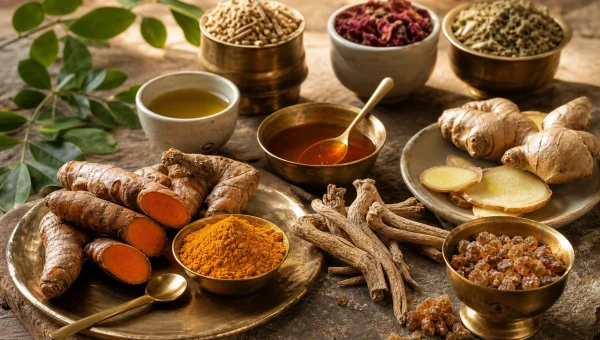
Ashwagandha (Withania somnifera): Classical and official Ayurvedic use centers on the mature root. For men with vata depletion, poor sleep, nervous exhaustion, low resilience, and weak recovery, ashwagandha is often used as a nourishing rasayana. Commonly studied adult doses of standardized extract range from about 240-600 mg per day, while traditional powder dosing should be individualized by a qualified practitioner. It is best suited to depleted, anxious, under-recovered patterns rather than hot, inflamed, ama-heavy, or liver-sensitive states.
Purified Shilajit: Shilajit is a rasayana substance and should only be used in purified, tested form. A purified shilajit preparation has been evaluated at 250 mg twice daily for 90 days in healthy men aged 45-55, with increases in total testosterone, free testosterone, and DHEA-S reported. This does not make raw or untested shilajit safe. Product quality is essential because contamination with heavy metals and other impurities is a recognized concern.
Shatavari (Asparagus racemosus): Shatavari is not a male testosterone stimulant in the narrow sense. It is a cooling, nourishing rasayana that may be useful in selected men when depletion, dryness, heat, irritability, poor tissue nourishment, or pitta-vata aggravation is prominent. The Ayurvedic Pharmacopoeia of India lists shatavari root with a powder dose of 3-6 grams for decoction use. Men can use shatavari when the pattern fits, but it should not be added mechanically to every testosterone protocol.
Sleep Architecture: The Non-Negotiable Foundation
No herbal protocol can reliably compensate for chronically short sleep. Testosterone rhythm is sleep-dependent, and sustained sleep restriction can lower daytime testosterone even in healthy young men. From an Ayurvedic viewpoint, sleep is one of the three pillars of health, and disturbed sleep is one of the fastest ways to aggravate vata and drain ojas.
A vata-pacifying bedtime routine should be simple and repeatable: finish dinner early enough to digest comfortably, reduce stimulating work at night, keep a stable sleep and wake time, apply warm sesame oil to the feet or scalp when suitable, and practice slow breathing or alternate-nostril breathing for 5-10 minutes. A lengthened exhale gently shifts the system toward parasympathetic settling. The aim is not forced sedation; the aim is to teach the body that the day has ended.
Dietary Fat, Agni, and Shukra Nourishment
Testosterone is a steroid hormone, and steroid hormone synthesis depends on cholesterol-derived pathways. Extremely low-fat dieting, chronic calorie restriction, and under-eating can be unfavorable for male hormonal recovery. A 2021 meta-analysis found that low-fat diets may reduce testosterone compared with higher-fat diets in men, while a later 2025 meta-analysis found no clear significant difference between low- and high-fat diets overall. The practical conclusion is balanced: avoid extreme low-fat dieting, but do not treat fat-loading as a hormone cure.
Ayurveda emphasizes digestible nourishment rather than isolated macronutrient obsession. For vata depletion and shukra nourishment, suitable foods may include warm milk when tolerated, ghee in moderation, sesame, soaked almonds, dates, mung soup, rice, and well-cooked meals taken at regular times. For men with obesity, fatty liver, insulin resistance, high lipids, or kapha-ama patterns, the same principle must be adapted with lighter, cleaner nourishment and medical nutrition guidance.
When to Test and When to Seek Care
Low testosterone should be evaluated with proper testing, not assumed from stress symptoms alone. A reasonable medical workup may include fasting morning total testosterone, repeat confirmation if low, free testosterone or calculated free testosterone, SHBG, LH, FSH, prolactin, thyroid assessment, metabolic markers, and sleep apnea screening when indicated. Cortisol testing should be ordered and interpreted by a clinician when symptoms suggest an adrenal or pituitary disorder.
Medical disclaimer: Hormonal decline, infertility, erectile dysfunction, depression, persistent fatigue, and abnormal cortisol or testosterone results require medical evaluation. This article is educational and does not replace care from an endocrinologist, urologist, physician, or qualified Ayurvedic practitioner. Review herbs and supplements with a healthcare provider before use, especially if you have liver, kidney, thyroid, cardiovascular, fertility, psychiatric, or autoimmune conditions, or if you use prescription medication, testosterone therapy, steroids, sedatives, or blood-sugar or blood-pressure medicines.
References
- Stress and the reproductive axis (2014), PubMed Central
- NCBI
- Glucocorticoids, stress, and fertility (2010), PubMed Central
- NCBI
- The relationship between sleep disorders and testosterone in men (2014), PubMed Central
- Effect of 1 week of sleep restriction on testosterone levels in young healthy men (2011), PubMed
- My (my.clevelandclinic.org)
- MedlinePlus
- Diurnal cortisol slopes and mental and physical health outcomes: A systematic review and meta-analysis (2017), PubMed Central
- Academic (academic.oup.com)
- MedlinePlus
- MedlinePlus
- Blog (blog.mygov.in)
- Easyayurveda (easyayurveda.com)
- Jaims (jaims.in)
- Effects of Adaptogens on the Central Nervous System and the Molecular Mechanisms Associated with Their Stress-Protective Activity (2010), PubMed Central
- Ministry of AYUSH
- Fssai (fssai.gov.in)
- An investigation into the stress-relieving and pharmacological actions of an ashwagandha (Withania somnifera) extract: A randomized, double-blind, placebo-controlled study (2019), PubMed Central
- A Randomized, Double-Blind, Placebo-Controlled, Crossover Study Examining the Hormonal and Vitality Effects of Ashwagandha ( Withania somnifera) in Aging, Overweight Males (2019), PubMed Central
- Examining the effect of Withania somnifera supplementation on muscle strength and recovery: a randomized controlled trial (2015), PubMed Central
- NCCIH
- Clinical evaluation of purified Shilajit on testosterone levels in healthy volunteers (2016), PubMed
- Operation Supplement Safety
- Ayurvedic Pharmacopoeia of India
- Adaptogenic property of Asparagus racemosus: Future trends and prospects (2023), PubMed Central
- Slow breathing for reducing stress: The effect of extending exhale (2023), PubMed Central
- Breathing Practices for Stress and Anxiety Reduction: Conceptual Framework of Implementation Guidelines Based on a Systematic Review of the Published Literature (2023), PubMed Central
- Effects of alternate nostril breathing exercise on cardiorespiratory functions in healthy young adults (2021), PubMed Central
- Effects of Ayurvedic Oil-Dripping Treatment with Sesame Oil vs. with Warm Water on Sleep: A Randomized Single-Blinded Crossover Pilot Study (2016), PubMed Central
- Low-fat diets and testosterone in men: Systematic review and meta-analysis of intervention studies (2021), PubMed
- The Effect of Low-Fat Diets Versus High-Fat Diet on Sex Hormones: A Systematic Review and Meta-Analysis of Randomized Controlled Trials (2025), PubMed
this oversimplifies a complex endocrine relationship. Age-related testosterone decline involves many more factors.