
My father died on a Tuesday, and by Wednesday I had lost my appetite completely. By the following Monday I could not sleep longer than two or three hours before waking to a heaviness that had no object. My mind, normally occupied with recipes and preparations and the particular creative pleasure of working with food, went entirely blank. Three weeks after his death I found myself standing in my kitchen unable to remember what I had intended to cook. The grief I already understood intellectually — the loss of a central person in a life is a comprehensible devastation. What I did not expect was the way it affected my body: the digestive shutdown, the sleep fragmentation, the profound depletion of vitality.
Ayurveda describes Shoka (grief) as a powerful disturbance of the mind that directly affects the body through its influence on Prana (vital life force) and Ojas (the subtle essence that supports immunity, resilience, and stability). In classical understanding, intense grief can weaken Agni (digestive fire), disturb Vata dosha, and lead to a state of depletion marked by fatigue, poor appetite, disturbed sleep, and mental fog. This state is understood as Shoka-janya Kshaya — depletion arising from grief. Traditional Ayurvedic care in such conditions focuses not on suppressing emotion, but on supporting the body so that the process of grieving can unfold without excessive physical deterioration.
Understanding Shoka’s Effect on the Body
In Ayurvedic physiology, grief affects the doshas in distinct ways:
- Vata aggravation: The sudden loss, instability, and emotional disruption of grief increases Vata, leading to restlessness, irregular sleep, dryness, and reduced appetite.
- Pitta disturbance: Emotional rumination, mental replaying, and internal questioning can disturb Pitta, contributing to mental heat, agitation, and difficulty settling the mind.
- Kapha depletion: The stabilising quality of Kapha and Ojas becomes weakened over time in prolonged grief, contributing to low energy, withdrawal, and reduced emotional resilience.
From a physiological perspective, bereavement is widely recognised as a state of significant stress for the nervous and endocrine systems. During intense grief, sleep patterns, appetite, and immune balance may all be temporarily affected. Ayurveda interprets these changes as the combined effect of disturbed Vata and reduced Ojas.
The Rasayana Response: Supporting the Body Through Grief
Classical Ayurvedic care in grief focuses on gentle nourishment, stabilisation of Agni, and gradual rebuilding of strength. Heavy interventions are avoided in the early phase, as digestion is often weakened.
Phase 1: Acute Grief (Weeks 1–4) — Stabilisation and Gentle Nourishment
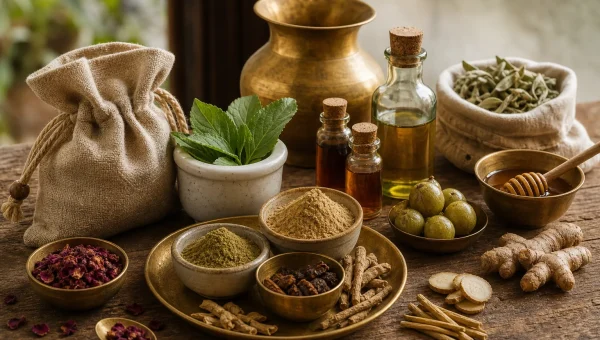
Ashwagandha Kshira (nourishing milk preparation): Warm milk prepared with a small amount of Ashwagandha, cardamom, and a pinch of warming spice is traditionally used to support sleep, grounding, and recovery in Vata-aggravated states. This preparation is considered nourishing and stabilising for depleted conditions, especially when appetite is low and sleep is disturbed.
Khichadi as primary food: Simple khichadi made from rice and mung dal with ghee is classically regarded as easy to digest, light, and supportive of Agni. It is commonly used when the digestive system is weak or sensitive, including during emotional stress and recovery.
Phase 2: Subacute Grief (Months 1–3) — Rebuilding Strength
- Brahmi (Bacopa monnieri): Traditionally classified as a Medhya Rasayana, Brahmi is used to support clarity of mind, emotional balance, and cognitive stability during periods of mental strain.
- Ashwagandha: Commonly used in Ayurvedic practice as a Rasayana to support strength, endurance, and nervous system stability during prolonged stress states.
- Chyawanprash: A classical Rasayana formulation described in Ayurvedic tradition for general rejuvenation, especially in states of weakness, recovery, or reduced vitality.
Phase 3: Reintegration (Months 3–12) — Gradual Restoration
- Shatavari: Traditionally used as a nourishing Rasayana to support stability, nourishment, and long-term rebuilding of depleted tissues.
- Shankhpushpi: Classically used in Ayurveda as a Medhya herb to support calmness, mental clarity, and emotional steadiness during prolonged mental strain.
Supportive Practices in Grief
- Abhyanga (oil massage): Daily warm oil application, especially with sesame oil, is traditionally used to calm Vata, support grounding, and restore bodily stability.
- Gentle breathing practices: Slow, steady breathing techniques such as Nadi Shodhana are traditionally used to balance Prana and support emotional regulation.
- Sattvic diet: Fresh, warm, simply prepared food with ghee is recommended in Ayurvedic tradition to support mental clarity and emotional steadiness.
Grief Support Schedule
| Phase | Support | Form | Duration |
|---|---|---|---|
| Acute (Weeks 1–4) | Ashwagandha Kshira | Warm milk preparation at night | Daily |
| Acute (Weeks 1–4) | Khichadi diet | Simple cooked meals | As needed |
| Subacute (Months 1–3) | Brahmi | Herbal support | Daily |
| Subacute (Months 1–3) | Ashwagandha | Rasayana support | 3 months |
| Subacute (Months 1–3) | Chyawanprash | Classical formulation | Daily |
| Reintegration | Shankhpushpi | Mental support herb | As needed |
For related perspectives on emotional balance and Ayurvedic mind support, see complex PTSD and Sattvajaya therapy, Daiva Vyapashraya approaches in Ayurveda, and Ayurvedic perspectives on obsessive thinking.
Grief is a natural human process. Ayurvedic approaches are intended to support physical and mental resilience during this period and are not a substitute for psychological counselling or medical care. If grief becomes overwhelming, prolonged, or associated with severe depression or self-harm thoughts, professional support should be sought. Herbal preparations should be used under the guidance of a qualified practitioner, especially when combined with other medications or health conditions.



Lost my mother last year and the appetite disappearing first was the thing nobody warned me about. Did the author find any particular herb that helped bring hunger back before the sleep issues started resolving? I’m curious whether Ashwagandha alone was enough or if something else was needed alongside it.
The part about standing in the kitchen and going blank really hit close to home. After my husband passed I couldn’t cook for weeks, and cooking had always been my way of feeling grounded. Did any of the Rasayana practices help with that specific kind of mental blankness, or did it take time regardless of what you tried?
What I appreciate here is that grief is treated as something the body experiences, not just the mind. The two or three hours of broken sleep described in the opening is so accurate — I went through exactly that after losing my sister. Did Brahmi help specifically with the early waking, or more with the heaviness that came after?
this article found me at the right time. lost my mother eight months ago and the description of the blank mind in the kitchen, not being able to cook or even remember what I used to make, was so accurate it was almost uncomfortable to read. the section on Medhya herbs and gentle rebuilding rather than forcing normalcy was genuinely helpful 🙏 धन्यवाद
Grateful this exists. Most articles on grief focus entirely on the emotional side and skip over the physical depletion that comes with it. The loss of appetite and sleep disruption described here were the hardest parts for me too. Would love to know if there’s a recommended sequence, like whether to address the sleep first or the digestion first.
Reading this a few months after losing my father and the description in the opening is painfully accurate. That heaviness with no object is exactly the right phrase for it. I had no idea Ayurveda had a framework specifically for grief recovery — does the article go into how long a Rasayana course typically runs before you start noticing a shift?
The framing of bereavement as something that depletes Ojas makes intuitive sense to me. Grief is exhausting in a way that regular tiredness isn’t. Has anyone tried the herbal protocol described here alongside conventional grief counseling? Wondering if they complement each other or if one approach is better started first.
This is such a needed article. Grief gets talked about in emotional terms but rarely in terms of what it does to the body’s systems. The sleep disruption alone can last so long. Did the author work with a practitioner for the Rasayana recommendations or self-guide based on research?
That description of standing in the kitchen unable to remember what you came in for — I did that for weeks after my mother died. It’s such a strange fog. I’d be interested to know whether the author found any difference between morning and evening timing for taking Ashwagandha during the grief period.
The way you describe losing your appetite by the day after your father died is something I recognized immediately. My body did the same thing. I stayed on plain rice and warm water for almost two weeks. Did the Rasayana approach start with something very simple and build up, or did you jump into the full protocol?
Something about naming that early morning heaviness as having no object really captures what grief feels like physically. It’s not quite anxiety, not quite sadness, just weight. Curious whether any of the practices here helped with that specific early morning feeling or whether it was more the daytime functioning that improved first.
The description of waking with a heaviness that had no object hit home for me.
The mind going blank in a kitchen full of ingredients you know by heart — that detail says everything about what grief does to a person. I wonder if the practices described here would also help with the kind of grief that comes from long illness, where the anticipatory loss has already depleted you before the death even happens.
My grandmother was the one who introduced me to Ayurveda and losing her two years ago felt like losing access to that knowledge along with her. Coming across an article specifically about bereavement recovery through Rasayana feels meaningful. Is Shatavari typically included in grief protocols or is it more situation-dependent?
Three weeks of broken sleep after a loss changes everything. Your thinking, your patience, your sense of time. Glad to see this treated as a physiological reality and not just an emotional phase to push through. Did warm milk with Ashwagandha help with the early waking specifically, or more with falling back to sleep once awake?
Reading this while still in the middle of grieving my father and it’s both hard and helpful at the same time. The loss of appetite came first for me too. I haven’t been able to think about food in any intentional way. Did the author find that the body slowly started asking for nourishment again once the herbs were introduced, or did hunger have to be manually coaxed?
Has anyone tried the warm ashwagandha milk before bed and noticed a difference in sleep?
I found the explanation of Ojas depletion helpful for understanding why my appetite vanished.
Good one.
What strikes me is how isolating grief can be when your body stops cooperating with basic functions like eating and sleeping. The article’s framing makes it feel less like personal failure and more like something that has a cause and can be addressed. Are there any Rasayana foods that are particularly easy to prepare when you’re in that foggy state and can barely manage the kitchen?
I lost both parents within eighteen months of each other and the second time the physical depletion was even more pronounced, like my body had no reserves left. Didn’t know there was a name in Ayurveda for that state of deep Ojas exhaustion. Does the protocol differ at all when grief is layered or compounded?
This article made me think differently about what happened to my body after loss — I always assumed the exhaustion and appetite loss were purely emotional responses. The idea that they represent a real physiological depletion that can be supported with specific herbs and foods is genuinely reassuring. Would Chyawanprash be a reasonable starting point for someone who can’t access individual herbs easily?
The step by step Rasayana phases make it easier to know what to give and when.
The sleeplessness in grief is a particular kind of torture because you’re already depleted and then rest keeps escaping you. I tried everything I knew — warm milk, reducing screens, breathing exercises — but nothing worked consistently for months. Did any single practice from this list make the biggest difference early on, or was it more the combination?
Losing the pleasure in food is one of the stranger effects of grief that people don’t talk about enough. You can eat but nothing tastes like it should. The article’s connection between grief and digestive Agni feels right to me intuitively. How long did it typically take before the herbs started making a noticeable difference in appetite?
Does Khichadi really need to be the first food when appetite returns, or can something else work?
This is the first piece I’ve read that treats the grief body as something requiring its own specific support rather than just waiting for time to pass. That description of waking after two or three hours to a formless heaviness is so exact it’s almost uncomfortable to read. Were there any practices here that were simple enough to do even on the worst days?
Reading about Prana Vayu disruption made me think about my own restless nights after the loss.
My father died last spring and I went through almost exactly what’s described in the opening — the blank mind, the absent appetite, the shattered sleep. I started Ashwagandha about a month in and noticed the sleep improving before anything else. Has anyone else found the sleep responding faster than the appetite when starting Rasayana during grief?
There’s something deeply human about standing in the kitchen you know completely and being unable to function in it. Grief does that. The article’s suggestion that this has a physical explanation in Ojas depletion makes the experience feel less like weakness. Would the same Rasayana approach apply to anticipatory grief, or is it specifically for after a loss?
I appreciate that the article stresses these herbs aren’t a replacement for counseling.
The opening of this article is one of the most honest descriptions of acute grief I’ve read anywhere. That blank mind in the kitchen. I lost my partner and had the same experience for nearly two months. Found warm sesame oil Abhyanga helped more than I expected with the physical heaviness — did the author mention this anywhere or is it more typically used for other conditions?
The mention of Shoka ja Kshaya as a Sanskrit term gave me a new way to talk about grief.
Going through this with a close friend right now and trying to find things that might actually help rather than just platitudes. The sleep disruption feels like it hits hardest. Is there a gentler starting point in the Rasayana protocol for someone who is very depleted and might not tolerate stronger herbs well?
What this article does that most grief resources don’t is take the body seriously. The insomnia, the vanished appetite, the cognitive fog — these are treated as real symptoms that have a logical framework behind them, not just emotions to be felt and waited out. Curious whether the author found the practices easier to maintain with some external structure, like a schedule or a practitioner check-in.
Has anyone used Brahmi for the foggy thinking that comes with bereavement?
The advice to avoid tamasic foods like reheated meals feels practical during a low energy time.
@Geeta helpful.
I tried a spoonful of Chyawanprash with warm milk this morning and liked the taste.
The warning about discussing herbs with a physician if you’re on antidepressants is important.
Does Shankhpushpi really help with unresolved emotional patterns, or is it more hype?
The idea of using warm sesame oil for a quick foot massage before bed sounds soothing.
I’m curious how long the subacute phase usually lasts for most people.