
My son was born at 3:14 am on a Thursday in February. By the following Tuesday, I had slept nine hours across five days. By the end of the first month, a persistent irritability made ordinary tasks feel unmanageable and minor inconveniences catastrophic. I did not know whether I was depressed, but I was profoundly depleted. Ayurveda offers the concept of ojas, associated with strength and vitality, yet “new-father depletion” is not a classical diagnosis, and ojas is not a synonym for hormones, immunity, or mitochondrial energy. The safest approach combines verified Ayurvedic ideas with modern evidence and mental-health care.
The Physiology of New-Father Depletion
Paternal postnatal depression is real. A 2020 meta-analysis of 47 studies involving 20,728 fathers estimated a prevalence of 8.75% during the first year after birth. An earlier meta-analysis found an overall rate near 10%, with comparatively higher rates three to six months postpartum. Irritability, withdrawal, anxiety, loss of interest, impaired functioning, and increased alcohol or substance use can be important signs in men; exhaustion alone does not establish a diagnosis.
Sleep disruption is a major pressure of early parenthood. A large meta-analysis found that total deprivation, partial restriction, and fragmentation impair emotional functioning, reducing positive mood and increasing anxiety-related responses. Sleep loss also affects attention and judgment. Studies of fathers report hormonal associations involving testosterone, prolactin, oxytocin, vasopressin, and cortisol, but findings vary and do not establish one universal pattern.
Charaka Samhita, Sutrasthana 17.73 describes diminished ojas with features including fearfulness, weakness, persistent worry, troubled senses, poor lustre, low mood, dryness, and emaciation. Some of those descriptions can resemble the lived experience of severe depletion, but they are not diagnostic criteria for paternal depression. The original claims that 10 pm to 2 am is a classical “maximum ojas-restoration window,” or that missing it produces a specific apana-vata vikriti, could not be verified in an authoritative classical source and should not be presented as doctrine.
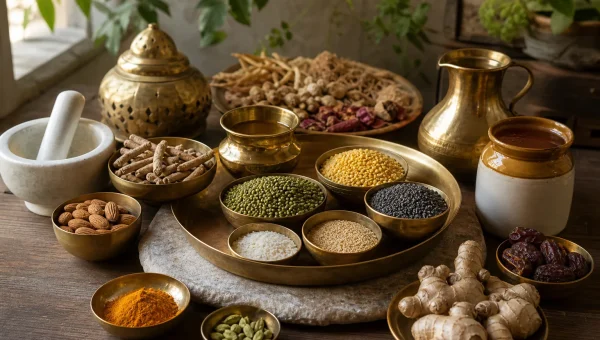
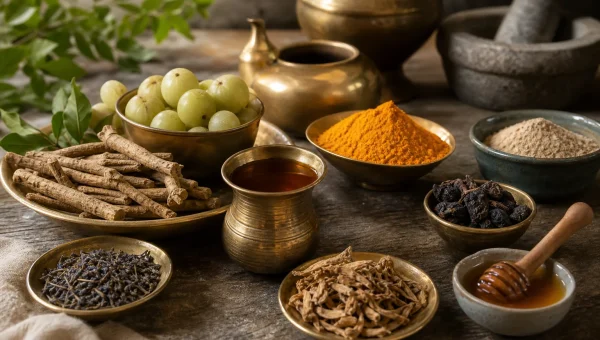
Ayurvedic Herbs: What Is Supported and What Is Not
The Ayurvedic Pharmacopoeia of India establishes official standards for the identity, purity, and strength of medicinal materials; it is not, by itself, proof that a herb treats postnatal stress, depression, or sleep deprivation. New fathers should not combine several herbs merely because each is described as a rasayana. Product, dose, health history, medicines, and the reason for use all matter.
1. Ashwagandha (Withania somnifera)
The Pharmacopoeia identifies Ashwagandha as the dried mature root of Withania somnifera and records tikta-kashaya rasa, laghu guna, ushna virya, madhura vipaka, and rasayana and balya actions. A 2012 randomized placebo-controlled trial in 64 chronically stressed adults used one specific root extract at 300 mg twice daily for 60 days and reported improved stress measures and lower cortisol. A later review found a small sleep benefit, but preparations and studies varied. Neither finding establishes a universal 600 mg dose or treatment for paternal depression. NCCIH lists gastrointestinal effects, drowsiness, rare liver injury, thyroid and autoimmune cautions, and several medicine interactions. See our Ashwagandha guide as general reading.
2. Brahmi (Bacopa monnieri)
The Pharmacopoeia defines Brahmi here as the dried whole plant of Bacopa monnieri. It records madhura-tikta-kashaya rasa, laghu-sara guna, shita virya, madhura vipaka, and medhya and rasayana actions. A meta-analysis of nine randomized trials found potential cognitive benefit, particularly for speed of attention, after sustained use in selected populations. It did not show that a bedtime dose reverses newborn-related sleep loss. Extracts vary in bacoside content, so “300 mg” is not interchangeable across products. Read our article on Brahmi and Brahmi Ghrita with this distinction in mind.
3. Shatavari (Asparagus racemosus)
The Pharmacopoeia identifies Shatavari as the tuberous root of Asparagus racemosus and records madhura-tikta rasa, guru-snigdha guna, shita virya, madhura vipaka, and balya, medhya, and rasayana actions. These classifications are not evidence for use in new fathers. Claims that Shatavari supports the adrenals, lowers sleep-loss cytokines, or replaces “Rasa dhatu depleted by stress” lacked suitable human evidence, so no fixed dose is recommended here.
4. Jatamansi (Nardostachys jatamansi)
The Pharmacopoeia defines Jatamansi as the dried rhizome of Nardostachys jatamansi. It records tikta-kashaya rasa, laghu guna, shita virya, katu vipaka, medhya and nidrajanana actions, and anidra among uses. This verifies a traditional sleep association, not that 250 to 500 mg improves sleep in new fathers. Modern evidence is mainly preclinical, and the claim of GABA-A action “without dependence risk” was too strong. Do not casually combine it with alcohol, sedatives, sleep medicines, or other calming herbs.
5. Shilajit
A randomized double-blind trial tested purified Shilajit at 250 mg twice daily for 90 days in healthy men aged 45 to 55 and reported increases in total and free testosterone and DHEAS. It did not study new fathers, depression, fragmented sleep, or “ojas restoration,” so routine use is not justified here. Composition varies, and toxic-metal contamination is a concern. Use only credible batch-tested material after professional review. Our Shilajit quality guide explains why verification matters.
A Safer New-Father Daily Protocol
The first-line plan should reduce preventable sleep loss, regularize meals and light exposure, share caregiving, and create a route to professional help—not impose a five-supplement stack. This routine keeps an Ayurvedic emphasis on orderly habits while remaining practical with a newborn.
| Time | Practice | Purpose | Time Required |
|---|---|---|---|
| After waking | Water, daylight, and a regular meal | Supports alertness and restores routine | 10-20 minutes |
| Morning or afternoon | Gentle walk outdoors | Movement, daylight exposure, and mood support | 10-20 minutes |
| During a quiet interval | Slow comfortable breathing without breath-holding | Brief down-regulation during stress | 3-5 minutes |
| Afternoon, if needed | Short nap that does not delay the main sleep period | Reduces acute sleepiness | 10-20 minutes |
| Before the longest sleep opportunity | Dim lights, stop work, and complete a caregiving handover | Protects the best available sleep window | 10 minutes |
| Daily check-in | Tell a partner or trusted person how you are functioning | Detects worsening anxiety, depression, anger, or withdrawal | 5 minutes |
Sleep Strategy: Protect Duration and Continuity
There is no verified classical rule that sleep from 10 pm to 2 am uniquely restores ojas. Modern sleep guidance is clearer: healthy adults should generally obtain at least seven hours of sleep regularly, although a newborn may make that temporarily difficult. Rather than chasing a perfect clock time, protect the longest available sleep opportunity. Partners or family members can rotate duties so that each caregiver periodically receives an uninterrupted block. Safe infant-feeding and caregiving arrangements must take priority, especially where breastfeeding or medical needs limit how shifts can be divided.
Keep caffeine early enough that it does not erode the next sleep opportunity. A systematic review found that caffeine can reduce total sleep time and sleep efficiency and delay sleep onset. Avoid alcohol as a sleep aid, and do not drive or operate machinery when severely sleepy. Persistent loud snoring, choking awakenings, morning headaches, or dangerous daytime sleepiness warrant medical assessment rather than an herbal sedative. Our dinacharya guide may help rebuild routine once the newborn period becomes more predictable.
Emotional Grounding and the Mental Dimension
New fatherhood can reorganize identity, partnership, work, and responsibility. Ayurveda discusses sattva, rajas, and tamas as qualities of mind, but these concepts should not be used to blame a distressed father for lacking “sattva.” Irritability, numbness, panic, hopelessness, intrusive thoughts, or withdrawal may reflect sleep loss, adjustment stress, depression, anxiety, or another condition that deserves assessment.
Brief breath awareness, quiet meals, time outdoors, and asking for help are reasonable supports. A 2024 review found that exercise, including walking or jogging, yoga, and strength training, can reduce depressive symptoms. During severe sleep deprivation, keep it moderate. Social contact and practical childcare relief may be more useful than another supplement.
Nutrition for the Sleep-Deprived Father
Acute sleep loss can alter appetite-related hormones and increase the pull toward energy-dense food, although responses vary between people. The practical answer is not a special “ojas food” that directly repairs hormones. It is reliable access to nourishing meals: dal or khichdi, vegetables, rice or roti, curd if tolerated, eggs or another suitable protein source, fruit, nuts, soups, and adequate fluids. Warm, simply prepared meals may be easier to digest and are consistent with many Ayurvedic household practices.
Milk, ghee, dates, almonds, cardamom, or saffron may be used as ordinary foods when culturally appropriate and medically suitable, but they are not proven treatments for paternal depression. Ksheerabala is a medicated preparation, not simply “milk cooked with Bala,” and should not be improvised from an online recipe. People with diabetes, food allergy, lactose intolerance, reflux, kidney disease, or other dietary restrictions need individualized advice.
Safety and Disclaimer
Paternal postnatal depression and anxiety can require professional treatment. Seek prompt help if low mood, irritability, panic, detachment, substance use, or inability to function persists or worsens. Thoughts of suicide, harming another person, harming the baby, or losing control require immediate emergency assistance through local emergency services or the nearest emergency department. Intrusive thoughts can occur in anxiety and do not automatically mean intent, but they still deserve urgent, compassionate assessment.
Herbs are supportive options, not replacements for sleep, psychotherapy, medical evaluation, or prescribed treatment. Consult both a qualified Ayurvedic practitioner and a healthcare provider before using Ashwagandha, Brahmi, Shatavari, Jatamansi, Shilajit, or combinations, especially when taking medicines or living with thyroid, liver, autoimmune, hormonal, psychiatric, seizure, blood-pressure, or diabetes conditions. Some Ayurvedic products have contained toxic amounts of lead, mercury, or arsenic; choose products with independent batch testing and stop any product that causes jaundice, dark urine, severe gastrointestinal symptoms, rash, marked sedation, or other concerning effects.
One Actionable Step
Tonight, replace the unverified Jatamansi-and-nutmeg prescription with a protected-sleep handover. Agree on one period when another capable adult handles safe, non-feeding tasks, place the phone outside reach, darken the room, and sleep as soon as possible. Repeat for a week and note mood, irritability, and functioning. If you remain overwhelmed or cannot care for yourself or your family, seek a professional mental-health assessment rather than escalating herbs.
References
- Prevalence of prenatal and postpartum depression in fathers: A comprehensive meta-analysis of observational surveys (2020), PubMed
- Prenatal and postpartum depression in fathers and its association with maternal depression: a meta-analysis (2010), PubMed
- Postpartum Depression in Men (2019), PubMed Central
- Sleep loss and emotion: A systematic review and meta-analysis of over 50 years of experimental research (2024), PubMed
- The neurocognitive consequences of sleep restriction: A meta-analytic review (2017), PubMed
- Birth of a Father: Fathering in the First 1,000 Days (2019), PubMed Central
- Astanga Hridaya (siva.sh)
- Charaka Samhita — Ojas
- Ayurvedic Pharmacopoeia of India
- A prospective, randomized double-blind, placebo-controlled study of safety and efficacy of a high-concentration full-spectrum extract of ashwagandha root in reducing stress and anxiety in adults (2012), PubMed
- Effect of Ashwagandha (Withania somnifera) extract on sleep: A systematic review and meta-analysis (2021), PubMed
- NCCIH
- Ayurvedic Pharmacopoeia of India
- Meta-analysis of randomized controlled trials on cognitive effects of Bacopa monnieri extract (2014), PubMed
- Ayurvedic Pharmacopoeia of India
- Natural product-based pharmacological studies for neurological disorders (2022), PubMed Central
- Clinical evaluation of purified Shilajit on testosterone levels in healthy volunteers (2016), PubMed
- Hazardous or Advantageous: Uncovering the Roles of Heavy Metals and Humic Substances in Shilajit (Phyto-mineral) with Emphasis on Heavy Metals Toxicity and Their Detoxification Mechanisms (2024), PubMed
- Jcsm (jcsm.aasm.org)
- The effect of caffeine on subsequent sleep: A systematic review and meta-analysis (2023), PubMed
- Effect of exercise for depression: systematic review and network meta-analysis of randomised controlled trials (2024), PubMed
- Effects of acute sleep loss on leptin, ghrelin, and adiponectin in adults with healthy weight and obesity: A laboratory study (2023), PubMed
- Impactfactor (impactfactor.org)
- Charaka Samhita — Triguna
- NCCIH
Nothing in this article diagnoses or treats a medical condition. Use it as educational information and consult a qualified Ayurvedic practitioner or physician before starting herbs, supplements, detoxes, or therapeutic protocols, especially if pregnant, managing a condition, or taking medication.
The 9 hours of sleep across 5 days description is exactly my first month. My wife kept telling me I was becoming someone she didn’t recognize. The cellular depletion feeling is real. Started ashwagandha at week 6 and noticed the background hum of tension ease within 10 days.
New dad here, 6 weeks in. Not sleeping. Not coping. Grateful someone wrote about this from the father’s perspective because every postpartum article is written for mothers and fathers are invisible in this conversation.
Can ojas be taken alongside metformin? I have type 2 diabetes and my endocrinologist hasn’t heard of this approach.
Is there a difference in efficacy between the churna form and capsules for ojas? I’ve heard the powder absorbs differently.
My doctor in Bangalore suggested something similar but used different herbs. Is there regional variation in how Ayurvedic practitioners approach this condition?
I tried the warm milk with ashwagandha and nutmeg protocol from this article. My sleep was no longer continuous (baby doesn’t allow that) but the quality of the 2-hour blocks I did get was noticeably deeper. That alone changed my functioning.
The New Fathers explanation is clearer than most short posts. Small daily changes are easier to follow than a perfect plan.
The traditional Indian practice of having extended family present for the first month exists partly for this reason so the new parents can actually follow the rest and nourishment protocols. Modern nuclear family structures make this nearly impossible in most cities.
Went through exactly this process last year. The ojas made a difference by week 3 and by month 2 I was back to sleeping through the night.
I appreciated the clear explanation of ojas and why it isn’t just a hormone marker.
The point about Vata aggravation from disrupted sleep schedules is interesting but the proposed solution maintaining routine is basically impossible with a newborn. Would be helpful to have strategies for when routine is genuinely not possible.
Shared this with my brother who is expecting his first child next month. He’s already anxious about the sleep deprivation. Having a framework for managing it ahead of time is actually quite reassuring.
The statistic that 8.75% of fathers experience postnatal depression in the first year stood out to me.
The New Fathers explanation is clearer than most short posts. I appreciate that it does not oversell the result.
Has anyone tried the short nap suggestion and noticed a change in irritability?
I wonder if the daytime walk tip works better in the morning or afternoon for mood.
The article’s caution about mixing jatamansi with sedatives feels important to remember.
Been using Ayurvedic protocols for 2 years and this is one of the more accurate breakdowns I’ve seen.
@Deepak Took notes on the part about seasonal adjustments, adding that to my practice now.
the table in the middle of the article was very clear but i couldn’t figure out the seasonal column
Does anyone know if this works with the churna form or only the tablet? can’t find KSM-66 locally.
Shilajit’s possible testosterone boost is interesting but the lack of data on new fathers makes me hesitant.
Second baby is 3 months old. Used the Jatamansi and Ashwagandha sleep stack from this article, prescribed by my Ayurvedic doctor after reading this. Not sleeping through the night obviously but functioning much better. My wife noticed the difference before I did.
Tried the morning routine for 2 months, gave up. the timing is impossible with a 9 to 5 job and kids.
Useful post on New Fathers. Would be useful to see a short checklist next.
where can u source teh herbs in india outside of major cities? i’m in a tier-2 town
does anyone know if this works with the churna form or only the tablet? can’t find ksm-66 locally
read this twice and took notes, the distinction between shamana and shodhana applications is really helpful
my functional medicine doctor had mentioned something similar, good to have the ayurvedic framing too
What brand of the extract do you personally use or recommend? the market is full of fake products.
This works in theory but practically very hard to source authentic herbs in most parts of India.
The dosage here seems higher than what my Ayurvedic doctor recommended, a bit concerned.
Useful post on New Fathers. This is the kind of detail readers can test slowly.
tried the morning routine from this article and noticed a difference by day 5, not placebo i think
my vaidya recommended something similar last month, good to see the science backing it up here
bookmarked this to share with my mother who has been struggling with the same issue for years
finally someone explains the theory behind it and not just the recipe, this made sense to me
feels like a lot of the advice is very general, my case is quite specific and this didnt really address it
Not sure I trust the quality of supplements available online, too many adulterated products out there.
The recipe proportions seem higher than what I see in other sources, is the difference intentional.
This is the kind of content that makes people delay real medical care, that concern is valid.
The herb combination you suggested 600mg KSM-66 morning worked well alongside my usual churna.
@Ashok how do i know if i’m seeing genuine results vs just placebo? any markers to watch
I liked the practical daily routine focusing on light exposure and regular meals rather than a supplement stack.
off topic but has anyone here tried this approach for hair loss? curious if similar principles apply
just started exploring ayurveda after years of allopathy, this is helpful as an intro but still a lot to absorb
how long before seeing results typically? the article mentions 4 to 6 weeks but is that for everyone 🙏
Quick question: does the dosage change if someone is also on metformin? asked my doc but he wasn’t sure.
I have low Agni according to my vaidya, does that change which phase to start with.
Appreciate that this goes into contraindications, most blogposts skip that part.
been following this for 3 weeks now and my energy levels are much better, the protocol you described really clicked for me
would this protocol work if i travel frequently and cant maintain a fixed routine
reading this after finding it on google, has the recommended dose changed since 2026? ❤️
this is the kind of content that makes people delay real medical care, that concern is valid
is there a hindi or regional language resource you’d recommend alongside this for my parents
this works in theory but practically very hard to source authentic herbs in most parts of india
The reminder to seek professional help if low mood persisted felt responsible and necessary.
This is specifically written from a father’s perspective but I’m wondering how much of the herbal support described would be appropriate for the mother during the same postpartum window. The depletion you describe — that cellular exhaustion — sounds exactly like what my partner experienced after our first. She was the one not sleeping, not me. Would ashwagandha be safe while breastfeeding or does that need modification?
Some of these claims are very strong for what is essentially anecdote-level evidence. 🙌
how do i know if im seeing genuine results vs just placebo? any markers to watch
starting this next week, will come back to report results in about a month
followed the dosage table exactly for 10 days and my sleep improved, will continue
the part about adjusting based on prakriti was exactly what i needed to understand, thanks
been eating the kitchari variation from this post 4 days a week, feels lighter in the mornings
The description of that background hum of irritability is painfully accurate. I’m eight weeks into having a newborn and I recognized it immediately. I don’t have a question, I just wanted to say it’s the first time I’ve read something that named what I’m feeling without telling me to sleep when the baby sleeps. Going to look into the adaptogen recommendations this week.
Did the authors mention any specific brand of ashwagandha that met the Pharmacopoeia standards?
just found this post, the section 3 protocol seems intensive for a beginner, any lighter version 🌿
Some of these claims are very strong for what is essentially anecdote-level evidence.
the science section feels thin, i’d want to see more than cell studies before calling something proven
Two months in and my symptoms are actually slightly worse, stopping and going back to basics.
Where are the actual clinical trials for this? referencing classical texts is fine but I need RCT data before trying.
packaging this as science when most of it is tradition makes me skeptical, need more rigorous sourcing
Reading this later and the New Fathers advice still feels relevant. This is the kind of detail readers can test slowly.
the pitta protocol in here did not work well for me, caused a lot of heat and skin irritation
just found this post, the section 3 protocol seems intensive for a beginner, any lighter version
this helped me understand why my previous attempt at this didnt work, i was doing the timing wrong 🙏
late to this but wanted to ask, do these recommendations still hold or has newer research changed anything
I found the nutrition advice about simple dal and vegetables realistic for sleep deprived days.
Doing this
tried this for 6 weeks and saw no difference, maybe i’m applying it wrong but nothing changed for me
Reading this later and the New Fathers advice still feels relevant. I would like to know how long to try it before judging results.
Reading this later and the New Fathers advice still feels relevant. This feels more usable than a long list of herbs.
anyone know if this is okay for kids or only adults? my 14 year old has similar symptoms
The suggestion to protect the longest sleep block by sharing caregiving seems doable with a supportive partner.
The New Fathers explanation is clearer than most short posts. Would be useful to see a short checklist next.
how does this compare to the classic ashtanga hridayam recommendation on the same topic
Shared this with my sister who is a yoga teacher and she said the dosing info was spot on. ❤️
The New Fathers explanation is clearer than most short posts. The article avoids making it sound like a quick fix.
some of these claims are very strong for what is essentially anecdote-level evidence
Tried this for 6 weeks and saw no difference, maybe I’m applying it wrong but nothing changed for me.
my constitution is vata-pitta, the article seems to focus on one or the other, any advice
What would the western equivalent supplement be for someone who can’t get the herb locally.
Will try this
Will try
Packaging this as science when most of it is tradition makes me skeptical, need more rigorous sourcing.
How do I know if I’m seeing genuine results vs just placebo? any markers to watch.
Just found this post, the section 3 protocol seems intensive for a beginner, any lighter version.
teh pitta protocol in here did not work well for me, caused a lot of heat and skin irritation
my constitution is vata-pitta, the article seems to focus on one or the other, any advice धन्यवाद
the table in the middle of the article was very clear but i couldn’t figure out the seasonal column 💯
I liked the practical side of New Fathers. The timing advice is the part I would start with.
Late to this but wanted to ask, do these recommendations still hold or has newer research changed anything.
I liked the practical side of New Fathers. The main idea is clear even if someone is new to Ayurveda.
How long before seeing results typically? the article mentions 4 to 6 weeks but is that for everyone. 🙏
The specific morning timing recommendation is practical, most articles skip that detail entirely.
is this suitable for pitta dominant people or mainly vata? i get confused about the cross-dosha applications
the specific morning timing recommendation is practical, most articles skip that detail entirely
been using ayurvedic protocols for 2 years and this is one of the more accurate breakdowns ive seen
noted
starting this next week, will come back to report results in about a month 🙌 ठीक है
shared this with my sister who is a yoga teacher and she said the dosing info was spot on