
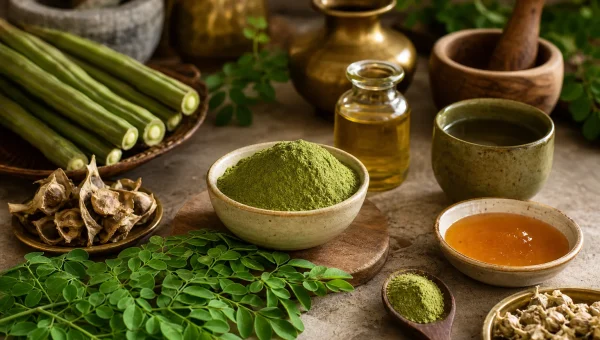
Every house I visited growing up in Kerala had a moringa tree in the yard. Not as an ornamental plant or a health fad, but as a kitchen staple, as unremarkable and expected as a coconut palm. The drumsticks went into sambar. The leaves went into dal. The flowers were cooked in seasonal dishes. Nobody called it a “superfood” because it was just food: a leafy vegetable and pod-bearing tree that happens to bring protein, calcium, iron, vitamin C, provitamin A carotenoids, and vitamin K into everyday meals.
Moringa (Moringa oleifera, known as Shigru in Sanskrit and Murungai in Tamil) has earned its modern reputation because it is practical, local, and nutritionally dense. But most online content stops at “add a teaspoon of moringa powder to your smoothie.” That is one way to use it. Here are six more, grounded in traditional kitchen practice and Ayurvedic reasoning, with exact measurements.
Moringa in Ayurveda: A Quick Framework
Ayurveda treats the plant part as important. The Ayurvedic Pharmacopoeia of India identifies Shigru leaf as the dried leaf of Moringa oleifera Lam., with regional names including Muringa in Malayalam and Murungai in Tamil. For the leaf, the pharmacopoeial profile lists Madhura Rasa, Guru-Ruksha-Tikshna Guna, Shita Virya, Madhura Vipaka, and actions such as Cakshushya, Medohara, Pittahara, Vatahara, Krimihara, Brimhana, and Shirovirecaka. It also lists traditional therapeutic contexts such as Shotha, Gulma, Krimiroga, Medoroga, Pliharoga, Vidradhi, and Galaganda.
This matters because general statements about Shigru are often drawn from the seed, root bark, or stem bark, which are sharper and heating in Ayurvedic pharmacology. The recipes below use the edible leaves, drumstick pods, and leaf powder, not root bark or concentrated bark preparations. In kitchen language, moringa is best understood as a nutrient-dense vegetable that can be paired with dal, spices, souring agents, and ghee to make it easier to eat regularly.
1. Morning Moringa Tea
This is the easiest entry point for people who already have good-quality moringa leaf powder at home. It is light, quick, and works best when kept simple rather than overloaded with sweeteners.
Ingredients (1 cup)
Use a small dose first; moringa powder has a strong green taste and settles quickly in water.
- 1 teaspoon dried moringa leaf powder, about 2 grams
- 1 cup hot water, about 240 ml, warm but not vigorously boiling
- 1 thin slice fresh ginger (Zingiber officinale)
- 1/2 teaspoon fresh lemon juice
- 1/2 teaspoon raw honey, optional, added only after the tea cools to comfortably warm
Method
The goal is a short infusion, not a long decoction.
- Place moringa powder and the ginger slice in a cup.
- Pour hot water over it and cover for 4 to 5 minutes.
- Stir well because the powder naturally settles at the bottom.
- Remove the ginger slice.
- Add lemon juice. Add honey only when the drink is warm, not hot.
How to use: Drink in the morning, either before breakfast if it suits your digestion or with breakfast if your stomach is sensitive. The ginger and lemon make the powder more palatable and help the drink fit better into a morning routine.
Nutritional note: Nutrient values vary by product and drying method. As a food reference, raw chopped moringa leaves provide useful amounts of calcium, iron, vitamin C, provitamin A, vitamin K, and protein. Powder is more concentrated by weight, but the exact amount depends on the brand and storage.
2. Moringa Dal
This is how moringa has been eaten in many South Indian homes for generations: cooked into a soft dal, where the leaves or drumstick pods become part of a complete meal rather than a separate supplement.
Ingredients (Serves 3 to 4)
Use either drumstick pods or fresh leaves. Pods give flavor to the broth; leaves make the dal greener and more mineral-rich.
- 1/2 cup split yellow mung dal, washed and soaked for 20 minutes
- 2 fresh moringa drumsticks, cut into 3-inch pieces, or 1 cup fresh moringa leaves stripped from stems
- 4 cups water, about 960 ml
- 1/2 teaspoon turmeric powder (Curcuma longa)
- 1/4 teaspoon rock salt, adjusted to taste
For the Tadka
The tadka gives aroma, improves acceptability, and pairs the greens with a small amount of fat.
- 1 tablespoon ghee or coconut oil
- 1/2 teaspoon mustard seeds
- 1/2 teaspoon cumin seeds (Cuminum cyminum)
- 1 pinch asafoetida
- 8 curry leaves (Murraya koenigii)
- 2 dried red chilies
- 2 cloves garlic, sliced
Method
Cook the dal until soft before adding delicate leaves.
- Boil the soaked mung dal in 4 cups of water with turmeric. Skim off foam as needed.
- If using drumstick pieces, add them with the dal and simmer for 25 to 30 minutes until the dal is soft and the drumstick flesh is tender.
- If using fresh moringa leaves instead of drumsticks, add them during the last 5 minutes of cooking.
- Prepare the tadka: heat ghee in a small pan. Add mustard seeds and cumin seeds. When they crackle, add asafoetida, curry leaves, dried chilies, and garlic. Fry briefly until aromatic.
- Pour the tadka into the dal. Add rock salt and stir well.
- Serve hot over rice or with flatbread.
Why this preparation matters: Mung dal makes moringa part of a full meal, not a bitter powder taken in isolation. The ghee or coconut oil supports absorption of carotenoids from the leaves, while lemon, tomato, or another sour side dish can help the body use plant-based iron more efficiently.
3. Moringa Chutney
This is the best option when you have fresh, tender moringa leaves and want a raw preparation. Because it is not cooked, it is especially useful when the aim is to preserve the fresh green character of the leaves.
Ingredients
Choose young leaves and remove thick stems, as mature stems can make the chutney fibrous.
- 1 packed cup fresh moringa leaves
- 1/2 cup fresh coconut, grated
- 1 tablespoon roasted Bengal gram
- 1 green chili, adjusted to preference
- 1/2 inch fresh ginger
- 1 tablespoon lemon juice
- 1/4 teaspoon rock salt
- 2 to 3 tablespoons water
Method
Keep the texture coarse; a very fine paste can taste more bitter.
- Combine all ingredients in a blender or mortar.
- Grind to a coarse paste, adding water one tablespoon at a time until thick but spreadable.
- Taste and adjust salt, chili, and lemon.
How to use: Serve 1 to 2 tablespoons with rice, dosa, idli, or flatbread. Refrigerate in a clean glass jar and use within 1 to 2 days, as fresh green chutneys lose color and flavor quickly.
Nutrient preservation: Vitamin C is sensitive to heat and water-based cooking. A raw chutney avoids those cooking losses, while lemon juice brightens the flavor and adds acidity.
4. Moringa Podi
Podi is a South Indian dry spice powder traditionally served with rice and ghee or oil. This moringa version is the most practical daily option because it can be prepared once and used for several weeks.
Ingredients
Use fully dried leaves; even slight moisture shortens shelf life.
- 1 cup dried moringa leaves, about 20 grams
- 2 tablespoons white sesame seeds (Sesamum indicum)
- 1 tablespoon cumin seeds
- 1 tablespoon coriander seeds (Coriandrum sativum)
- 6 to 8 dried red chilies, adjusted to heat preference
- 1/4 teaspoon asafoetida
- 1/2 teaspoon rock salt
Method
Roast each ingredient separately so nothing burns.
- Dry roast sesame seeds over low heat for about 2 minutes, just until they begin to pop. Remove and set aside.
- In the same pan, dry roast cumin seeds and coriander seeds separately until fragrant.
- Briefly roast the dried red chilies for about 30 seconds.
- Warm the dried moringa leaves in a clean, dry pan for 1 minute to remove residual moisture. Do not brown them.
- Cool everything completely.
- Grind with asafoetida and rock salt to a coarse powder.
How to use: Sprinkle 1 to 2 teaspoons over hot rice with ghee or sesame oil. It can also be mixed into curd, sprinkled over salads, or used as a seasoning for roasted vegetables. Store in an airtight glass jar in a cool, dark place and use within 4 to 6 weeks.
Why podi works for consistency: The biggest barrier to regular moringa use is preparation fatigue. Podi sits ready on the counter. A spoonful turns rice, dal, curd, or vegetables into a moringa-containing meal in seconds.
5. Moringa Rasam
Rasam is sour, spicy, thin, and comforting. Moringa fits naturally into this broth because the leaves cook quickly and the sour-spice base balances their green taste.
Ingredients (Serves 2 to 3)
Fresh leaves give the best flavor, but powder can be used when fresh leaves are not available.
- 1 cup fresh moringa leaves or 1 tablespoon moringa powder
- 1 medium tomato, chopped
- 1 tablespoon tamarind paste, about 15 grams
- 3 cups water, about 720 ml
- 1/4 teaspoon turmeric powder
- 1/2 teaspoon rasam powder made from black pepper, cumin, coriander, dry red chili, and fenugreek seeds
- 1/4 teaspoon rock salt, adjusted to taste
For the Tadka
A small tadka is enough because rasam should remain light.
- 1 teaspoon ghee
- 1/2 teaspoon mustard seeds
- 6 curry leaves
- 1 dried red chili
- 1 clove garlic, crushed
Method
Add moringa near the end so the leaves stay bright and the powder does not become muddy.
- Boil water with tomato, tamarind paste, turmeric, and rasam powder.
- Simmer for 12 to 15 minutes.
- If using fresh moringa leaves, add them during the last 3 minutes.
- If using moringa powder, remove the rasam from heat and whisk in the powder at the end.
- Prepare the tadka: heat ghee, add mustard seeds, curry leaves, dried chili, and garlic. When mustard seeds pop, pour into the rasam.
- Add rock salt, stir, and serve hot.
How to use: Drink as a light soup before a meal or pour over rice for a simple lunch. It is especially useful on days when a heavy meal does not appeal but you still want something warm, sour, and appetizing.
6. Moringa Ghee
This is a practical kitchen infusion, not a classical medicated ghee. Once made, it lets you use moringa in tadka, rice, dal, millet, toast, or flatbread without preparing leaves each time.
Ingredients
Use dry leaves and a clean, dry jar; moisture is the enemy of infused fats.
- 1 cup ghee, about 200 grams
- 1/4 cup dried moringa leaves, about 5 grams
- 1/4 teaspoon turmeric powder
- 1/4 teaspoon freshly ground black pepper (Piper nigrum)
Method
Keep the flame very low. The leaves should infuse, not fry hard.
- Warm ghee in a heavy-bottomed pan over the lowest heat until just melted.
- Add dried moringa leaves and stir gently.
- Keep on low heat for 15 to 20 minutes, stirring occasionally. Do not allow the ghee to smoke.
- Add turmeric and black pepper during the last 2 minutes.
- Remove from heat and cool for 10 minutes.
- Strain through a clean fine cloth into a dry glass jar.
- Seal and store away from direct sunlight. Refrigerate if your kitchen is hot or humid.
How to use: Replace regular ghee with moringa ghee in small amounts. Use 1 to 2 teaspoons in tadka, on rice, in dal, or on flatbread. Use within 3 to 4 weeks if stored carefully, or sooner if the aroma changes.
Why Infusing Into Ghee Works
Moringa leaves contain carotenoids, and carotenoids are better absorbed when eaten with dietary fat. Ghee also carries the aroma of the dried leaf into food gently, making moringa easier to include in everyday meals without the grassy edge of plain powder.
Dosage and Safety Considerations
For food use, start with modest amounts: 1 teaspoon moringa leaf powder daily, 1/2 cup cooked fresh leaves, or 1 to 2 teaspoons podi with a meal. Increase gradually only if it suits your digestion. The pharmacopoeial dose for Shigru leaf is given separately for fresh juice in a clinical context, so kitchen servings should not be treated as a substitute for individualized Ayurvedic treatment.
A few cautions are important:
- Start small. Some people experience gas, cramping, or loose stools when they suddenly add large amounts of leafy powders.
- Use the correct plant part. These recipes use leaves, drumstick pods, and leaf powder. Do not use moringa root bark or bark preparations casually at home.
- Do not replace anemia treatment. Moringa contains plant-based non-heme iron. If you have diagnosed iron-deficiency anemia, follow your healthcare provider’s plan and use moringa as a food alongside vitamin C-rich ingredients such as lemon, tomato, or amla.
- Be careful with medicines. If you take diabetes, blood pressure, thyroid, anticoagulant, or other prescription medication, discuss regular moringa use with your healthcare provider.
- Pregnancy and nursing need guidance. Food amounts of cooked leaves may be used traditionally in many regions, but high-dose powders, extracts, root, bark, and seed preparations should be avoided unless a qualified practitioner specifically advises them.
Safety disclaimer: Moringa leaf preparations are traditional foods and are not intended to diagnose, treat, cure, or prevent any disease. Consult a qualified Ayurvedic practitioner or healthcare provider if you are pregnant, nursing, managing a medical condition, taking prescription medication, or planning to use moringa daily in concentrated form.
The simplest health interventions are the ones you will actually keep using. A jar of podi on the counter, a pot of moringa dal on the stove, a spoon of moringa ghee in tadka: no exotic sourcing, no complicated protocol. Start with one recipe this week. Add a second next week. Within a month, moringa can become as ordinary and essential in your kitchen as salt.
References
- Ayurvedic Pharmacopoeia of India
- Ayurvedic Pharmacopoeia of India
- Fdc (fdc.nal.usda.gov)
- Effect of different cooking methods on the content of vitamins and true retention in selected vegetables (2018), PubMed Central
- Stable, water extractable isothiocyanates from Moringa oleifera leaves attenuate inflammation in vitro (2014), PubMed Central
- Dietary fat composition, food matrix and relative polarity modulate the micellarization and intestinal uptake of carotenoids from vegetables and fruits (2017), PubMed Central
- NCBI
- NIH Office of Dietary Supplements
- A comprehensive review of the phytochemicals, health benefits, pharmacological safety and medicinal prospects of Moringaoleifera (2024), PubMed Central
- Medicalnewstoday (medicalnewstoday.com)
- Rxlist (rxlist.com)

the citations!! finally a wellness blog that actually backs up its claims
THIS is what i needed to read today, bookmarked it
finally an article that explains this without being too simple or too technical. perfect balance
I have grown a moringa tree in my backyard for 3 years and never knew about more than half of what this article covers. I was using only the leaves in dal. Now I am using the drumstick pods, the flowers when in season, and the seed powder. The variety of preparations makes it much more versatile than I realized.
I teach wellness workshops and this is now on my recommended reading list.
The moringa powder in smoothies idea is one I have read widely online but the article doesn’t mention the taste issue. Raw moringa powder has a strong flavor that many people find unpleasant. What is the best food pairing for masking the flavor while preserving the nutritional value?
the tips at the end are gold. love the actionable steps not just theory
I was looking for a plain explanation of Moringa in Your Kitchen. Good starting point for a cautious reader.
I’d rate this a 6/10. Good foundational info but lacks the specificity needed to actually implement. More like an introduction than a protocol.
the combination approach here is exactly what worked for me too! validation feels good
Is there a specific brand or source you recommend for the herbs mentioned? Quality varies so much
Having studied both Ayurveda and Western nutrition, I think this article overstates some benefits while ignoring well-established nutritional science
The Moringa in Your Kitchen explanation is clearer than most short posts. The main idea is clear even if someone is new to Ayurveda.
Moringa seed pods causing temporary drop in blood pressure is something the article mentions casually. For someone already on antihypertensive medications this could be a clinically significant interaction. The article should make this more prominent since many readers may be on blood pressure medications.
The moringa flour substitution for wheat flour at 10-20 percent is something I tried in chapati dough. The color changes to dark green and the flavor is earthy but the nutrition addition is significant. My diabetic father’s post-meal glucose response was measurably lower on moringa chapati days.
Do the recommendations change for Vata-dominant types? I’ve read that moringa is quite heating and I’m already running warm. Wondering if the quantity or preparation method should be adjusted before I start adding it daily.
I bought moringa powder from three different brands before finding one that doesn’t taste bitter and rancid. The quality difference is enormous. The article should include guidance on how to choose quality moringa powder since a bad batch will put people off before they experience any benefit.
I liked the practical side of Moringa in Your Kitchen. A few more examples would still help.
Can the moringa podi keep its flavor longer if stored in a cool dark pantry rather than the fridge?
Grew up in a Tamil household where moringa leaves in dal was just a Tuesday thing, not a health decision. Now I’m in Toronto trying to explain to coworkers why I’m stirring green powder into my lunch and it’s a whole production. This article is exactly what I needed to send them.
I introduced moringa slowly starting with a quarter teaspoon of powder and built up to a teaspoon daily over 3 weeks. This gradual approach avoided any digestive upset. I have been at the full dose for 2 months and energy levels are noticeably better, particularly afternoon energy that used to drop sharply.
I appreciated how the piece connects each recipe to the Ayurvedic taste profile, making the practice feel more than just a trend.
Wonder if the heating quality means the tea is best enjoyed in cooler months rather than summer.
Adding a spoon of moringa ghee to warm rice gives a gentle aroma and a slight golden tint.
I tried the moringa tea this morning and noticed a mild bitterness that helped me feel more alert before breakfast.
The drumstick sambar reminder made me think of the simple meals my family cooked when I was a child.
does the smoothie addition with banana work differently for men vs women? curious about this.
Will try this.
Bookmarked this for the smoothie addition with banana. shared with my sister who has the same issue.
The benefits for the smoothie addition with banana are real but overstated here. took 5 months for mild improvement.
Not related to this post but does anyone know a good Ayurvedic remedy for migraines?
first time reading about the iron absorption note , with vitamin C sources. havent tried it yet but planning to.
Thanks!
didn’t work for me either. the powder vs fresh leaf comparison seems to benefit some people but not all.
the evidence for the iron absorption note , with vitamin C sources is still thin. anecdotal results vary widely.
i appreciate the write-up but moringa in dal was way number 3 caused me stomach upset after 4 days.
question about the iron absorption note , with vitamin C sources , what if someone has high pitta? same dosage?
Not sure I fully get the smoothie addition with banana yet. Will re-read the section.
Regarding moringa in dal was way number 3, the amount you gave seems high for someone my size. thoughts?
The Moringa in Your Kitchen explanation is clearer than most short posts. The practical details matter more than people think.
starting moringa in dal was way number 3 next week. will update if I remember to 🙏
does the powder vs fresh leaf comparison work differently for men vs women? curious about this.
reading about the smoothie addition with banana here for the first time. need to research more 🙏
What’s the source for your warning about excess moringa for pregnant women? asking because I want to look at the original research.
adding moringa in dal was way number 3 to my protocol. This post made it clear why.
I liked the practical side of Moringa in Your Kitchen. The main idea is clear even if someone is new to Ayurveda.
Not sure I fully get the iron absorption note , with vitamin C sources yet. Will re-read the section.