
There are herbs that everyone has heard of: Ashwagandha, Turmeric, Triphala. And then there are herbs that traditional Ayurvedic practice reaches for quietly, especially when the concern is specific and tissue-level. Lodhra (Symplocos racemosa) belongs to that second group. It is not a flashy wellness herb, but in classical Ayurveda it has a precise place as an astringent, cooling, Kapha-Pitta-pacifying bark used for abnormal discharge, excessive flow, bleeding tendencies, swelling, loose stools, and certain eye and skin conditions.
What Is Lodhra and Why Should You Know About It?
Lodhra is the dried stem bark of Symplocos racemosa Roxb., a tree of the Symplocaceae family. The Ayurvedic Pharmacopoeia of India describes the official drug as stem bark and gives its key Ayurvedic profile as Kashaya rasa (astringent taste), Laghu guna (light quality), Shita virya (cooling potency), and Katu vipaka (pungent post-digestive effect). Its listed actions include Grahi and Kaphapittanut, meaning it helps bind or check excessive fluidity while pacifying Kapha and Pitta.
This is the reason Lodhra is traditionally valued in conditions where there is too much looseness, discharge, seepage, heat, or inflammatory flow. Classical lists in the Charaka tradition include Lodhra among herbs used for binding, checking loose stools, and supporting blood-stabilising actions. The Ayurvedic Pharmacopoeia lists its therapeutic uses as Shotha (swelling), Atisara (diarrhoea), Netraroga (eye disorders), Raktapitta (bleeding disorders), and Pradara (abnormal female genital tract discharge or bleeding).
Lodhra for Menstrual Health
Lodhra’s traditional women’s-health use is best understood through its astringent and cooling nature. It is most suited to Kapha-Pitta patterns of excessive flow, dampness, heaviness, heat, irritation, or abnormal discharge. It is not a general fertility tonic, not a hormone replacement, and not an herb to use casually for every cycle-related problem; its value lies in careful selection according to the pattern of symptoms.
Excessive Menstrual Bleeding (Raktapradara / Asrigdara)
Lodhra is used in Ayurveda for Pradara and Raktapitta, and it appears as an ingredient in Pushyanuga Churna, a classical formulation whose listed uses include Asrigdara, Shveta Pradara, Rajodosha, and Yonidosha. This makes it especially relevant in the Ayurvedic management of excessive menstrual bleeding when the presentation matches an astringent, cooling, Kapha-Pitta-pacifying approach.
Classical dosage context: the Ayurvedic Pharmacopoeia gives Lodhra bark powder in the range of 3–5 grams and decoction in the range of 20–30 grams of the crude drug. The Ayurvedic Formulary of India gives Pushyanuga Churna in the range of 1–3 grams, with honey and Tandulodaka (rice-wash water) as the vehicle. These are reference ranges, not a self-prescription; the right dose, timing, and combination depend on strength, digestion, age, bleeding pattern, associated pain, pregnancy status, and medical history.
Important: heavy menstrual bleeding can have serious causes such as fibroids, polyps, endometrial changes, thyroid problems, pregnancy-related complications, or bleeding disorders. If bleeding soaks through protection every hour, lasts more than seven days, includes large clots, causes dizziness, fatigue, breathlessness, faintness, or begins suddenly, consult a gynecologist or qualified healthcare provider before using herbal treatment.
Leucorrhea (Shveta Pradara)
In Ayurveda, Lodhra is one of the important herbs for Pradara, and Pushyanuga Churna, which contains Lodhra, is classically indicated for Shveta Pradara. Its Kashaya taste and Grahi action make it appropriate where there is excessive white discharge with Kapha-type dampness, heaviness, or tissue laxity, especially when Pitta-type irritation is also present.
For leucorrhea, Lodhra is usually used as part of a formulation rather than as a single herb chosen casually. Persistent discharge with itching, burning, foul smell, pelvic pain, fever, bleeding after intercourse, pregnancy, or recurrent infections needs medical evaluation. Ayurveda can support tissue tone and dosha balance, but infection, cervicitis, sexually transmitted disease, and other causes should not be missed.
Postpartum and Perimenopausal Use
Lodhra may be selected by an Ayurvedic practitioner when postpartum or perimenopausal bleeding and discharge patterns call for an astringent, cooling, Kapha-Pitta-pacifying approach. These stages of life are also times when self-treatment is risky, because abnormal bleeding can reflect retained products, infection, anemia, hormonal transition, endometrial pathology, or other conditions that need diagnosis.
After childbirth, during breastfeeding, during pregnancy, or around menopause, Lodhra should be used only with professional guidance. The same caution applies when bleeding is new, heavy, painful, irregular, or associated with weakness, fever, dizziness, or anemia symptoms.
Lodhra for Skin: Astringent Toning and Calm-Looking Complexion
Lodhra’s skin use is best understood through the same Ayurvedic qualities: astringent, cooling, light, and Kapha-Pitta-pacifying. Traditionally, it is used externally where the skin is oily, congested, inflamed, or prone to eruptions, especially when the aim is to tone the tissue and reduce excess moistness without using harsh measures.
Lodhra Face Pack for Oily or Congested Skin
A well-known Ayurvedic topical combination for acne-prone or congested facial skin uses Lodhra with Dhanyaka (coriander) and Vacha (Acorus calamus) in the style of Lodhradi Lepa. For home use, keep the preparation gentle, avoid the eye area, and patch test first because facial skin can react even to traditional powders.
- 1 tablespoon finely sieved Lodhra bark powder
- 1 teaspoon finely powdered Dhanyaka seed
- A small pinch of Vacha powder only if it suits the skin and is recommended by a practitioner; omit it for sensitive skin
- Enough rose water or plain water to make a smooth paste
Apply a thin layer to clean skin, leave it for 10–15 minutes, and wash off before it becomes fully tight and cracking. Use once or twice weekly. Stop if there is burning, excessive dryness, redness, or irritation. For dry or Vata-sensitive skin, Lodhra should be used sparingly and balanced with a softer base such as aloe gel or a small amount of honey, depending on skin tolerance.
Pairing Lodhra With Other Herbs and Vehicles
Lodhra is often more useful when placed in the right formulation rather than taken alone. Classical Ayurveda pays attention not only to the herb, but also to its companions and anupana, the vehicle that carries and directs the medicine.
Lodhra With Honey and Tandulodaka
In Pushyanuga Churna, the Ayurvedic Formulary of India gives honey and Tandulodaka as the vehicle. Honey adds scraping and binding qualities, while rice-wash water is traditionally mild, cooling, and supportive in conditions where excess flow or discharge needs to be checked.
Lodhra in Pushyanuga Churna
Pushyanuga Churna is one of the most relevant classical formulations for understanding Lodhra’s role in women’s health. It contains Lodhra among many astringent and stabilising herbs and is listed for Asrigdara, Shveta Pradara, Rajodosha, Arsha, and Yonidosha. This supports the traditional view that Lodhra works best as part of a broader pattern-based formula, not as a one-size-fits-all remedy.
Lodhra With Nagakeshara and Other Cooling Astringents
Charaka’s treatment context for bleeding disorders includes Lodhra along with other cooling and stabilising herbs such as Nagakeshara, lotus-related herbs, Priyangu, Chandana, Sariva, Musta, and Ushira. This reflects a larger Ayurvedic principle: when bleeding is associated with Pitta heat and looseness of blood flow, cooling astringents are selected together according to the patient’s strength and condition.
Sourcing and Quality Concerns
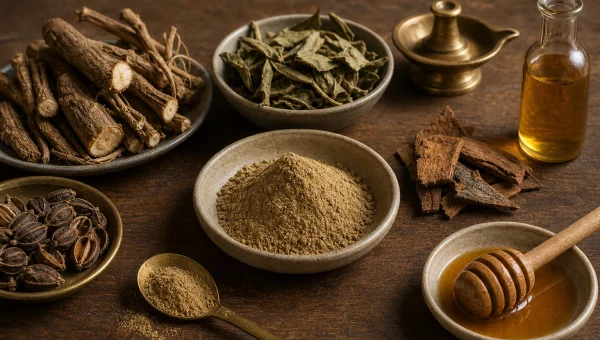
Good Lodhra starts with correct identity. The official Ayurvedic drug is the dried stem bark of Symplocos racemosa Roxb., not the leaf, flower, root, or an unidentified brown bark powder. The Pharmacopoeia describes the bark and powder macroscopically and microscopically, and also gives its characteristic astringent and slightly bitter taste.
When buying Lodhra, choose established Ayurvedic pharmacies or suppliers that clearly state the botanical name, plant part, batch details, and testing standards. Genuine Lodhra powder is typically brownish to reddish-brown and strongly astringent to the taste. If the product has no botanical identity, no batch number, no manufacturer details, or an unusually weak taste, it is better not to use it for menstrual or gynecological concerns.
Who Should Avoid Lodhra?
Lodhra is useful because it is astringent and binding, but those same qualities make it unsuitable in the wrong person or the wrong condition. It should be avoided or used only under supervision in scanty periods, marked dryness, hard constipation, strong Vata aggravation, pregnancy, breastfeeding, unexplained bleeding, severe anemia symptoms, or when taking anticoagulant or antiplatelet medicines.
- Women with scanty or delayed periods should not use Lodhra casually, because its traditional direction is to check excess flow rather than increase flow.
- People with dryness, constipation, low body weight, or Vata-dominant depletion may need nourishing companions or a different herb altogether.
- Pregnant or breastfeeding women should consult a qualified practitioner and healthcare provider before using Ayurvedic herbs internally.
- Anyone with heavy bleeding, dizziness, fatigue, shortness of breath, fainting, or suspected anemia should seek medical evaluation promptly.
- People taking prescription medicines, especially blood thinners or hormone-related medicines, should ask their clinician before starting Lodhra.
Lodhra does not need hype to be valuable. Its strength is its precision: a cooling, astringent bark for carefully selected Kapha-Pitta patterns of excess flow, discharge, swelling, and tissue laxity. Used well, it can be an important part of Ayurvedic care for heavy menstrual bleeding patterns, leucorrhea, and oily or congested skin. Used carelessly, it can dry, bind, or mask conditions that need diagnosis.
Herbal remedies for menstrual and gynecological disorders should complement, not replace, proper medical care. Consult a qualified Ayurvedic practitioner and a healthcare provider if symptoms are severe, recurrent, sudden, painful, associated with pregnancy, or accompanied by weakness, fever, dizziness, or anemia symptoms.
The skin brightening aspect caught my attention but I want to make sure I understand the mechanism. Is it reducing inflammation that causes uneven tone, or something more direct at the melanin level? I have melasma and I’m cautious about anything that claims to affect pigmentation without understanding how it works.
The skin brightening properties of Lodhra can you explain the mechanism more? The article mentions astringency and Varnya action but I’d like to understand whether this is pigmentation regulation or surface brightening through exfoliation.
How does Lodhra compare to Ashoka for dysmenorrhea? My practitioner uses both in combination but I’ve seen them recommended separately elsewhere and I’m not clear on the clinical differentiation.
I had been on the oral contraceptive pill for 8 years to manage PCOS. When I came off it, my periods were chaotic for 14 months. Adding Lodhra and Shatavari under my Ayurvedic doctor’s guidance helped my cycle regulate within 3 months.
Where do you buy quality Lodhra bark or powder? I’ve found it in some Indian grocery stores but don’t know how to evaluate quality. Is there a third-party tested commercial brand that’s reliable?
The face pack application for skin brightening is this appropriate for all skin types or should Pitta types avoid the astringent properties? I have very sensitive reactive skin.
I hadn’t heard of Lodhra before this. The description of it being a go-to herb in traditional Kerala healing families while staying completely off the mainstream radar is interesting — usually the effective ones get commercialized quickly. Is the lack of Western clinical trials the main reason it hasn’t crossed over, or is there a supply or standardization issue with the bark?
Is Lodhra safe during early pregnancy? I take it for PCOS and would want to know when to stop if I become pregnant.
The comment about it not having a marketing campaign captures exactly why traditional knowledge gets lost. The profitable herbs get studied and promoted. The effective but unpatentable herbs stay in the hands of village healers until someone writes an article like this.
The lodhra bark powder sounds interesting for skin brightening especially the rose water mask
Has Lodhra been studied specifically in PCOS? The androgen-modulating activity suggested here is interesting but I’d want to know if there are clinical studies before trying something with potential hormonal effects.
I have been curious about lodhra after reading how it’s used for leucorrhea wonder if the external wash is safe for sensitive skin
Does anyone know if the lodhra and ashoka combo is available as a ready made powder
The article mentions rice water as an anupana I wonder if plain warm water works just as well for the menstrual protocol
I tried the lodhra face pack once and felt my skin a bit tighter after rinsing
It’s good to see a warning about consulting a doctor for heavy bleeding before self treating with herbs
The sourcing advice about buying from established Ayurvedic pharmacies makes sense given the adulteration issue
I appreciate the note about avoiding lodhra during pregnancy due to its uterine contracting nature
Seems like lodhra could be a gentle alternative to harsh chemical toners for evening out skin tone
Good reminder on Lodhra. The practical details matter more than people think.
that’s a fair point. I noticed the Lodhra + Usheera combination approach varies by school
my ayurvedic doctor told me the same thing about the skin brightening mechanism last month. glad to see it here
I had the same issue. didn’t work well for me either
The part about Lodhra + Usheera combination finally cleared up something I’d been confused about for months.
probably best to check with a qualified vaidya on Eladi Churna formula
I’m a nursing student and the skin brightening mechanism isn’t covered in our curriculum at all. Interesting to read the classical view. ✨
I asked my doctor about the skin brightening mechanism and got mixed answers tbh
I notice you don’t mention any contraindications for Lodhra + Usheera combination. That feels like an important omission.
omg the the hormonal regulation claim part is exactly what i needed to read today
been searching for this for weeks. the the hormonal regulation claim explanation makes total sense now
You mention the hormonal regulation claim works for Vata types, but what about mixed Vata-Pitta constitutions?
Tried the the hormonal regulation claim protocol for 3 weeks now, sleep is noticeably better.
Is the Lodhra + Usheera combination version from Kerala classical or is it more modern? नमस्ते
omg the Lodhra for PCOS-related spotting part is exactly what i needed to read today
Where are the actual studies on the hormonal regulation claim? A few citations would strengthen this considerably. नमस्ते
The part about Lodhra feels realistic. The safety notes could be expanded a little.
The part about Lodhra feels realistic. The examples make the advice less abstract.
For the hormonal regulation claim specifically I think the article oversells the benefits. The data I’ve seen is preliminary.
great info on Eladi Churna formula. the dosage breakdown is super clear
Tried the hormonal regulation claim for 6 weeks, honestly didn’t notice much. Maybe my dosage was off.
The the hormonal regulation claim schedule in section 2 , is that for all three doshas or specifically for Kapha?
The Lodhra + Usheera combination schedule in section 2 , is that for all three doshas or specifically for Kapha?
bookmarked. the Lodhra for PCOS-related spotting section saved me so much confusion
yeah the Lodhra + Usheera combination claims need better sourcing 🙏
How long before you start seeing results with Eladi Churna formula? My practitioner said 90 days.
have been doing Lodhra + Usheera combination for about 3 months. Saw improvement in month 2, slight plateau now. ✨
bookmarked. the the hormonal regulation claim section saved me so much confusion
Late to this post but wanted to ask about the hormonal regulation claim , has anything changed since this was published? 🙏