
Hair loss hits differently when you are a man in your 30s who is otherwise healthy, fit, and performing at a high level. Ayurveda discusses progressive hair fall and balding under the Khalitya and Indralupta spectrum, and the useful classical approach is not oil alone. A complete protocol looks at the scalp, digestion, Rakta Dhatu support, stress load, sleep, diet, and the type of hair loss pattern, while also respecting modern factors such as androgen-sensitive follicle miniaturization, inflammation, telogen shedding, dandruff, thyroid imbalance, nutrient deficiency, medication effects, or alopecia areata.
Ayurvedic Pathology of Khalitya
Classical Ayurvedic descriptions do not reduce Khalitya to one local scalp problem. Charaka describes the involvement of Tejas with Vata and other doshas in the region of the scalp, while Sushruta describes Pitta with Vata acting at the Romakupa, followed by Kapha with Rakta obstructing the hair channels and affecting regrowth. In practical terms, Khalitya management aims to cool excessive heat, reduce dryness and strain, clear obstruction, support Rakta, and restore a healthier scalp environment.
Modern male pattern hair loss is commonly described as androgen-sensitive follicle miniaturization in which DHT, 5-alpha-reductase activity, and androgen receptors are relevant at affected scalp sites. This does not mean DHT is literally Pitta, but it gives a useful bridge: when heat, irritation, redness, oiliness, itching, stress, or rapid shedding coexist with recession or crown thinning, Ayurveda treats the terrain around the follicle rather than only the visible symptom.
Internal Protocol: The Herbs That Fit the Pattern
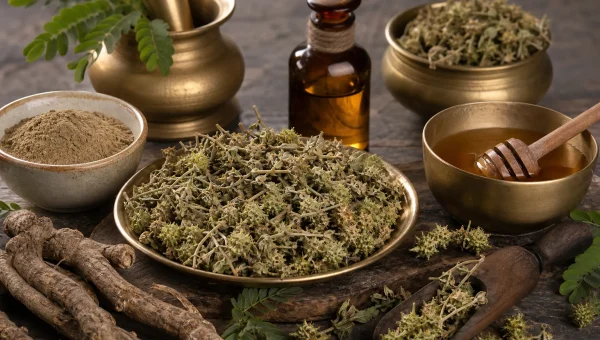
Bhringaraj (Eclipta alba / Eclipta prostrata): Bhringaraj remains the central herb in a Khalitya stack because the Ayurvedic Pharmacopoeia of India lists it as Keshya and Rasayana, and classical formulations such as Bhringaraja Taila and Nili Bhringadi Taila are built around it. Its verified Ayurvedic profile is better described as hair-supportive, rasayana, and Vata-Kapha balancing rather than as a simple “Pitta-cooling DHT blocker.” Use the form and dose selected by a qualified practitioner; the API lists the juice and decoction forms rather than a universal modern extract dose.
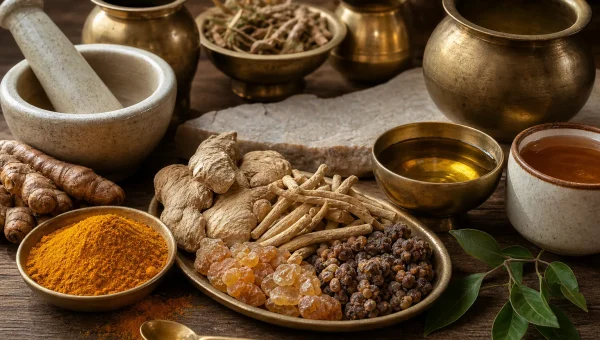
Amalaki (Emblica officinalis / Phyllanthus emblica): Amalaki is useful when the hair-loss picture includes heat, acidity, burning, premature greying tendency, or Pitta-Rakta aggravation. The API lists Amalaki as Shita in virya, Tridoshajit, Rasayana, and a source of ascorbic acid and tannins. It supports the cooling and rejuvenative side of the protocol without overstimulating the system. The API dose for dried Amalaki fruit powder is 3-6 g, but individual dosing should be adjusted to digestion and constitution.
Brahmi (Bacopa monnieri): Brahmi belongs in the protocol when stress, overthinking, poor sleep, mental workload, or stress-related shedding is part of the story. The API lists Brahmi as Medhya, Rasayana, Shita in virya, and Vatahara. Modern monographs also describe Bacopa as a calming cognitive herb with traditional use for anxiety and insomnia. It is not a primary “hair tonic” in the narrow sense; it supports the nervous-system side of the hair-loss pattern.
Haritaki and Triphala: Haritaki is useful when the Khalitya pattern is tied to sluggish digestion, irregular bowels, heaviness, coating, or poor routine. The API lists Haritaki as Dipana, Anulomana, Sarvadoshaprasamana, and Rasayana, and it is a classical component of Triphala Churna. In a hair protocol, Triphala is best understood as digestive and eliminative support, not as a direct scalp stimulant.
Guduchi (Tinospora cordifolia): Guduchi may be selected when the presentation includes inflammatory tendency, heat with depletion, recurrent irritation, or a need for Rasayana and Rakta support. The API lists Guduchi as Tridoshashamaka, Raktashodhaka, Balya, Dipana, and Rasayana. It should not be promoted as a blanket immune herb for every case; concentrated Guduchi products require caution in people with liver disease, autoimmune disease, pregnancy, breastfeeding, or regular medication use.
External Protocol: Beyond Standard Oils
Bhringaraj Taila: Warm Bhringaraj Taila can be applied to the scalp 30-60 minutes before washing, usually 2-4 times weekly depending on scalp oiliness, dandruff, climate, and digestion. The point is not aggressive massage. Use gentle fingertip pressure, cover the scalp evenly, and wash properly so that oil does not build up around the follicles. Bhringaraja Taila is a recognized Ayurvedic formulation associated with Bhringaraj in the API.
Nili Bhringadi Taila: Nili Bhringadi Taila is a classical hair-oil formulation listed among important Bhringaraj formulations in the API. It is best used when a practitioner sees a need for a traditional Keshya oil approach, especially where hair fall and greying tendency are both part of the concern. Apply according to product instructions or clinical guidance rather than assuming that daily heavy oiling is always better.
Coconut Oil for Hair Shaft Protection: When the problem includes brittle hair, breakage, roughness, or washing-related damage, coconut oil can be used on the hair lengths as a pre-wash support. This is different from treating follicle miniaturization. Coconut oil has documented benefit in reducing protein loss from hair when used before or after washing, so it can complement the Ayurvedic scalp protocol for men whose “hair loss” is partly breakage.
Shirodhara: For men whose hair fall worsens with high stress, poor sleep, anxiety, heat in the head, or constant sympathetic arousal, professional Shirodhara may be useful as part of a broader plan. It should be done by a trained practitioner, with proper oil selection and contraindication screening. It is not a replacement for diagnosis when hair loss is patchy, sudden, scarring, infected, or associated with systemic symptoms.
The Khalitya Protocol Stack
The stack below is a clinical framework, not a self-prescription. The exact choices depend on whether the dominant pattern is Pitta-Rakta heat, Vata dryness and stress, Kapha obstruction with oiliness or dandruff, or androgen-sensitive pattern thinning with a modern dermatology diagnosis.
| Intervention | Form | Dose / Application | Timing |
|---|---|---|---|
| Bhringaraj | Juice, decoction, churna, or practitioner-selected preparation | API lists 3-6 ml juice or 12-36 g for decoction preparation | As directed for Keshya and Rasayana support |
| Amalaki | Dried fruit powder or classical preparation | API lists 3-6 g powder | Often morning or as directed when Pitta-Rakta heat is present |
| Brahmi | Whole plant powder or practitioner-selected preparation | API lists 1-3 g powder | Morning or evening depending on stress and sleep pattern |
| Haritaki / Triphala | Churna or classical preparation | Haritaki API dose is 3-6 g powder; Triphala dose should be individualized | Commonly used at bedtime when digestion and elimination need support |
| Guduchi | Stem powder, decoction, or classical preparation | API lists 3-6 g powder or 20-30 g for decoction preparation | Only when clinically suitable; avoid unsupervised concentrated use |
| Bhringaraj Taila | Warm medicated oil | Thin, even scalp application with gentle massage | 2-4 times weekly, 30-60 minutes before washing |
| Nili Bhringadi Taila | Classical medicated oil | Scalp and hair application as directed | Used when a Keshya oil protocol is appropriate |
| Coconut oil | Plain oil for hair lengths | Small amount on lengths, not heavy scalp buildup | Pre-wash support when breakage and roughness are present |
| Shirodhara | Professional procedure | Practitioner-administered | Short course when stress, sleep, and nervous-system load dominate |
Support: Amalaki, cooling routine, Pitta-pacifying diet, suitable medicated oil
Support: gentle warm oiling, Brahmi, stable meals, earlier sleep
Support: Triphala or Haritaki when suitable, Guduchi when indicated, lighter food, clean scalp hygiene
Support: dermatology assessment, stress regulation, Shirodhara when suitable, long-term consistency
Diet for Khalitya: What to Stop Overfeeding
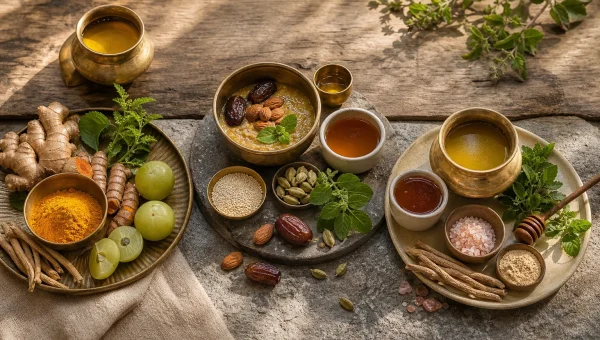
For a Pitta-Kapha scalp pattern, the diet should stop feeding heat, heaviness, and stagnation. Reduce alcohol, repeated fried food, very spicy food, excess sour or fermented food, excess salt, heavy late meals, and large sugar loads. Replace them with regular warm meals, light proteins such as mung dal when suitable, cooked vegetables, Amalaki, adequate hydration, and small amounts of ghee only when digestion supports it. Cold-heavy habits should be avoided when the scalp is oily, itchy, or congested.
Use supportive foods without pretending that one food can replace a proper diagnosis. Pumpkin seed oil has been clinically evaluated in men with androgenetic alopecia, but it should be treated as a supportive dietary option rather than a prescription-strength DHT therapy. Give the protocol a first 90-day review and a fuller 3-6 month window, because visible hair-density change follows the hair cycle and does not move on a two-week supplement timeline.
This article is educational and does not diagnose, treat, or cure hair loss. Consult a qualified Ayurvedic practitioner and a healthcare provider or dermatologist before starting herbs, supplements, medicated oils, detoxes, or procedures, especially if hair loss is sudden, patchy, scarring, associated with itching or infection, or if you are pregnant, breastfeeding, managing liver disease, autoimmune disease, thyroid disease, anemia, a chronic illness, or taking medication. Choose quality-tested products, because some Ayurvedic products have been found to contain unsafe levels of heavy metals.
References
- Ijtsrd (ijtsrd.com)
- Acspublisher (acspublisher.com)
- Easyayurveda (easyayurveda.com)
- NCBI
- The Inflammatory Aspect of Male and Female Pattern Hair Loss (2020), PubMed Central
- Integrative and Mechanistic Approach to the Hair Growth Cycle and Hair Loss (2023), PubMed Central
- My (my.clevelandclinic.org)
- Ayurvedic Pharmacopoeia of India
- Hair growth promoting activity of Eclipta alba in male albino rats (2008), PubMed
- Eclipta alba extract with potential for hair growth promoting activity (2009), PubMed
- Ayurvedic Pharmacopoeia of India
- NCBI
- NCBI
- Effect of mineral oil, sunflower oil, and coconut oil on prevention of hair damage (2003), PubMed
- Shirodhara: A psycho-physiological profile in healthy volunteers (2013), PubMed Central
- Impact of Shirodhara on biological markers of stress: A case study (2021), PubMed Central
- Banyanbotanicals (banyanbotanicals.com)
- Effect of pumpkin seed oil on hair growth in men with androgenetic alopecia: a randomized, double-blind, placebo-controlled trial (2014), PubMed Central
- NCCIH
I started losing hair at 32 and tried Minoxidil for 18 months. It slowed the loss but did not reverse it, and stopping caused an accelerated shed. Starting the internal Bhringaraj and Amalaki protocol alongside the Nasya 4 months ago. Too early to call results but I no longer find handfuls in the drain.
Started this journey as a complete skeptic. Now I recommend it to everyone who asks.
THIS is what i needed to read today, bookmarked it
The Pitta-Vata dual mechanism for Khalitya is something no dermatologist has ever mentioned to me. My pattern, temple recession with inflammatory scalp, matches the Pitta-primary description. The cooling internal herbs alongside the scalp treatments makes sense for this combination.
my whole family has benefited from this site. keep up the amazing work!!
how does pregnancy affect this protocol? Should I pause during the first trimester?
I would like more detail on Khalitya. I would like to know how long to try it before judging results.
I took Bhringaraj oil and Amalaki internally for 4 months. My dermatologist said the mild regrowth at the hairline was consistent with pattern hair loss variability rather than treatment response. I cannot prove he is wrong but the timing and location of the regrowth are suggestive.
Interesting perspective, but I’ve read contradicting information from other Ayurvedic sources. How does a beginner know who to trust?
Useful post on Khalitya. A few more examples would still help.
practical tips at the end 👍 theory is great but the actionable stuff is what I need
I’d appreciate a section on contraindications. Not mentioning who should NOT try this is a significant oversight in health content.
the citations!! finally a wellness blog that actually backs up its claims
I keep coming back to this article. There’s always something new I pick up on each read.
The article’s acknowledgment that DHT sensitivity is constitutional and difficult to fully override is honest. Too many Ayurvedic hair loss articles promise reversal. Managing the inflammatory component and optimizing what can be optimized is a more realistic outcome.
I appreciate the content but the formatting could use work. Hard to follow without clear numbered steps or a summary section.
this changed my perspective completely. was doing it all wrong before lol
Clear, evidence-based and practical. Everything a good health article should be
the part about seeing a doctor is important. wish more wellness sites did this
I appreciate your thoughtful question. I’ll address this in more detail in an upcoming post, but in the meantime, the key is to listen to your body and adjust accordingly.
That’s a very fair point. We always recommend working with a qualified practitioner alongside any self-guided protocol. We’ll add a more prominent disclaimer.
You’ve raised a really important point, thank you! I’m actually planning a follow-up post on exactly this aspect, so stay tuned.
where was this article 5 years ago lol. would have saved me so much trial and error
I’ve been looking for exactly this information for weeks. Thank you for being so thorough.
How long should I continue this before expecting results? I’m on week two with no change yet
I have been combining Ayurvedic scalp treatments with PRP therapy (platelet-rich plasma injections). My practitioner knows about both. The combination has produced better results at 6 months than PRP alone did previously over the same period.
The explanation of Pitta and Vata working together to damage follicles makes a lot of sense when thinking about inflammation and dryness.
The stress-cortisol-Pitta link for telogen effluvium is the missing piece in most hair loss discussions. I lost significant hair during a high stress period. My dermatologist diagnosed TE and said it would resolve. Six months later it had not. The Pitta-clearing approach finally moved things.
The safest part of the Khalitya advice is keeping it simple. This is the kind of detail readers can test slowly.
I appreciate how the article links DHT to heating Pitta activity in the scalp.
I want to know whether the Nasya protocol is safe for someone with deviated septum. My nostril anatomy is asymmetric and I am concerned about oil pooling in one passage.
Using Bhringaraj powder twice a day with warm water seems like a simple internal step to try.
Amalaki’s vitamin C content and its role in collagen support caught my attention.
The stress connection via cortisol and Brahmi’s effect on the HPA axis is an interesting angle.
Including Triphala at bedtime for toxin clearance feels like a gentle addition to a nightly routine.
Guduchi as an immune modulator could help with any autoimmune aspect of hair thinning.
Warm Bhringaraj oil applied before washing offers a practical external method.
Nili Bhringaraj oil targeting premature greying adds a nuanced layer to scalp care.
Shirodhara sounds like a relaxing therapy that might reduce head heat for those with noticeable scalp redness.
starting the diet protocol for hair fall in section 3 next week. will update if I remember to.
Cutting out alcohol fried foods and refined sugar while adding sesame seeds pumpkin seeds beets and coconut water aligns with the dietary advice given.
Does the bhringraj paste application you described work differently for men vs women? curious about this.
The Khalitya section feels grounded enough to try carefully. The examples make the advice less abstract.
Not sure I fully get the nasya connection to hair loss yet. Will re-read the section.
interesting. did you try the nasya connection to hair loss with or without food?
For the bhringraj paste application you described, is morning or evening application better? नमस्ते
Not related to this post but does anyone know a good Ayurvedic remedy for migraines?
What’s the source for the bhringraj paste application you described? asking because I want to look at the original research. धन्यवाद
I was looking for a plain explanation of Khalitya. Would be useful to see a short checklist next.
I was looking for a plain explanation of Khalitya. I would still ask a practitioner before changing medicines.
I was looking for a plain explanation of Khalitya. This is the kind of detail readers can test slowly.
For the nasya connection to hair loss, is morning or evening application better? 🌿
Seems overhyped to me. the diet protocol for hair fall in section 3 didn’t work for anyone in my family.
what’s the source for the diet protocol for hair fall in section 3? asking because I want to look at the original research 🙏
asked my vaidya about the scalp massage technique with warm oil. he agreed but said to add triphala first.
The article is good but the nasya connection to hair loss should come with a stronger dosage caution.
I was looking for a plain explanation of Khalitya. The main idea is clear even if someone is new to Ayurveda.
been thinking about the bhringraj paste application you described for a while. this post clarified some doubts.
the section on the bhringraj paste application you described was helpful. any follow-up posts planned on this?
Late to this post but wanted to ask about the nasya connection to hair loss. Is the guidance still current?
The benefits for the diet protocol for hair fall in section 3 are real but overstated here. took 5 months for mild improvement. नमस्ते
I was looking for a plain explanation of Khalitya. Good starting point for a cautious reader.