
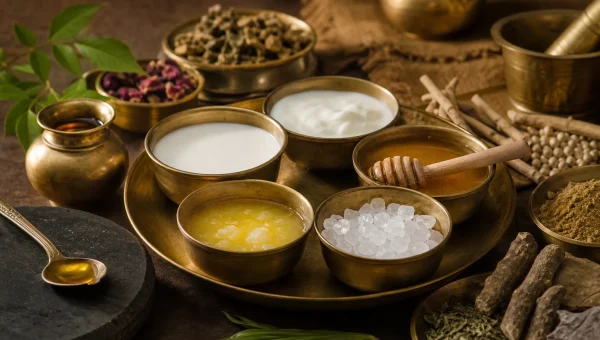
A small cup of warm, spiced liquid can be a practical morning ritual: concentrated enough to taste the herb clearly, simple enough to prepare before breakfast, and gentle enough to fit into a broader Ayurvedic routine.
These five immunity-supporting shots keep the kitchen-remedy spirit while staying grounded in classical Ayurvedic use. They focus on supporting Agni digestion, clearing Kapha-type heaviness, soothing the throat, and nourishing Ojas, the subtle vitality Ayurveda associates with resilience and stable strength.
Why Small, Warm Shots Fit Ayurveda
Ayurveda does not treat immunity as something built from one ingredient alone. Resilience depends on steady digestion, suitable food, sleep, seasonal routine, and the gradual nourishment of Ojas. A small warm shot is best understood as a focused herbal serving that supports these foundations rather than replacing them.
Warm water helps powdered herbs disperse and makes pungent spices easier to take in a small amount. Honey, when used, should be added only after the liquid has cooled to a comfortably warm temperature, because heating honey is traditionally discouraged in Ayurveda.
1. The Golden Shield: Turmeric and Black Pepper Shot
This is the simplest foundational shot, built around Haridra turmeric and Maricha black pepper. It is best for people who want a warming, Kapha-clearing morning preparation that is easy to repeat for a short seasonal cycle.
Ingredients (1 shot)
Use these measures for one small serving. Start with the lower end if you are sensitive to pungent or heating herbs.
- 30 ml (1 oz) warm water
- 1/2 teaspoon turmeric powder (Curcuma longa), about 1.5 to 2 grams
- 1 small pinch freshly ground black pepper (Piper nigrum)
- 1/4 teaspoon raw honey, added only when the liquid is warm, not hot
- 3 drops fresh lemon juice, optional
Method
Keep the water warm enough to dissolve the powder but not so hot that it burns the tongue or heats the honey.
- Add turmeric and black pepper to the warm water.
- Stir until the turmeric is evenly suspended.
- Add lemon juice, if using.
- When the liquid is comfortably warm, stir in honey.
- Drink immediately and follow with a small sip of plain warm water.
Why it works: In the Ayurvedic Pharmacopoeia of India, turmeric is described as pungent and bitter in taste, dry in quality, hot in potency, and Kapha-Pitta balancing in action. Black pepper is pungent, sharp, light, hot, and traditionally used to kindle appetite and support digestion. Modern pharmacological literature also identifies piperine from black pepper as a bioavailability enhancer for curcumin.
Best timing: Take in the morning, about 15 to 20 minutes before breakfast. Use for 2 to 4 weeks, then pause or rotate with a gentler preparation.
2. The Fire Starter: Ginger and Tulsi Shot
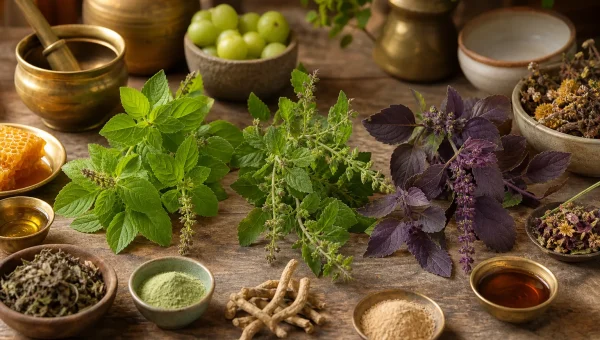
This shot combines fresh ginger with Tulsi for a sharp, aromatic preparation that supports digestion and the respiratory channels. It is useful when the body feels cold, dull, heavy, or Kapha-laden.
Ingredients (1 shot)
Fresh ginger juice gives the strongest taste, while Tulsi leaves add an aromatic, slightly camphor-like note.
- 1-inch piece fresh ginger (Zingiber officinale), about 5 grams
- 5 fresh Tulsi leaves (Ocimum sanctum), or 1/4 teaspoon dried Tulsi powder
- 30 ml (1 oz) warm water
- 1 pinch rock salt
- 1/4 teaspoon raw honey, optional
Method
Prepare this shot fresh, because ginger juice and crushed Tulsi leaves are most aromatic immediately after extraction.
- Grate the ginger finely and squeeze the pulp through a small strainer to obtain about 1 teaspoon of juice.
- Crush the Tulsi leaves and steep them in warm water for 30 to 60 seconds, then strain. If using Tulsi powder, stir it directly into the water.
- Add ginger juice and rock salt.
- When the liquid is comfortably warm, add honey if desired.
- Stir well and drink immediately.
Why it works: Dry ginger, known as Shunthi, is classically described as pungent, hot, digestive, carminative, Vata-Kapha balancing, and useful in Ama-type sluggishness. Tulsi is described as pungent, bitter, astringent, light, dry, sharp, hot, and supportive in traditional conditions of cough, breathlessness, and nasal congestion. Together they make a strong warming shot for Kapha-type seasons.
Best timing: Take in the morning or early afternoon. Avoid taking it late in the evening if heating spices disturb your sleep, acidity, or Pitta balance.
3. The Sour Fortress: Amla and Honey Shot
Amla, or Amalaki, is one of Ayurveda’s important Rasayana fruits. This shot is more cooling and nourishing than the pepper-heavy formulas, making it a better choice when you want support without too much heat.
Ingredients (1 shot)
The amount below uses a small classical-style serving of Amla powder with a pinch of warming cinnamon for balance.
- 1 teaspoon Amla powder (Emblica officinalis / Phyllanthus emblica), about 3 grams
- 30 ml (1 oz) warm water
- 1/2 teaspoon raw honey
- 1 small pinch cinnamon powder (Cinnamomum zeylanicum / Cinnamomum verum)
Method
Amla powder tastes sour and astringent, so stir well and drink it while the powder remains evenly suspended.
- Add Amla powder to warm water and stir thoroughly.
- Add cinnamon and mix again.
- When the liquid is comfortably warm, add honey.
- Drink immediately. Add a little more warm water if the taste is too intense.
Why it works: Amalaki is described in the Ayurvedic Pharmacopoeia of India as having five tastes except salty, with cooling potency and sweet post-digestive effect. It is listed as Rasayana, Tridoshajit, and an ingredient in classical preparations such as Triphala Churna and Chyavanaprasha. Amla fruit is also pharmacopoeially noted for ascorbic acid and tannin constituents. Cinnamon, or Tvak, adds a light, dry, warming, digestive quality to the preparation.
Best timing: Take in the morning on an empty stomach or mid-afternoon between meals. Use for 4 to 6 weeks, then pause and reassess according to digestion, season, and constitution.
4. The Throat Guard: Turmeric, Ginger, Honey, and Yashtimadhu Paste Shot
This preparation is thicker than the others. It is made as a small herbal paste and stirred into warm water when the throat feels dry, coated, or irritated.
Ingredients (about 6 small shots)
Make this in a small batch so the paste stays fresh and clean. Always use a dry spoon when removing it from the jar.
- 2 tablespoons raw honey
- 1 tablespoon turmeric powder (Curcuma longa)
- 1 teaspoon dry ginger powder (Shunthi, Zingiber officinale)
- 1/4 teaspoon finely ground black pepper (Piper nigrum)
- 1/4 teaspoon Yashtimadhu / licorice root powder (Glycyrrhiza glabra)
Method (For the paste)
The paste should be thick, smooth, and golden, with all powders evenly mixed through the honey.
- Place turmeric, dry ginger, black pepper, and Yashtimadhu in a clean, dry jar.
- Add honey and stir until a uniform paste forms.
- Cover tightly and keep in a cool, clean place.
Method (For each shot)
Use warm water, not boiling water, so the honey is not overheated.
- Add 1 teaspoon of the paste to a small cup.
- Pour in 30 ml (1 oz) warm water.
- Stir until the paste loosens into the water.
- Sip slowly, letting it briefly coat the throat before swallowing.
Why it works: Yashtimadhu is described as sweet, heavy, unctuous, cooling, and traditionally used in conditions such as cough and hoarseness. Turmeric, dry ginger, and black pepper add warming, Kapha-clearing, digestive qualities, while honey acts as a traditional vehicle for powdered herbs.
Best timing: Use at the first sign of throat discomfort for short periods only. Because licorice can affect blood pressure and potassium balance in sensitive people, this shot should not be used continuously without professional guidance.
5. The Deep Cleanser: Trikatu and Lemon Shot
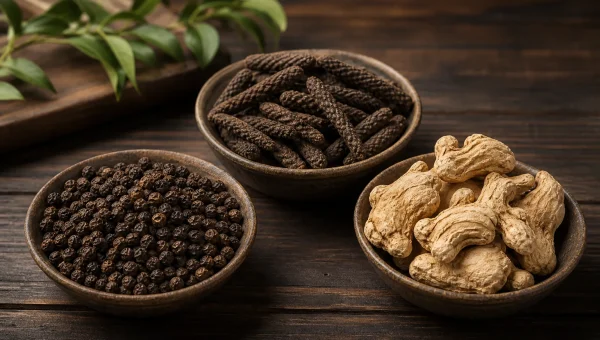
Trikatu means “three pungents”: dry ginger, black pepper, and long pepper. This is the strongest shot in the list and is best suited to Kapha-type heaviness, sluggish digestion, and cold seasonal transitions.
Ingredients (1 shot)
Begin with 1/8 teaspoon if you are new to Trikatu or have a Pitta-sensitive constitution.
- 1/8 to 1/4 teaspoon Trikatu powder, made from equal parts dry ginger, black pepper, and long pepper
- 30 ml (1 oz) warm water
- 3 to 5 drops fresh lemon juice
- 1/4 teaspoon raw honey, optional
Method
This shot is intentionally pungent. It should feel warming, not burning or irritating.
- Stir Trikatu powder into warm water.
- Add lemon juice and mix well.
- When the liquid is comfortably warm, add honey if desired.
- Drink promptly, followed by a sip of plain warm water.
Why it works: Trikatu combines the digestive and Kapha-clearing qualities of Shunthi, Maricha, and Pippali. Classical monographs describe these herbs as supporting Agni, clearing Kapha, and helping with Ama-type heaviness. Long pepper is also listed as Rasayana in the Ayurvedic Pharmacopoeia of India.
Best timing: Take 15 to 20 minutes before lunch, when digestion is usually stronger. Use for 1 to 2 weeks during cold, damp, Kapha-heavy periods. Avoid during gastritis, active acidity, mouth ulcers, bleeding tendency, high Pitta aggravation, or peak summer heat unless guided by a practitioner.
Quick Reference Table
Use this table to choose the shot that best matches the season, digestion, and the way your body feels that day.
| Shot | Primary Ayurvedic Support | Key Herbs | Best Time | Suggested Cycle |
|---|---|---|---|---|
| Golden Shield | Kapha-clearing, digestive support | Turmeric, black pepper | Morning before breakfast | 2 to 4 weeks |
| Fire Starter | Respiratory and digestive warmth | Ginger, Tulsi | Morning or early afternoon | Use during cold or Kapha-heavy periods, with breaks |
| Sour Fortress | Rasayana-style nourishment | Amla, cinnamon | Morning or mid-afternoon | 4 to 6 weeks |
| Throat Guard | Throat soothing and Kapha support | Turmeric, ginger, Yashtimadhu | When throat discomfort begins | Short-term only |
| Deep Cleanser | Agni stimulation and Ama-type heaviness | Trikatu, lemon | Before lunch | 1 to 2 weeks |
Tips for Getting the Most From Your Shots
These preparations work best when treated as part of a daily rhythm, not as a substitute for meals, rest, or medical care.
Use warm water, not boiling water. Warm water disperses powders and makes pungent herbs easier to take. Add honey only after the liquid is comfortably warm.
Take them away from heavy meals. Most of these shots are best before food or between meals, when the stomach is not already full. If a shot causes burning, nausea, or discomfort, reduce the dose or stop.
Rotate according to season and constitution. Trikatu and ginger-heavy shots suit cold, damp, Kapha-type states. Amla is gentler and more cooling. Licorice-containing preparations should be reserved for short-term use.
Prepare powders in advance, but mix liquids fresh. You can keep dry blends such as turmeric-black pepper or Trikatu in a small jar. Add water, honey, and fresh juice only when you are ready to drink.
When to Expect Results
Ayurvedic resilience is gradual. A shot may quickly create warmth, improve the feeling of digestive readiness, or reduce a sense of Kapha heaviness, but Ojas is built through consistent nourishment, sound sleep, stable digestion, and suitable routine over time.
For best results, choose one preparation that matches your constitution and season, use it consistently for a short cycle, and then pause. More pungency is not always better; the right preparation should leave the body feeling clear, comfortable, and steady.
Safety disclaimer: These shots contain concentrated herbs and spices. Turmeric, ginger, and black pepper may not be suitable for everyone using anticoagulant or antiplatelet medicines. Ginger and Amla may require caution for people using diabetes medication. Licorice / Yashtimadhu can affect blood pressure and potassium balance and should be avoided or professionally supervised in people with hypertension, kidney disease, heart disease, pregnancy, or long-term medication use. Pregnant or nursing women, children, older adults, and anyone with a medical condition should consult a qualified Ayurvedic practitioner or healthcare provider before using concentrated herbal preparations. These recipes are not intended to diagnose, treat, cure, or prevent any disease. If symptoms persist or worsen, seek professional medical care.
Keep the ingredients fresh, the water warm, and the dose modest. A two-minute herbal shot is most valuable when it supports the larger Ayurvedic foundations of digestion, rest, seasonal awareness, and steady daily care.
References
- Ayurvedic Pharmacopoeia of India
- Ia800501 (ia800501.us.archive.org)
- Influence of piperine on the pharmacokinetics of curcumin in animals and human volunteers (1998), PubMed
- Gingerols and shogaols: Important nutraceutical principles from ginger (2015), PubMed
- An Ayurvedic formulation ‘Trikatu’ and its constituents (1992), PubMed
- Studies on the physicochemical characteristics of heated honey, honey mixed with ghee and their food consumption pattern by rats (2010), PubMed Central
- Ayushdhara (ayushdhara.in)
- NCCIH
- Medsafe (medsafe.govt.nz)
- NCCIH
- NCBI
- NCCIH
- A low dose of daily licorice intake affects renin, aldosterone, and home blood pressure in a randomized crossover trial (2024), PubMed
Made the turmeric and black pepper shot this morning and honestly was surprised how drinkable it is. I expected it to taste medicinal but the honey balanced it out completely. How critical is it to use raw honey versus regular? I only have the processed kind at home right now.
omg this is exactly what I needed today.. bookmarked for later
The small brass cup description from Kerala kitchens is my childhood. I thought it was just my family. Nice to see it described as a tradition with actual reason behind it.
I tried the tulsi-ginger shot as my daily immunity support this winter. Got through December and January without a single cold for the first time I can remember.
Can any of these five be taken during active illness or are they better as preventive? Specifically asking about the Trikatu shot when someone already has a cold.
This makes sense for 5 Ayurvedic Immunity Shots You Can Make. The practical details matter more than people think.
I make three of these weekly in a small batch and keep them in the fridge. Does advance preparation change the potency of any of them? The fresh approach works best but batch prep makes daily use more realistic.
The ginger-honey-pepper shot is the one I use when I feel a sore throat coming on. It’s reliably stopped the progression twice now in situations where I would previously have developed a full cold.
which of the five is appropriate for children? I’d adapt the quantities but want to know if there are any contraindications for the under-12 age group.
How long can the turmeric paste stay fresh if kept in a glass jar?
The Shatavari milk shot for women specifically is something I hadn’t seen before. Good to have an option that isn’t as pungent as the others for mornings when spicy isn’t tolerable.
The 2-minute preparation time is accurate only if your ingredients are already out and prepped. Add 5 minutes for grating ginger and measuring everything from scratch. Not a criticism just a realistic note.
I like that the recipes use measurements in both ml and teaspoons, makes it easy to follow without a scale.
I wonder if the honey really needs to be added after cooling, or if warm water still works.
Trying the ginger tulsi shot gave me a warm feeling in my chest.
The brass cup detail makes the tradition feel real.
Taking the shot twenty minutes before breakfast fits well with my morning routine.