
Ayurvedic Approach to Hormonal Acne: Treating the Root Cause
Hormonal acne is one of the most persistent forms of adult acne, often appearing around the chin, jawline, lower cheeks, and premenstrual window. In Ayurveda, acne-like facial eruptions are discussed under Mukhadushika and Yauvana Pidaka. The classical description emphasizes eruptions on the face of young people caused by vitiated Kapha, Vata, and Rakta. For cyclical, inflamed, painful, oily, or cystic breakouts, Ayurvedic care focuses on the internal pattern behind the skin expression: heat in Rakta, Kapha congestion in the channels, irregular Vata, impaired Agni, and lifestyle factors that repeatedly disturb the same pattern.
Understanding Hormonal Acne in an Ayurvedic Framework
Modern dermatology describes acne as an inflammatory condition of hair follicles and sebaceous glands, involving excess sebum, follicular plugging, microbial imbalance, and inflammation. Ayurveda views the same presentation through dosha, dhatu, srotas, Agni, and nidana. In the classical description of Mukhadushika, the main pathological factors are Kapha, Vata, and Rakta; when lesions are red, hot, tender, or pustular, a Pitta-Rakta interpretation is clinically relevant because Rakta and Pitta share heat-bearing qualities.
- Kapha involvement: oiliness, heaviness, whiteheads, clogged pores, thick secretions, and slow-resolving cystic depth.
- Vata involvement: pain, dryness around lesions, irregular flare patterns, sensitivity, and worsening with stress, travel, poor sleep, or menstrual irregularity.
- Rakta and Pitta involvement: redness, heat, burning, pustules, post-inflammatory discoloration, and aggravation after hot, sour, salty, fried, spicy, or alcoholic intake.
The Menstrual Cycle and Breakout Patterns
Hormonal acne commonly follows a cyclical pattern, especially before menstruation. Ayurveda uses this pattern as a practical guide rather than a rigid rule. The aim is to observe when oiliness, tenderness, redness, dryness, cravings, constipation, stress, or disturbed sleep intensify, then adjust diet, herbs, cleansing, and topical care before the breakout peak.
- Menstrual phase: Vata is easily disturbed, so the skin may feel sensitive, dry, dull, or reactive. Gentle cleansing, rest, warm cooked food, and minimal topical intervention are preferred.
- Post-menstrual and follicular phase: Kapha rebuilding predominates. If Kapha is excessive, oiliness, pore congestion, and under-surface bumps may begin. Light, bitter, astringent foods and gentle herbal cleansing are helpful.
- Ovulatory phase: Heat and circulation are more prominent. Pitta-Rakta signs such as redness, tenderness, and inflammatory lesions may become more visible in sensitive individuals.
- Luteal and premenstrual phase: Pitta, Vata, and Kapha congestion may overlap. This is often the most important window for prevention: avoid heating foods, maintain bowel regularity, reduce stress overload, and use calming topical care.
Understanding these patterns supports cycle-syncing approaches to skincare that work with the monthly rhythm instead of waiting until breakouts are already inflamed.
Root Cause Analysis: The Four Pillars
An Ayurvedic root-cause approach does not treat acne as a purely cosmetic problem. It studies the repeated triggers behind the skin pattern, then corrects the internal terrain that allows lesions to recur. The four most useful pillars are Pitta-Rakta heat, Kapha congestion, impaired Agni with Ama, and disturbed Vata rhythm.
1. Pitta-Rakta Heat
Excess heat may appear as redness, burning, pustules, tenderness, and dark or red post-acne marks. Common aggravating factors include hot and spicy foods, sour and fermented foods, excess salt, alcohol, sun exposure, sleep deprivation, anger, frustration, and high-pressure routines. Cooling, bitter, mildly astringent, and Rakta-supportive measures are prioritized when the face feels hot and inflamed.
2. Kapha-Meda Congestion
Kapha contributes oiliness, heaviness, swelling, slow drainage, thick secretions, and clogged pores. Excessively heavy, sweet, oily, fried, dairy-rich, cold, or processed diets can worsen this pattern, especially when digestion is sluggish. Treatment focuses on lightening the diet, supporting Agni, clearing channels, and using drying or astringent topical herbs when appropriate.
3. Agni, Ama, and the Gut-Skin Axis
Ayurveda places Agni at the center of skin health because poor digestion can create Ama, disturb the channels, and affect Rakta quality. Modern discussions of the gut-skin axis also connect intestinal microbial balance, immune signaling, and inflammatory skin conditions. For acne patterns with bloating, constipation, coated tongue, heaviness, cravings, or irregular appetite, digestive correction is as important as facial care.
4. Vata Rhythm and Apana Vata
Hormonal acne often worsens when Vata is disturbed by irregular sleep, travel, excessive fasting, stress, anxiety, overwork, or menstrual irregularity. Apana Vata governs downward elimination and the menstrual cycle; when it is disturbed, premenstrual symptoms, constipation, painful periods, and irregular breakout timing may appear together. Regular meals, adequate rest, warm cooked foods, oil massage when suitable, and calming breath practices help restore rhythm.
Internal Herbal Support
Internal herbs for hormonal acne should be selected according to constitution, menstrual history, bowel pattern, digestive strength, medication use, pregnancy status, and severity of lesions. The following herbs and formulations are traditionally relevant, but they should be used under the guidance of a qualified Ayurvedic practitioner, especially in cystic acne, PCOS-like symptoms, pregnancy, breastfeeding, liver disease, or when taking prescription medicines.
Shatavari (Asparagus racemosus) for Cooling and Nourishment
Shatavari is a cooling, nourishing Rasayana with Madhura and Tikta taste, Guru and Snigdha qualities, Shita virya, and Madhura vipaka. In acne patterns marked by heat, dryness, irritability, premenstrual depletion, or Pitta aggravation, Shatavari may be used as a supportive herb rather than as a stand-alone acne treatment. It is most appropriate when the person needs cooling, tissue nourishment, and reproductive-system support without increasing Kapha excessively.
Neem (Azadirachta indica) for Kapha-Pitta Skin Patterns
Neem is bitter, cooling, drying, and traditionally used in skin, itching, wound, and heat-related conditions. Its Ruksha quality makes it especially useful when acne is oily, pustular, itchy, or Kapha-Pitta dominant. Because it can be too drying or depleting for some Vata constitutions, long-term internal use should be individualized rather than taken casually.
Manjistha (Rubia cordifolia) for Rakta-Oriented Skin Care
Manjistha is a classical skin and Rakta-supportive herb with Varnya, Shothaghna, Kushthaghna, Shonitasthapana, and Rasayana actions described in the Ayurvedic Pharmacopoeia of India. It is commonly chosen when acne is associated with redness, swelling, post-inflammatory marks, sluggish lymphatic drainage, or recurrent Rakta-Pitta signs. Its Ushna virya means it should be combined carefully in strongly heat-dominant individuals.
Guduchi (Tinospora cordifolia) for Agni, Rakta, and Resilience
Guduchi is described as Tikta-Kashaya in taste, Laghu in quality, Madhura in vipaka, and Rasayana in action. The Ayurvedic Pharmacopoeia lists actions including Dipana, Balya, Tridoshashamaka, Raktashodhaka, and Jvaraghna. In acne care, Guduchi is useful when the pattern includes weak digestion, recurrent inflammation, heat, fatigue, or a need for broader constitutional support.
Kaishore Guggulu for Deep, Recurrent, Practitioner-Directed Cases
Kaishore Guggulu is a classical Guggulu formulation used in Vata-Rakta and inflammatory patterns, with important ingredients such as Guduchi and Guggulu. In acne care, practitioners may consider it when lesions are deep, tender, recurrent, and associated with Kapha congestion and Rakta involvement. Because Guggulu preparations can interact with medications and may not suit pregnancy, bleeding disorders, thyroid medication use, liver concerns, or sensitive digestion, they should not be self-prescribed.
External Treatment Protocol
External care should match the stage of the breakout. Active, inflamed, oily lesions need cooling, cleansing, and non-clogging support; post-acne discoloration and dryness need gentler nourishment. Patch testing is important because acne-prone skin may react to oils, essential oils, herbal powders, fragrances, or over-exfoliation.
Kumkumadi Tailam
Kumkumadi Tailam is a classical saffron-led facial oil preparation described in Ayurvedic cosmetic practice. It is best reserved for dryness, dullness, uneven tone, and post-acne marks after active inflammation has calmed. For acne-prone skin, only a few drops should be used, preferably after patch testing; it may be unsuitable during very oily, pustular, or actively cystic phases.
Neem-Turmeric Paste
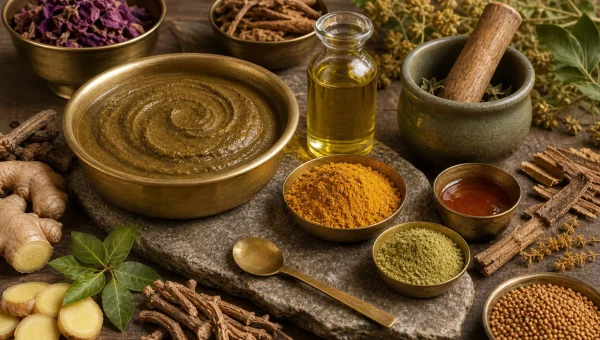
Neem and turmeric paste is a simple topical option for oily, inflamed, Kapha-Pitta skin. Neem brings bitter, cooling, drying qualities, while turmeric and curcumin are widely described for anti-inflammatory and antimicrobial potential in skin care. A thin paste may be applied briefly and rinsed fully; avoid aggressive scrubbing, prolonged use, or application on broken, highly irritated skin.
Lodhra Face Pack
Lodhra (Symplocos racemosa) is Kashaya and Tikta in taste, cooling in virya, and traditionally associated with Varnya and Shothahara actions. A Lodhra face pack with rose water or aloe vera can be useful when the skin is oily, red, swollen, or loose-pored. It should be used gently and discontinued if it causes excessive dryness or irritation.
Cooling Aloe, Rose, and Sandalwood Support
For heat-dominant acne, simple cooling topicals are often preferable to heavy oils or harsh exfoliants. Aloe vera gel, rose water, and sandalwood-based preparations may be used to calm heat, redness, and burning sensations when they suit the individual skin type. These should be clean, non-irritating, and free from heavy fragrance when used on acne-prone skin.
Reading Breakout Patterns Without Rigid Face Mapping
Breakout location can be useful, but it should not be treated as a precise organ-diagnosis map. The most reliable approach is to combine location with timing, lesion type, digestion, menstrual pattern, stress load, topical product use, and lifestyle triggers. Jawline acne that flares predictably around the period is more suggestive of a hormonal pattern than an isolated “organ” signal.
| Pattern | Common Clues | Ayurvedic Reading | Practical Response |
|---|---|---|---|
| Chin and jawline | Premenstrual flares, tender cysts, irregular cycles, excess facial hair, or weight changes | Vata-Pitta disturbance with Rakta involvement; consider Apana Vata and reproductive rhythm | Cycle tracking, cooling diet, bowel regularity, stress reduction, and medical evaluation if PCOS signs appear |
| Forehead and hairline | Oiliness, sweat, hair products, clogged pores, late nights, or digestive heaviness | Kapha congestion with Agni disturbance | Light diet, gentle cleansing, avoid comedogenic hair products, support digestion |
| Cheeks | Mask friction, phone contact, cosmetics, heat, redness, or recurring inflammation | Pitta-Rakta irritation with possible external nidana | Clean contact surfaces, simplify skincare, use cooling topical care, reduce heating triggers |
| T-zone | Excess oil, blackheads, whiteheads, enlarged pores | Kapha-Pitta accumulation | Use light, non-comedogenic products, bitter-astringent foods, and mild herbal cleansing |
Diet Modifications for Hormonal Acne
Diet is the first daily medicine in Ayurvedic acne management. For hormonal acne with Pitta-Rakta and Kapha congestion, meals should reduce heat, support Agni, maintain bowel regularity, and avoid foods that repeatedly produce oiliness, heaviness, acidity, or inflammation.
Foods to Emphasize
Choose simple, fresh, cooked, seasonal foods that cool Pitta without weakening digestion. Favor bitter, astringent, and mildly sweet foods when they suit your constitution and appetite.
- Bitter and astringent vegetables such as bitter gourd, leafy greens, coriander leaves, and tender greens
- Cooling fruits such as pomegranate, sweet grapes, ripe melon, and coconut in moderation
- Light whole grains such as basmati rice, barley, oats, and millets when well tolerated
- Mung dal, vegetable soups, and lightly spiced khichadi for Agni support
- Cooling digestive spices such as coriander, fennel, cumin, and small amounts of turmeric
- Moderate ghee when digestion is strong and the acne pattern is not heavily oily or congestive
- Adequate hydration, preferably room-temperature water or herbal infusions suited to the season
Foods to Minimize or Avoid
Reduce foods that aggravate Pitta heat, Kapha congestion, or Ama formation. The exact level of restriction should be individualized, but repeated flare triggers should be taken seriously.
- Very spicy, sour, fermented, salty, fried, and oily foods
- Excess refined sugar, packaged snacks, and highly processed foods
- Frequent heavy dairy, especially cheese, sweetened dairy, and yogurt at night when congestion is present
- Alcohol, excess caffeine, and late-night heavy meals
- Overeating, meal skipping, and irregular meal timing
Cycle-Syncing Skincare
Cycle-syncing skincare applies Ayurvedic observation to the monthly rhythm. Instead of using the same strong treatment every day, the routine becomes gentler during sensitivity, lighter during congestion, and cooler during heat.
- Menstrual phase: Keep skincare minimal. Use gentle cleansing, avoid harsh exfoliation, and choose soothing hydration if the skin is dry or sensitive.
- Post-menstrual phase: Use mild herbal cleansing or ubtan when the skin is stable. If pores clog easily, add a gentle neem or Lodhra-based mask once weekly.
- Ovulatory phase: Focus on cooling and calming. Aloe vera, rose water, and sandalwood-based preparations are better than aggressive peels or strong scrubs.
- Premenstrual phase: Begin prevention early. Reduce heating foods, support elimination, avoid new comedogenic products, and use Lodhra, neem, or turmeric topicals only if they do not irritate the skin.
Lifestyle Practices for Hormonal Acne
Ayurveda treats lifestyle as part of the prescription. Acne that recurs every cycle rarely clears with topical care alone if sleep, stress, digestion, sweating, bowel rhythm, and menstrual health remain disturbed.
Stress Management and Emotional Balance
Stress and emotional intensity can aggravate Vata and Pitta, worsening pain, sensitivity, heat, and premenstrual flares. Gentle Pranayama practices such as Sheetali and Nadi Shodhana, regular meditation, time outdoors away from heat, and consistent daily rhythm support both skin and menstrual balance.
Sleep Hygiene
Regular sleep supports Agni, Vata stability, and skin repair. Staying up late, working intensely at night, and using screens until bedtime can aggravate heat and irregularity in many acne-prone patterns. A steady bedtime, lighter dinner, and a calming evening routine are preferred over late-night stimulation.
Exercise Considerations
Moderate exercise supports circulation, sweating, lymphatic movement, mood, and metabolic health. When acne is very red, hot, or inflamed, excessively intense exercise, hot yoga, and prolonged exercise in direct sun may aggravate Pitta. Walking, swimming, moderate cycling, and balanced yoga are often better choices.
Virechana for Persistent Pitta-Rakta Cases
For stubborn acne with strong Pitta-Rakta signs, a qualified Ayurvedic physician may consider Virechana as part of a broader Shodhana plan. This is not a home remedy. It requires assessment, preparation, supervision, and post-therapy diet, and it should be avoided unless a practitioner determines that the person is fit for the procedure.
Modern Dermatology Context
Hormonal acne should be managed with respect for both Ayurvedic pattern recognition and medical diagnosis. Dermatology recognizes hormonal acne as acne that may persist into adulthood, commonly appears on the lower face, and often flares in relation to the menstrual cycle. Small modern acne trials have evaluated oral guggulipid, and modern skin literature also discusses gut-skin communication and curcumin’s anti-inflammatory pathways. These points can support an integrative plan, but they do not replace diagnosis or prescription treatment when acne is severe, scarring, painful, or associated with endocrine symptoms.
Understanding the Pitta skin type and its tendencies toward redness, heat, and inflammation helps customize treatment protocols without ignoring Kapha congestion, Vata irregularity, or Rakta involvement.
When to See a Dermatologist or Endocrinologist
Ayurvedic treatment is most appropriate for mild to moderate acne and for supporting diet, lifestyle, digestion, cycle rhythm, and skin recovery. Medical consultation is essential when acne is severe, scarring, rapidly worsening, emotionally distressing, or linked with signs of hormonal disorder.
- Severe cystic acne, nodules, scarring, or significant pain
- Acne with irregular periods, missed periods, excess facial or body hair, scalp hair thinning, unexplained weight gain, or suspected PCOS
- No improvement after 3-4 months of consistent, appropriate care
- Acne appearing with thyroid, adrenal, or other endocrine symptoms
- Use of oral contraceptives, spironolactone, isotretinoin, antibiotics, fertility medicines, anticoagulants, thyroid medication, or liver-affecting medicines
- Pregnancy, breastfeeding, trying to conceive, or a history of significant medical conditions
Herbs such as Neem, Guggulu, Shatavari, Guduchi, Manjistha, and classical formulations may not suit every person and may interact with medicines or medical conditions. Always consult a qualified Ayurvedic practitioner and a healthcare provider before starting internal herbal treatment for hormonal acne.
Priya Nair is a certified Ayurvedic wellness consultant and women’s health educator. This article is for informational purposes only and does not replace medical advice, diagnosis, or treatment.
References
- Easyayurveda (easyayurveda.com)
- Niams (niams.nih.gov)
- Aad (aad.org)
- My (my.clevelandclinic.org)
- Perimenstrual flare of adult acne (2014), PubMed Central
- World Health Organization
- The Gut Microbiome as a Major Regulator of the Gut-Skin Axis (2018), PubMed Central
- Potential Role of the Microbiome in Acne: A Comprehensive Review (2019), PubMed Central
- Mdpi (mdpi.com)
- Ayurvedic Pharmacopoeia of India
- Ayurvedic Pharmacopoeia of India
- Ayurvedic Pharmacopoeia of India
- Ayurvedic Pharmacopoeia of India
- Tinospora cordifolia (Willd.) Hook. f. and Thoms. (Guduchi) – validation of the Ayurvedic pharmacology through experimental and clinical studies (2010), PubMed Central
- Ijrap (ijrap.net)
- Nodulocystic acne: oral gugulipid versus tetracycline (1994), PubMed
- Ijdvl (ijdvl.com)
- Guggulipid for the treatment of hypercholesterolemia: a randomized controlled trial (2003), PubMed
- Ijapr (ijapr.in)
- Effects of Turmeric (Curcuma longa) on Skin Health: A Systematic Review of the Clinical Evidence (2016), PubMed
- Potential of Curcumin in Skin Disorders (2019), PubMed Central
- Link (link.springer.com)
- Ia800501 (ia800501.us.archive.org)
- NCCIH
I run a small Ayurvedic beauty brand and content like this educates customers in ways that make my work easier. Well-written educational material raises everyone.
The combination approach you described is exactly what my practitioner recommended too. Validation always feels good
The Approach to Hormonal Acne explanation is clearer than most short posts. The examples make the advice less abstract.
As someone with Kapha skin tendencies, the specific guidance for my skin type is so much more useful than generic skincare advice. My pores are visibly clearer
I switched to an Ayurvedic skincare routine six months ago and the improvement in my skin texture is genuinely remarkable. My esthetician keeps asking what I’m doing differently.
I had the exact same confusion about this. Glad the article cleared it up for both of us.
The Approach to Hormonal Acne explanation is clearer than most short posts. I appreciate that it does not oversell the result.
I’ve been incorporating these practices into my self-care ritual and the psychological effect is as meaningful as the physical. It’s a form of self-honoring that feels good.
I appreciate you sharing the skeptical perspective too. It keeps the conversation grounded
I’m a dermatologist interested in integrative approaches and the discussion of skin as a reflection of gut health is something I discuss with patients regularly.
I shared this with my book club, we have a wellness focus this month. Everyone immediately wanted to try the face mask recipe. It’s become our next group activity
Three months sounds right from my experience too. Commit to that and then evaluate.
The Approach to Hormonal Acne explanation is clearer than most short posts. Would be useful to see a short checklist next.
I had the exact same confusion about this. Glad the article cleared it up for both of us
I liked the practical side of Approach to Hormonal Acne. A few more examples would still help.
The Approach to Hormonal Acne explanation is clearer than most short posts. This feels more usable than a long list of herbs.
The Approach to Hormonal Acne explanation is clearer than most short posts. A few more examples would still help.
wonderful to see someone from a medical background engaging with this content thoughtfully
Hormonal acne ran my life from age 17 to 32. Spironolactone worked for the symptoms but the root cause was never addressed and the second I stopped it came back worse. The liver and blood purification approach in this post is the first framework that has made sense to me mechanistically.
I have Pitta skin and the cooling, calming recommendations here resonate exactly with what my skin responds well to. Finally a skincare approach built for my constitution
The ingredient explanations are practical. I’ve always read ingredient lists but this gives me a framework for understanding what those ingredients are actually doing.
The grandmothers always knew! I keep finding that traditional knowledge holds up to modern scrutiny.
How long before seeing results with this protocol? My practitioner said 4 weeks but I’m seeing other timelines mentioned online.
The explanation of how processed foods affect skin at a systemic level helped me make the dietary changes I’d been resistant to. External changes alone weren’t working
Your comment about the dosage issue is so important. Getting it right makes all the difference.
The Approach to Hormonal Acne explanation is clearer than most short posts. This would be easier to follow with a one-week sample plan.
the hair care section in your related article brought me here. Now I’m going down a rabbit hole of Ayurvedic beauty knowledge. Everything connects so logically
I’m going to share this comment with my skeptical partner. Exactly what I needed to articulate why this works.
I’d been spending a fortune on fancy serums. After implementing the Ayurvedic basics here, oil cleansing, herbal toners, the diet changes, my skin looks better than it ever did.
I came here to say exactly this and you said it better. Completely agree.
the Rasa and tissue nourishment explanation is a really different way of thinking about skin health. Surface-level treatments make more sense when you understand the layers beneath.
The Ubtan recipe here works better for my skin than any commercial exfoliant I’ve tried. And it costs a fraction of the price. My whole family has switched
I was looking for a plain explanation of Approach to Hormonal Acne. Small daily changes are easier to follow than a perfect plan.
the general advice is sound but the claim that this ‘cures’ or ‘fixes’ the condition is irresponsible wording. ‘May help manage’ is more accurate.
I tried the Neem and Manjistha blood purification approach for 3 months and the deep cystic acne reduced by about 60 percent. The surface congestion on my forehead actually got slightly worse before improving, which I assume was a purification reaction.
Is Shatavari appropriate for acne if it is driven by excess estrogen rather than androgen dominance? The article seems to assume androgen excess as the driver but for some women the pattern is the opposite and phytoestrogenic herbs could potentially make it worse.
Appreciate you keeping us honest. We’ve noted your feedback about dosage specificity and will address it in a revised version of this article.
The concept is great but the execution could be better. A lot of ‘do this’ without explaining the why behind each step
Your skepticism is healthy and welcome. We never intend for our content to replace medical advice, and we’ll make that clearer going forward.
Bought the pitta supplement from a reputable supplier, followed the protocol for 2 months. Nothing. I want to believe but my experience doesn’t match what’s described here.
I was looking for a plain explanation of Approach to Hormonal Acne. The article avoids making it sound like a quick fix.
The dosha framework is interesting philosophically, but I think attributing every health issue to dosha imbalance oversimplifies complex medical conditions.
My concern with articles like this is that people might delay proper medical treatment. A stronger disclaimer would be responsible
That’s a very fair point. We always recommend working with a qualified practitioner alongside any self-guided protocol. We’ll add a more prominent disclaimer.
The diet section is where this becomes genuinely useful for implementation. Cutting dairy and refined sugar is conventional advice but the Ayurvedic framework for why these aggravate both Kapha and Pitta depending on constitution gives you a personalized approach rather than a blanket elimination.
The explanation of how Pitta aggravation leads to Rakta Dushti helped me see why my breakouts flare after spicy meals.
My dermatologist told me my cystic acne was purely hormonal, specifically elevated DHT on bloodwork, and would require either isotretinoin or long-term spiro. Has anyone here successfully cleared DHT-driven acne using only Ayurvedic approaches? 6 months? 12 months? What were the herbs and timeline?
I had to stop the Guggul protocol after 4 weeks because it was causing significant heartburn and upper GI discomfort. The article does not mention this common side effect of Guggul, especially at higher doses. People with Pitta constitution should probably be warned.
The connection between stress-triggered cortisol spikes and Pitta aggravation explains why my acne always clusters around exam periods and high-pressure work deadlines. I had been treating these flares with topical products when the input is entirely internal and stress-driven.
I wonder if the neem turmeric paste works as well for cystic lesions as the article suggests for surface inflammation.
Three years following Ayurvedic protocols for hormonal acne. The blood purification approach using Manjistha combined with strict dietary discipline cleared my skin in a way that 7 years of topical retinoids and two rounds of antibiotics did not. I do not think conventional dermatology addresses the systemic cause.
It makes sense to focus on liver support when dealing with hormonal acne, especially after noticing more oiliness during stressful weeks.
I’m skeptical of the bioavailability claims. The pharmacokinetics of many Ayurvedic compounds are not well studied and absorption varies hugely based on preparation.
The cycle syncing skincare tips line up with what I’ve noticed about my skin being oilier right after ovulation.
For anyone asking about timeline, in my experience it took 4 months before I saw meaningful improvement using the Neem plus Guduchi plus dietary changes protocol. The first month was actually slightly worse as the purification process seemed to increase surface congestion initially.
Reading about Shatavari’s cooling quality makes me curious about trying it alongside my current vitamin routine.
The seasonal variation advice is the part most Ayurveda articles skip. The quality of the herb matters a lot.
The avoidance of cold foods during treatment is something my body confirmed independently. Digestive improvement came before other benefits.
Been researching this for my father. The practical tips are what he can actually follow. Still a work in progress.
I’ve tried multiple approaches before landing on what the article recommends. Digestive improvement came before other benefits.
The safety profile section is the most important part and it’s well done. The diet changes helped too.
Any recommended books for deeper reading on this topic? The timing of doses matters more than I expected.
The mechanism explanation is clearer than the PubMed abstract I read. Still a work in progress.
The face mapping chart linking chin breakouts to reproductive organs feels like a useful guide for tracking patterns.
Finding a quality herb source is harder than following the protocol itself. The timing of doses matters more than I expected.
Guduchi for the inflammatory component alongside Shatavari for the hormonal complementary dual approach.
The mechanism explanation is clearer than the PubMed abstract I read. More research needed but encouraging.
Finding a quality herb source is harder than following the protocol itself. Consistency seems to be the key.
The dosage section here is more specific than most sources I’ve seen. My sleep improved first, then energy.
The seasonal variation advice is the part most Ayurveda articles skip. Results are slow but steady.
I’ve tried multiple approaches before landing on what the article recommends. Finding a good source was the challenge.
Started this last February and will report back after 3 months. Digestive improvement came before other benefits.
I appreciate the caution about combining Ayurvedic herbs with prescriptions; it’s something I’ll discuss with my doctor.
The underlying Pitta vs the triggering hormonal fluctuation treating both simultaneously is the approach here.
Shared this with my mother who has been dealing with this for 5 years. More research needed but encouraging.
Been following this for 4 weeks and noticed less bloating. Combined with yoga practice for better results.
The suggestion to avoid hot yoga and intense cardio resonates because I’ve seen more redness after those workouts.
The herb quality issue is real I’ve noticed significant variation across brands. Took 3 weeks before I noticed anything.
My integrative doctor agrees with this approach, which surprised me. My sleep improved first, then energy.
Using Kumkumadi Tailam at night sounds nice, but I’m unsure if the saffron oil will clog my pores.
The Lepa (paste) formulation Lodhra, Vacha, Chandana article doesn’t give proportions.
The contraindication list should be read first before starting anything here. The timing of doses matters more than I expected.
Started this last October and will report back after 3 months. Finding a good source was the challenge.
The diet changes listed here are harder to follow than the herbs but more impactful. Will update in a few months.
The seasonal variation advice is the part most Ayurveda articles skip. Still a work in progress.
The mention of Ama from poor digestion makes me want to pay more attention to meal timing and hydration.
Would appreciate a follow-up article specifically on the dosage for elderly patients. Digestive improvement came before other benefits.
The safety profile section is the most important part and it’s well done. Still a work in progress.
The contraindication list should be read first before starting anything here. Still a work in progress.
Is this safe with antacids? More research needed but encouraging.
I’ve tried multiple approaches before landing on what the article recommends. My sleep improved first, then energy.
The mechanism explanation is clearer than the PubMed abstract I read. The diet changes helped too.
Shatavari for the Pitta-hormonal component of acne. 6 weeks and chin breakout frequency dropped by half.
The contraindication list should be read first before starting anything here. Finding a good source was the challenge.
My integrative doctor agrees with this approach, which surprised me. My practitioner is monitoring.
Late to this post but it answered a question I’ve had for months. The diet changes helped too.
The seasonal variation advice is the part most Ayurveda articles skip. The timing of doses matters more than I expected.
The dosage section here is more specific than most sources I’ve seen. Consistency seems to be the key.
I appreciate that the article mentions when to see a doctor rather than only promoting herbs. My practitioner is monitoring.
Late to this post but it answered a question I’ve had for months. The quality of the herb matters a lot.
Would love to see a version of this article aimed at practitioners. Started with half the dose initially.
The classical Sanskrit terms with explanations are helpful for beginners. My practitioner is monitoring.
The avoidance of cold foods during treatment is something my body confirmed independently. More research needed but encouraging.
The mechanism explanation is clearer than the PubMed abstract I read. Started with half the dose initially.
Is this safe with antacids? My practitioner is monitoring.
My vaidya prescribed something nearly identical. Good to see the classical basis. Combining with dietary changes.
Just discovered this on 2026-09-05. Is the herb protocol still considered current?